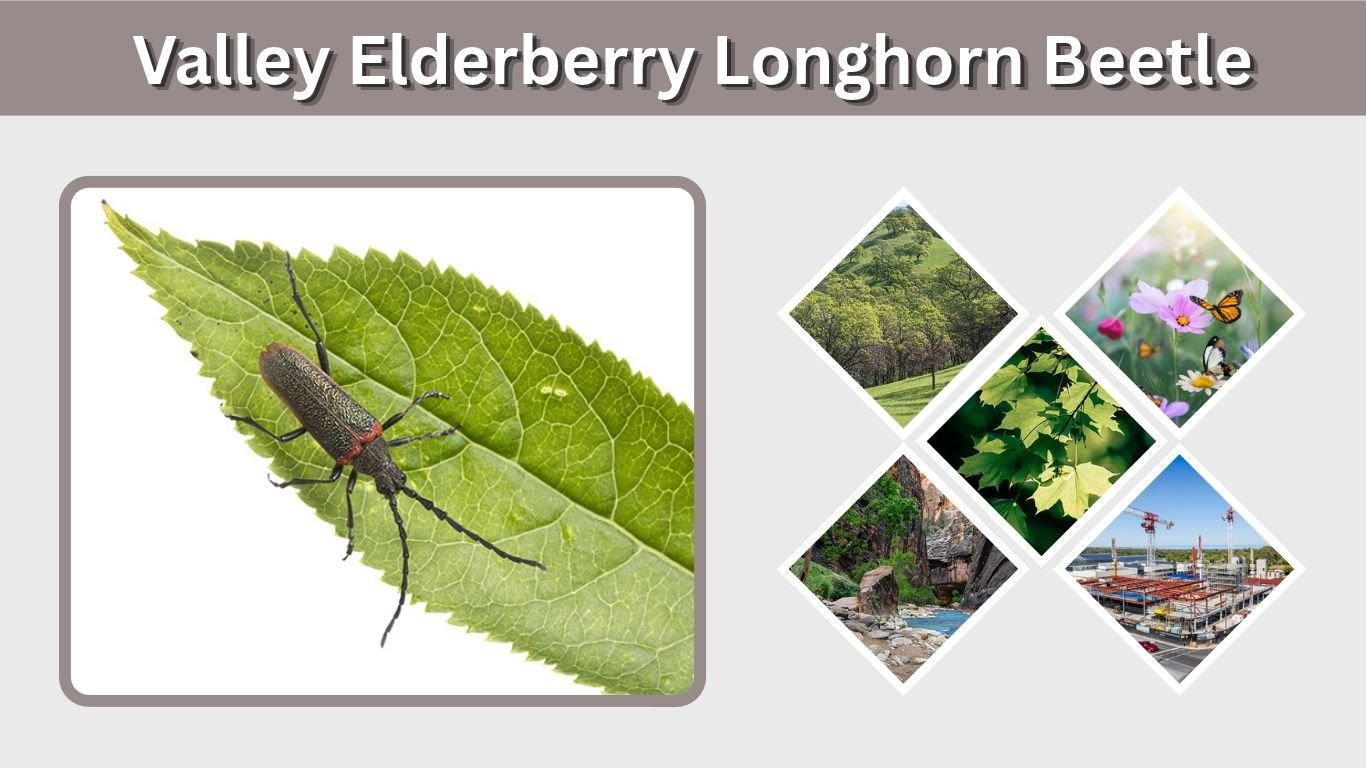
The valley elderberry longhorn beetle is a rare, colorful insect native to California’s Central Valley. Recognized by its reddish-orange or metallic green wing covers and long antennae, this protected beetle depends almost entirely on elderberry shrubs for survival. Its restricted habitat, unusual life cycle, and declining natural environment have made it an important focus of wildlife conservation. Although small, the species plays a meaningful role in riparian ecosystems. Understanding its identification, habitat, diet, reproduction, conservation status, and protection requirements helps explain why preserving this distinctive beetle is important.
What Is the Valley Elderberry Longhorn Beetle?
The valley elderberry longhorn beetle (Desmocerus californicus dimorphus) is a subspecies of longhorn beetle belonging to the family Cerambycidae. It occurs naturally in California’s Central Valley and depends on elderberry plants for food, reproduction, and shelter.
Unlike many other wood-boring beetles, this insect has a highly specialized relationship with its host plant. Its larvae spend most of their development inside elderberry stems.
Scientific Name and Classification
The scientific name of the valley elderberry longhorn beetle is Desmocerus californicus dimorphus. It belongs to the order Coleoptera and the genus Desmocerus.
The subspecies is closely related to the California elderberry longhorn beetle, Desmocerus californicus californicus. Although similar, they differ in geographical distribution and certain physical characteristics.
Valley Elderberry Longhorn Beetle Identification
The valley elderberry longhorn beetle is a medium-sized insect with noticeable differences between males and females. Adults generally measure about 0.5–0.8 inches long, although females may be somewhat larger. Their long antennae, distinctive wing coloration, and association with elderberry shrubs help distinguish them from other longhorn beetles.
Key Identification Features
- Body size: Usually approximately 13–20 millimeters long.
- Male coloration: Red-orange wing covers with four elongated dark spots.
- Female coloration: Dark metallic green or black wing covers bordered by reddish-orange.
- Antennae: Long, segmented antennae, especially prominent in males.
- Body shape: Elongated body with a relatively narrow thorax.
- Legs: Six slender, dark-colored legs adapted for moving through vegetation.
- Host plant: Adults are generally encountered on or around elderberry shrubs.
Male vs. Female Elderberry Longhorn Beetle
Male beetles typically have brighter reddish-orange wing covers with dark markings. Their antennae are longer and thicker than those of females.
Females usually display darker metallic coloration with reddish borders around their wing covers.
This difference in appearance between sexes is called sexual dimorphism and is particularly noticeable in this subspecies.
Valley Elderberry Longhorn Beetle Habitat and Range
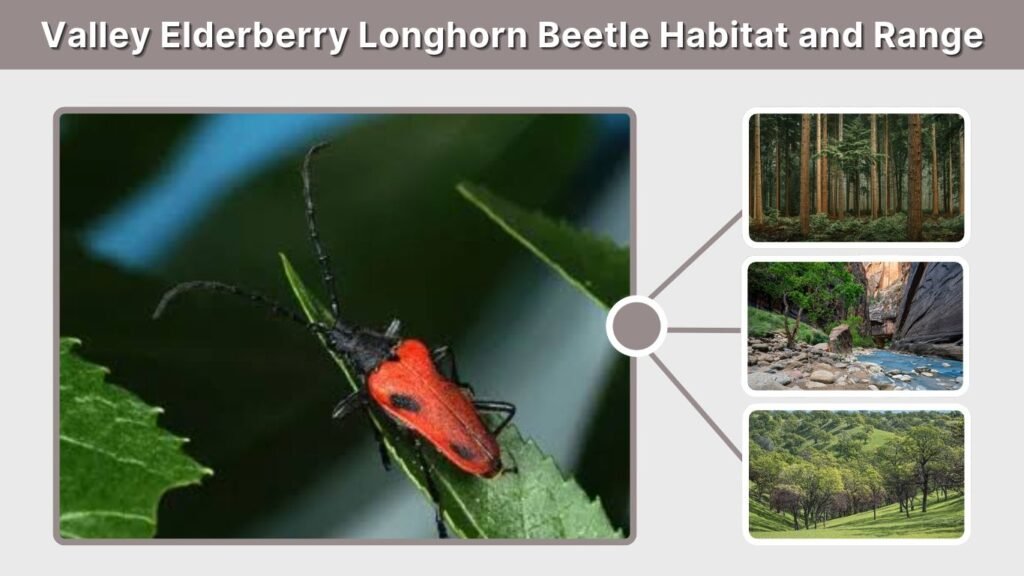
The valley elderberry longhorn beetle inhabits riparian forests, stream corridors, and foothill oak woodlands in California’s Central Valley. Its survival depends on environments where elderberry shrubs grow naturally. These areas provide food, breeding sites, and protective cover for developing larvae and adult beetles.
Where Does the Beetle Live in California?
Its documented geographical range extends from approximately Shasta County in northern California to the Madera and Fresno County region farther south.
Important habitats occur along the Sacramento River, American River, and other Central Valley waterways.
The species is especially associated with low-elevation areas containing established elderberry shrubs. It is not found throughout every part of California where elderberry grows.
Valley Elderberry Longhorn Beetle Critical Habitat
Critical habitat refers to specific geographical areas designated under the federal Endangered Species Act because of their importance to a protected species.
Designated critical habitat for this beetle includes areas in Sacramento and the American River Parkway.
However, suitable elderberry habitat also exists outside these designated areas. Such locations may still require conservation consideration when development or vegetation removal is proposed.
Elderberry Longhorn Beetle Host Plant and Diet
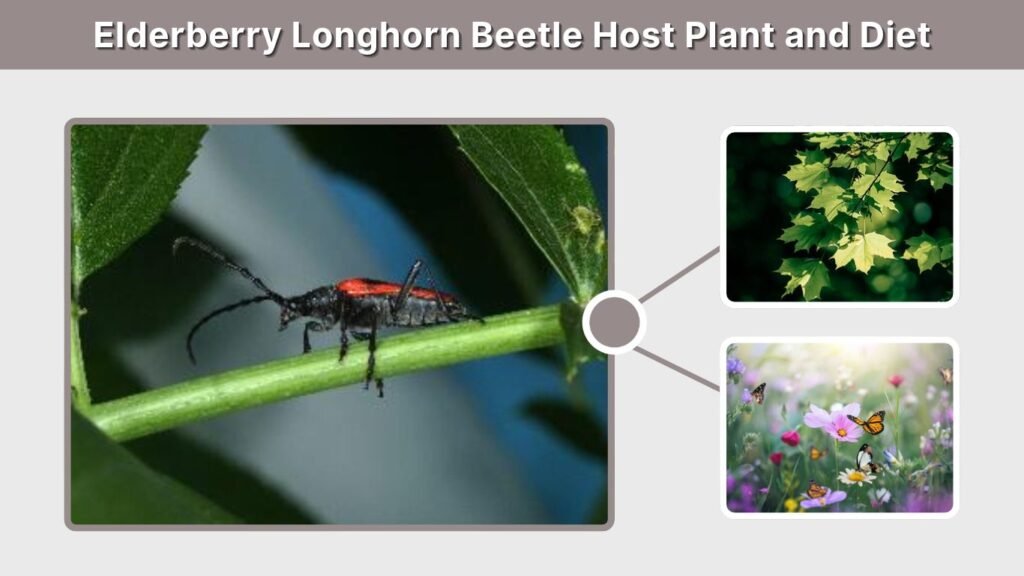
Elderberry shrubs are essential to the entire life cycle of the valley elderberry longhorn beetle. These plants provide the food consumed by adults and the internal stem tissue required by developing larvae. Without suitable elderberry shrubs, the beetle cannot complete its normal reproductive cycle.
What Do Valley Elderberry Longhorn Beetles Eat?
Adult beetles feed on elderberry leaves, flowers, and nectar. They become active when elderberry shrubs begin producing new foliage and flowers during spring.
Their feeding usually causes little noticeable damage to the plants.
Larvae have a different diet. After hatching, they enter elderberry stems and consume the soft central tissue known as pith.
Why Are Elderberry Shrubs Important?
Blue elderberry (Sambucus spp.) is the principal host plant associated with this subspecies. Red elderberry can also serve as a host.
These shrubs provide shelter for larvae during their extended development, which can last up to two years.
Protecting existing elderberry plants is therefore fundamental to conserving the beetle’s population.
Valley Elderberry Longhorn Beetle Life Cycle
The valley elderberry longhorn beetle undergoes complete metamorphosis, developing through four stages: egg, larva, pupa, and adult. Most of its life is spent concealed within elderberry stems. The adult stage is relatively brief and primarily dedicated to feeding, mating, and reproduction.
Eggs and Larval Development
Female beetles lay eggs individually on elderberry leaves, stems, or near leaf-stalk junctions.
After hatching, larvae bore into the stems and begin feeding on the pith. Their development typically continues for one to two years.
Because larvae remain hidden inside the plant, their presence is difficult to detect through ordinary observation.
Pupation and Adult Emergence
When fully developed, larvae prepare emergence openings and create chambers inside the elderberry stems.
They transform into pupae before emerging as adult beetles.
Adults are generally active from March through June, with activity often peaking during spring. Most survive only several days to a few weeks after emergence.
Valley Elderberry Longhorn Beetle Exit Holes and Surveys
One of the most recognizable signs of valley elderberry longhorn beetle activity is the presence of emergence holes in elderberry stems. Researchers use these openings to investigate possible habitat occupancy because adult beetles are difficult to observe. However, identifying the species from exit holes alone requires caution.
Signs of Beetle Activity
- Exit holes: Small, usually rounded openings in elderberry stems.
- Suitable stems: Mature elderberry branches capable of supporting developing larvae.
- Adult sightings: Red-orange or dark metallic longhorn beetles observed during spring.
- Host plant condition: Living elderberry shrubs with suitable stem growth and surrounding habitat.
- Historical evidence: Previously documented beetle activity at the location.
Why Are Surveys Important?
Professional surveys help determine whether proposed construction, vegetation clearing, or habitat management could affect the protected beetle.
Exit holes do not always prove current occupancy because old openings may remain after the beetles have emerged.
Qualified biologists follow established assessment protocols and consider surrounding habitat conditions when evaluating potential impacts.
Why Is the Valley Elderberry Longhorn Beetle Threatened?
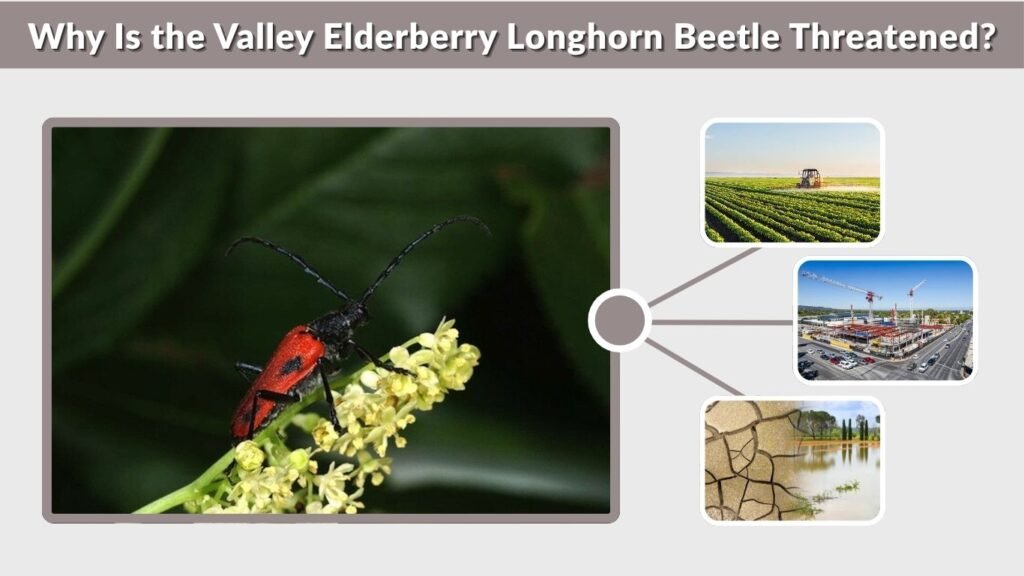
The valley elderberry longhorn beetle faces several environmental threats, primarily associated with habitat loss and fragmentation. Its dependence on a specific host plant makes the species particularly vulnerable when natural streamside vegetation is removed or altered. Although conservation programs have protected some habitats, maintaining connected elderberry populations remains important.
Major Threats to Survival
- Agricultural expansion: Conversion of natural vegetation into agricultural land reduces suitable habitat.
- Urban development: Construction and infrastructure projects can remove elderberry shrubs.
- Habitat fragmentation: Isolated shrub populations make movement and reproduction more difficult.
- Pesticide exposure: Chemical applications may harm adult beetles or developing larvae.
- Invasive species: Argentine ants and invasive plants can interfere with beetle survival and habitat quality.
- Drought and flooding: Extreme environmental conditions can affect elderberry growth and survival.
Valley Elderberry Longhorn Beetle Conservation Status
The valley elderberry longhorn beetle has been federally listed as threatened under the Endangered Species Act since August 8, 1980. This classification means the subspecies is considered likely to become endangered within the foreseeable future.
Was the Valley Elderberry Longhorn Beetle Delisted?
In 2012, the U.S. Fish and Wildlife Service proposed removing the beetle from federal protection.
However, the agency withdrew that proposal on September 17, 2014, after determining that remaining threats had not been adequately resolved.
As of October 2026, the valley elderberry longhorn beetle remains federally listed as threatened.
Recovery Plan and Protection Guidelines
Conservation efforts focus on preserving suitable elderberry habitat, restoring riparian vegetation, and reducing threats from development.
The U.S. Fish and Wildlife Service published a revised recovery plan in 2019 and provides a framework for assessing potential impacts to the species.
Landowners and developers should consult current agency guidance before pruning, removing, or disturbing elderberry shrubs within the beetle’s range.
Why Are Valley Elderberry Longhorn Beetles Important?
The valley elderberry longhorn beetle is an important component of California’s native riparian biodiversity. Its specialized dependence on elderberry shrubs demonstrates how individual insects and plants can become closely connected through evolution.
Do They Help With Pollination?
Adult valley elderberry longhorn beetles visit elderberry flowers and consume nectar. During these visits, they may contact pollen and potentially contribute to pollen transfer.
However, they are not established as exclusive or highly specialized pollinators. Their primary ecological significance lies in their association with native elderberry habitats.
Conserving this beetle also supports broader efforts to protect riverbank vegetation and the wildlife communities that depend on it.
FAQs
1. Are Valley Elderberry Longhorn Beetles Endangered?
The valley elderberry longhorn beetle is federally classified as threatened rather than endangered. It has received protection under the Endangered Species Act since 1980. Habitat loss, fragmentation, and dependence on elderberry shrubs remain important concerns for its long-term survival.
2. Are Elderberry Longhorn Beetles Poisonous?
Valley elderberry longhorn beetles are not known to be poisonous to humans. They do not possess venomous stingers and are not considered aggressive. However, because they are protected wildlife, unnecessary handling, collection, or disturbance should be avoided.
3. Can Valley Elderberry Longhorn Beetles Fly?
Yes, adult valley elderberry longhorn beetles can fly between elderberry shrubs and nearby vegetation. However, they are generally considered relatively weak long-distance dispersers. Habitat fragmentation can therefore make movement between suitable breeding areas more difficult.
4. Why Are Valley Elderberry Longhorn Beetles Important?
These beetles contribute to California’s native biodiversity and demonstrate the ecological importance of elderberry shrubs. Protecting their habitat also helps conserve riparian vegetation, supports other wildlife, and maintains important natural ecosystems along rivers and streams.
5. What Is Being Done to Protect the Valley Elderberry Longhorn Beetle?
Conservation programs protect elderberry shrubs, restore streamside habitats, and assess development impacts. Federal recovery planning also emphasizes monitoring populations and improving habitat connectivity. Landowners and project managers must consider applicable Endangered Species Act requirements when working within the beetle’s range.