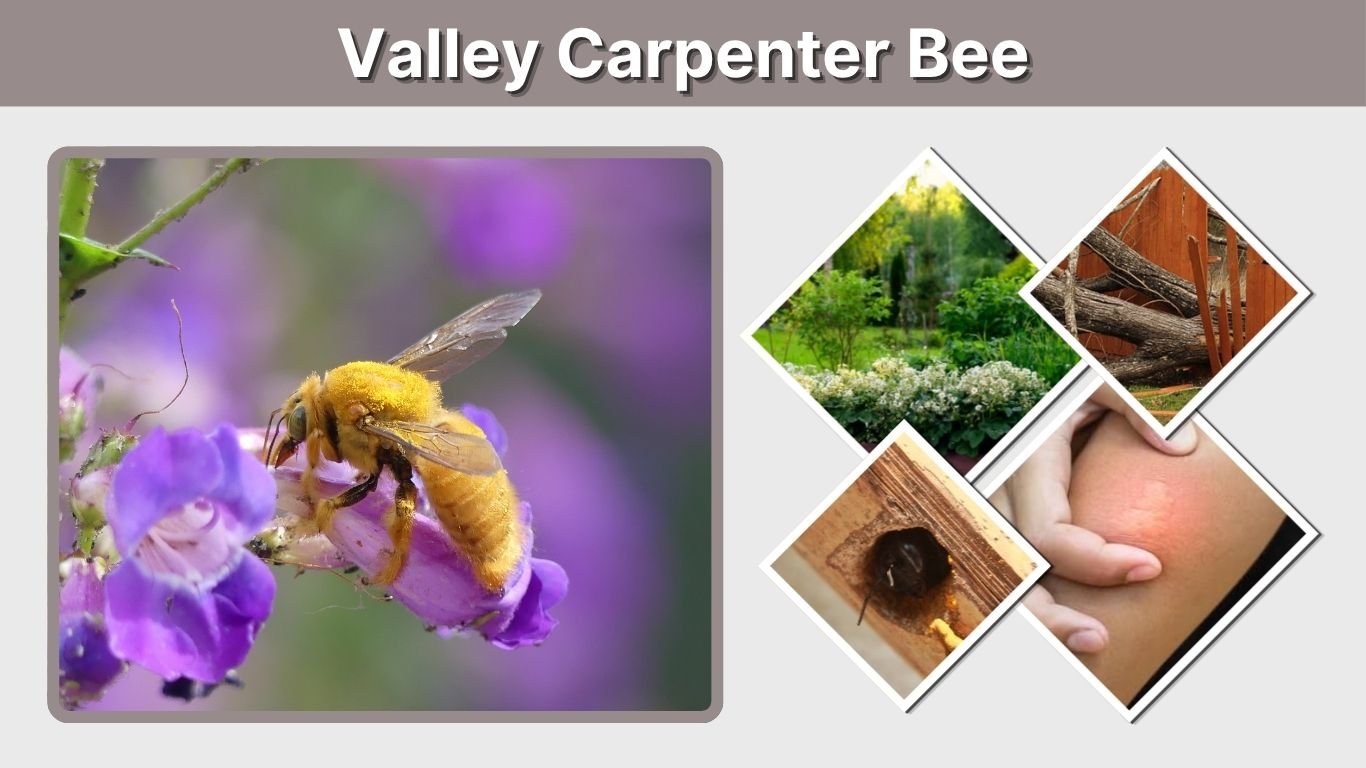
The valley carpenter bee (Xylocopa varipuncta) is one of the largest and most distinctive carpenter bees in western North America. Females are glossy black, while males are covered in striking golden-yellow hairs, making the sexes look almost like different species. These large bees are especially common in California and parts of the southwestern United States. Despite their intimidating size and loud flight, valley carpenter bees are generally peaceful pollinators. They nest in wood, visit many flowering plants, and rarely pose a serious threat to people.
What Is a Valley Carpenter Bee?
The valley carpenter bee is a large solitary bee belonging to the family Apidae. Its scientific name is Xylocopa varipuncta. Like other carpenter bees, females excavate tunnels in wood for nesting rather than building wax hives.
They are particularly interesting because males and females have dramatically different appearances.
Valley Carpenter Bee Identification
Common identification features include:
- Large, robust body
- Approximately 20–30 mm long
- Strong, dark wings
- Females are mostly shiny black
- Males appear golden or yellow
- Large compound eyes
- Powerful jaws used for excavating wood
- Loud, noticeable flight
- Smooth or relatively hairless female abdomen
Their large size makes them difficult to confuse with most ordinary garden bees.
Valley Carpenter Bee Scientific Name
The scientific name is Xylocopa varipuncta.
Its classification includes:
Family: Apidae
Genus: Xylocopa
Species: Xylocopa varipuncta
The genus Xylocopa includes large carpenter bees found in warm regions throughout much of the world.
Valley Carpenter Bee Size
The valley carpenter bee is among the largest bees found in the United States.
Adults commonly reach roughly 2–3 cm in length, although exact size varies between individuals. Females tend to look especially heavy and robust because of their broad black bodies.
Their size, dark wings, and powerful buzzing may make them appear threatening even though they are generally docile.
Male vs Female Valley Carpenter Bee
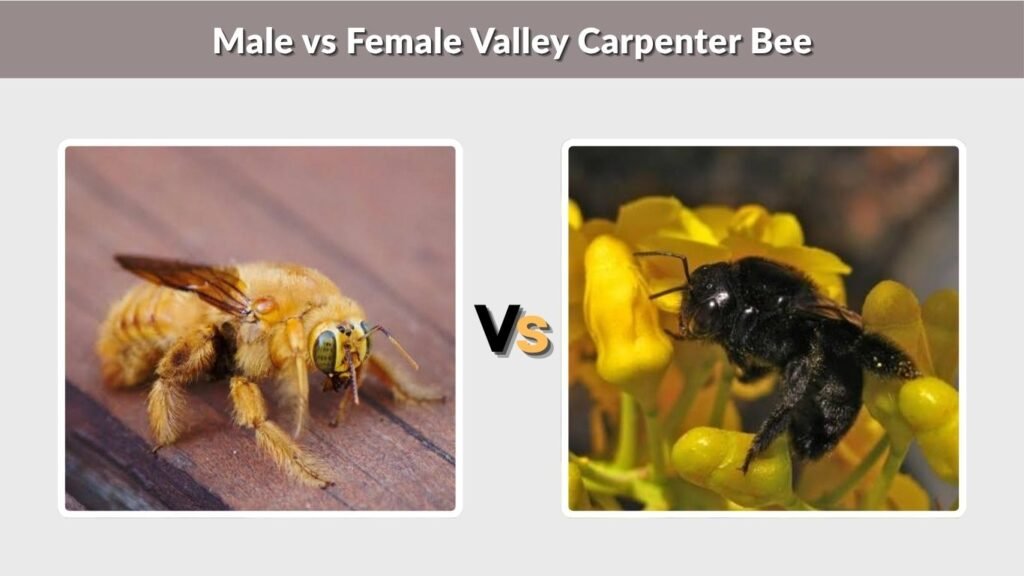
One of the most remarkable things about this species is the dramatic difference between males and females.
A person unfamiliar with the species may easily assume the golden male and black female are completely unrelated bees.
Male Valley Carpenter Bee
Male valley carpenter bees are known for their beautiful golden appearance.
Their bodies are covered with yellow, tan, or golden hairs, giving rise to the informal name of the golden carpenter bee.
Male characteristics include:
- Golden-yellow or tan body
- Dense fuzzy hairs
- Large greenish or light-colored eyes
- Long legs
- Active hovering behavior
- No functional stinger
Males frequently patrol territories around flowers or nesting areas.
They may fly directly toward people, but this territorial behavior is largely bluff because males cannot sting.
Female Valley Carpenter Bee
Female valley carpenter bees look completely different.
They are predominantly black, often with shiny bodies and dark wings that may reflect blue or violet under bright light.
Females are responsible for constructing nests, collecting pollen, provisioning brood chambers, and laying eggs.
Their dark coloration explains why people commonly search for a black valley carpenter bee after seeing one around gardens or wooden structures.
Valley Carpenter Bee Male vs Female
The easiest comparison is color.
The male is golden and fuzzy, while the female is predominantly glossy black.
Their behavior also differs. Males often hover around territories searching for females and confronting other insects. Females spend much more time gathering pollen, searching for nest sites, and working inside wooden tunnels.
Only females possess functional stingers.
Valley Carpenter Bee Range and Distribution
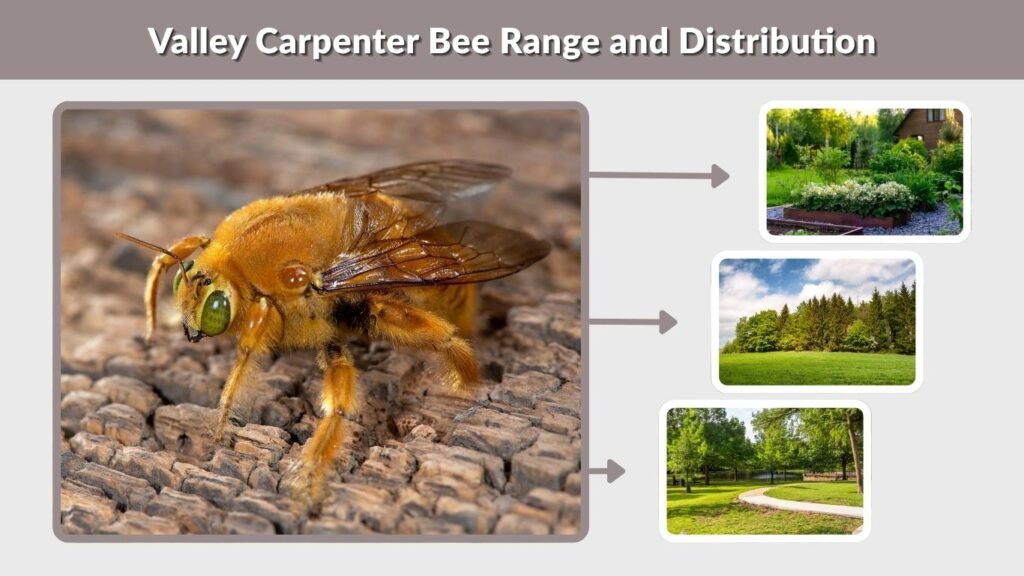
Valley carpenter bees are strongly associated with western North America, particularly warm and dry regions.
California is one of the best-known areas for this species, although its distribution extends into neighboring regions.
Valley Carpenter Bee in California
The California valley carpenter bee can be encountered in many warm areas of the state.
Typical habitats include:
- Residential gardens
- Desert communities
- Agricultural areas
- Woodland edges
- Parks
- Canyons
- Suburban landscapes
- Areas containing flowering native plants
They may be especially noticeable during warm months when adults are actively feeding and nesting.
Valley Carpenter Bee in Arizona
Valley carpenter bees also occur in Arizona, particularly where temperatures are warm and flowering plants are abundant.
Desert gardens can provide excellent feeding opportunities because these large bees readily visit flowering shrubs, vines, trees, and ornamentals.
The availability of dead wood, wooden structures, or large plant stems may influence where females establish nests.
Are Valley Carpenter Bees Found in Texas or Florida?
The valley carpenter bee is primarily a western species.
Other carpenter bee species occur in Texas, Florida, and the southeastern United States, so a large black bee seen there should not automatically be identified as Xylocopa varipuncta.
Geographic location is therefore an important part of accurate identification.
The species is also not native to places such as the United Kingdom or Australia, although other Xylocopa species occur in different parts of the world.
Valley Carpenter Bee Nest and Life Cycle
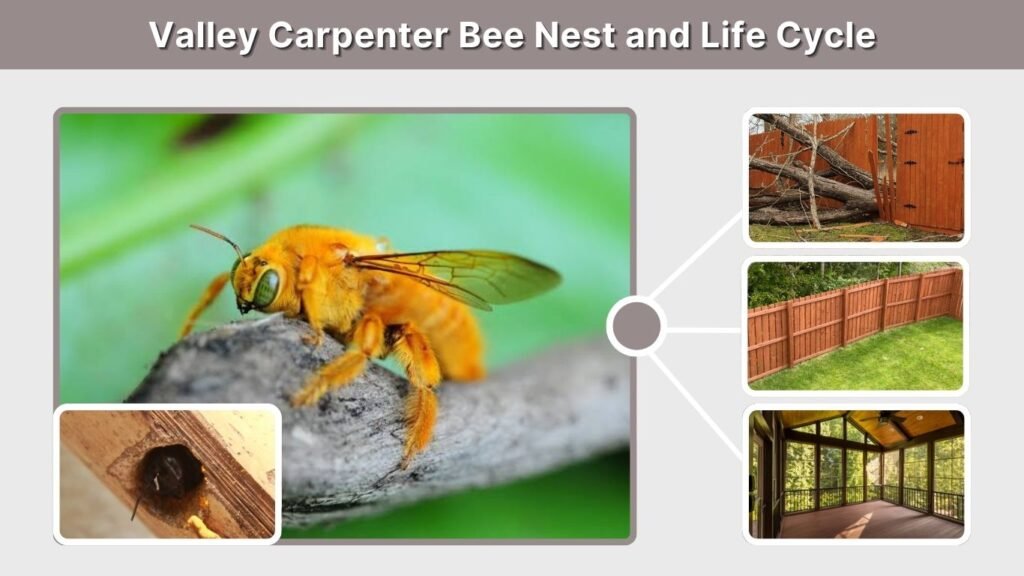
Valley carpenter bees are called carpenter bees because females excavate tunnels into wood.
They do not consume the wood. Instead, they remove material with their jaws to create protected chambers for developing offspring.
Where Do Valley Carpenter Bees Nest?
Possible nesting locations include:
- Dead tree branches
- Weathered logs
- Wooden fences
- Porch beams
- Roof eaves
- Pergolas
- Untreated lumber
- Wooden posts
- Outdoor furniture
The entrance typically appears as a smooth, round hole in the wood.
Inside, the female extends the tunnel and divides it into several individual brood chambers.
How the Nest Is Built
A female begins by excavating or reusing a suitable tunnel.
She then gathers pollen and nectar and places a food supply inside a chamber. An egg is deposited on or near the food.
The nesting process generally includes:
- Finding suitable wood
- Excavating a tunnel
- Collecting pollen and nectar
- Creating a food provision
- Laying an egg
- Constructing a partition
- Repeating the process for additional eggs
Each larva develops inside its own protected chamber.
Valley Carpenter Bee Life Cycle
After an egg hatches, the larva feeds on the pollen and nectar stored by its mother.
It grows, pupates, and eventually becomes an adult. Depending on season and climate, adults may remain protected inside nesting tunnels for a period before emerging.
The overall life cycle includes egg, larva, pupa, and adult stages.
Adults spend their active periods mating, visiting flowers, and establishing another generation of nests.
Valley Carpenter Bee Lifespan
Exact lifespan varies according to sex, season, weather, and environmental conditions.
Much of an individual’s development occurs inside the protected nesting chamber. Adult activity is concentrated around mating, feeding, and reproduction.
Females may survive long enough to establish and provision multiple brood cells during their nesting period.
Do Valley Carpenter Bees Sting?
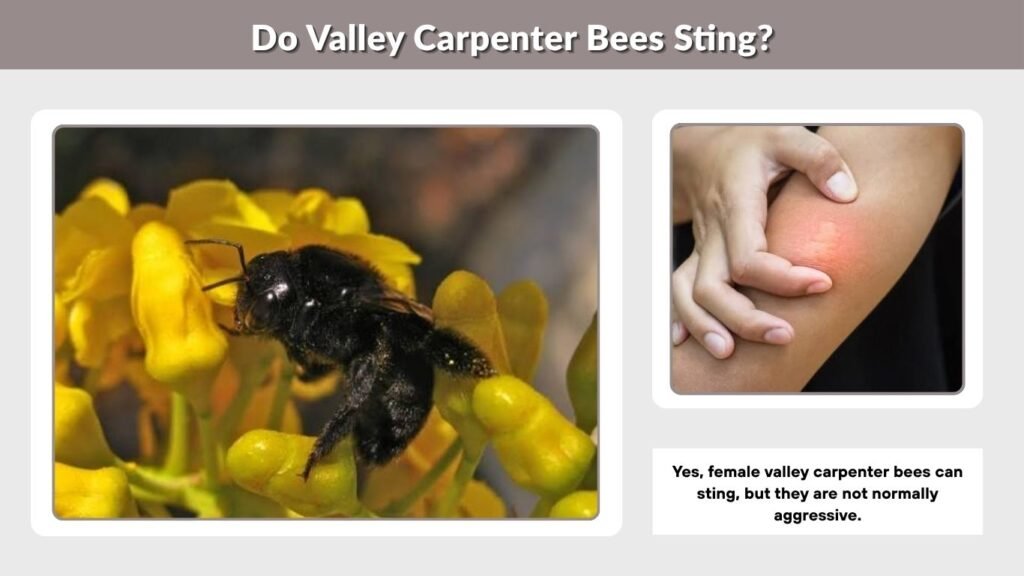
Yes, female valley carpenter bees can sting, but they are not normally aggressive.
Their large size causes many people to assume they are dangerous, yet encounters usually end without anyone being stung.
Are Valley Carpenter Bees Dangerous?
Valley carpenter bees are generally not considered dangerous to people.
A female may sting when:
- Grabbed by hand
- Squeezed
- Stepped on
- Trapped inside clothing
- Roughly handled
Otherwise, she typically prefers escaping to attacking.
The males that frequently hover around people cannot sting at all.
Male Valley Carpenter Bee Sting
A male valley carpenter bee cannot sting because male bees lack functional stingers.
This is particularly useful to know because golden males often behave more boldly than females. They may hover near a person’s face or investigate movement around their territory.
Although this can be intimidating, the male cannot deliver a sting.
What Happens If a Female Stings?
A sting may cause temporary:
- Sharp pain
- Redness
- Local swelling
- Itching
- Tenderness
Most reactions remain localized. Severe allergic reactions to bee venom can occur in sensitive individuals, however. Difficulty breathing, widespread hives, dizziness, or swelling of the throat or tongue requires immediate medical attention.
Are Valley Carpenter Bees Good or Bad?
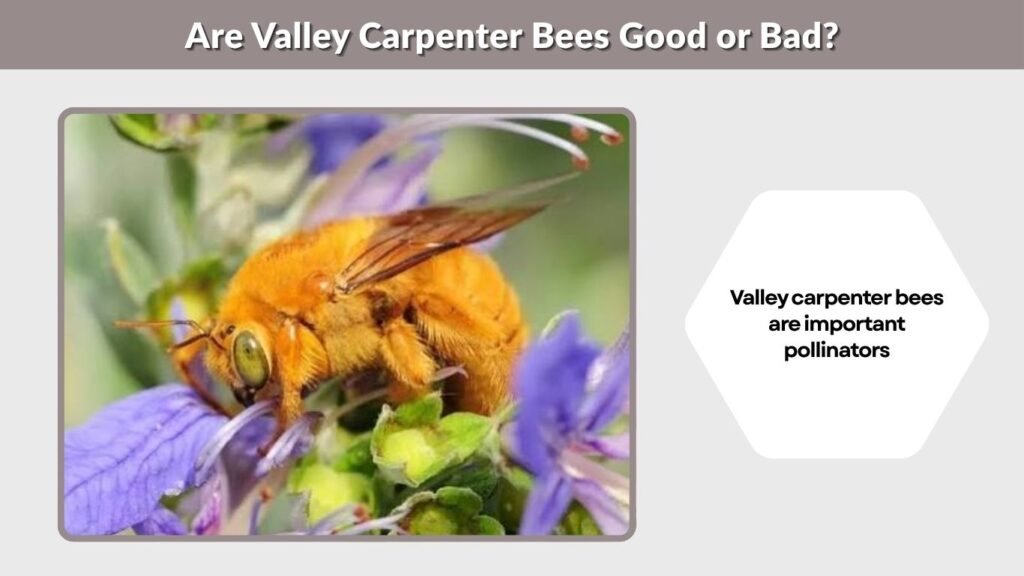
Valley carpenter bees are important pollinators, although their nesting habits can occasionally bring them into conflict with homeowners.
They visit many native and cultivated flowering plants and can transfer large amounts of pollen while feeding.
Benefits of Valley Carpenter Bees
These bees can:
- Pollinate garden flowers
- Pollinate native plants
- Support wild plant reproduction
- Visit flowering fruit and vegetable crops
- Provide food for other wildlife
- Increase local pollinator diversity
Their large bodies allow them to contact pollen-producing structures effectively.
Can They Damage Wood?
Yes. Females can create holes and tunnels in wooden structures.
A single tunnel usually causes relatively minor damage, but repeated nesting in the same piece of wood over many years can become more significant.
Keeping wooden structures painted or properly sealed can make them less attractive as nesting sites. Old active nests should be handled carefully because beneficial bees may still be developing inside.
FAQs
What is the scientific name of the valley carpenter bee?
The valley carpenter bee is scientifically known as Xylocopa varipuncta. It belongs to the large carpenter bee genus Xylocopa and the family Apidae.
Why are male valley carpenter bees golden?
Male valley carpenter bees are naturally covered in dense golden-yellow hairs, while females are predominantly black. This dramatic sexual difference is a normal characteristic of the species.
Do valley carpenter bees sting?
Female valley carpenter bees can sting but rarely do unless trapped or handled. Male valley carpenter bees cannot sting.
How large is a valley carpenter bee?
Adults are large bees that commonly measure around 20–30 mm long, making them considerably larger than many common garden bees.
Are valley carpenter bees dangerous?
No. Valley carpenter bees are generally peaceful pollinators. Males may aggressively hover around people but cannot sting, while females usually sting only when physically threatened.