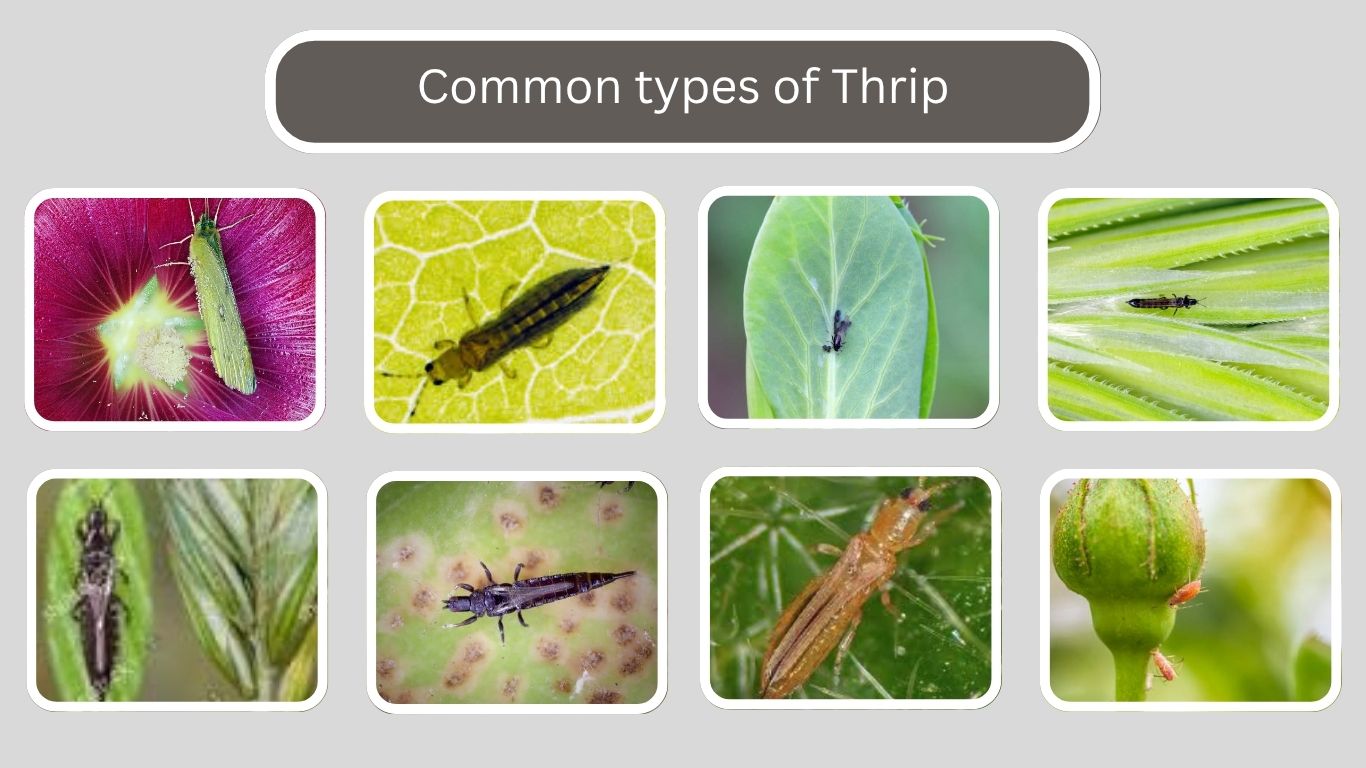
Thrips are tiny, slender insects that affect a wide range of plants worldwide. With over 6,000 species, many thrips are serious agricultural and ornamental pests, causing leaf damage, scarring fruits, and transmitting plant viruses. Understanding the most common thrips species, their identification, behavior, and control methods is essential for effective pest management and protecting crop health and yield. This article covers 25 important thrips types you should know.
1. Western Flower Thrips

Western Flower Thrips (Frankliniella occidentalis) are among the most common and destructive thrips species affecting agricultural crops and ornamental plants. These tiny insects are widespread across North America and other regions, known for their rapid reproduction and ability to transmit plant viruses.
Identification
- Scientific Name: Frankliniella occidentalis
- Size: 1–1.5 mm long
- Color: Yellowish to dark brown
- Wings: Narrow with long fringes
- Antennae: 7–8 segments
- Life Stages: Egg, larva (2 stages), prepupa, pupa, adult
Host Plants and Damage
Western Flower Thrips feed on a wide variety of crops including tomatoes, strawberries, peppers, and ornamentals like roses. They pierce plant cells to feed on sap, causing silvering, stippling, curling, and distortion of leaves and flowers. Their feeding also leads to reduced yields and unsightly blemishes on produce.
Virus Transmission
This species is a known vector of several plant viruses, most notably Tomato Spotted Wilt Virus (TSWV) and Impatiens Necrotic Spot Virus (INSV). These viruses can cause severe economic damage, and only the larval stages acquire the virus, but adults spread it.
Reproduction and Lifecycle
Western Flower Thrips reproduce both sexually and through parthenogenesis (females reproducing without males). Females lay eggs inside plant tissues. Depending on temperature, the full life cycle can be completed in 10–20 days, allowing populations to build up quickly under favorable conditions.
Management and Control
Controlling Western Flower Thrips involves an integrated pest management (IPM) approach, including:
- Monitoring with sticky traps
- Using insecticidal soaps or horticultural oils
- Introducing biological control agents like predatory mites and minute pirate bugs
- Rotating insecticides to prevent resistance
2. Onion Thrips

Onion Thrips (Thrips tabaci) are a highly adaptable species that infest a wide range of crops beyond onions, including cabbage, leeks, garlic, and tobacco. They are common in both open fields and greenhouse environments.
Identification
- Scientific Name: Thrips tabaci
- Size: 1–1.3 mm
- Color: Pale yellow to light brown
- Wings: Slender, fringed
- Life Stages: Egg, 2 larval stages, prepupa, pupa, adult
Host Plants and Damage
They cause silvery streaks and scarring on leaves due to their rasping-sucking feeding style. Infestations reduce photosynthesis, leading to stunted growth and yield loss, especially in bulb-forming crops.
Virus Transmission
Onion Thrips are known to transmit Iris Yellow Spot Virus (IYSV), particularly damaging to onion crops and sometimes other Allium species.
Reproduction and Lifecycle
They reproduce asexually in many populations (parthenogenesis), with females depositing eggs inside plant tissues. Lifecycle duration depends on temperature but can complete in under two weeks in warm climates.
Management and Control
Effective control includes cultural practices like crop rotation and removal of plant debris, reflective mulches, and targeted use of insecticides, especially systemic ones.
3. Greenhouse Thrips

Greenhouse Thrips (Heliothrips haemorrhoidalis) are a pest mainly in indoor or greenhouse environments but can also infest outdoor tropical or subtropical gardens. They primarily affect ornamental plants.
Identification
- Scientific Name: Heliothrips haemorrhoidalis
- Size: 1.2–1.4 mm
- Color: Dark brown to black
- Wings: Transparent with fringes
- Distinctive Feature: Red tip at the end of the abdomen
- Life Stages: Egg, larva, prepupa, pupa, adult
Host Plants and Damage
They feed on a wide range of indoor and tropical plants such as ferns, figs, orchids, and avocados. Damage includes scarring, silvering of leaves, and black fecal spots which reduce aesthetic value.
Virus Transmission
Unlike other major thrips, Greenhouse Thrips are not known to transmit plant viruses but cause economic loss through physical damage.
Reproduction and Lifecycle
Females reproduce without mating and lay eggs on the undersides of leaves. The lifecycle typically takes 20–30 days, depending on environmental conditions.
Management and Control
Biological control using predatory bugs (like Orius spp.) is effective. Maintaining humidity and avoiding over-fertilization help suppress populations, along with insecticidal soaps or oils.
4. Banana Thrips

Banana Thrips (Chaetanaphothrips signipennis) are a serious pest of banana plantations, known for their destructive feeding on banana fruits and leaves. This tropical species thrives in warm, humid environments and can significantly reduce crop marketability.
Identification
- Scientific Name: Chaetanaphothrips signipennis
- Size: 1.2–1.5 mm
- Color: Dark brown to black with lighter legs
- Wings: Slender and feather-like, lightly banded
- Antennae: 8 segments
- Life Stages: Egg, two larval stages, prepupa, pupa, adult
Host Plants and Damage
Although they primarily affect bananas, Banana Thrips have also been recorded on sugarcane, palm, and some ornamental plants. They feed by puncturing the fruit and leaf surfaces, causing brown to black scars. On bananas, this leads to characteristic “rust thrips” damage—small reddish-brown scars on the peel that reduce visual quality but not edibility.
Damage is usually concentrated along the fruit’s surface where it touches other fruits or leaves, making control difficult once populations build.
Virus Transmission
Banana Thrips are not known to be major vectors of plant viruses, but their feeding damage alone is sufficient to cause economic losses, especially in export-quality banana production.
Reproduction and Lifecycle
Females lay eggs singly on the leaf sheaths or in crevices of young banana fruits. The entire life cycle is completed in about 18–25 days depending on environmental conditions. Populations thrive in dry weather and can spike rapidly if not monitored.
Egg → 2 larval stages → prepupa → pupa → adult.
Management and Control
- Cultural practices: Removing damaged leaves, maintaining good field sanitation, and reducing overlapping fruit contact helps lower infestation risk.
- Biological control: Predators like lacewings and minute pirate bugs help suppress populations.
- Chemical control: Spot treatment with insecticides may be needed, particularly during fruiting. However, overuse can lead to resistance.
- Monitoring: Sticky traps and regular field scouting are key to early detection and timing of interventions.
Careful timing of treatment during early fruit development stages gives the best results in preventing long-term fruit scarring.
6. Melon Thrips

Melon Thrips (Thrips palmi) are a widespread pest of vegetables and ornamentals in tropical and subtropical climates. They are especially damaging to cucurbits and solanaceous crops, both through direct feeding and virus transmission.
Identification
- Scientific Name: Thrips palmi
- Size: 1.0–1.3 mm
- Color: Pale yellow to light brown
- Wings: Slender, pale with fringes
- Antennae: 7–8 segments
- Life Stages: Egg, larva I & II, prepupa, pupa, adult
Host Plants and Damage
This thrips species infests over 60 plant species including cucumber, melon, eggplant, pepper, and tomato. They feed by rasping and sucking cell contents, causing leaf distortion, silvering, curling, and scarring on fruit surfaces.
Damage is particularly severe in young plants and can lead to plant stunting, reduced fruit quality, and unmarketable produce.
Virus Transmission
Melon Thrips are a known vector of several plant viruses, notably:
- Tomato Spotted Wilt Virus (TSWV)
- Watermelon Silver Mottle Virus (WSMoV)
- Capsicum Chlorosis Virus (CaCV)
They can acquire viruses in their larval stage and transmit them as adults, making them especially problematic in virus-prone crops.
Reproduction and Lifecycle
Melon Thrips reproduce rapidly, with each female laying up to 80 eggs inside leaf tissue. Development from egg to adult takes around 14–18 days under warm conditions, and populations can explode quickly if left unchecked.
Lifecycle:
Egg → 2 larval stages (feeding) → Prepupa & Pupa (non-feeding) → Adult
They often hide in folded leaves and flowers, making them hard to spot during early infestations.
Management and Control
- Monitoring: Use yellow or blue sticky traps and regular leaf inspections.
- Cultural control: Remove crop residues, use reflective mulches, and practice crop rotation.
- Biological control: Beneficial insects like Orius spp., Amblyseius cucumeris, and green lacewings are effective natural enemies.
- Chemical control: Insecticides should be rotated to prevent resistance, especially targeting early larval stages.
Due to their virus-vectoring ability and stealthy behavior, early intervention is essential in managing Melon Thrips effectively.
7. Cuban Laurel Thrips

Cuban Laurel Thrips (Gynaikothrips ficorum) are ornamental pests that primarily affect Ficus trees, especially the Indian laurel fig. They are known for causing unsightly leaf galls and folds.
Identification
- Scientific Name: Gynaikothrips ficorum
- Size: About 2 mm
- Color: Dark brown to black body with pale legs
- Wings: Narrow with long fringes
- Distinctive Trait: Associated with curled or folded leaf margins
- Life Stages: Egg, larva I & II, prepupa, pupa, adult
Host Plants and Damage
Cuban Laurel Thrips target ornamental Ficus species. They feed on young leaves, injecting saliva that causes abnormal growth, resulting in tight leaf rolling or folding. This not only ruins the plant’s appearance but also inhibits photosynthesis and growth.
Affected leaves turn dark, dry out, and may drop prematurely. Severe infestations can defoliate entire plants, especially in urban landscapes and nurseries.
Virus Transmission
This species is not a known virus vector. Their primary issue is the visible leaf deformation they cause.
Reproduction and Lifecycle
Eggs are laid inside folded leaves where larvae develop. These thrips often complete their life cycle inside the same rolled leaf, offering them protection from predators and weather. The full cycle takes about 20–30 days depending on conditions.
Their population tends to spike during warmer months, and the hidden nature of their habitat makes early detection difficult.
Management and Control
- Pruning: Removing and destroying infested leaves prevents further spread.
- Biological control: Predatory mites and bugs like Orius spp. can access rolled leaves and reduce numbers.
- Insecticides: Systemic insecticides may be necessary in severe cases, especially in nursery settings.
- Prevention: Avoid overfertilization which encourages rapid leaf growth, making plants more susceptible.
This species is largely a cosmetic pest but can become a serious problem in ornamental landscapes and plant nurseries if left unmanaged.
8. Avocado Thrips

Avocado Thrips (Scirtothrips perseae) are an economically important pest of avocado trees, especially in California and Mexico. They are known for causing significant scarring on fruit surfaces, affecting both yield and market value.
Identification
- Scientific Name: Scirtothrips perseae
- Size: 0.8–1.0 mm
- Color: Pale yellow with dark spots on the body
- Wings: Narrow, lightly fringed
- Antennae: 8 segments
- Life Stages: Egg, larva I & II, prepupa, pupa, adult
Host Plants and Damage
While primarily associated with avocados, they have also been found on ornamentals and some citrus species. Their feeding on young leaves and developing fruits results in scabby, brown scars on the avocado skin. Though internal fruit quality is unaffected, the visible damage reduces consumer appeal.
Fruit near leaf contact zones or in dense foliage is more prone to infestation and injury. Heavy infestations can reduce marketable yield by up to 40%.
Virus Transmission
Avocado Thrips are not known to transmit plant viruses. Their impact is through cosmetic damage and reduced fruit quality.
Reproduction and Lifecycle
Eggs are laid in young leaves and fruits. The lifecycle is temperature-dependent and completes in 15–22 days under warm conditions. Populations can spike quickly in spring and summer when new foliage and fruit flushes are present.
Lifecycle:
Egg → 2 larval stages (feed on young tissues) → Prepupa & pupa (drop to soil) → Adult (migrates back to tree canopy)
Management and Control
- Monitoring: Beat trays, leaf inspections, and visual scouting help detect early stages.
- Cultural practices: Proper pruning to increase airflow and reduce dense foliage discourages infestation.
- Biological control: Predators like green lacewings and minute pirate bugs can suppress populations.
- Chemical control: Insecticides are often required in commercial orchards, applied during early fruit development.
Managing this pest early in the season is essential to minimize scarring and maintain high-value fruit quality.
9. Citrus Thrips

Citrus Thrips (Scirtothrips citri) are a major pest in citrus-growing regions, particularly affecting oranges, lemons, and tangerines. They are notorious for damaging both fruit and young leaves during rapid growth phases.
Identification
- Scientific Name: Scirtothrips citri
- Size: About 1 mm
- Color: Pale yellow to orange
- Wings: Narrow with short fringes
- Antennae: 8 segments
- Life Stages: Egg, larva I & II, prepupa, pupa, adult
Host Plants and Damage
They attack citrus fruit, new shoots, and leaves. Feeding leads to ring scars on developing fruit and leaf curling. Damage appears as silvery patches or brown lines, primarily on the upper surface of young fruit.
Citrus Thrips also feed on rose, pomegranate, and grapes, making them a polyphagous pest.
Virus Transmission
They are not known to transmit any major plant viruses, though their physical damage can significantly reduce crop quality and yield.
Reproduction and Lifecycle
Females lay eggs inside young leaf and fruit tissues. Nymphs feed on tender tissues, then drop to the ground to pupate. A generation completes in about 12–20 days depending on weather conditions.
Peak population coincides with the citrus fruit-set period, especially during spring and early summer.
Management and Control
- Monitoring: Visual inspections of fruit and use of tapping methods are common detection strategies.
- Cultural practices: Proper irrigation, pruning, and minimizing leaf contact with fruits can reduce infestations.
- Biological control: Predatory mites (Amblyseius spp.) and pirate bugs can help regulate populations.
- Chemical control: Timed insecticide sprays are effective, especially at petal fall or early fruit formation.
Timing is critical—treating during early fruit development reduces the chance of ring scarring and maintains fruit quality.
10. Black Hunter Thrips

Black Hunter Thrips (Aeolothrips intermedius) are often considered beneficial rather than harmful, as they are predatory thrips that feed on other thrips, mites, and small arthropods. They are native to Europe but have been found in parts of North America and Asia.
Identification
- Scientific Name: Aeolothrips intermedius
- Size: 1.5–2 mm
- Color: Shiny black with white wing bands
- Wings: Broad and banded
- Antennae: 9 segments
- Life Stages: Egg, 2 larval stages, prepupa, pupa, adult
Host Plants and Behavior
Though often found on cereal crops like wheat and barley, they are not plant feeders. Instead, Black Hunter Thrips move between flowers and foliage in search of prey, including pest thrips such as Onion Thrips and Western Flower Thrips.
Their presence on crops is a good indicator of natural pest control. Occasionally, they may be mistaken for pest thrips due to their appearance, but they cause no direct damage to plants.
Virus Transmission
They are not associated with any plant virus transmission. In fact, their presence helps suppress virus-spreading thrips species.
Reproduction and Lifecycle
Females lay eggs on plants near prey populations. The nymphs and adults are active hunters. Their lifecycle completes in about 2–3 weeks depending on temperature, and they tend to thrive in warm, dry conditions where pest thrips are abundant.
They are particularly active during spring and early summer, coinciding with the peak activity of pest thrips.
Management and Role in IPM
- Conservation: Avoiding broad-spectrum insecticides helps preserve their populations.
- Identification: Training scouts to distinguish between predatory and pest thrips is crucial.
- IPM Value: They are considered natural enemies and are beneficial in integrated pest management systems.
Encouraging Black Hunter Thrips populations contributes to natural control of economically important pest thrips.
11. Tea Thrips

Tea Thrips (Scirtothrips dorsalis) are highly invasive and destructive pests of numerous crops, including tea, chili, cotton, strawberry, and various ornamentals. Their adaptability and resistance to insecticides make them especially problematic in many regions.
Identification
- Scientific Name: Scirtothrips dorsalis
- Size: 1.0–1.2 mm
- Color: Pale yellow to light brown
- Wings: Narrow and pale with short fringes
- Antennae: 8 segments
- Life Stages: Egg, larva I & II, prepupa, pupa, adult
Host Plants and Damage
Tea Thrips attack new shoots, buds, and young leaves. Their feeding leads to bronzing, leaf curling, and stunted growth, particularly in tea plantations and chili crops. In ornamentals, they cause severe deformation of flowers and leaf distortion.
They are known for infesting over 100 plant species, making them one of the most polyphagous thrips globally.
Virus Transmission
Tea Thrips are significant vectors of:
- Groundnut Bud Necrosis Virus (GBNV)
- Capsicum Chlorosis Virus (CaCV)
This virus transmission capability, combined with their rapid reproduction, increases their economic threat in many crop systems.
Reproduction and Lifecycle
Reproduction is primarily parthenogenetic. Females lay eggs in young tissues, and development from egg to adult can take as little as 12–15 days in favorable temperatures. They complete multiple overlapping generations per season.
They are typically active on the undersides of leaves and in flower buds, making them difficult to detect early.
Management and Control
- Monitoring: Blue sticky traps and regular leaf inspections aid in early detection.
- Cultural control: Removal of crop residues, intercropping, and reflective mulches help suppress populations.
- Biological control: Predators like Orius spp., green lacewings, and predatory mites are effective.
- Chemical control: Systemic insecticides are often required, but resistance is a major issue—rotation of active ingredients is essential.
Due to their polyphagous nature and virus-spreading ability, Tea Thrips are among the most serious pests in tropical agriculture.
12. Rose Thrips

Rose Thrips (Thrips fuscipennis) are common pests of ornamental roses and various flowering plants. They are particularly troublesome in greenhouses and home gardens, where they damage petals and leaves, affecting the aesthetic and commercial value of flowers.
Identification
- Scientific Name: Thrips fuscipennis
- Size: 1.2–1.5 mm
- Color: Yellow to dark brown
- Wings: Slender with fringed edges
- Antennae: 7–8 segments
- Life Stages: Egg, larva I & II, prepupa, pupa, adult
Host Plants and Damage
These thrips primarily attack rosebuds, petals, and young leaves. Their feeding results in:
- Deformed or unopened flower buds
- Brown edges on petals
- Silvery or bronzed patches on leaves
- Black specks of frass on petals
They also damage peonies, chrysanthemums, gladiolus, and other ornamentals, making them a broad threat in decorative horticulture.
Virus Transmission
Rose Thrips are not confirmed vectors of major plant viruses, though some closely related species in the same genus can spread tospoviruses.
Reproduction and Lifecycle
Eggs are laid in flower tissues or leaf veins. Larvae feed on developing buds and petals, completing their life cycle in 14–18 days in warm conditions. Multiple overlapping generations can occur, especially in greenhouses or during warm seasons outdoors.
Lifecycle:
Egg → Larva I & II (feed in buds) → Prepupa & Pupa (in soil or petal folds) → Adult
Management and Control
- Pruning: Remove and destroy affected flower buds to reduce larvae.
- Monitoring: Use blue or white sticky traps; inspect unopened buds regularly.
- Biological control: Predators like minute pirate bugs and predatory thrips (e.g., Franklinothrips) are effective.
- Chemical control: Targeted use of contact insecticides or systemic options during bud development is effective.
Managing humidity, avoiding overcrowding of plants, and maintaining good air circulation are also helpful in preventing outbreaks.
13. Gladiolus Thrips

Gladiolus Thrips (Thrips simplex) are a highly specialized species that target gladiolus plants. They are a major pest in flower bulb production and ornamental horticulture worldwide, causing economic losses due to deformed blooms and damaged bulbs.
Identification
- Scientific Name: Thrips simplex
- Size: 1.2–1.4 mm
- Color: Pale yellow to dark brown
- Wings: Narrow and lightly fringed
- Distinctive Trait: Common in gladiolus corms and spikes
- Life Stages: Egg, larva I & II, prepupa, pupa, adult
Host Plants and Damage
Their primary host is gladiolus. They feed on:
- Flower spikes, causing discolored and malformed flowers
- Leaves, resulting in streaks, browning, and curling
- Corms, where they hide and feed, leaving scars that reduce bulb quality and viability
In storage, they continue to damage bulbs, affecting next season’s planting material.
Virus Transmission
Gladiolus Thrips are not major virus vectors but cause substantial physical damage, particularly in commercial flower production and bulb trade.
Reproduction and Lifecycle
Eggs are laid inside leaf sheaths and flower buds. Thrips can survive in stored corms, which makes control difficult. Their lifecycle completes in 15–20 days under warm conditions, and they reproduce continuously in protected environments like greenhouses or storage areas.
Lifecycle:
Egg → Feeding larval stages → Non-feeding prepupa/pupa (often within the plant or in storage) → Adult
Management and Control
- Cultural control: Proper drying and cleaning of corms before storage help reduce overwintering populations.
- Monitoring: Regular field inspection during spike formation is essential.
- Biological control: Limited options, but predatory mites and parasitoids may help in field settings.
- Chemical control: Systemic insecticides during active growth and fumigation or hot water treatment for corms before storage are effective strategies.
Effective gladiolus thrips control requires year-round vigilance, especially in storage and early growing stages.
14. Palm Thrips

Palm Thrips (Parthenothrips dracaenae) primarily infest palm trees and related ornamental plants. They are distributed worldwide in tropical and subtropical regions and can cause significant cosmetic damage to palms used in landscaping.
Identification
- Scientific Name: Parthenothrips dracaenae
- Size: About 1.2 mm
- Color: Dark brown to black
- Wings: Narrow with fringes
- Antennae: 7–8 segments
- Life Stages: Egg, larva I & II, prepupa, pupa, adult
Host Plants and Damage
They attack various palm species including coconut palms, date palms, and ornamental palms like Dracaena. Feeding causes:
- Silvery or bronze discoloration of leaf surfaces
- Leaf curling and browning at tips
- Premature leaf drop in severe infestations
Damage mainly affects palm aesthetics and can reduce the plant’s vigor if heavy.
Virus Transmission
Palm Thrips are not known to transmit plant viruses.
Reproduction and Lifecycle
Eggs are inserted into leaf tissue, with larvae feeding on the leaf undersides. The lifecycle usually takes 20–30 days, depending on environmental factors. Populations build up rapidly during warm, dry seasons.
Management and Control
- Cultural control: Remove heavily infested fronds to reduce populations.
- Biological control: Predatory mites and insects can provide natural suppression.
- Chemical control: Targeted insecticide sprays during active feeding stages are effective, but care must be taken to protect beneficial organisms.
Regular monitoring is important to prevent heavy infestations and maintain palm health.
15. Wheat Thrips

Wheat Thrips (Anaphothrips obscurus) are common pests in cereal crops, particularly wheat and barley, across temperate regions. They can cause significant damage to seedlings and young plants, affecting crop establishment and yield.
Identification
- Scientific Name: Anaphothrips obscurus
- Size: 1–1.5 mm
- Color: Pale yellow to brownish
- Wings: Narrow with fringes
- Antennae: 8 segments
- Life Stages: Egg, larva I & II, prepupa, pupa, adult
Host Plants and Damage
Wheat Thrips primarily feed on young wheat, barley, rye, and oat plants. They rasp the leaf surface, causing silvery streaks and reduced photosynthetic capacity. In severe infestations, seedlings may become stunted or die.
Damage typically occurs early in the season, especially in dry, warm conditions favorable to thrips development.
Virus Transmission
Wheat Thrips are not known to vector plant viruses significantly.
Reproduction and Lifecycle
Females lay eggs in plant tissue or soil debris near host plants. The complete lifecycle takes approximately 2–3 weeks depending on temperature. Multiple generations per year are possible in suitable climates.
Management and Control
- Cultural practices: Crop rotation and avoiding early sowing in dry soils help reduce thrips populations.
- Biological control: Natural predators include minute pirate bugs and predatory mites.
- Chemical control: Insecticide seed treatments and foliar sprays may be used in severe outbreaks.
Monitoring early in the crop cycle is critical to identify and manage infestations before damage becomes severe.
16. Bean Thrips

Bean Thrips (Caliothrips fasciatus) affect various leguminous crops and some vegetables. They are known to feed on bean plants, causing leaf damage and sometimes affecting pod development.
Identification
- Scientific Name: Caliothrips fasciatus
- Size: 1.1–1.4 mm
- Color: Yellowish with dark bands on wings
- Wings: Fringed, often with distinctive banding
- Antennae: 8 segments
- Life Stages: Egg, larva I & II, prepupa, pupa, adult
Host Plants and Damage
Bean Thrips feed on beans, peas, and other legumes, causing silvering and stippling on leaves. Heavy infestations can lead to leaf curling, reduced photosynthesis, and poor pod set. They may also feed on other vegetables like tomatoes and peppers.
Virus Transmission
They are not major virus vectors but may occasionally contribute to virus spread in legume crops.
Reproduction and Lifecycle
Eggs are deposited inside leaf tissue. The lifecycle typically completes in about 15–20 days under favorable conditions, with multiple generations possible during the growing season.
Management and Control
- Monitoring: Use sticky traps and inspect plants regularly.
- Cultural control: Crop rotation and removing crop residues reduce populations.
- Biological control: Predatory insects like Orius spp. and lacewings are effective.
- Chemical control: Foliar insecticides may be used if populations exceed economic thresholds.
Integrated management is recommended to reduce reliance on chemical controls and prevent resistance development.
17. Pea Thrips

Pea Thrips (Kakothrips robustus) are pests primarily of leguminous plants, especially peas and beans. They cause damage to leaves and pods, affecting plant growth and crop yield.
Identification
- Scientific Name: Kakothrips robustus
- Size: Approximately 1.2 mm
- Color: Pale yellow to brownish
- Wings: Narrow with fringed edges
- Antennae: 8 segments
- Life Stages: Egg, larva I & II, prepupa, pupa, adult
Host Plants and Damage
Pea Thrips feed on pea plants, beans, and related legumes. Their feeding causes stippling and silvery patches on leaves, which can lead to leaf curling and reduced photosynthesis. Damage to pods can affect seed quality and quantity.
Virus Transmission
They are not significant vectors of plant viruses.
Reproduction and Lifecycle
Females lay eggs in plant tissues. Development from egg to adult takes about 15–20 days under optimal conditions. Multiple generations may occur in a single growing season.
Management and Control
- Monitoring: Regular field inspections for early detection.
- Cultural control: Crop rotation and removal of plant debris.
- Biological control: Predators such as minute pirate bugs and lacewings can help suppress populations.
- Chemical control: Use insecticides when populations exceed economic thresholds.
Early intervention helps prevent severe damage and yield loss.
18. Tobacco Thrips

Tobacco Thrips (Frankliniella fusca) are widespread pests that infest tobacco and many other crops, including cotton, peanuts, and various vegetables. They are important both for their feeding damage and as vectors of plant viruses.
Identification
- Scientific Name: Frankliniella fusca
- Size: 1–1.3 mm
- Color: Yellowish to brownish with darker markings
- Wings: Narrow with fringes
- Antennae: 7–8 segments
- Life Stages: Egg, larva I & II, prepupa, pupa, adult
Host Plants and Damage
Tobacco Thrips feed on a wide range of host plants, but they are especially problematic in tobacco, cotton, peanuts, and some vegetable crops. Their feeding causes:
- Leaf bronzing and distortion
- Reduced plant vigor
- Scarring on fruits and pods
Damage to young plants can be severe, leading to stunting and yield reduction.
Virus Transmission
They are vectors of important plant viruses such as Tomato Spotted Wilt Virus (TSWV) and Impatiens Necrotic Spot Virus (INSV), which significantly impact crop health and production.
Reproduction and Lifecycle
Females lay eggs inside plant tissue. The lifecycle from egg to adult takes roughly 12–20 days depending on temperature. Multiple overlapping generations occur annually, allowing rapid population growth.
Management and Control
- Monitoring: Use yellow sticky traps and scout plants regularly.
- Cultural practices: Crop rotation, removal of crop debris, and planting resistant varieties.
- Biological control: Predators such as Orius spp. (minute pirate bugs) help control populations.
- Chemical control: Insecticides targeting early larval stages, with rotation to avoid resistance.
Because of their role in virus transmission, managing tobacco thrips populations early and effectively is critical to protect susceptible crops.
19. Corn Thrips

Corn Thrips (Frankliniella williamsi) primarily infest corn crops but may also be found on other grasses and some vegetable plants. They are known for causing feeding damage that can reduce photosynthesis and stunt young corn plants.
Identification
- Scientific Name: Frankliniella williamsi
- Size: About 1.0–1.3 mm
- Color: Yellowish to brown with darker markings
- Wings: Narrow with fringed edges
- Antennae: 7–8 segments
- Life Stages: Egg, larva I & II, prepupa, pupa, adult
Host Plants and Damage
Corn Thrips feed mostly on young corn leaves, scraping the surface to suck out cell contents. This feeding leads to silvery or bleached streaks, leaf curling, and in severe cases, stunted growth and reduced yields. They may also feed on sorghum and other grasses.
Virus Transmission
Corn Thrips are not well-documented as vectors of plant viruses but can contribute to general crop stress, making plants more susceptible to diseases.
Reproduction and Lifecycle
Females insert eggs into leaf tissue. Development time from egg to adult is approximately 14–18 days under favorable conditions. Multiple generations can occur during the growing season.
Management and Control
- Monitoring: Regular scouting for early symptoms and use of sticky traps.
- Cultural control: Crop rotation and early planting to avoid peak thrips populations.
- Biological control: Predators such as minute pirate bugs help reduce populations naturally.
- Chemical control: Foliar insecticides may be applied when thresholds are exceeded.
Timely management is important to prevent population outbreaks that can reduce corn vigor and yield.
20. Rice Thrips

Rice Thrips (Stenchaetothrips biformis) are specialized pests of rice crops, commonly found in Asian rice-growing regions. They damage young rice plants by feeding on leaf tissue, affecting plant growth and grain production.
Identification
- Scientific Name: Stenchaetothrips biformis
- Size: About 1.0 mm
- Color: Pale yellow to light brown
- Wings: Narrow with fringed edges
- Antennae: 8 segments
- Life Stages: Egg, larva I & II, prepupa, pupa, adult
Host Plants and Damage
Rice Thrips primarily infest rice seedlings and young plants. Their feeding causes:
- Silvering or whitening of leaf blades
- Leaf curling and drying at the tips
- Reduced tillering and stunted growth
Severe infestations can significantly reduce crop yields.
Virus Transmission
Rice Thrips are not known to transmit plant viruses but can increase plant stress and vulnerability to other pathogens.
Reproduction and Lifecycle
Eggs are laid in leaf tissue. The full lifecycle typically completes within 15–20 days depending on temperature and humidity. Multiple generations occur annually, often coinciding with rice cropping cycles.
Management and Control
- Cultural practices: Maintaining proper water management, removing weeds, and avoiding over-fertilization.
- Monitoring: Regular field scouting and use of yellow sticky traps.
- Biological control: Natural enemies include predatory mites and insects.
- Chemical control: Judicious use of insecticides when populations reach damaging levels.
Integrated pest management combining cultural, biological, and chemical methods is effective for controlling Rice Thrips and minimizing yield loss.
21. Barley Thrips

Barley Thrips (Limothrips denticornis) are pests mainly affecting barley crops but can also feed on other cereals like wheat and oats. They are found in temperate regions and can cause damage to young plants, reducing crop vigor.
Identification
- Scientific Name: Limothrips denticornis
- Size: About 1.2 mm
- Color: Pale yellow to light brown
- Wings: Narrow with fringed edges
- Antennae: 8 segments
- Life Stages: Egg, larva I & II, prepupa, pupa, adult
Host Plants and Damage
They feed on the leaves and developing heads of barley plants, causing:
- Silvery or bleached streaks on leaves
- Curling and drying of leaf tips
- Damage to developing grains in severe cases
This feeding reduces photosynthesis and can lead to yield losses if populations are high.
Virus Transmission
Barley Thrips are not known to transmit plant viruses.
Reproduction and Lifecycle
Eggs are laid inside leaf tissue. The lifecycle from egg to adult generally takes 2–3 weeks, with several generations possible per season depending on climate.
Management and Control
- Monitoring: Scouting and use of sticky traps during early crop stages.
- Cultural control: Crop rotation and removal of crop residues reduce thrips breeding sites.
- Biological control: Predatory insects and mites help keep populations in check.
- Chemical control: Foliar insecticides may be used if thrips exceed economic thresholds.
Early detection and integrated management practices help minimize the impact of Barley Thrips on cereal crops.
22. Peanut Thrips

Peanut Thrips (Enneothrips flavens) are pests primarily of peanut (groundnut) crops but may also feed on other legumes. They cause damage by feeding on leaves and young pods, affecting plant health and yield.
Identification
- Scientific Name: Enneothrips flavens
- Size: Approximately 1.2 mm
- Color: Yellow to light brown
- Wings: Narrow with fringed edges
- Antennae: 7–8 segments
- Life Stages: Egg, larva I & II, prepupa, pupa, adult
Host Plants and Damage
Their main host is peanut plants, where they feed on leaf surfaces, causing stippling, silvering, and in severe cases, leaf curling and premature leaf drop. Damage to young pods can also reduce pod development and yield quality.
Virus Transmission
Peanut Thrips are not known vectors of plant viruses.
Reproduction and Lifecycle
Eggs are laid in leaf tissue or on pod surfaces. The lifecycle typically completes within 15–20 days under favorable conditions, with multiple generations possible during the growing season.
Management and Control
- Monitoring: Regular field inspections and use of sticky traps.
- Cultural control: Crop rotation and removal of crop residues reduce infestation risk.
- Biological control: Predatory insects and mites contribute to natural population control.
- Chemical control: Targeted insecticide applications are used when thrips populations exceed thresholds.
Timely management helps protect peanut crops from thrips-related damage and yield loss.
23. Chilli Thrips

Chilli Thrips (Scirtothrips dorsalis) are highly destructive pests of chili peppers and many other crops, especially in tropical and subtropical regions. They are known for their rapid reproduction and ability to cause severe damage.
Identification
- Scientific Name: Scirtothrips dorsalis
- Size: 1.0–1.3 mm
- Color: Pale yellow to light brown
- Wings: Narrow with fringes
- Antennae: 8 segments
- Life Stages: Egg, larva I & II, prepupa, pupa, adult
Host Plants and Damage
Chilli Thrips feed on young leaves, buds, and fruits of chili plants, causing:
- Leaf bronzing and curling
- Scarring and deformation of fruits
- Stunted plant growth and reduced yield
They also attack tomatoes, eggplants, cotton, and ornamental plants.
Virus Transmission
They are vectors of tospoviruses such as Capsicum chlorosis virus, which cause further crop damage beyond feeding injury.
Reproduction and Lifecycle
Females lay eggs in young tissues; development takes about 12–15 days in warm conditions. Multiple overlapping generations occur per season.
Management and Control
- Monitoring with sticky traps and field scouting
- Use of biological controls like predatory mites and bugs
- Application of insecticides with rotation to prevent resistance
- Cultural practices such as removing crop residues and weed hosts
Early intervention is crucial due to their rapid population growth and virus vectoring ability.
24. Hollyhock Thrips

Hollyhock Thrips (Frankliniella gardeniae) primarily infest hollyhock and related ornamental plants. They cause damage mainly to flowers and young leaves, affecting the plant’s appearance and flowering quality.
Identification
- Scientific Name: Frankliniella gardeniae
- Size: About 1.2 mm
- Color: Yellowish to brown
- Wings: Narrow with fringes
- Antennae: 7–8 segments
- Life Stages: Egg, larva I & II, prepupa, pupa, adult
Host Plants and Damage
These thrips feed on hollyhock buds and petals, causing distorted and discolored flowers that may fail to open properly. Feeding on leaves results in stippling and bronzing. Damage can reduce the ornamental value of affected plants.
Virus Transmission
Hollyhock Thrips are not significant vectors of plant viruses.
Reproduction and Lifecycle
Eggs are laid inside flower buds and young leaves. The life cycle completes in about 14–18 days depending on temperature. Multiple generations may occur during the growing season.
Management and Control
- Monitoring through inspection of buds and flowers
- Pruning and destroying affected plant parts
- Encouraging natural predators such as minute pirate bugs
- Using insecticidal soaps or targeted insecticides when necessary
Proper garden hygiene and early treatment help maintain healthy hollyhock plants.
25. Sugarcane Thrips

Sugarcane Thrips (Fulmekiola serrata) are pests primarily affecting sugarcane crops in tropical and subtropical regions. They feed on young leaves and shoots, causing damage that can reduce crop vigor and yield.
Identification
- Scientific Name: Fulmekiola serrata
- Size: Approximately 1.2 mm
- Color: Yellowish-brown
- Wings: Narrow with fringed edges
- Antennae: 7–8 segments
- Life Stages: Egg, larva I & II, prepupa, pupa, adult
Host Plants and Damage
Their main host is sugarcane, where feeding causes:
- Silvering and streaking on young leaves
- Leaf curling and drying of leaf tips
- Reduced photosynthetic capacity and growth
Heavy infestations can lead to significant yield losses in sugarcane plantations.
Virus Transmission
Sugarcane Thrips are not known to transmit plant viruses.
Reproduction and Lifecycle
Eggs are inserted into leaf tissue. The lifecycle completes in about 15–20 days under favorable conditions. Multiple generations occur annually, especially in warm climates.
Management and Control
- Monitoring through field inspections
- Cultural practices such as weed control and crop sanitation
- Biological control using natural enemies like predatory mites
- Targeted insecticide applications when populations reach damaging levels
Integrated management approaches are recommended to minimize chemical use and sustain sugarcane production.