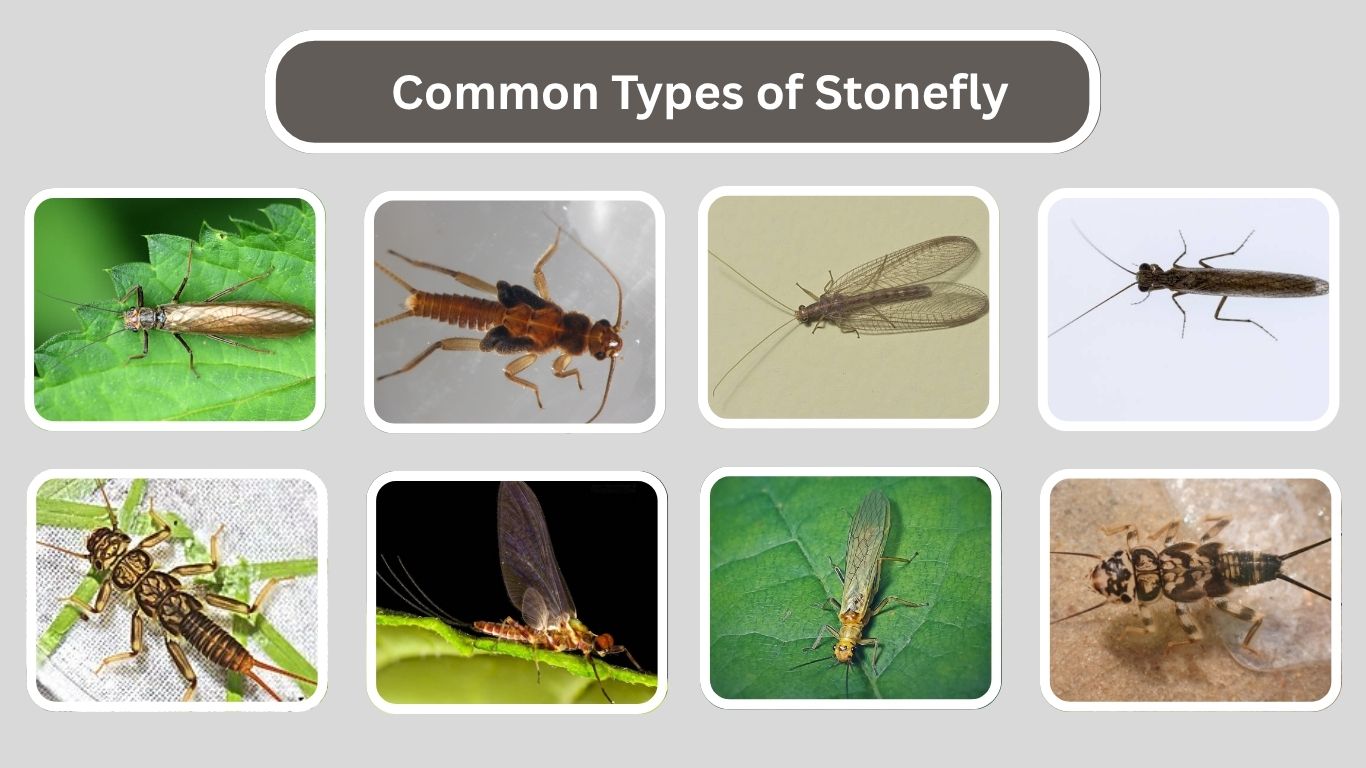
Stoneflies (Order: Plecoptera) are a diverse group of aquatic insects known for their sensitivity to water quality and their importance in freshwater ecosystems. Found around the world, especially in cool, oxygen-rich streams and rivers, these insects are essential indicators of clean water and play vital roles in the food web—both as nymphs living underwater and as short-lived adults. This article explores 25 unique types of stoneflies, providing identification traits, life cycles, habitats, and ecological roles for each species. From the well-known Giant Stonefly to lesser-known winter-emerging species, each type contributes to the health and balance of aquatic environments.
1. Pteronarcys dorsata (Giant Stonefly)

The Giant Stonefly, scientifically known as Pteronarcys dorsata, is one of the largest stonefly species found in North America. It is an important indicator of water quality and is often spotted in cold, clean rivers and streams. Due to its large size and sensitivity to pollution, it plays a vital role in aquatic ecosystems and fly-fishing culture.
Identification
- Large body length (up to 5 cm or 2 inches)
- Dark brown to black coloration
- Two pairs of long, membranous wings folded flat over the body
- Long antennae
- Distinct orange or reddish markings on the thorax and abdomen
- Nymphs have visible gills on the thorax and abdomen
Habitat
Pteronarcys dorsata typically inhabits fast-flowing, well-oxygenated streams and rivers with gravel or cobble substrates. It is commonly found in forested regions across the northern United States and southern Canada.
Life Cycle
The life cycle includes egg, nymph, and adult stages. The nymphal stage lasts up to 2–3 years underwater before emerging as a winged adult. Adults live only a few weeks, primarily to reproduce.
Behavior
Nymphs are active predators and detritivores, feeding on decaying plant material and small invertebrates. Adults are mostly nocturnal and tend to remain near water sources after emergence.
Ecological Role
As a bioindicator species, the presence of Giant Stoneflies signals high water quality. Their nymphs contribute to nutrient cycling by breaking down organic material, supporting both aquatic and riparian food webs.
2. Pteronarcella badia

Pteronarcella badia, often called the Western Stonefly, is a smaller relative of the Giant Stonefly and is commonly found in the western regions of North America. Though less prominent in size, it shares similar ecological significance and serves as an indicator of pristine aquatic environments.
Identification
- Medium-sized body, smaller than Pteronarcys dorsata
- Brown to reddish-brown coloration
- Delicate, clear wings with visible veining
- Two long antennae and two tail-like cerci
- Nymphs have gills along the thorax and abdomen
Habitat
This species is mostly found in cool, fast-flowing mountain streams, especially in forested regions of the Pacific Northwest, the Rockies, and parts of British Columbia. It prefers gravelly or rocky streambeds with plenty of submerged debris.
Life Cycle
Pteronarcella badia undergoes incomplete metamorphosis, spending up to two years as aquatic nymphs. Emergence into adulthood happens in spring or early summer, with adults surviving only a short time to mate and lay eggs.
Behavior
The nymphs are detritivores, feeding mostly on leaf litter and decomposing organic matter. Adults are relatively inactive, often hiding under rocks or nearby vegetation during the day and becoming more active at dusk.
Ecological Role
By consuming organic debris and contributing to decomposition, this species plays a crucial role in maintaining the health of freshwater ecosystems. Its sensitivity to pollution makes it an effective indicator for water quality assessments.
3. Acroneuria abnormis (Common Stone)

Acroneuria abnormis, commonly known as the Common Stonefly, is a widespread species in eastern North America. It is often seen near clear, temperate streams and rivers. Its presence is a good sign of moderate to high water quality and balanced aquatic ecosystems.
Identification
- Medium to large body size (up to 3 cm)
- Brown to dark brown coloration with yellowish markings on the thorax
- Transparent wings with dense venation, held flat over the back
- Two long antennae and two cerci extending from the abdomen
- Nymphs have robust bodies with bristly legs and bushy gills
Habitat
This stonefly species is commonly found in rocky-bottomed streams and rivers throughout the eastern United States and parts of Canada. It prefers cool, oxygen-rich waters with moderate current and abundant cover like submerged logs and stones.
Life Cycle
Acroneuria abnormis spends approximately 1–2 years as a nymph. Adults emerge from the water in late spring to early summer. After a brief terrestrial phase for mating, females return to the water to deposit eggs on the surface.
Behavior
The nymphs are active hunters and scavengers, often hiding under rocks during the day and feeding at night. Adults are attracted to lights and are typically found near riparian zones, especially on vegetation and rocks close to water.
Ecological Role
This species contributes significantly to the food chain, serving as prey for fish, birds, and amphibians. Its nymphs help control smaller invertebrate populations and recycle nutrients from detritus, making it essential for stream health.
4. Perlesta placida

Perlesta placida is a small to medium-sized stonefly commonly known as the “Yellow Sally” in the fly-fishing community. It is widely distributed in central and eastern North America and is often one of the most abundant summer-emerging stonefly species.
Identification
- Small to medium size (8–15 mm in length)
- Pale yellow to light brown body coloration
- Distinct lighter yellowish wings with fine venation
- Long, thin antennae and two tail-like cerci
- Nymphs are light brown with pale legs and streamlined bodies
Habitat
Perlesta placida thrives in smaller rivers and streams with moderate flow and clean, well-oxygenated water. It’s adaptable and often found in both headwater streams and larger tributaries with mixed substrates of sand, gravel, and cobble.
Life Cycle
This species typically has a one-year life cycle. Nymphs develop during fall and winter, emerging as adults in early to mid-summer. Adults live for about a week to 10 days, during which mating and egg-laying occur quickly.
Behavior
Nymphs are fast crawlers and feed on fine organic debris and algae. Adults are mostly nocturnal, flying at dusk or after dark. They’re short-lived and may be found resting on rocks or foliage close to the water.
Ecological Role
Due to their abundance and short development time, Perlesta placida nymphs are a vital seasonal food source for fish, especially during the summer. Their populations can help support game fish and are also used as biological indicators of water quality.
5. Isoperla bilineata (Two-lined Stripetail)

Isoperla bilineata, commonly called the Two-lined Stripetail, is a striking stonefly known for its distinctive dorsal stripes. It is one of the more recognizable species in the Isoperla genus and is frequently found in the eastern and midwestern United States.
Identification
- Small to medium body size (around 10–15 mm)
- Bright yellow or greenish-yellow body with two dark longitudinal stripes on the back
- Clear wings with fine venation
- Long antennae and slender cerci
- Nymphs are similarly colored with distinct striping and well-developed gills
Habitat
This species prefers cool, shaded, forested streams with gravel or rocky bottoms. It inhabits clear, moderately fast-flowing water with minimal pollution, often in upland or mountainous regions.
Life Cycle
Isoperla bilineata typically completes its life cycle in one year. Nymphs mature through winter and spring and emerge in late spring or early summer as winged adults. Mating and egg-laying occur soon after emergence.
Behavior
The nymphs are active predators of smaller aquatic invertebrates. Adults rest on vegetation and rocks during the day and are more active during the evening. They do not feed in the adult stage.
Ecological Role
This species is a reliable indicator of high water quality. It helps maintain ecological balance by preying on smaller aquatic organisms and providing food for fish, amphibians, and insectivorous birds.
6. Isoperla namata

Isoperla namata is a less conspicuous but ecologically important member of the Isoperla genus. Though similar in form to its relatives, it lacks bold striping and is typically identified through subtle morphological features and habitat preference.
Identification
- Small size (typically under 12 mm)
- Pale greenish to yellowish coloration with minimal or no dorsal stripes
- Delicate clear wings
- Long antennae and slender cerci
- Nymphs are lightly colored and streamlined with visible gills on the thorax
Habitat
This species is often found in pristine, high-elevation streams and spring-fed tributaries in forested or mountainous regions. It favors cold, fast-moving water with rocky or gravel beds.
Life Cycle
Isoperla namata has a univoltine (one-year) life cycle, with adults emerging in late spring to early summer. Egg-laying occurs soon after mating, and nymphs develop rapidly through the remaining months.
Behavior
Nymphs are typically found clinging to submerged stones and woody debris, feeding on algae and fine organic material. Adults are short-lived and secretive, staying close to the emergence site.
Ecological Role
This species contributes to energy flow in clean-water ecosystems. It supports fish and other predators and serves as an important bioindicator for assessing stream health and detecting subtle environmental changes.
7. Isoperla holochlora

Isoperla holochlora is a vibrant, greenish-yellow stonefly species found primarily in the eastern United States. Though less commonly encountered than other Isoperla species, it plays a significant role in cold stream environments and is appreciated for its subtle beauty.
Identification
- Small to medium size (10–14 mm)
- Bright green to yellow-green body with a glossy sheen
- Transparent wings that rest flat over the body
- Long, slender antennae and cerci
- Nymphs are pale green or yellow with minimal markings and thin gills
Habitat
This species resides in clean, spring-fed streams and headwaters with stable temperatures and moderate to swift current. It prefers shaded, forested areas with rocky or gravel substrates.
Life Cycle
Isoperla holochlora generally has a one-year life cycle. Eggs hatch in late summer or fall, and nymphs overwinter before emerging as adults in mid to late spring. Adults are seen for a short period during the peak of the emergence window.
Behavior
The nymphs are often found crawling along the undersides of rocks and woody debris, feeding on fine organic particles and diatoms. Adults are rarely seen except near emergence zones and are mostly active in the late afternoon and evening.
Ecological Role
This species helps support stream food webs by contributing to the diet of fish and amphibians. It also plays a role in nutrient cycling and is highly sensitive to pollution, making it valuable for environmental monitoring.
8. Taeniopteryx burksi

Taeniopteryx burksi is a winter-emerging stonefly species, often one of the earliest insects seen during late winter and early spring. It belongs to the family Taeniopterygidae and is sometimes called the “early brown stonefly.”
Identification
- Small size (8–12 mm)
- Dark brown to chocolate-colored body
- Wings slightly smoky and held flat over the body
- Shorter antennae compared to larger species
- Nymphs are dark and stocky with sparse gills
Habitat
Commonly found in cool, well-oxygenated streams and rivers, especially in forested areas of eastern North America. It is often associated with stream margins, riffles, and leaf packs in slow to moderate flow.
Life Cycle
Unlike many other stoneflies, Taeniopteryx burksi emerges in late winter to very early spring. Its univoltine life cycle is adapted to colder conditions, with nymphs maturing through fall and winter before emerging on warmer days.
Behavior
Nymphs are detritivores, feeding heavily on decomposing leaf material. Adults are typically seen walking on snow or resting near the stream edge. They are relatively weak fliers and tend to stay close to the ground.
Ecological Role
Taeniopteryx burksi plays a crucial role in early-season nutrient cycling. As one of the first aquatic insects to emerge annually, it provides an important food source for early-feeding fish and birds, and helps break down organic material in stream ecosystems.
9. Taeniopteryx nivalis

Taeniopteryx nivalis, commonly called the “Snowfly,” is well-known for its unique emergence during cold months. This species is one of the few aquatic insects active in late winter and early spring, often walking on snow near streambanks.
Identification
- Small to medium size (10–14 mm)
- Dark brown to nearly black body
- Slightly smoky wings with fine venation
- Short antennae and small, compact cerci
- Nymphs are dark, robust, and lack extensive gills
Habitat
Found throughout northern and northeastern North America, this species prefers cool, clean, slow to moderately flowing streams and small rivers. It is often associated with leaf packs and woody debris.
Life Cycle
Taeniopteryx nivalis follows a winter-emergence strategy. Nymphs develop over the summer and fall, maturing by mid-winter and emerging in late January through March. Adults mate and lay eggs soon after emerging, with eggs attaching to submerged rocks.
Behavior
Nymphs feed primarily on decaying leaves and fine organic matter. Adults are poor fliers but actively crawl across snowbanks and streamside vegetation. Mating occurs in near-freezing temperatures.
Ecological Role
This species helps break down organic matter during a time when most invertebrate activity is minimal. Its winter activity provides critical food for early-active fish, birds, and other streamside predators.
10. Paragnetina media

Paragnetina media is a larger, golden-brown stonefly commonly found in the central and southeastern United States. It is part of the Perlidae family and is valued for its role in aquatic ecosystems and recreational fly fishing.
Identification
- Medium to large size (15–25 mm)
- Golden brown to reddish-brown coloration with dark patterns on the thorax
- Wide, veined wings that extend beyond the body
- Long, thin antennae and two prominent cerci
- Nymphs are robust with heavily patterned thorax and tufts of gills on thoracic segments
Habitat
Paragnetina media favors moderately flowing streams and rivers with stable substrates like gravel, cobble, and submerged wood. It is often found in forested regions with clean, well-oxygenated water.
Life Cycle
This species typically has a two-year life cycle, with nymphs growing slowly before emerging as adults in late spring or early summer. Adults are active for several weeks during the mating season.
Behavior
Nymphs are active predators, preying on other aquatic invertebrates. Adults are relatively strong fliers compared to many stoneflies and can travel short distances from the stream, often resting on nearby foliage.
Ecological Role
Paragnetina media helps regulate populations of smaller aquatic insects and is an important food source for fish like trout and bass. Its sensitivity to habitat degradation makes it a useful species for monitoring stream health.
11. Paragnetina fumosa

Paragnetina fumosa is a large, dark-colored stonefly species found in parts of eastern North America. A member of the Perlidae family, it is notable for its strong presence in clean rivers and its role as a top-level aquatic predator during the nymphal stage.
Identification
- Large size (up to 25 mm)
- Dark brown to smoky gray body with faint lighter markings
- Clear wings with dark veins, held flat over the back
- Long, slender antennae and noticeable cerci
- Nymphs are thick-bodied with heavily patterned thoraxes and feathery thoracic gills
Habitat
This species inhabits cool, fast-flowing rivers and streams with cobble and boulder substrates. It is especially common in mountainous and forested areas with minimal pollution.
Life Cycle
Paragnetina fumosa typically requires two years to complete its life cycle. The nymphs grow slowly in cold water and emerge as adults in late spring to early summer. Adults survive for a couple of weeks, just long enough to reproduce.
Behavior
Nymphs are aggressive predators, feeding on insect larvae and other small aquatic creatures. Adults are most active during evening hours and are occasionally attracted to lights. They often cling to rocks and riparian vegetation.
Ecological Role
As a large predator, the nymphs help regulate prey populations in streams and contribute to aquatic biodiversity. They’re also an essential part of the diet for larger fish, especially during emergence periods.
12. Claassenia sabulosa

Claassenia sabulosa, sometimes known as the “Golden Stone,” is a widespread and relatively large stonefly species of western North America. It’s popular among fly anglers due to its visibility and importance in trout diets.
Identification
- Large body size (20–30 mm)
- Golden brown to light tan body with dark mottling
- Distinctively long and veined wings extending past the abdomen
- Long, thick antennae and prominent cerci
- Nymphs are broad, heavily patterned, and possess feathery thoracic gills
Habitat
This species thrives in cold, rocky rivers and large mountain streams. It prefers high-gradient, clean waters with strong currents and stable streambeds, typically in the Pacific Northwest and Rocky Mountain regions.
Life Cycle
Claassenia sabulosa has a two- to three-year life cycle. Nymphs are present year-round, with adults emerging from late spring through mid-summer. Egg-laying females return to the stream to deposit eggs on the water surface.
Behavior
The nymphs are active and strong crawlers, often sheltering beneath rocks. Adults are agile and can fly moderate distances. They’re often seen resting on rocks and vegetation near the stream after emergence.
Ecological Role
This species is a key part of riverine food webs. Its nymphs prey on other aquatic invertebrates, and in turn, serve as critical forage for trout and other fish. Their abundance and pollution sensitivity also make them useful indicators of stream health.
13. Calineuria californica

Calineuria californica, commonly known as the Western Stonefly or California Stonefly, is a striking species native to the western United States. Its bold body patterns and important ecological role make it a favorite among anglers and aquatic biologists.
Identification
- Large body size (up to 30 mm)
- Golden yellow to amber body with dark, reticulated (net-like) markings
- Long, narrow, transparent wings with dense venation
- Long antennae and two segmented cerci
- Nymphs are heavily armored, with distinctive markings and tufts of thoracic gills
Habitat
This species is widespread in cold, swift-flowing mountain streams, particularly in the Pacific Northwest, northern California, and the Sierra Nevada. It prefers cobble and boulder substrates and well-oxygenated water.
Life Cycle
Calineuria californica generally has a two-year life cycle. Nymphs grow steadily over time, emerging as adults in late spring and summer. Adults are short-lived and remain close to stream edges.
Behavior
Nymphs are active predators and detritivores, often found crawling under rocks or hiding in leaf packs. Adults tend to be weak fliers and often cling to boulders or riparian vegetation during mating.
Ecological Role
This species is an important part of western stream food webs. Nymphs help control insect populations and contribute to the diet of salmonids. Their presence is a sign of healthy, high-quality freshwater ecosystems.
14. Hesperoperla pacifica (Golden Stonefly)

Hesperoperla pacifica, commonly known as the Golden Stonefly, is one of the most famous and widespread western stoneflies. It’s highly valued in the fly fishing world for its size and attractiveness to trout.
Identification
- Large body size (20–30 mm)
- Yellow to golden tan coloration with brown speckling on the thorax and wing pads
- Long, heavily veined wings held flat over the back
- Long antennae and two prominent cerci
- Nymphs are thick-bodied with dark bands and tufts of fine thoracic gills
Habitat
Golden Stoneflies are found in clean, cold rivers across western North America, including mountain streams in California, Oregon, Washington, Idaho, and Montana. They prefer rocky substrates in fast-flowing sections.
Life Cycle
Hesperoperla pacifica has a two- to three-year nymphal stage, making it one of the longest-living stoneflies in its range. Adults emerge from late spring to midsummer, depending on elevation and temperature.
Behavior
Nymphs are powerful swimmers and active at night. Adults are typically seen in late afternoons and evenings, often flying near the stream. Females return to water surfaces to lay eggs after mating.
Ecological Role
As one of the largest stonefly species, it plays a major role in stream food chains. It supports large fish populations and is a reliable indicator of unpolluted, oxygen-rich waters. Fly anglers often mimic this species with artificial “golden stone” patterns.
15. Hesperoperla pacifica

Skwala americana is a medium-sized stonefly known for its early spring emergence and importance in coldwater fisheries. It’s a favorite among fly anglers and a key species in western North American streams.
Identification
- Medium size (12–20 mm)
- Dark brown to olive-gray body with subtle markings
- Long, transparent wings with light venation
- Slender antennae and cerci
- Nymphs are dark, flattened, and lack conspicuous gills
Habitat
Skwala americana is typically found in mid-elevation streams and rivers in the western U.S., especially in Montana, Idaho, and California. It prefers stable-flowing waters with gravel and cobble bottoms.
Life Cycle
This species has a one- to two-year life cycle. Adults emerge as early as late February or March, making it one of the first major stonefly hatches of the year. Females lay eggs directly into the water after mating.
Behavior
Nymphs are active in winter, often clinging to rocks in riffle areas. Adults are weak fliers and tend to crawl onto nearby rocks and vegetation to molt and mate. They’re most active on warm spring afternoons.
Ecological Role
Skwala americana is an early-season food source for trout and birds. Its predictable emergence makes it a critical hatch in fly fishing. As a coldwater specialist, it also helps gauge stream health and temperature stability.
16. Skwala curvata

Skwala curvata is a lesser-known species in the Skwala genus, with a restricted range and a preference for undisturbed mountain streams. Though similar to its cousin Skwala americana, it can be distinguished by subtle anatomical differences.
Identification
- Medium body size (12–18 mm)
- Olive-brown coloration with minimal patterning
- Clear wings with moderate venation held flat over the abdomen
- Long antennae and two slim cerci
- Nymphs are squat, dark-colored, with well-developed legs for crawling
Habitat
Skwala curvata is found in select streams in the northwestern U.S., especially in higher elevations with cold, spring-fed water. It favors riffles with stable, rocky bottoms and limited sedimentation.
Life Cycle
This species likely follows a one-year life cycle, with adults emerging in early spring. Limited emergence data suggests a brief adult phase focused on reproduction near the stream edge.
Behavior
Nymphs are active under stones and debris, often staying hidden from predators. Adults are more secretive than other Skwala species and are rarely seen flying, instead crawling close to the water.
Ecological Role
Though not as well-studied as other stoneflies, Skwala curvata contributes to the early-season food web and can help assess the ecological integrity of remote mountain streams. Its sensitivity to disturbance makes it a valuable indicator species.
17. Pteronarcys dorsata

Perlinella drymo is a small to medium-sized stonefly species belonging to the Perlidae family. It is found mainly in the eastern United States and is recognized for its distinctive body patterns and its role as a mid-level aquatic predator.
Identification
- Body length ranges from 10–15 mm
- Yellowish to light brown body with darker mottling
- Clear wings that extend slightly beyond the abdomen
- Long, threadlike antennae and well-developed cerci
- Nymphs have patterned thoraxes, sturdy legs, and tufts of gills near the thorax
Habitat
This species inhabits smaller to mid-sized streams and rivers with clean, oxygenated water and rocky or gravelly substrates. It is most commonly encountered in forested or lightly disturbed watersheds.
Life Cycle
Perlinella drymo typically follows a one-year life cycle. Nymphs are present throughout the year and emerge as adults in late spring to early summer. Females lay eggs on the water surface, and the cycle begins again.
Behavior
The nymphs are primarily nocturnal and prefer to hide under rocks and debris during daylight. They are predators of smaller invertebrates and detritivores. Adults are short-lived and usually rest on rocks or vegetation near streams.
Ecological Role
This species plays a dual role—breaking down organic material and preying on smaller aquatic organisms. Its presence supports fish populations and helps maintain balance in benthic invertebrate communities. Because of its sensitivity to water quality, it is often included in bioassessment surveys.
18. Malirekus hastatus

Malirekus hastatus is a small but distinctive species of stonefly belonging to the Perlodidae family. It is primarily found in eastern North America and is associated with cold, high-quality streams. Its dagger-like abdominal structure gives rise to the species name “hastatus,” meaning spear-shaped.
Identification
- Small to medium size (10–14 mm)
- Dark brown to nearly black body with pale markings on legs and thorax
- Narrow, clear wings with distinct venation
- Slender, segmented antennae and sharp, pointed cerci
- Nymphs are slender, dark-colored, and have pronounced thoracic gills and hooked legs
Habitat
Malirekus hastatus is usually found in small to medium forested streams, particularly in mountainous or upland regions. It prefers shaded, cold water habitats with clean gravel or cobble substrates and abundant leaf litter.
Life Cycle
This species typically has a one- to two-year life cycle, depending on environmental conditions. Adults emerge from late spring to early summer. Mating and egg-laying take place quickly, with females depositing eggs in or near water.
Behavior
Nymphs are agile crawlers and active predators, often hunting small aquatic insects among leaf packs and stones. Adults are secretive, usually staying close to the stream and active during dusk or overcast conditions.
Ecological Role
Malirekus hastatus plays a vital role in headwater ecosystems. Its predatory nymphs help maintain invertebrate balance, while its presence indicates cold, undisturbed water conditions. It also serves as prey for trout, birds, and amphibians in forested stream corridors.
19. Perlesta decipiens

Perlesta decipiens is a small, summer-emerging stonefly commonly found in the eastern and central United States. It belongs to the family Perlidae and is a member of the Perlesta genus, often referred to as “little yellow stones” due to their pale appearance.
Identification
- Small size (typically 6–12 mm)
- Pale yellow to light brown body
- Wings are transparent with fine venation and longer than the body
- Long, thin antennae and short cerci
- Nymphs are slender, pale brown, with fine gills on the thorax and patterned legs
Habitat
This species thrives in clean, warm to moderately cool streams and rivers with low to moderate flow. It is frequently found in lowland creeks and mid-sized rivers with gravel and mixed substrates, often in forested or semi-rural areas.
Life Cycle
Perlesta decipiens has a univoltine (one-year) life cycle. Nymphs develop over winter and spring, emerging in large numbers during early to mid-summer. Adults are active for several weeks, especially during warm, humid evenings.
Behavior
The nymphs feed on detritus and algae, playing a role as scrapers and collectors. Adults are weak fliers and mostly nocturnal, often resting on rocks, bridge pilings, or riparian plants. They are frequently drawn to lights at night.
Ecological Role
This species contributes to organic matter processing and supports summer fish diets, particularly those of warmwater species like smallmouth bass. Its abundance and seasonal timing make it a useful species for stream monitoring and ecological assessments.
20. Amphinemura delosa

Amphinemura delosa is a small winter stonefly belonging to the family Nemouridae. It is one of the earliest insects to emerge in late winter or early spring and is found primarily in eastern North America. Despite its size, it plays an important role in coldwater stream ecosystems.
Identification
- Very small body size (4–8 mm)
- Dark brown to black body with slightly smoky wings
- Wings fold flat over the abdomen and extend just beyond the body
- Short antennae and cerci
- Nymphs are dark, compact, with stout legs and bushy gills near the thorax
Habitat
This species is found in cool, well-shaded forest streams and spring-fed headwaters. It prefers slow to moderate flow and is typically associated with leaf packs, woody debris, and mossy stream margins.
Life Cycle
Amphinemura delosa is a winter-emerging species with a one-year life cycle. Nymphs develop through fall and winter, and adults emerge in late winter or early spring—sometimes seen crawling on snowbanks near streams.
Behavior
Nymphs are detritivores, feeding on decaying plant matter. Adults are poor fliers and tend to crawl over stones and streamside vegetation. They’re most active on mild days in late winter, making them one of the few aquatic insects active during this time.
Ecological Role
This species is crucial for early-season nutrient cycling, breaking down leaf litter and contributing to the base of the stream food web. Its winter emergence also supports early-feeding fish and other predators during a typically scarce time.
21. Leuctra tenuis (Needlefly)

Leuctra tenuis, commonly called the Needlefly, is a slender winter stonefly from the family Leuctridae. Known for its tiny, needle-like shape and cold-season emergence, it is often one of the first signs of insect activity in stream ecosystems each year.
Identification
- Very small and slender (4–7 mm in length)
- Cylindrical, dark brown to black body
- Long, narrow wings that wrap tightly around the abdomen
- Short antennae and cerci
- Nymphs are thin-bodied with reduced or absent gills and uniform coloration
Habitat
Leuctra tenuis inhabits cool, well-oxygenated headwater streams, often in forested or mountainous regions. It prefers slow-flowing water with abundant organic debris and shaded conditions.
Life Cycle
This species has a univoltine life cycle. Eggs hatch in late spring or summer, with nymphs developing through fall and winter. Adults emerge from late winter to early spring, often walking on snow or ice along stream edges.
Behavior
The nymphs feed on fine detritus and periphyton and are well adapted to life in leaf packs and between stones. Adults are terrestrial crawlers with weak flight and often go unnoticed except by keen observers during snowmelt.
Ecological Role
Leuctra tenuis plays a key role in breaking down organic matter in cold, headwater environments. Its early emergence helps bridge the seasonal gap in aquatic food chains, offering nourishment to fish and birds when few other insects are available.
22. Capnia vernalis

Capnia vernalis is a tiny winter stonefly in the family Capniidae, often emerging during the coldest months when snow still covers much of the ground. It is common in eastern North America and is a strong bioindicator of healthy headwater streams.
Identification
- Very small size (3–6 mm)
- Slender, dark brown to black body
- Short wings that barely cover the abdomen in some individuals
- Short antennae and cerci
- Nymphs are compact, dark, and lack visible external gills
Habitat
Capnia vernalis is found in cold, spring-fed or snowmelt-fed headwater streams with slow to moderate flow. It prefers shaded, forested environments with stable water chemistry and plenty of leaf litter.
Life Cycle
This species completes its life cycle in one year. Eggs are laid in late winter, hatch in spring, and the nymphs grow through summer and fall. Adults emerge between late January and March, walking across snowbanks or ice.
Behavior
Nymphs are detritivores, feeding on decomposing leaves and other organic material. Adults are winged but rarely fly, instead crawling along streambanks, snow surfaces, or ice to mate and lay eggs.
Ecological Role
Capnia vernalis is a vital contributor to early-season nutrient cycling and a rare food source during winter for trout and stream birds. Its presence reflects good water quality and thermal stability in small, isolated streams.
23. Allocapnia recta

Allocapnia recta is another cold-adapted, winter-emerging stonefly species in the family Capniidae. Though tiny and often overlooked, it’s one of the most widespread Allocapnia species across eastern North America.
Identification
- Very small size (4–7 mm)
- Slender black to dark brown body
- Wings lie flat and may appear slightly shortened
- Short antennae and tapering cerci
- Nymphs are thin, dark, and adapted for crawling among fine streambed materials
Habitat
Allocapnia recta thrives in cool, clean streams, especially those fed by springs or melting snow. It’s often found in small tributaries, upland brooks, and forested creeks with ample organic debris and shade.
Life Cycle
The species has a univoltine life cycle, with adult emergence occurring from January to March. Eggs are deposited in winter, hatch in early spring, and the nymphs develop during summer and autumn.
Behavior
The nymphs are slow-moving and prefer hiding among leaf packs and detritus. Adults are winged but primarily terrestrial, crawling along snowbanks or wet rocks to mate and deposit eggs in icy water.
Ecological Role
Allocapnia recta plays an essential role in winter stream ecosystems. It helps decompose organic matter during cold months and provides an early-season food source for aquatic and riparian predators when few other insects are active.
24. Soyedina vallicularia

Soyedina vallicularia is a rare, small stonefly in the family Nemouridae. It is found in isolated, cool streams of the northeastern United States and parts of eastern Canada. This species is typically associated with undisturbed, forested headwaters.
Identification
- Very small size (4–6 mm)
- Dark brown to black body with a slightly flattened shape
- Short wings held flat over the body, sometimes extending slightly past the abdomen
- Short antennae and short cerci
- Nymphs are compact and rounded with thick legs and fine gill tufts near the thorax
Habitat
Soyedina vallicularia inhabits cold, spring-fed or snowmelt-fed headwater streams. It is often found in remote, forested areas where water quality is high, and human disturbance is minimal.
Life Cycle
The species has a one-year life cycle. Nymphs develop through the fall and winter, with adult emergence occurring in early to mid-spring. Adults are seldom seen due to their small size and brief flight period.
Behavior
Nymphs are slow-moving detritivores, feeding on decaying plant matter among leaf packs and stream gravel. Adults are mostly active at dusk, staying close to streamside vegetation or hiding under stones.
Ecological Role
Though not commonly encountered, Soyedina vallicularia contributes to organic matter breakdown in sensitive aquatic habitats. Its presence is often used to assess the health and stability of coldwater headwater systems.
25. Nemoura trispinosa

Nemoura trispinosa is a small, winter-emerging stonefly belonging to the Nemouridae family. It is found across parts of eastern North America, where it is often one of the first insects to appear at the edge of receding snowbanks.
Identification
- Small body size (5–8 mm)
- Dark brown to black coloration
- Wings are smoky and lay flat over the body, slightly longer than the abdomen
- Short antennae and two short, fine cerci
- Nymphs are stout, with dark bodies and three distinct spines on the tergum (dorsal body segments)
Habitat
This species inhabits small, cold, shaded forest streams with rocky or gravel bottoms. It prefers areas with rich organic input, such as leaf packs, and is especially common in spring-fed channels and upland creeks.
Life Cycle
Nemoura trispinosa has a univoltine life cycle. Nymphs develop through the fall and winter and emerge as adults in late winter or early spring. Adults are most active on warm afternoons and may be seen walking on snow.
Behavior
Nymphs are detritivores and collectors, scraping algae and consuming fine particulate organic matter. Adults are terrestrial crawlers with limited flight and are often spotted mating on wet rocks and streamside logs.
Ecological Role
This species plays an important role in cold-season nutrient cycling and supports early-feeding trout and other predators. It is also a valuable bioindicator for detecting thermal and chemical changes in sensitive freshwater ecosystems.