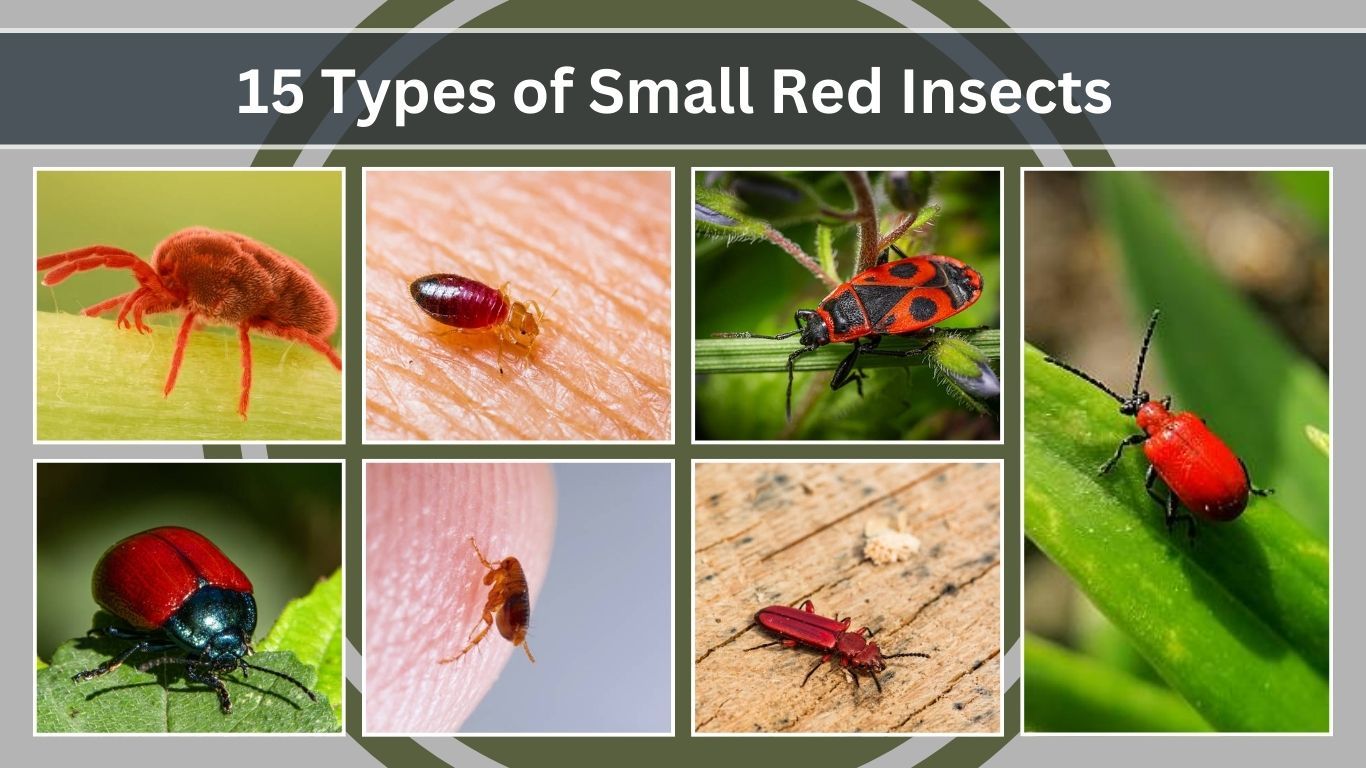
Small red insects are often overlooked, but many of them play significant roles in ecosystems, from aiding in pest control to becoming garden nuisances. Whether they are harmless or potentially harmful, understanding these insects can help in managing them effectively. In this article, we explore 15 red insects, highlighting their characteristics, habitats, and behaviors, so you can better identify and manage their presence.
1. Red Spider Mite (Tetranychidae)

Overview
The Red Spider Mite is a tiny, bright red pest belonging to the Tetranychidae family. Known for its destructive feeding habits, it targets a variety of plants, from houseplants to agricultural crops. These mites are especially problematic in dry, warm environments, and can cause significant damage by feeding on the sap of plants, leading to leaf discoloration and eventual plant decline.
Identification
- Bright red to orange color, sometimes appearing as a speck
- Tiny size, typically around 0.2 mm in length
- Oval-shaped body with long legs
- Often found in large clusters or webs
- Can be difficult to spot with the naked eye without magnification
Habitat
Red spider mites prefer warm, dry environments and are commonly found on the undersides of leaves where they feed on plant sap. They thrive in greenhouses, gardens, and indoor spaces with low humidity, infesting a variety of plants such as vegetables, ornamental flowers, and fruit-bearing crops. The mites are particularly prevalent during the summer months when conditions are ideal for reproduction.
Behavior and Facts
- Rapid Reproduction: Red spider mites reproduce quickly, with females laying dozens of eggs in their lifetime, leading to rapid colony expansion.
- Feeding Damage: Their feeding causes stippling (yellow or white spots) on plant leaves, weakening plants and potentially leading to leaf drop.
- Silk Webbing: They produce fine silk webs that protect them from environmental factors and provide shelter for their feeding activities.
2. Clover Mite (Bryobia praetiosa)

Overview
The Clover Mite is a very small, reddish mite often found in homes and gardens. These pests are typically found crawling on walls, windows, and concrete surfaces. While they do not bite humans or animals, their presence can be a nuisance, especially during the warmer months when they invade homes in large numbers.
Identification
- Bright red color, sometimes appearing orange or pinkish
- Very small, approximately 0.75 mm in length
- Oval-shaped body with long legs
- Often seen in large groups or swarms
- Can be difficult to detect without magnification
Habitat
Clover mites are commonly found in gardens, lawns, and on plants like clover, dandelions, and grasses. During spring and autumn, they may migrate into homes, typically through cracks in windows, doors, and walls. They thrive in areas with a high moisture level but can survive in dry conditions as well. These mites are often seen crawling on windowsills, particularly on the sunny side of buildings.
Behavior and Facts
- Non-Biting: Clover mites do not bite humans or pets, but their presence can be irritating as they invade homes in large numbers.
- Plant Feeding: They feed on plant material, especially clover, and may cause slight damage to plants by feeding on the sap.
- Seasonal Invasions: Clover mites often invade homes in the spring and fall, seeking warmer areas to overwinter or reproduce.
3. Red Aphid (Uroleucon spp.)

Overview
The Red Aphid is a small, red insect that typically clusters on plants in gardens and agricultural fields. They are part of the Aphididae family and are known for their ability to reproduce rapidly. Red aphids suck sap from plants, which weakens them and can lead to the transmission of plant diseases.
Identification
- Small, red to reddish-orange color
- Pear-shaped body with long, slender antennae
- Approximately 1-2 mm in length
- Can be seen in dense clusters on plant stems, leaves, or flower buds
Habitat
Red aphids are commonly found on the undersides of leaves and on tender plant parts like flower buds, stems, and shoots. They thrive in both outdoor gardens and greenhouses, where they prefer plants like roses, beans, and lettuce. These aphids can also be found on fruit trees and other crops, particularly in areas with warm climates.
Behavior and Facts
- Rapid Reproduction: Red aphids reproduce quickly, with some species able to produce offspring without mating (parthenogenesis).
- Sap Feeding: They feed by piercing plant cells and extracting sap, which weakens the plant and may cause yellowing of leaves.
- Disease Transmission: Red aphids are known vectors for plant diseases, including viruses like the cucumber mosaic virus, which can affect crops and ornamental plants.
4. Red Fire Ant (Solenopsis invicta)

Overview
The Red Fire Ant is a small, aggressive ant species known for its painful sting and rapid colonization. They are notorious for forming large colonies and are particularly dangerous in areas where they infest homes and outdoor spaces. Red fire ants are a significant concern in the southern United States and other warm climates.
Identification
- Small, reddish-brown body
- Workers are about 3-6 mm in length
- Rounded thorax with no spines
- Often seen in large colonies with multiple mounds
- Highly aggressive when disturbed
Habitat
Red fire ants typically build their nests outdoors, often in open areas like lawns, fields, and gardens. They prefer dry, sunny locations and are commonly found around buildings, agricultural fields, and even on roadsides. These ants can invade homes, especially if they are disturbed or food is readily available. Their nests are easily identified by the raised mounds they create in soil.
Behavior and Facts
- Aggressive Defense: Red fire ants are highly territorial and will aggressively defend their colonies, often swarming anyone who disturbs their mound.
- Painful Stings: When threatened, fire ants sting repeatedly, injecting venom that can cause severe pain, itching, and allergic reactions.
- Quick Colonization: They can establish large colonies in a short time, with each colony containing thousands of worker ants, making them difficult to control.
5. Red Flour Beetle (Tribolium castaneum)

Overview
The Red Flour Beetle is a small pest commonly found in stored grains and pantry products. It is a significant pest in the food industry, particularly affecting flour, cereals, and other dry food items. While not harmful to humans directly, the infestation of red flour beetles can lead to contamination and food spoilage.
Identification
- Reddish-brown, oval-shaped body
- Approximately 3-4 mm in length
- Long, slender antennae
- Smooth, shiny exoskeleton
- Often seen crawling in pantry areas or on food products
Habitat
Red flour beetles are typically found in stored food products, such as flour, rice, and dried beans. They thrive in warm, dry conditions and are often present in homes, grocery stores, or warehouses where food is stored improperly or for long periods. These beetles are commonly found in sealed packages of dry goods.
Behavior and Facts
- Food Contamination: Red flour beetles feed on grain products, causing contamination with larvae, feces, and insect bodies, which leads to food spoilage.
- Nocturnal Activity: These beetles are primarily nocturnal, becoming active at night when they search for food.
- Reproduction: Red flour beetles can lay up to 400 eggs in their lifetime, making it important to monitor food storage areas closely to prevent infestations.
6. Scarlet Lily Beetle (Lilioceris lilii)

Overview
The Scarlet Lily Beetle is a small, bright red beetle known for its destructive impact on lilies. These beetles, which are also known as red lily beetles, feed on lily plants, causing significant damage to the leaves, stems, and flowers. The larvae of this beetle are equally damaging, as they chew through the plant’s tissues, making them a major concern for lily growers.
Identification
- Bright red body with black legs and antennae
- Adults are about 7-10 mm in length
- Oval-shaped with smooth, shiny exoskeleton
- Larvae are brownish and covered in a slimy, dark coating
- Found mostly on lily plants, particularly in early spring and summer
Habitat
Scarlet lily beetles are commonly found in gardens, particularly where lilies (Lilium spp.) are grown. They are often seen on the leaves, stems, and buds of lily plants, where they feed and lay eggs. These beetles thrive in temperate regions and are particularly problematic in areas with a large concentration of lilies or other bulb plants.
Behavior and Facts
- Feeding Damage: Both adults and larvae feed on the foliage of lilies, causing holes in leaves and flower buds, which can result in weakened plants and reduced blooming.
- Reproduction: Female beetles lay eggs on the undersides of lily leaves, and the larvae hatch and immediately begin feeding on the plant, causing significant damage.
- Pest Control: Controlling scarlet lily beetles requires regular monitoring of lily plants, removing beetles by hand, or using insecticides if necessary.
7. Ladybird Beetle (various Coccinellidae)

Overview
The Ladybird Beetle (or ladybug) is a small, brightly colored beetle, commonly red with black spots. It is considered a beneficial insect due to its role in controlling pests, particularly aphids, in gardens and agricultural fields. While their appearance is charming, ladybird beetles are voracious predators of soft-bodied insects, making them important for pest management.
Identification
- Typically red or orange with black spots, though some species may be yellow or black
- Round or oval-shaped body, approximately 4-8 mm in length
- Short, hard wing covers that protect their soft bodies
- Small black antennae and legs
Habitat
Ladybird beetles are commonly found in gardens, orchards, and fields, where they prey on aphids, mealybugs, and other pest insects. They are also found in homes during the colder months, seeking shelter. Ladybugs are often seen on plants like roses, tomatoes, and beans, where they help control pest populations.
Behavior and Facts
- Natural Pest Control: Ladybird beetles are highly effective at controlling aphid populations, making them an essential part of integrated pest management systems.
- Defense Mechanism: When threatened, ladybugs secrete a yellowish fluid from their legs, which has a strong odor and can deter predators.
- Overwintering Behavior: As temperatures drop, ladybird beetles seek shelter in buildings, where they may cluster in large numbers around windows, walls, and ceilings.
8. Red Velvet Mite (Trombidiidae)

Overview
The Red Velvet Mite is a bright, fuzzy red mite that belongs to the Trombidiidae family. These mites are commonly found in soil and gardens, where they are often spotted crawling on the ground or among plant debris. Despite their striking appearance, red velvet mites are harmless to humans and animals but play an essential role in soil ecosystems as predators of other small arthropods.
Identification
- Bright red or orange color, often velvety in texture
- Small, approximately 1-2 mm in length
- Fuzzy, almost velvet-like appearance due to fine hairs on their body
- Round, stocky body with long, spindly legs
- Often seen in large groups, particularly during warm months
Habitat
Red velvet mites are primarily found in moist, sheltered environments like garden soil, leaf litter, and under rocks. They are commonly found in temperate regions during late summer and fall when they emerge to feed. These mites thrive in moist conditions and are often seen in the presence of decaying organic matter, which supports their prey.
Behavior and Facts
- Predatory Nature: Red velvet mites are predators, feeding on small arthropods, including other mites and insects. Their feeding helps maintain the balance of the soil ecosystem.
- Seasonal Activity: These mites are most active during the late summer to fall months when they emerge from the soil to hunt and breed.
- Non-Harmful to Humans: While their appearance may be striking, red velvet mites do not bite or harm humans, making them harmless despite their predatory habits.
9. Bed Bug (Cimex lectularius, engorged)

Overview
The Bed Bug is a small, reddish-brown insect known for its ability to infest homes and feed on human blood. When engorged, bed bugs appear redder due to the blood they have consumed. These nocturnal pests are notorious for causing itchy bites and can spread quickly in places with high turnover, such as hotels or apartments.
Identification
- Reddish-brown, oval-shaped body
- Adults are about 4-5 mm long when not engorged
- Flattened, wingless body with small antennae
- Engorged bed bugs appear redder and slightly larger after feeding
- Typically found in crevices and seams of mattresses or furniture
Habitat
Bed bugs are typically found in human dwellings, including homes, hotels, and other places where people sleep. They hide in cracks and crevices near sleeping areas, including the seams of mattresses, bed frames, and furniture. Bed bugs are nocturnal, emerging at night to feed on sleeping hosts, typically humans or pets.
Behavior and Facts
- Blood Feeding: Bed bugs feed on the blood of their hosts, often leaving itchy, red welts on the skin.
- Nocturnal Feeding: Bed bugs are active at night and feed on humans while they are sleeping, making them difficult to detect.
- Rapid Reproduction: Bed bugs reproduce quickly, with females laying hundreds of eggs in their lifetime, making infestations hard to control without intervention.
10. Boxelder Bug Nymph (Boisea trivittata)

Overview
The Boxelder Bug Nymph is the immature stage of the adult boxelder bug, a small insect that often infests boxelder trees and other maples. These nymphs are bright red with black markings, and although they do not cause significant damage to plants, they can become a nuisance when they invade homes in large numbers.
Identification
- Bright red body with black markings
- Approximately 5-7 mm in length as nymphs
- Oval-shaped with long, slender legs
- Nymphs lack fully developed wings, unlike adults
Habitat
Boxelder bug nymphs are commonly found on boxelder trees, where they feed on seeds and leaves. They may also infest other trees like maples or ash. During the fall, these bugs often migrate to homes and buildings to overwinter, entering through cracks and crevices in walls and windows.
Behavior and Facts
- Feeding Habits: The nymphs feed on the seeds and leaves of boxelder trees, causing minor damage, but are not usually harmful to plants.
- Seasonal Migration: Boxelder bug nymphs seek warmth in homes as temperatures drop, making them a common indoor pest in late autumn.
- Harmless to Humans: While boxelder bugs can be a nuisance, they do not bite and are not considered a health threat.
11. Firebug (Pyrrhocoris apterus)

Overview
The Firebug is a small, strikingly colorful insect known for its black-and-red markings. These insects are often found in large groups, typically on plants or in gardens. While firebugs do not pose a significant threat to plants, their large congregations and bold colors make them easily recognizable. They are commonly found in temperate regions and are part of the Pyrrhocoridae family.
Identification
- Bright red body with black markings, typically on the thorax and legs
- Approximately 10-12 mm in length
- Oval-shaped body with long, slender legs and antennae
- Found in clusters, especially during the warmer months
- Adults have wings but are often seen walking or crawling on plant stems and leaves
Habitat
Firebugs are primarily found in gardens, fields, and areas with plenty of vegetation. They prefer sunny spots, where they feed on seeds, young plants, and various herbs. These bugs are commonly seen in the late summer to autumn months when they gather in large groups to overwinter. They are particularly attracted to maples and linden trees but can also be found on other plants.
Behavior and Facts
- Sap Feeders: Firebugs feed on plant sap, particularly from seeds, which can cause mild damage to certain plants.
- Group Behavior: Firebugs often aggregate in large numbers, especially in autumn, to find suitable overwintering sites.
- Non-Harmful to Humans: While firebugs are visually striking, they are harmless to humans and pets, with no stings or bites.
12. Red Soldier Beetle (Rhagonycha fulva)

Overview
The Red Soldier Beetle is a small, reddish beetle commonly seen in gardens and fields, especially during summer months. Known for its striking red color and black legs, it is often mistaken for a firefly due to its appearance. Red soldier beetles are beneficial in gardens as they prey on aphids and other pests.
Identification
- Reddish body with black legs, head, and antennae
- Adults are about 6-10 mm in length
- Elongated, oval-shaped body with soft wings
- Wings are slightly transparent, visible when the beetle is flying
- Often seen on flowers or leaves, feeding on pests
Habitat
Red soldier beetles are commonly found in gardens, meadows, and fields, particularly on flowering plants like daisies, sunflowers, and wildflowers. They thrive in temperate climates and are frequently seen in both urban and rural gardens, where they help control aphid populations.
Behavior and Facts
- Aphid Predators: Red soldier beetles feed on aphids, caterpillars, and other small soft-bodied insects, making them natural pest control agents.
- Nocturnal Behavior: These beetles are primarily active during the day, but they are also seen in the evening feeding on plants or mating.
- Benign to Humans: While red soldier beetles are highly beneficial for gardens, they are harmless to humans and pets.
13. Red Bark Beetle (Hylurgus ligniperda)

Overview
The Red Bark Beetle is a tiny red insect that infests wood, particularly in forests and wooded areas. These beetles are known for causing damage to trees, particularly conifers, as they burrow into the bark and feed on the tree’s tissues. While they do not directly threaten human health, they can weaken trees and make them more vulnerable to other pests and diseases.
Identification
- Reddish-brown to red body, about 3-5 mm in length
- Cylindrical body shape with a hard exoskeleton
- Small, curved antennae and legs
- Often found in tree bark, where they create small holes
Habitat
Red bark beetles are commonly found in wooded areas, where they infest trees like pine, spruce, and fir. They are particularly destructive to trees that are already weakened by other factors such as drought, disease, or injury. These beetles burrow into the bark to lay their eggs, where the larvae then feed on the inner tissues of the tree.
Behavior and Facts
- Tree Infestation: Red bark beetles feed on the cambium layer of trees, which can cause the tree to weaken and eventually die if left unchecked.
- Wood-Boring: These beetles bore into the bark and wood, leaving behind small holes as evidence of their presence.
- Tree Vulnerability: Infestations can make trees more susceptible to other pests or diseases, leading to long-term damage to forested areas.
14. Red Leaf Beetle (Chrysomelidae)

Overview
The Red Leaf Beetle is a small, bright red beetle belonging to the Chrysomelidae family, known for its tendency to feed on the foliage of various plants. These beetles are common garden pests and can cause significant damage to ornamental plants and crops by consuming leaves, which can weaken the plants and stunt their growth. While their vibrant red color makes them easily identifiable, their destructive feeding habits can quickly lead to plant damage if left uncontrolled.
Identification
- Bright red body with black spots or markings
- Typically 5-8 mm in length
- Oval-shaped body with long legs and antennae
- Larvae are usually yellowish or green with black heads
- Often seen feeding on plant leaves or under plant debris
Habitat
Red leaf beetles are typically found in gardens, agricultural fields, and wild areas where they feed on a variety of plants, including potatoes, tomatoes, and ornamental flowers. They are most commonly found in the warmer months, as they tend to emerge in late spring to summer when vegetation is abundant. The beetles seek shelter in plant foliage and soil, often hiding in the undersides of leaves or in dense vegetation.
Behavior and Facts
- Leaf Feeding: Red leaf beetles feed on the leaves of plants, causing significant damage by eating holes in the foliage. This feeding can weaken the plant and reduce its ability to photosynthesize.
- Reproduction: Female beetles lay eggs on the leaves, and the larvae hatch and immediately begin feeding on the plant. This can lead to substantial defoliation if populations are large.
- Pest Control: These beetles are often considered a pest in gardens and crops, and their populations must be controlled through physical removal or targeted insecticides to prevent excessive plant damage.
15. Fleas (Reddish-Brown Adult Fleas)

Overview
Fleas are small, reddish-brown insects that are well-known for their ability to bite and feed on the blood of mammals and birds. Adult fleas are typically found on pets, such as cats and dogs, and can infest homes if left unchecked. While fleas are not only a nuisance due to their bites, they can also transmit diseases like the plague and are a significant health concern for both humans and animals.
Identification
- Reddish-brown, oval-shaped body
- About 1-4 mm in length
- Wingless, with powerful hind legs for jumping
- Flat body adapted for moving through fur or feathers
- Often found on pets or in areas where animals frequent
Habitat
Fleas live on mammals and birds, where they feed on the host’s blood. They can infest homes, especially where pets sleep or spend time. In homes, fleas are commonly found in carpets, bedding, and furniture, where they lay eggs that hatch into larvae. The larvae are typically found in areas with pet debris, such as fur or feces. Fleas can be spread through contact with infested animals or environments, leading to widespread infestations if not treated.
Behavior and Facts
- Blood-Feeding: Fleas feed by biting into the skin of their hosts and extracting blood. This feeding process can cause itching and irritation, and may lead to allergic reactions in pets and humans.
- Reproduction: Fleas reproduce quickly, with females laying dozens of eggs daily, which fall off the host and hatch into larvae that eventually develop into adults.
- Disease Transmission: Fleas are vectors for several diseases, including the plague and typhus, making them a significant health risk for both pets and humans.