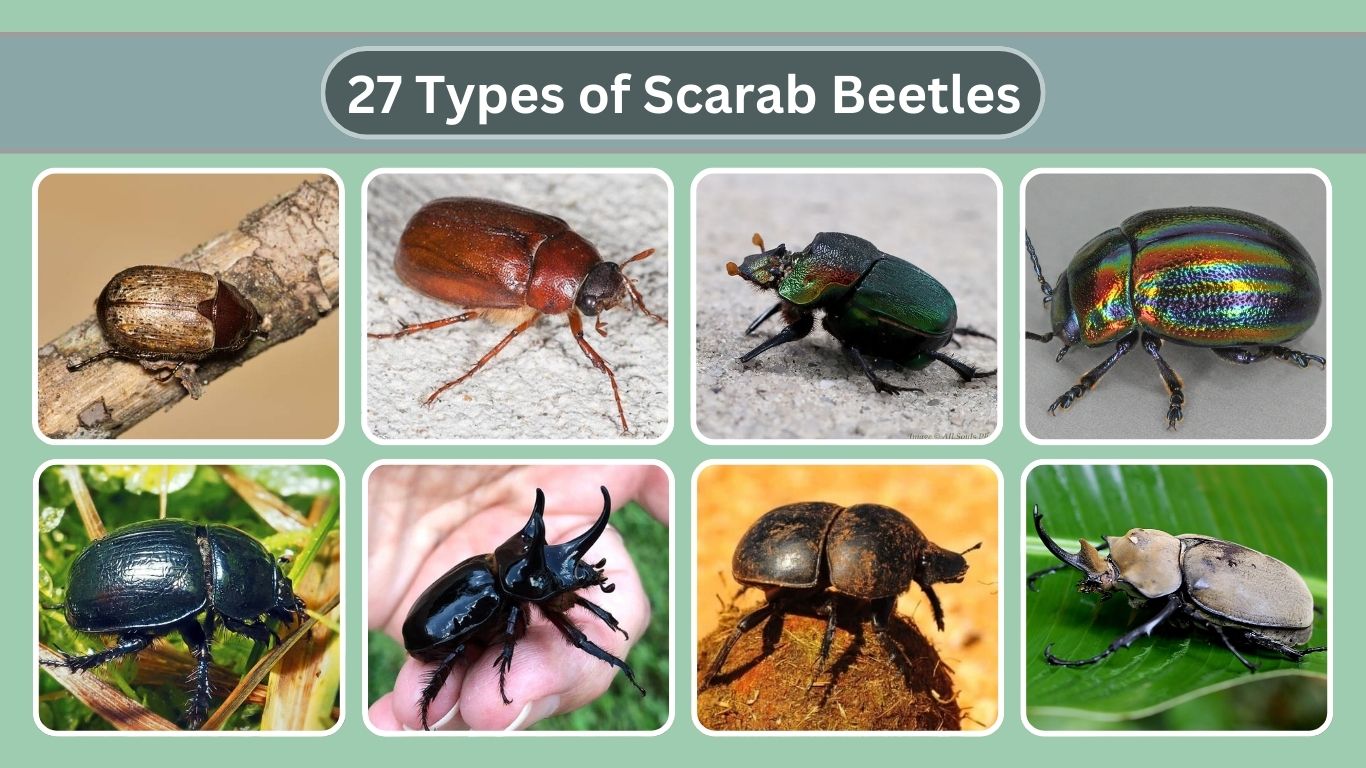
Scarab beetles are among the most fascinating and diverse members of the insect world, known for their strength, vibrant colors, and ecological importance. From dung recyclers to fruit feeders, these beetles play vital roles in nature by enriching soil, pollinating plants, and maintaining balance in ecosystems. This guide explores 27 different types of scarab beetles, highlighting their unique traits, habitats, and behaviors that make them truly remarkable.
1. Japanese Beetle (Popillia japonica)

The Japanese beetle is one of the most destructive scarab beetles, especially in North America where it is considered an invasive pest. Despite its small size, this beetle causes significant damage to ornamental plants, turfgrass, fruits, and crops due to its feeding habits in both larval and adult stages. Its metallic coloration makes it easy to recognize.
Identification
- Adult beetles measure around 8–12 mm in length
- Metallic green head and thorax
- Coppery-brown wing covers (elytra)
- White tufts of hair along each side of the abdomen
- Larvae are white C-shaped grubs found in soil
Habitat
Japanese beetles thrive in warm, sunny areas with abundant plants. They are common in gardens, parks, farmlands, and turfgrass regions. Larvae live underground, feeding on grass roots, while adults live above ground on leaves and flowers.
Behavior
Adults emerge in early summer, often feeding in groups, which leads to skeletonized leaves where only the veins remain. They are strong fliers and can infest wide areas quickly. Larvae are equally destructive, attacking lawns and turf by eating roots.
Diet
Adults feed on over 300 species of plants including roses, grapes, beans, and fruit trees. Larvae feed mainly on grass and crop roots, making them a double threat to agriculture and horticulture.
2. Green June Beetle (Cotinis nitida)

The green June beetle is a large scarab beetle commonly seen in the eastern United States during the summer months. Its metallic green body and buzzing flight make it noticeable, and although it feeds on fruit and flowers, the larvae cause more significant damage to soil and turf.
Identification
- Large beetle, measuring 20–25 mm in length
- Shiny metallic green upper body with bronze or gold highlights
- Brownish wing covers with faint orange margins
- Larvae are large, whitish grubs that crawl on their backs on the soil surface
Habitat
Green June beetles prefer moist, sandy soils and are often found in gardens, orchards, pastures, and golf courses. Adults are active during the day, especially in sunny areas, while larvae live underground.
Behavior
Adults are strong fliers and are often seen hovering around fruit trees and flowering plants. The grubs are unusual because they crawl on their backs using stiff hairs for movement. They damage turf and crops by feeding on roots.
Diet
Adults feed on ripening fruit such as peaches, grapes, and apples, as well as nectar and plant sap. Larvae primarily consume decaying organic matter and plant roots, which can weaken grass and crops.
3. May Beetle / June Bug (Phyllophaga spp.)

The May beetle, also called the June bug, is a well-known scarab beetle seen around lights on summer nights. While adults feed on tree leaves, their larvae are serious pests of lawns, pastures, and agricultural crops, making them economically important insects.
Identification
- Adults are medium to large, ranging from 12–25 mm in length
- Brown to reddish-brown body, somewhat oval and robust
- Antennae with distinctive lamellate (plate-like) clubs
- Larvae are thick, white C-shaped grubs with brown heads
Habitat
These beetles are widespread across North America, often inhabiting agricultural fields, grasslands, and wooded areas. Adults fly at night and are attracted to lights, while larvae live underground in soil.
Behavior
Adults feed on tree and shrub leaves, often causing noticeable defoliation. The larvae live in soil for 1–3 years depending on the species, feeding on roots and causing significant damage to crops and turfgrass.
Diet
Adults feed mainly on the foliage of hardwood trees such as oaks, maples, and fruit trees. Larvae feed on roots of grasses, corn, and other crops, leading to yellowing and death of plants.
4. Dung Beetle (Scarabaeus sacer)

The dung beetle, often symbolized in ancient Egyptian culture as the sacred scarab, plays an important ecological role by recycling animal waste. These beetles are strong diggers and are famous for rolling dung into balls, which they use for feeding and reproduction.
Identification
- Medium-sized beetle, about 25–37 mm long
- Shiny black body with a robust, rounded shape
- Strong legs with spines adapted for digging and rolling dung
- Smooth elytra without distinct markings
- Both sexes look similar, though males are often larger
Habitat
Dung beetles are commonly found in grasslands, farmlands, and savannas where large herbivores are present. They thrive in warm, open environments with access to fresh animal droppings.
Behavior
These beetles collect animal dung, roll it into balls, and bury it underground. Some species bury the dung directly below the dropping site, while others transport it away. This behavior not only provides food but also improves soil fertility.
Diet
Adults and larvae feed exclusively on animal feces. Adults consume liquid nutrients from dung, while larvae develop inside buried dung balls, which serve as both food and shelter.
5. Rhinoceros Beetle (Xyloryctes jamaicensis)

The rhinoceros beetle is a striking scarab beetle named for the horn-like projection on the males’ heads. Despite their intimidating appearance, they are harmless to humans and play an important role in breaking down decaying plant matter.
Identification
- Large beetle, measuring 20–35 mm in length
- Dark brown to black, shiny, and robust body
- Males have a single curved horn on the head; females lack horns
- Thick legs with strong spines for digging
- Larvae are large white grubs with brown heads
Habitat
Rhinoceros beetles are found in woodlands, gardens, and areas with plenty of decaying logs, leaf litter, or compost piles. They prefer warm, moist environments with abundant organic material.
Behavior
Males use their horns to fight rivals when competing for mates. Adults are strong fliers but are usually active at night. Larvae live in soil or decaying wood, where they grow for months before pupating.
Diet
Adults feed on nectar, sap, and overripe fruit, while larvae consume decaying wood and organic matter, helping recycle nutrients back into the soil.
6. Hercules Beetle (Dynastes hercules)

The Hercules beetle is one of the largest and most powerful scarab beetles in the world, renowned for its incredible size and strength. Males are famous for their massive horns, which they use in battles for dominance and mating rights. Native to the rainforests of Central and South America, this beetle has become a symbol of power and resilience in many cultures.
Identification
- One of the largest beetles, ranging from 50–170 mm in length (including horns)
- Males possess two prominent horns: one on the head and one on the thorax, forming a pincer-like structure
- Females lack horns and are smaller, around 50–80 mm long
- Elytra (wing covers) are yellowish to olive-green with black spots, though they can change color depending on humidity
- Strong, spiny legs designed for gripping bark and climbing
Habitat
Hercules beetles inhabit tropical rainforests, living among decaying logs, fallen trees, and dense vegetation. They thrive in moist, warm environments with plenty of organic debris to support their long larval stage.
Behavior
Males are territorial and use their horns to fight by lifting and throwing rivals off logs or branches. Despite their fierce appearance, they are gentle with humans. Adults are mostly nocturnal, emerging at night to feed and mate. Larvae can remain underground for up to two years, growing into some of the largest beetle grubs ever recorded.
Diet
Adults feed on decaying fruits, tree sap, and nectar. They are especially attracted to rotting bananas and mangos in the wild. The larvae feed primarily on rotting wood and organic matter, playing a crucial role in nutrient recycling within the rainforest ecosystem.
7. Goliath Beetle (Goliathus goliatus)

The Goliath beetle is considered one of the heaviest insects on Earth and is a true giant among scarab beetles. Native to Africa, it is admired for its striking patterns, massive size, and incredible strength. These beetles are often kept in insect collections and are sometimes bred by enthusiasts due to their impressive appearance.
Identification
- Among the largest beetles in the world, weighing up to 100 grams
- Adult length ranges from 50–110 mm
- Color varies: usually white with bold black or brown markings on the elytra
- Pronotum (the shield behind the head) often displays symmetrical black markings
- Males have a prominent Y-shaped horn on their heads; females are hornless but broader
- Larvae are thick, C-shaped grubs that can reach over 100 grams in weight
Habitat
Goliath beetles inhabit tropical forests and woodlands across central and western Africa. They live in areas rich in decaying vegetation and rotting wood, which provide food for the larvae and shelter for adults.
Behavior
Males use their horns to battle for mates, flipping rivals off branches or tree trunks. Adults are strong fliers despite their weight and can travel considerable distances in search of food. Their life cycle includes a long larval stage that may last a year or more, during which they consume large amounts of decaying matter.
Diet
In the wild, adults feed on tree sap, nectar, and overripe fruits. In captivity, they can be sustained on a protein-rich diet such as dog or cat food in addition to fruits, as they require more protein than many other beetles. Larvae primarily feed on decaying wood and leaf litter, helping recycle nutrients back into the soil.
8. Rainbow Scarab (Phanaeus vindex)

The rainbow scarab is a brilliantly colored dung beetle native to North America. Known for its metallic sheen and ecological importance, it helps recycle nutrients by burying animal waste. This species is also admired for its striking beauty and is sometimes referred to as a “jewel beetle” among scarabs.
Identification
- Medium-sized beetle, about 15–25 mm in length
- Shiny metallic colors: green, blue, or copper with iridescent reflections
- Males have a single, curved horn on the head; females lack horns
- Compact, rounded body adapted for digging
- Strong forelegs equipped with spines for rolling and burying dung
Habitat
Rainbow scarabs are found in open habitats such as grasslands, pastures, and agricultural fields across the southern United States. They prefer areas with large grazing animals, where fresh dung is readily available.
Behavior
Males and females work together to roll dung into balls, which they bury underground as food for their larvae. Males often use their horns in combat to defend their food source or mates. Adults are active during the day and are strong diggers, moving large amounts of soil as they bury dung.
Diet
Adults feed primarily on the liquid portion of animal dung, while their larvae develop inside buried dung balls, consuming the solid material. This recycling process enriches the soil and reduces fly populations.
9. Flower Beetle (Euphoria inda)

The flower beetle, also called the bumble flower beetle, is a scarab beetle frequently seen buzzing around flowers in summer. It is often mistaken for a bumblebee due to its flight pattern and buzzing sound. This species is common across North America and plays an important role in pollination.
Identification
- Medium-sized beetle, about 12–15 mm long
- Light brown to yellowish body with irregular dark markings
- Covered in fine hairs, giving a fuzzy appearance
- Elytra are often slightly open while flying, revealing the hind wings
- Antennae are short and clubbed, typical of scarab beetles
Habitat
Flower beetles are widespread across gardens, fields, and meadows in North America. They prefer sunny habitats rich in flowers, where adults feed, and compost piles or decaying organic matter, where larvae thrive.
Behavior
Adults are fast fliers and produce a buzzing sound similar to bees. They are often seen visiting flowers for nectar and pollen. Larvae live in soil or compost heaps, feeding on decaying plant matter. Unlike some scarabs, they are not major pests and are generally beneficial as pollinators and decomposers.
Diet
Adults feed on pollen, nectar, and occasionally overripe fruit. Larvae consume decaying organic material, helping recycle nutrients back into the soil.
10. Ox Beetle (Strategus aloeus)

The ox beetle is one of the largest scarab beetles found in North America, particularly in the southern United States and Central America. It is well known for the impressive horns of the males, which resemble those of an ox, giving the species its name. Despite their intimidating appearance, these beetles are harmless to humans.
Identification
- Large beetle, measuring 40–60 mm in length
- Dark reddish-brown to black in color with a shiny exoskeleton
- Males have three prominent horns on the head and thorax; females lack horns and are smaller
- Robust, oval-shaped body with strong legs adapted for digging
- Larvae are thick, C-shaped white grubs living in soil or rotting wood
Habitat
Ox beetles inhabit sandy soils, compost piles, and decaying woodlands across Texas, Mexico, and Central America. They prefer warm, humid regions with access to organic matter for their larvae to feed on.
Behavior
Males use their horns to fight rivals for mates, pushing and lifting each other in combat. Adults are nocturnal and are strongly attracted to lights at night. Larvae spend months underground feeding and can reach impressive sizes before pupating.
Diet
Adults feed mainly on decaying plant matter, tree sap, and fruit. Larvae consume decomposing wood, leaf litter, and other organic debris, contributing to soil fertility and nutrient cycling.
11. Coconut Rhinoceros Beetle (Oryctes rhinoceros)

The coconut rhinoceros beetle is a destructive scarab species native to South and Southeast Asia but has spread to many Pacific islands. It is a serious pest of coconut and oil palm trees, where adults bore into the crowns to feed on sap, often killing young trees.
Identification
- Large beetle, typically 30–40 mm in length
- Shiny dark brown to black body with a smooth surface
- Males have a single curved horn on the head; females may have a smaller horn or none
- Stout body with strong forelegs for digging
- Larvae are large, C-shaped grubs with pale bodies and brown heads
Habitat
This beetle is found in tropical regions, especially in coconut-growing areas. It prefers plantations, gardens, and coastal zones where palm trees are abundant. Larvae develop in rotting logs, stumps, and decomposing organic matter.
Behavior
Adults are nocturnal and fly to palm crowns at night, boring holes into the shoots. This damage weakens the tree and may kill it if the central bud is destroyed. Males use their horns mainly for digging and defending themselves rather than fighting rivals.
Diet
Adults feed on sap from coconut and oil palms by boring into unopened fronds and the crown of the tree. Larvae consume decaying organic matter, rotting logs, and compost piles, where they grow until pupation.
12. Atlas Beetle (Chalcosoma atlas)

The Atlas beetle is one of the most powerful scarab beetles, famous for its enormous size and impressive horns. Found in Southeast Asia, this beetle gets its name from Atlas, the Titan in Greek mythology who bore the weight of the sky. It is admired for its strength and unique appearance but is also known as a fierce fighter among males.
Identification
- Large beetle, ranging from 40–130 mm in length
- Shiny black to dark brown exoskeleton
- Males have three large horns: one on the head and two on the thorax, forming a trident-like shape
- Females lack horns and are smaller, more compact in body shape
- Larvae are large, pale white grubs that can weigh up to 100 grams
Habitat
Atlas beetles live in tropical rainforests of Malaysia, Indonesia, and Thailand. They prefer moist, decaying woodlands where there is plenty of rotting plant matter for larvae and tree sap for adults.
Behavior
Males are extremely aggressive and use their horns in battles, attempting to flip or crush opponents. They are among the strongest insects relative to body size, capable of lifting objects over 100 times their weight. Adults are nocturnal and are often attracted to lights.
Diet
Adults feed on tree sap, nectar, and rotting fruits. Larvae survive on decomposing wood and organic material, contributing to the recycling of forest nutrients.
13. Elephant Beetle (Megasoma elephas)

The elephant beetle is one of the largest scarab beetles in the world, closely related to rhinoceros and Hercules beetles. Native to Central and South America, it is named for its massive size and horned appearance, resembling the strength of an elephant. Despite their intimidating look, these beetles are gentle and non-aggressive toward humans.
Identification
- Very large beetle, ranging from 50–120 mm in length
- Thick, heavy body covered with fine yellowish hairs, giving a dusty appearance
- Males have three horns: one long central horn on the head and two shorter curved horns on the thorax
- Females are smaller and lack horns
- Larvae are robust, white C-shaped grubs that can weigh over 100 grams
Habitat
Elephant beetles live in tropical rainforests, especially in Mexico, Central America, and northern South America. They prefer moist, decaying environments with rotting logs, which serve as food and shelter for larvae.
Behavior
Males use their horns in combat to wrestle rivals, lifting and pushing opponents during battles for mates. Adults are nocturnal and are often seen flying near lights at night. Larvae spend over a year underground feeding on decaying wood before emerging as adults.
Diet
Adults feed on sap, nectar, and fermenting fruits such as bananas and mangos. Larvae consume rotting wood and leaf litter, helping recycle nutrients in the rainforest ecosystem.
14. White Grub Beetle (Cyclocephala spp.)

The white grub beetle, belonging to the genus Cyclocephala, is a common scarab whose larvae are notorious agricultural pests. While the adults are less damaging, the larvae, known as white grubs, feed heavily on plant roots and can cause significant crop and turf losses.
Identification
- Adults are small to medium-sized, 12–18 mm long
- Light brown to tan in color with a smooth, oval body
- Elytra are shiny and lack prominent markings
- Antennae end in short, lamellate clubs typical of scarabs
- Larvae are thick, white, C-shaped grubs with brown heads and three pairs of legs
Habitat
These beetles are widespread in North and South America, inhabiting lawns, gardens, agricultural fields, and pastures. Adults are often attracted to lights at night, while larvae remain hidden underground.
Behavior
Adults are nocturnal fliers and may be seen in large numbers around lights during summer. Larvae live in soil for months, feeding on roots, which weakens plants and can kill turfgrass when infestations are heavy.
Diet
Adults feed on flowers and fruit, often causing minor damage. Larvae feed primarily on the roots of grasses, corn, sugarcane, and other crops, making them a serious pest in agriculture and landscaping.
15. Figeater Beetle (Cotinis mutabilis)

The figeater beetle, also known as the green fruit beetle, is a large scarab commonly seen in the southwestern United States and Mexico. It is recognized for its bright metallic green coloration and its habit of feeding on ripe fruit, often becoming a nuisance in orchards and gardens.
Identification
- Large beetle, 20–35 mm in length
- Shiny metallic green body with bronze or gold reflections on the elytra
- Edges of the pronotum and underside are often iridescent with shades of purple or bronze
- Elytra are smooth and broad, covering most of the body
- Larvae are large white grubs that move by crawling on their backs
Habitat
Figeater beetles thrive in warm, arid to semi-arid regions, particularly in deserts, gardens, orchards, and farmlands. They are especially common in areas where fruit trees or compost piles are available.
Behavior
Adults are diurnal (active during the day) and are strong, noisy fliers often seen buzzing around fruiting trees. They are clumsy in flight and frequently collide with objects. Larvae, often called “crawly backs,” feed on organic matter in compost heaps and soils rich in decaying vegetation.
Diet
Adults feed on ripe and overripe fruits such as figs, grapes, peaches, and plums, often piercing the skin to consume the juice and pulp. Larvae consume decomposing plant material and organic debris, aiding in nutrient recycling.
16. Sacred Scarab (Scarabaeus sacer)

The sacred scarab is one of the most famous beetles in history, revered by ancient Egyptians as a symbol of the sun and rebirth. It belongs to the dung beetle group and plays an essential ecological role in recycling animal waste. Its cultural significance makes it one of the best-known scarabs worldwide.
Identification
- Medium-sized beetle, 25–37 mm in length
- Shiny black, rounded, and robust body
- Strong forelegs adapted for digging and rolling dung
- Elytra are smooth, lacking distinct markings
- Males and females appear very similar in size and shape
Habitat
Sacred scarabs are found in arid and semi-arid regions of North Africa, particularly deserts and sandy plains where animal dung is plentiful. They prefer warm, open habitats.
Behavior
These beetles are expert diggers and rollers. They form balls of dung, which they roll away from the original pile and bury underground. In ancient Egypt, their behavior was linked to the rolling of the sun across the sky, leading to their worship as sacred animals.
Diet
Adults feed on the liquid nutrients found in animal dung, while larvae develop inside dung balls, consuming the solid portions. This activity improves soil health and reduces waste in the environment.
17. African Dung Beetle (Kheper nigroaeneus)

The African dung beetle is a strong and efficient scarab beetle native to Africa, well known for its ability to move dung balls many times its own weight. It is one of the key species in maintaining soil fertility and controlling waste in savanna ecosystems.
Identification
- Medium-sized beetle, 20–30 mm in length
- Glossy black or dark metallic body with a smooth, rounded shape
- Strong forelegs with spines for rolling and digging
- Compact elytra that cover the body completely
- Both sexes are similar in appearance, though males are sometimes larger
Habitat
This beetle thrives in African grasslands, savannas, and agricultural fields, especially where grazing animals such as cattle, elephants, and antelopes provide fresh dung.
Behavior
African dung beetles are excellent rollers, often seen shaping dung into balls and transporting them over long distances. They bury these balls underground for feeding and reproduction. Their activity not only recycles nutrients but also reduces fly populations and promotes plant growth.
Diet
Adults feed mainly on the liquid nutrients in dung. Larvae develop inside buried dung balls, consuming the solid material as they grow. This dual role makes them crucial for nutrient cycling in their habitats.
18. Red Scarab Beetle (Dicronorhina derbyana)

The red scarab beetle, also known as the Derby’s flower beetle, is a strikingly beautiful scarab native to Africa. It is prized among collectors for its vibrant colors and is one of the largest flower beetles. Unlike dung beetles, this species feeds on nectar and fruit, making it a more ornamental member of the scarab family.
Identification
- Large beetle, 30–50 mm in length
- Elytra usually reddish-brown to orange with white or cream longitudinal stripes
- Pronotum often green or metallic, with a glossy finish
- Males possess a small forked horn on the head, while females lack horns
- Strong legs with spines suited for climbing and holding onto vegetation
Habitat
This beetle is native to tropical forests of Central and East Africa. It prefers areas rich in flowers and fruiting trees, where adults can feed and reproduce.
Behavior
Adults are diurnal and spend much of their time visiting flowers and fruits. Males use their small horns in light pushing contests over food and mates. They are strong fliers and are often seen buzzing between flowering trees. Larvae develop in soil rich in decaying plant matter.
Diet
Adults feed on flower nectar, pollen, and soft fruits such as bananas, mangos, and figs. Larvae live in the soil, where they consume rotting wood and decomposed vegetation, contributing to forest nutrient recycling.
19. King Stag Beetle (Lucanus cervus)

The king stag beetle, also known as the European stag beetle, is one of the most iconic beetles in Europe. Although technically belonging to the family Lucanidae rather than Scarabaeidae, it is often grouped with scarabs due to its size and cultural importance. Males are famous for their huge mandibles that resemble stag antlers, which they use in combat.
Identification
- Very large beetle, 35–75 mm in length, with males being larger than females
- Dark brown to black body with shiny wing covers (elytra)
- Males have oversized mandibles shaped like deer antlers; females have smaller, stronger jaws
- Robust, elongated body with long legs adapted for climbing
- Larvae are large, creamy-white grubs with brown heads, developing inside rotting wood
Habitat
The king stag beetle is found in Europe, especially in woodlands, parks, and areas with old oak trees. It prefers habitats with plenty of decaying wood, which provides food for larvae.
Behavior
Males use their large mandibles to fight rivals by lifting and pushing them away, mainly during the mating season in summer. They are slow fliers and often seen around dusk. Females spend more time near rotting wood, where they lay eggs.
Diet
Adults feed mainly on tree sap and decaying fruits. Larvae feed on rotting wood, particularly from oak trees, and can take several years to mature before pupating into adults.
20. Sun Beetle (Pachnoda marginata)

The sun beetle is a colorful flower beetle from Africa, popular among insect keepers due to its bright appearance and ease of breeding. Unlike many scarabs that rely on dung, this species feeds on fruits and nectar, making it an important pollinator in its native habitats.
Identification
- Medium-sized beetle, 20–30 mm long
- Bright yellow or orange elytra with black markings, often in symmetrical patterns
- Pronotum usually dark brown to black, contrasting with the wing covers
- Compact, oval-shaped body with smooth, glossy surface
- Larvae are typical white C-shaped grubs found in soil rich in organic matter
Habitat
Sun beetles are native to tropical and subtropical regions of Africa. They thrive in forests, savannas, and gardens with abundant flowering plants and fruit trees.
Behavior
Adults are active during the day, flying from flower to flower to feed. They are strong fliers but often remain near food sources. In captivity, they are easy to rear and breed, making them a favorite in educational displays and private insect collections.
Diet
Adults feed on fruit, nectar, and pollen, favoring soft fruits like bananas, mangos, and figs. Larvae consume decaying wood, leaf litter, and compost material, helping decompose organic matter in the soil.
21. Rainbow Flower Beetle (Dicronorrhina micans)

The rainbow flower beetle is one of the most strikingly colorful scarabs, admired for its iridescent sheen. Native to Africa, it belongs to the flower beetle group and is a favorite among collectors due to its vibrant metallic colors and relatively large size.
Identification
- Medium to large beetle, 25–40 mm in length
- Iridescent green body with metallic blue and copper reflections
- Elytra often marked with white or cream longitudinal stripes
- Males possess a short horn on the head; females lack horns
- Strong legs and tarsal claws adapted for gripping flowers and foliage
Habitat
Rainbow flower beetles are found in tropical African forests, especially in regions rich in flowering plants. They prefer warm, humid environments with access to both flowers and decaying organic material for larvae.
Behavior
Adults are diurnal and are most active during sunny days, flying between flowers in search of nectar and pollen. Males use their small horn in light combat to push rivals away. Larvae grow in soil or rotting wood, feeding on decomposing matter.
Diet
Adults feed mainly on nectar, pollen, and soft fruits. Larvae feed on decaying wood and organic debris, recycling nutrients into the soil.
22. Camel Dung Beetle (Scarabaeus laticollis)

The camel dung beetle is a desert-dwelling scarab known for its strength and ability to survive in extremely harsh environments. It plays a vital ecological role in recycling animal waste, particularly that of camels and livestock, in arid regions.
Identification
- Medium-sized beetle, about 20–30 mm long
- Matte black or dark brown, with a robust and rounded body
- Smooth elytra without striking patterns
- Strong, spiny forelegs specialized for digging and rolling dung
- Both males and females appear very similar
Habitat
This beetle thrives in deserts and semi-arid regions of North Africa and the Middle East. It is especially common in areas where camels and other large herbivores roam, providing a steady source of dung.
Behavior
Camel dung beetles are expert rollers, shaping balls of dung and transporting them over sand. They bury these balls underground for food storage and larval development. Their behavior helps improve soil aeration and reduces pest fly populations.
Diet
Adults feed on the liquid nutrients in fresh camel and livestock dung. Larvae grow within buried dung balls, feeding on the solid material. This feeding strategy makes them essential decomposers in desert ecosystems.
23. Garden Chafer (Phyllopertha horticola)

The garden chafer is a small scarab beetle commonly found in Europe, especially in gardens, meadows, and agricultural fields. Though not as large or flashy as other scarabs, it is considered a serious pest because of the damage its larvae cause to grass and crop roots.
Identification
- Small beetle, 8–12 mm in length
- Elytra are light brown, while the head and thorax are metallic green or blue
- Oval, compact body with fine hairs on the underside
- Antennae end in fan-like clubs typical of scarabs
- Larvae are small white C-shaped grubs with brown heads
Habitat
Garden chafers are widespread across Europe, especially in lawns, gardens, pastures, and farmland. Adults are most active in early summer, often seen flying in swarms above grasslands.
Behavior
Adults emerge in late May to June and live only for a few weeks. They feed in groups on leaves, leaving behind skeletonized foliage. Larvae live underground for most of the year, feeding on roots and causing yellow patches of dead grass in lawns and pastures.
Diet
Adults feed on the leaves of trees and shrubs, such as roses, birch, and fruit trees. Larvae feed on the roots of grasses and crops, making them an agricultural and horticultural pest.
24. Anomala Scarab (Anomala orientalis)

The Anomala scarab, also called the Oriental beetle, is a small scarab beetle native to Asia but now widespread in North America, where it has become a turf and garden pest. Though less famous than the Japanese beetle, it causes similar damage in lawns and ornamental plants.
Identification
- Small beetle, 8–12 mm long
- Elytra are tan, brown, or mottled with darker markings, giving a net-like appearance
- Head and thorax usually darker, sometimes metallic
- Antennae end in short fan-like clubs
- Larvae are small white C-shaped grubs with brown heads
Habitat
This beetle thrives in lawns, gardens, nurseries, and agricultural fields. It is especially common in the northeastern United States, where it infests turfgrass and ornamental plants.
Behavior
Adults are nocturnal and are attracted to lights at night. They emerge in summer and live for several weeks, feeding on flowers and foliage. Larvae live underground and overwinter in the soil, resuming feeding in spring.
Diet
Adults feed on flower petals, foliage, and fruit of ornamental plants, though usually causing only minor damage. Larvae are more destructive, feeding on the roots of turfgrass, corn, and other crops, leading to brown patches in lawns and weakened plants.
25. Yellow Dung Beetle (Onthophagus taurus)

The yellow dung beetle is a small but powerful scarab species known for its strength relative to its body size. Native to Europe, Asia, and North Africa, it has been introduced to other regions for biological control, where it helps recycle animal waste and improve soil quality.
Identification
- Small beetle, about 6–12 mm in length
- Body color ranges from yellowish-brown to reddish-brown, sometimes with darker markings
- Compact, rounded body shape with smooth elytra
- Males have short horns on the head, while females lack horns
- Larvae are small white C-shaped grubs found in soil beneath dung
Habitat
Yellow dung beetles thrive in pastures, grasslands, and agricultural areas where livestock provide fresh dung. They prefer warm, open environments with sandy or loamy soils for easy burrowing.
Behavior
These beetles are dung rollers and tunnelers, often burying dung underground to use as food storage. Males and females sometimes cooperate in preparing dung balls for larval development. Males may use their horns in minor combat when competing for females.
Diet
Adults feed on the nutrient-rich liquid portion of dung. Larvae develop inside dung balls, consuming the solid material as they grow. This recycling process reduces parasites and fly populations while enriching the soil.
26. Dor Beetle (Geotrupes stercorarius)

The dor beetle, also known as the earth-boring dung beetle, is a well-known scarab found across Europe. It is recognized for its shiny body and its role in burying animal dung, which improves soil fertility. Dor beetles are among the most common dung beetles in temperate regions.
Identification
- Medium-sized beetle, 12–20 mm in length
- Shiny black or dark metallic blue body
- Rounded, robust shape with strong digging legs
- Elytra smooth, sometimes with faint striations
- Larvae are white, C-shaped grubs living in soil under dung
Habitat
Dor beetles inhabit grasslands, pastures, forests, and farmland across Europe and parts of Asia. They prefer areas where grazing animals such as cattle, sheep, and horses provide a steady dung supply.
Behavior
These beetles dig burrows beneath or near dung piles and bury portions underground for food and reproduction. They are mostly nocturnal but can also be active during the day. When handled, they often make a “chirping” noise by rubbing body parts together (stridulation).
Diet
Adults feed on animal dung, particularly the liquid portion, while larvae consume the solid dung buried underground. Their activity enriches soil, reduces parasites, and helps control pests.
27. Ox Scarab (Onthophagus hecate)

The ox scarab is a widespread dung beetle species in North America, valued for its role in breaking down livestock waste. It is a small but efficient scarab that helps reduce pest populations and improve soil health in pastures and rangelands.
Identification
- Small beetle, about 6–10 mm in length
- Shiny black to dark brown body, compact and oval in shape
- Males may have small horns on the head, while females lack horns
- Strong, spiny forelegs adapted for digging and rolling dung
- Larvae are typical white, C-shaped grubs found in soil beneath dung piles
Habitat
Ox scarabs live in grasslands, pastures, farmlands, and open woodlands across North America. They thrive in areas with grazing animals, especially cattle and horses, where dung is abundant.
Behavior
Adults are dung rollers and tunnelers, burying dung underground to feed themselves and nourish their offspring. They are most active during warm months and are often seen quickly working fresh dung piles. Their digging improves soil aeration and fertility.
Diet
Adults feed on nutrient-rich fluids in animal dung. Larvae develop inside buried dung balls, feeding on the solid portion. This activity helps recycle nutrients, reduce foul odors, and suppress fly breeding.