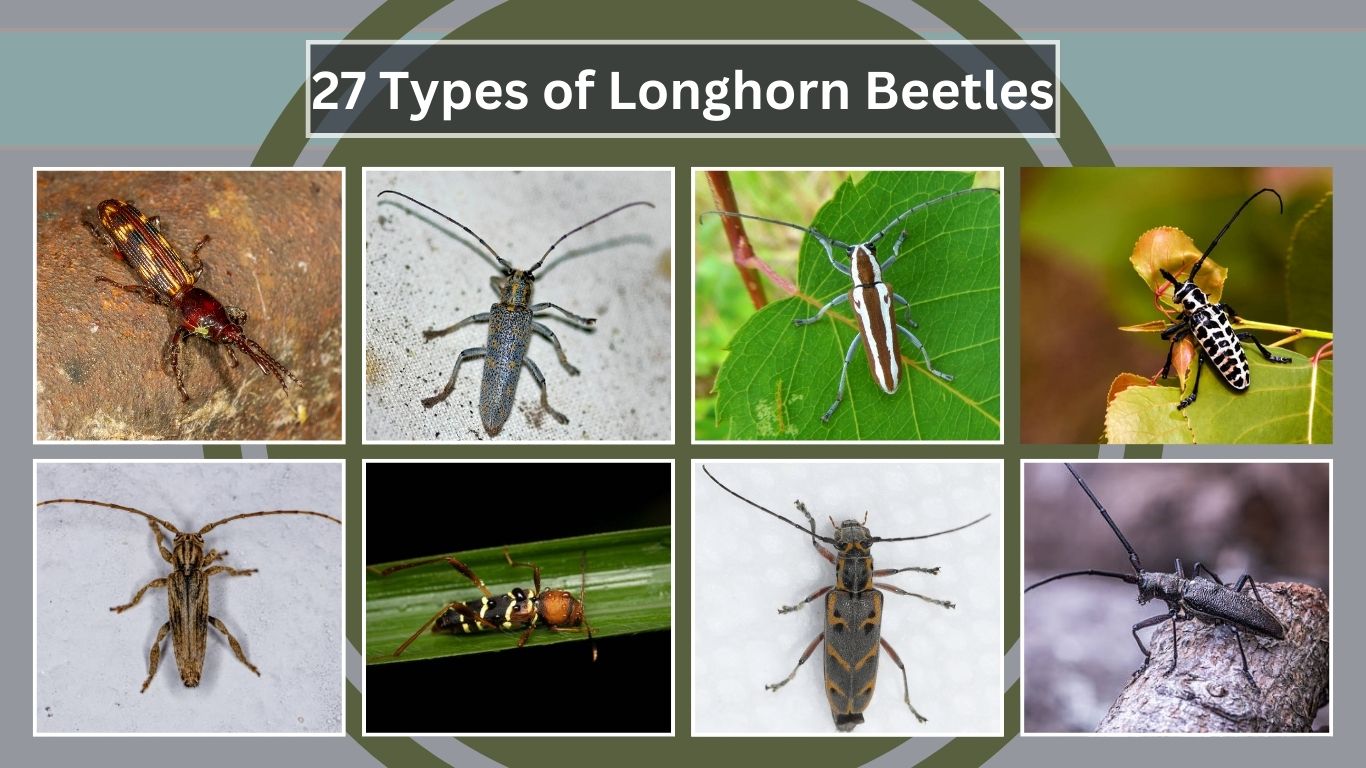
Longhorn beetles (family Cerambycidae) are a diverse group of insects recognized for their elongated bodies and extremely long antennae. Found worldwide, they play important roles in forest ecosystems by decomposing weakened or dead wood, though some species are destructive pests of living trees and timber. This list highlights 27 fascinating longhorn beetles, from the notorious Asian longhorned beetle to the striking cottonwood borer, each with unique traits, habitats, and behaviors.
1. Asian Longhorned Beetle (Anoplophora glabripennis)

The Asian longhorned beetle is a highly destructive wood-boring insect that has spread beyond its native range in China and Korea to many countries, including the United States and Europe. Known for its striking appearance and long antennae, this beetle poses a serious threat to hardwood trees such as maples, elms, willows, and birches.
Identification
- Large beetle, ranging from 20–40 mm in length
- Shiny black body with irregular white spots on the wing covers
- Antennae are longer than the body, black with distinct white bands
- Legs often bluish in color
- Larvae are large, creamy-white grubs that tunnel deep into wood
Habitat
This beetle thrives in hardwood forests, city landscapes, and suburban areas where host trees are abundant. It prefers maples but can infest a wide range of hardwoods, making it a threat to both urban and natural ecosystems.
Behavior
Adults emerge in summer and feed on leaves, bark, and twigs, but the most damage is caused by larvae, which bore deep into tree trunks and branches. Their tunneling weakens trees, disrupts nutrient flow, and eventually causes tree death.
Diet
Adults feed on leaves, twigs, and bark, while larvae consume the inner wood of host trees. Their feeding habits make them extremely destructive to hardwood species.
2. Citrus Longhorned Beetle (Anoplophora chinensis)

The citrus longhorned beetle is a close relative of the Asian longhorned beetle and is considered one of the most invasive wood-boring pests worldwide. Originally native to East Asia, it has spread through international trade and is a serious threat to fruit trees, hardwoods, and ornamentals.
Identification
- Body length ranges from 21–37 mm
- Shiny black body with irregular white spots on the elytra (wing covers)
- Very long black-and-white banded antennae, longer than the body
- Legs often tinged with a bluish hue
- Larvae are large, creamy-white grubs that bore into woody tissue
Habitat
This beetle inhabits orchards, parks, and forested regions where citrus and other hardwood trees grow. It is especially harmful in agricultural areas due to its preference for fruit-bearing trees.
Behavior
Females chew small pits in the bark of host trees to lay eggs. Once hatched, the larvae tunnel deep into trunks and branches, weakening or killing the host tree. Their ability to infest a wide variety of species makes eradication efforts very challenging.
Diet
Adults feed on leaves, bark, and small twigs, while larvae bore into and consume the wood of host trees. Their preferred hosts include citrus, maples, mulberries, willows, and poplars.
3. Musk Beetle (Aromia moschata)

The musk beetle is a longhorn beetle native to Europe and Asia, known for the musky scent it releases when handled, which gives the species its name. With its metallic sheen and long antennae, it is one of the more striking beetles found near wetlands and rivers.
Identification
- Medium to large beetle, 15–35 mm in length
- Metallic green, blue, or bronze body with a shiny surface
- Very long antennae, often longer than the body in males
- Emits a strong musky odor when disturbed
- Larvae are creamy-white and bore into willow wood
Habitat
The musk beetle is commonly found in wetlands, along rivers, and in damp woodland areas. It favors habitats with abundant willows, as they are the main host plants for its larvae.
Behavior
Adults are strong fliers and are active during warm summer months. They are diurnal and are often seen basking on leaves or tree bark. When threatened, they release a distinct musky smell to deter predators.
Diet
Adults feed mainly on willow leaves, stems, and bark. Larvae develop inside willow trunks and branches, tunneling through the wood as they mature.
4. Timberman Beetle (Acanthocinus aedilis)

The timberman beetle is a longhorn beetle commonly found across Europe and parts of Asia. It is particularly well known in coniferous forests, where it plays an important ecological role in breaking down weakened or dead trees. Its long antennae and cryptic coloring help it blend in with tree bark.
Identification
- Medium-sized beetle, 12–20 mm in length
- Body elongated and mottled gray-brown, resembling tree bark
- Extremely long antennae, 2–3 times the body length in males
- Flattened body, which helps it stay close to tree bark
- Larvae are pale, legless grubs that bore into wood
Habitat
This beetle thrives in coniferous forests, especially where pine and spruce are present. It prefers dead or weakened trees, as well as recently felled logs, making it common in lumberyards and forest edges.
Behavior
Timberman beetles are most active in spring and early summer. Adults are strong fliers, often found resting on pine bark. Unlike some invasive relatives, they usually infest weakened trees rather than healthy ones, playing a role in forest decomposition.
Diet
Adults feed on pine and spruce bark and twigs, while larvae bore into the inner wood of conifers. They help recycle nutrients back into the soil by decomposing dead wood.
5. Red Milkweed Beetle (Tetraopes tetrophthalmus)

The red milkweed beetle is a brightly colored longhorn beetle native to North America. It is commonly seen in summer on milkweed plants, which serve as both its food source and breeding site. Its vivid red and black coloration is a warning signal to predators of its toxic diet.
Identification
- Medium-sized beetle, 7–15 mm in length
- Bright red or orange body with several distinct black spots on the wing covers
- Long black antennae that appear to split each eye, giving it a “four-eyed” look
- Larvae are pale grubs that develop within milkweed roots
Habitat
This beetle is found in meadows, fields, and gardens across North America, wherever milkweed plants are abundant. It is closely associated with open sunny areas that support its host plants.
Behavior
Red milkweed beetles are diurnal and can often be seen feeding in groups on milkweed stems and leaves. They rely on chemical defenses from milkweed toxins to deter predators, making them less vulnerable to birds and other insectivores.
Diet
Adults and larvae both feed exclusively on milkweed. Adults consume leaves and stems, while larvae bore into and feed on the roots, completing their life cycle underground before emerging as adults.
6. Pine Sawyer Beetle (Monochamus galloprovincialis)

The pine sawyer beetle is a widespread longhorn beetle found across Europe, Asia, and parts of North Africa. It is closely associated with pine trees and is recognized as a serious forestry pest, partly due to its role as a vector of the pinewood nematode, which causes pine wilt disease.
Identification
- Large beetle, 10–28 mm in length
- Body elongated, dark brown to black, often with grayish or mottled patterns
- Extremely long antennae, especially in males, often twice the body length
- Strong mandibles adapted for chewing bark and wood
- Larvae are creamy-white grubs that tunnel deep into pine wood
Habitat
This beetle thrives in pine forests, plantations, and lumber storage areas. It prefers stressed, dying, or freshly felled pines, making it a common pest in forestry and timber industries.
Behavior
Adults emerge in summer and are strong fliers, dispersing widely to find host trees. They are attracted to weakened pines for egg-laying, while larvae bore deep tunnels inside trunks and branches. Their presence accelerates tree decline and spreads pathogens.
Diet
Adults feed on pine bark, twigs, and needles, while larvae feed inside the wood, causing structural damage. Their feeding behavior combined with their role as nematode carriers makes them particularly harmful.
7. Northeastern Pine Sawyer (Monochamus notatus)

The northeastern pine sawyer is a longhorn beetle native to North America, commonly associated with coniferous forests. Although similar in appearance to other sawyer beetles, it plays an important role in breaking down weakened or dying pines, aiding forest recycling.
Identification
- Large beetle, 15–25 mm long
- Body dark brown to black with scattered gray or whitish hairs
- Antennae very long, often 1.5–2 times the body length in males
- Elytra sometimes show faint mottled or speckled patterns
- Larvae are pale, legless grubs that bore into pine wood
Habitat
This species is primarily found in northeastern parts of North America, especially in pine and spruce forests. It prefers stressed, dead, or recently felled conifers.
Behavior
Adults emerge in late spring through summer and are strong fliers. They lay eggs in the bark of weakened trees, where larvae develop inside, creating long tunnels. Though not as harmful to healthy trees, they are important decomposers in forest ecosystems.
Diet
Adults feed on pine bark and twigs, while larvae tunnel into conifer wood, feeding on the inner layers. Their activity helps return nutrients to the soil, although they may damage timber when infestations occur in felled logs.
8. White-Spotted Sawyer (Monochamus scutellatus)

The white-spotted sawyer is a large longhorn beetle native to North America, easily recognized by the distinctive white spot located near the center of its wing covers. It is one of the most common sawyer beetles and is frequently seen in coniferous forests, especially after wildfires or logging.
Identification
- Large beetle, 12–25 mm long
- Black or dark brown body with a characteristic single white spot at the upper center of the wing covers
- Antennae very long, often longer than the body, with alternating light and dark segments
- Body may be covered with fine golden or gray hairs
- Larvae are creamy-white wood borers
Habitat
This beetle is widespread across Canada and the northern United States. It thrives in conifer forests, especially where spruce, fir, and pine dominate. It is often abundant in recently burned or cut forests.
Behavior
Adults are strong fliers and are attracted to freshly cut logs and dead or dying conifers. Females lay eggs in the bark, and larvae tunnel into the wood. They are often among the first colonizers of disturbed forest areas, playing a role in decomposition.
Diet
Adults feed on bark and twigs of conifers, while larvae bore into and consume the inner wood of spruce, pine, and fir trees. Although not usually harmful to healthy trees, they can cause damage to stored timber.
9. Brown Prionid Beetle (Orthosoma brunneum)

The brown prionid beetle is one of the larger longhorn beetles in North America, commonly found in wooded areas and often attracted to lights at night. Though its size and strong mandibles make it look intimidating, it primarily targets weakened or decaying wood rather than healthy trees.
Identification
- Large beetle, 25–45 mm in length
- Elongated, reddish-brown to dark brown body
- Antennae long but not exceeding the body length
- Strong mandibles with a robust head and thorax
- Larvae are large, white, C-shaped grubs that tunnel inside wood
Habitat
This beetle is widespread across eastern North America. It is commonly found in hardwood forests, wooded areas, and occasionally near human dwellings where firewood or decaying logs are stored.
Behavior
Adults are nocturnal and strongly attracted to lights during summer months. They are less commonly seen during the day, as they hide under logs or tree bark. Larvae develop inside rotting wood, sometimes taking several years to mature.
Diet
Adults may feed lightly on plant material but are not significant leaf feeders. The larvae feed on decaying or weakened wood of hardwood trees, helping recycle nutrients back into the ecosystem.
10. Hardwood Stump Borer (Mallodon dasystomus)

The hardwood stump borer is one of the largest longhorn beetles in North America, often striking in appearance due to its size and powerful mandibles. Though it looks intimidating, it mainly infests decaying wood and plays an important role in forest decomposition.
Identification
- Very large beetle, 30–60 mm in length
- Body robust, dark brown to nearly black in color
- Strong, prominent mandibles capable of delivering a painful pinch
- Antennae medium to long, though shorter than the body length
- Larvae are thick, creamy-white grubs that bore into hardwood stumps and logs
Habitat
This species inhabits hardwood forests, particularly in the southeastern United States. It is commonly found in old stumps, rotting logs, and decayed hardwood trees, especially oak and hickory.
Behavior
Adults are nocturnal and strongly attracted to lights at night, which makes them more visible to humans during summer. Larvae live deep inside stumps or fallen logs, where they can take several years to complete development.
Diet
Adults are not heavy feeders and may nibble on bark or sap, but the larvae are the main wood consumers. They bore into decaying hardwoods, helping break down and recycle dead trees into the ecosystem.
11. Sawyer Beetle (Monochamus alternatus)

The sawyer beetle (Monochamus alternatus) is a well-known longhorn beetle in East Asia, notorious for being a major vector of the pinewood nematode, which causes pine wilt disease. This makes it a significant forestry pest, especially in China and Japan, where it affects large areas of pine forest.
Identification
- Large beetle, 12–25 mm long
- Body dark brown to black with grayish mottled patterns
- Very long antennae, often longer than the body in males
- Elytra rough in texture with scattered pale hairs
- Larvae are pale, legless grubs that tunnel deep into pine wood
Habitat
This beetle thrives in pine forests and plantations, particularly in warm temperate regions of East Asia. It is often found in weakened, dying, or freshly felled pine trees.
Behavior
Adults emerge from late spring through summer and disperse widely in search of host trees. They are strong fliers and lay eggs in the bark of pines. The larvae bore into the wood, creating tunnels that weaken trees. Their association with the pinewood nematode makes them especially destructive.
Diet
Adults feed on pine bark and twigs, while larvae consume the inner wood of pines. Their feeding weakens host trees, while nematode transmission often kills them outright.
12. Locust Borer (Megacyllene robiniae)

The locust borer is a strikingly patterned longhorn beetle native to North America. It is particularly associated with black locust trees (Robinia pseudoacacia), where its larvae bore into the wood. While beautiful in appearance, it is considered a serious pest because it weakens and damages its host trees.
Identification
- Medium-sized beetle, 12–20 mm long
- Black body with bold, irregular yellow bands across the wing covers
- A distinct yellow “W”-shaped band near the middle of the elytra
- Long, slender antennae, dark in color
- Larvae are pale grubs that bore into locust tree trunks and branches
Habitat
This beetle is found across North America, especially in areas where black locust trees are common. It is frequently seen in meadows, roadsides, and woodlands during late summer and fall.
Behavior
Adults are most active in late summer to autumn and are often seen feeding on goldenrod flowers. Females lay eggs in the bark of black locust trees, and larvae tunnel inside, weakening the tree. Infested trees are more susceptible to disease and breakage.
Diet
Adults feed on pollen and nectar, particularly from goldenrod flowers. Larvae, however, feed inside the wood of black locust trees, making them destructive pests to this species.
13. Banded Alder Borer (Rosalia funebris)

The banded alder borer is one of the most visually striking longhorn beetles in North America, easily recognized by its bold black and white patterns. Despite its intimidating appearance, it is harmless to healthy trees and usually infests only weakened or dead wood.
Identification
- Large beetle, 15–25 mm long
- White or pale bluish body with three broad black bands across the wing covers
- Long, black-and-white banded antennae, often longer than the body
- Elytra smooth with a glossy sheen
- Larvae are pale, elongated grubs that tunnel into decayed wood
Habitat
This beetle is found along the western regions of North America, from Alaska down to Mexico. It is commonly associated with alder trees but also infests ash, willow, and other hardwoods in riparian areas and woodlands.
Behavior
Adults are often active in spring and summer, frequently attracted to lights at night. They are not aggressive and play an ecological role in breaking down decaying wood. The larvae live inside rotting logs and stumps until they mature.
Diet
Adults feed lightly on bark and nectar but are not considered significant plant feeders. Larvae feed inside decaying alder and other hardwoods, aiding in decomposition rather than damaging living trees.
14. Elderberry Longhorn Beetle (Desmocerus palliatus)

The elderberry longhorn beetle is a colorful North American species closely tied to elderberry plants, which serve as both its habitat and food source. Its vivid markings and preference for moist habitats make it a noticeable insect during summer months.
Identification
- Medium-sized beetle, 12–25 mm long
- Black body with a metallic blue or green sheen
- Bright orange or yellow band across the wing covers, forming a striking contrast
- Long, black antennae, about the same length as the body
- Larvae are creamy-white grubs that bore into elderberry stems and roots
Habitat
This beetle is found in moist lowlands, forest edges, and riparian zones across eastern and central North America. It is almost always associated with elderberry shrubs, which are essential for its reproduction.
Behavior
Adults are diurnal and active during midsummer, often seen crawling or flying around elderberry plants. They are not aggressive and spend much of their life cycle hidden, with larvae tunneling inside elderberry stems.
Diet
Adults feed on foliage and flowers of elderberry plants, while larvae bore into and consume the pith and roots of elderberry shrubs, which can weaken or kill the host plant over time.
15. Flower Longhorn Beetle (Strangalia luteicornis)

The flower longhorn beetle is a slender, brightly colored species commonly seen visiting flowers in summer. Unlike many wood-boring beetles, the adults of this species spend much of their time on blossoms, where they act as incidental pollinators.
Identification
- Medium-sized beetle, 8–15 mm long
- Elongated body with yellow wing covers marked by irregular black patches
- Long, slender black antennae, often longer than the body
- Thorax and legs often reddish or yellowish in color
- Larvae are white, cylindrical grubs that develop in decaying wood
Habitat
This beetle inhabits meadows, forest edges, and gardens across eastern North America. It is strongly associated with flowering plants during summer months but depends on decayed hardwood logs for larval development.
Behavior
Adults are active during the day and are frequently seen crawling across or flying between flowers. They are especially attracted to goldenrod and other composite flowers, where they feed and mate.
Diet
Adults feed on pollen and nectar, often acting as pollinators while visiting flowers. Larvae develop in rotting logs and stumps of hardwood trees, consuming decaying plant material.
16. Black Pine Sawyer (Monochamus carolinensis)

The black pine sawyer is a large longhorn beetle native to North America, commonly found in pine forests. It is closely related to other sawyer beetles and is known for its role in breaking down weakened or freshly felled pine trees.
Identification
- Large beetle, 15–28 mm long
- Dark brown to nearly black elongated body with faint mottled gray markings
- Antennae very long, often 1.5–2 times the body length in males
- Elytra coarse and slightly ridged
- Larvae are pale, legless grubs that tunnel into pine wood
Habitat
This beetle inhabits coniferous forests throughout eastern and southern North America. It prefers stressed, dying, or cut pine trees, making it a common species in lumberyards and recently logged areas.
Behavior
Adults are active from late spring through summer and are strong fliers. Females lay eggs beneath pine bark, and larvae bore into the wood, leaving extensive galleries. Though rarely a threat to healthy trees, it can be a nuisance in timber production.
Diet
Adults feed on pine bark and twigs, while larvae consume the inner wood of conifers. Their activity helps in the decomposition of dead pines, though they can damage stored timber.
17. Spotted Pine Sawyer (Monochamus clamator)

The spotted pine sawyer is a North American longhorn beetle primarily associated with conifer forests in the western United States. It is easily recognized by its mottled patterns and very long antennae. Like other sawyers, it plays a role in decomposing weakened or dead trees.
Identification
- Large beetle, 18–28 mm long
- Dark brown to black body with numerous irregular white or gray spots on the wing covers
- Antennae extremely long, often 1.5–2 times body length in males
- Elytra rough in texture with pale patches giving a mottled appearance
- Larvae are creamy-white, legless grubs that bore into pine wood
Habitat
This beetle is found in western North America, especially in mountainous regions with coniferous forests. It prefers pine, fir, and spruce trees that are stressed, dying, or freshly cut.
Behavior
Adults are most active in summer and are strong fliers. Females lay eggs in pine bark, and larvae tunnel deep into the wood, creating extensive galleries. They are often among the first insects to colonize recently felled or fire-damaged conifers.
Diet
Adults feed on bark and twigs of conifer trees, while larvae bore into the wood of pines and firs, accelerating tree decay. Though not a threat to healthy trees, they may damage logs in lumber production.
18. Flat-Faced Longhorn Beetle (Graphisurus fasciatus)

The flat-faced longhorn beetle is a North American species often encountered on hardwood trees. It is named for its distinctive flattened head and patterned body. While not as destructive as some relatives, it contributes to the breakdown of weakened or dead trees.
Identification
- Medium-sized beetle, 10–20 mm long
- Body grayish to brown with mottled bands and patches resembling tree bark
- Flattened head and thorax, giving it a distinctive profile
- Long antennae, often equal to or longer than the body
- Larvae are pale grubs that tunnel into hardwood logs and branches
Habitat
This species is found across eastern North America, primarily in deciduous forests. It prefers weakened, dying, or fallen hardwood trees, especially oak, hickory, and maple.
Behavior
Adults are active during the summer, usually seen resting on tree bark where their cryptic coloring provides camouflage. Females lay eggs in cracks of dead or stressed wood, where larvae develop over one or more years.
Diet
Adults feed on bark and twigs of hardwoods, while larvae bore into the wood, aiding in the decomposition of fallen logs and stumps. They are beneficial recyclers in forest ecosystems.
19. American Longhorn Beetle (Hylotrupes bajulus)

The American longhorn beetle, also known as the old house borer, is a wood-boring species notorious for damaging structural timber. Although native to Europe, it has spread to many regions, including North America, where it infests seasoned softwood used in buildings.
Identification
- Medium to large beetle, 8–25 mm long
- Elongated, dark brown to black body with fine grayish hairs
- Elytra often marked with two lighter gray patches near the center
- Antennae moderately long, usually about half the body length
- Larvae are long, cream-colored grubs that bore into dry wood
Habitat
This beetle prefers human-made structures containing seasoned softwood, such as pine and spruce. It is found in homes, warehouses, and lumber storage areas rather than forests.
Behavior
Adults are most active during warm months and are attracted to light. Females lay eggs on rough, unfinished wood surfaces, where larvae burrow deep into the timber. Their development can take several years, making infestations difficult to detect until significant damage occurs.
Diet
Adults feed little or not at all, while larvae consume the interior of seasoned softwood timber. They create long tunnels inside beams, flooring, and furniture, leading to structural weakening over time.
20. Round-Headed Apple Tree Borer (Saperda candida)

The round-headed apple tree borer is a destructive longhorn beetle native to North America, best known for infesting fruit trees. It is a serious pest in orchards, particularly in apple trees, where its larvae weaken and eventually kill young trees.
Identification
- Medium-sized beetle, 12–18 mm long
- Elongated body, dark brown to black with thin white stripes running lengthwise on the wing covers
- Antennae moderately long, about the same length as the body
- Larvae are creamy-white, legless grubs with a round head capsule, giving the species its name
Habitat
This beetle inhabits orchards, gardens, and woodland edges across North America. It is strongly associated with apple trees but also infests related fruit trees such as pear, cherry, and hawthorn.
Behavior
Adults are active from late spring through summer, usually at dusk and night. Females lay eggs in small notches chewed into the bark at the base of host trees. Larvae bore into the wood, tunneling through trunks and roots, which can girdle and kill young trees.
Diet
Adults feed lightly on leaves and bark, but the larvae are the primary feeders. They consume the inner wood of apple and other fruit trees, causing severe damage in orchards.
21. Poplar Borer (Saperda calcarata)

The poplar borer is a longhorn beetle widely distributed across North America and is a serious pest of poplar and aspen trees. Its larvae bore deep into trunks and branches, weakening trees and making them more susceptible to breakage and disease.
Identification
- Large beetle, 15–30 mm long
- Elongated grayish-blue body densely covered with yellowish hairs
- Elytra marked with irregular black spots and blotches, giving a mottled appearance
- Antennae long and slender, typically about the same length as the body
- Larvae are creamy-white, legless grubs that can reach up to 25 mm in length
Habitat
This species primarily inhabits forests, plantations, and riparian zones where poplars, cottonwoods, and aspens grow. It is particularly common in the northern and western United States and southern Canada.
Behavior
Adults emerge in summer and are active during the day, often resting on tree trunks. Females chew through bark to lay eggs, and larvae bore into the wood, creating long tunnels that weaken host trees. Infestations can persist for several years.
Diet
Adults feed lightly on the bark of twigs, but larvae are the main feeders. They consume the woody tissues of poplars and aspens, often causing significant structural damage to the trees.
22. Elm Borer (Saperda tridentata)

The elm borer is a North American longhorn beetle that primarily attacks elm trees. Although not usually fatal by itself, its tunneling activity weakens trees and makes them more vulnerable to diseases such as Dutch elm disease.
Identification
- Medium-sized beetle, 8–15 mm long
- Elongated, brownish body with three pale yellowish stripes running lengthwise on the wing covers
- Antennae moderately long, about the same length as the body
- Distinctive “trident-like” markings on the back, giving the species its name
- Larvae are creamy-white, slender grubs that bore into elm wood
Habitat
This beetle inhabits woodlands, urban parks, and roadside areas where elm trees are common. It is distributed widely across eastern and central North America.
Behavior
Adults are active in summer, often resting on elm trunks and branches. Females lay eggs in bark crevices, and larvae tunnel under the bark and into the sapwood. Their galleries disrupt the flow of water and nutrients in the tree.
Diet
Adults feed on elm twigs and bark, while larvae bore into the wood of elm trees. Heavy infestations weaken trees, especially those already stressed by disease or environmental conditions.
23. Red-Headed Ash Borer (Neoclytus acuminatus)

The red-headed ash borer is a common and widespread longhorn beetle in North America. It is frequently encountered in firewood and lumber piles and is known for its distinctive coloration and swift movements.
Identification
- Medium-sized beetle, 6–18 mm long
- Elongated reddish-brown body with four narrow yellow bands slanting across the wing covers
- Head and thorax usually reddish, giving the species its name
- Long, slender antennae, shorter than the body
- Larvae are cream-colored, slender grubs that tunnel through hardwood
Habitat
This beetle inhabits forests, woodlands, and areas where cut logs and firewood are stored. It commonly infests ash, oak, hickory, and other hardwoods.
Behavior
Adults are very active, fast-moving beetles that can often be seen running across logs and lumber surfaces. They are active in spring and summer, with females laying eggs in bark crevices of stressed or recently felled trees. Larvae bore into the wood, leaving winding tunnels.
Diet
Adults feed on pollen and nectar, frequently visiting flowers. Larvae feed on the inner wood of hardwood trees, especially ash, but also infest other hardwoods, sometimes becoming pests in stored lumber.
24. Cottonwood Borer (Plectrodera scalator)

The cottonwood borer is one of the largest longhorn beetles in North America and is easily recognized by its striking black-and-white pattern. It primarily infests cottonwood and other poplar species, where its larvae bore into the roots and lower trunks.
Identification
- Very large beetle, 25–40 mm long
- Bold black-and-white patterned body and wing covers, resembling marble
- Antennae long, often longer than the body, with alternating black and white segments
- Legs strong and also marked with black-and-white patterns
- Larvae are thick, cream-colored grubs that tunnel into roots and trunks
Habitat
This beetle inhabits floodplains, river valleys, and lowland forests where cottonwoods and poplars grow. It is distributed across central and southern United States.
Behavior
Adults are most active in summer, often seen crawling on host trees or flying short distances. Females chew notches at the base of cottonwood trees to deposit eggs. Larvae bore into roots and the lower trunk, sometimes causing severe structural damage to young trees.
Diet
Adults feed on twigs, bark, and leaves of cottonwood and related trees. Larvae consume woody tissue within the roots and trunk, weakening or killing young trees when infestations are heavy.
25. Hickory Borer (Goes tigrinus)

The hickory borer is a longhorn beetle found in North America, particularly associated with hickory and pecan trees. Its cryptic coloration allows it to blend in with tree bark, making it less noticeable than some of its brightly patterned relatives.
Identification
- Large beetle, 18–35 mm long
- Elongated body, mottled gray, brown, and black, resembling tree bark
- Antennae long, but usually shorter than the body length
- Elytra coarse in texture with irregular dark markings
- Larvae are creamy-white, cylindrical grubs that bore into wood
Habitat
This beetle is commonly found in hardwood forests across eastern North America. It prefers hickory and pecan trees but may also infest other hardwoods.
Behavior
Adults emerge in late spring and summer, often resting on tree trunks where they are well camouflaged. Females deposit eggs on bark, and larvae tunnel deep into the wood, creating galleries that weaken the tree.
Diet
Adults feed lightly on tree bark and sap, while larvae consume the inner wood of hickory, pecan, and related species. Their tunneling can cause economic losses in timber production.
26. Willow Borer (Oberea linearis)

The willow borer is a slender longhorn beetle found across Europe and Asia, strongly associated with willow trees. Unlike many bulky longhorns, it has a narrow body and elongated appearance, which helps it blend with twigs and stems.
Identification
- Medium-sized beetle, 10–20 mm long
- Slender, cylindrical body, usually reddish-brown with a darker head and tips of wing covers
- Antennae long, often equal to or longer than the body
- Elytra smooth, lacking bold patterns
- Larvae are thin, pale grubs that tunnel lengthwise inside twigs and stems
Habitat
This beetle is found in woodlands, riverbanks, and wetlands across Europe and Asia, where willow trees are abundant. It also occasionally infests related plants like poplars.
Behavior
Adults are active in summer, often resting on willow twigs. Females chew small grooves in stems to lay eggs, and larvae develop inside, tunneling along the stems. This weakens branches, sometimes causing dieback.
Diet
Adults feed on leaves and bark of willows, while larvae bore into stems and branches, feeding on the woody tissues. Heavy infestations can damage young willows or reduce their growth.
27. Oak Timberworm (Arrhenodes minutus)

The oak timberworm is a distinctive longhorn beetle native to North America, best known for its elongated snout-like head and destructive boring habits. Despite its name, it is not a true weevil but belongs to the longhorn beetle family.
Identification
- Medium-sized beetle, 15–25 mm long
- Elongated, dark brown to black body with a narrow, extended snout
- Antennae moderately long, shorter than the body
- Elytra smooth and usually uniform in color
- Larvae are long, pale grubs that bore into oak and other hardwoods
Habitat
This beetle is found across eastern North America in hardwood forests, especially where oaks are dominant. It also infests hickory, elm, and other hardwood species.
Behavior
Adults are active during summer and are often found on tree trunks or logs. Females use their long snouts to bore small holes into bark, where they deposit eggs. Larvae then tunnel deep into the wood, sometimes taking several years to mature.
Diet
Adults feed on bark and sap, while larvae consume the woody tissues of oak and related hardwoods. Their boring weakens trees and can cause economic losses in lumber industries.