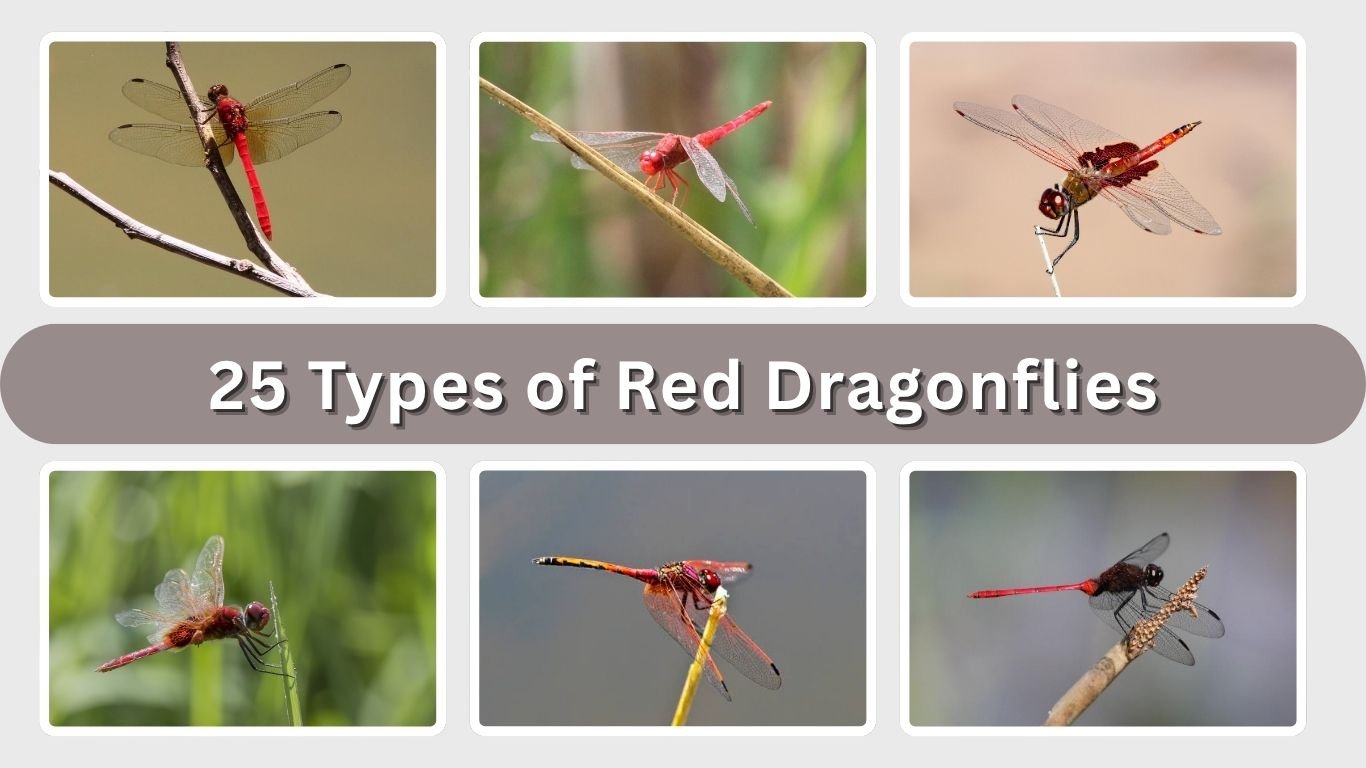
Red dragonflies are among the most eye-catching insects found around ponds, marshes, streams, lakes, and other freshwater habitats. Mature males of many species develop brilliant scarlet, crimson, ruby, or reddish-orange colors, while females are often more yellow, brown, or patterned. Although these dragonflies may look similar at first, each species has its own markings, range, habitat preferences, and behavior. In this guide, we explore 25 types of red dragonflies, including their identification features, habitat and distribution, feeding behavior, lifespan, and life cycle.
1. Scarlet Darter
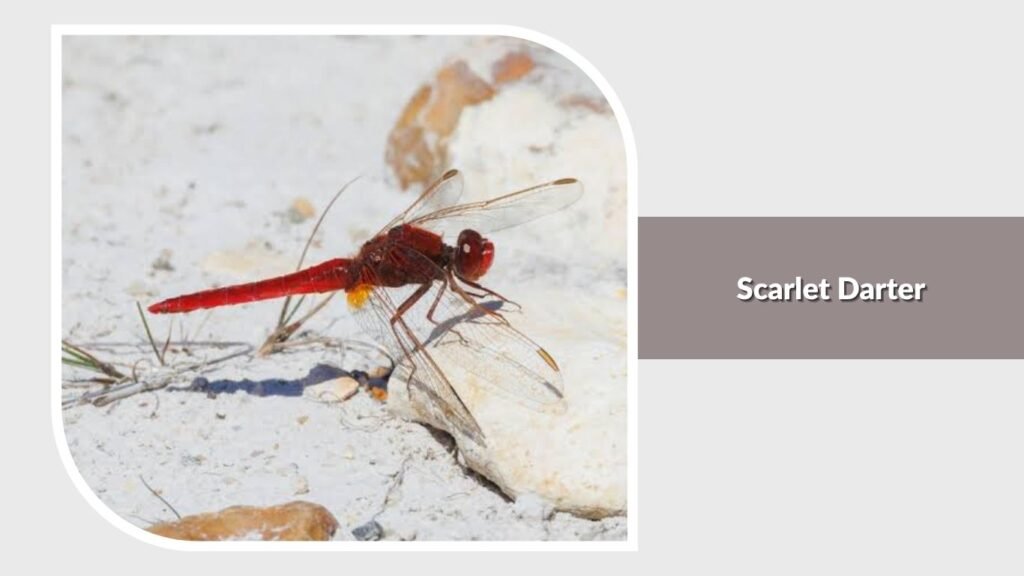
The Scarlet Darter is a striking red dragonfly best known for the intense scarlet coloration of mature males. It is often seen around warm, sunny ponds and slow-moving waters, where males perch prominently and defend small territories. Females are usually more yellowish or brownish, making the sexes look noticeably different.
Identification
- Mature males are bright scarlet-red
- Females are usually yellow-brown or ochre
- Broad, relatively flattened abdomen
- Clear wings with small colored patches near the bases
- Dark legs
- Large reddish-brown compound eyes
- Medium-sized dragonfly with a strong build
Habitat and Distribution
Scarlet Darters prefer warm freshwater habitats such as ponds, lakes, marshes, irrigation channels, and slow-moving streams. They are widespread across southern Europe, North Africa, and large parts of Asia. In warmer regions, they can be particularly common around shallow water with exposed banks and sunny perching areas.
Behavior and Diet
Males frequently perch on exposed stems, rocks, or bare ground and repeatedly return to the same location after short hunting flights. They are active aerial predators that catch mosquitoes, midges, flies, and other small insects while flying. Territorial males may chase rival dragonflies away from preferred breeding sites.
Lifespan and Life Cycle
The Scarlet Darter undergoes incomplete metamorphosis. Females lay eggs in or near water, where aquatic nymphs develop and prey on small aquatic organisms. The nymph passes through multiple molts before climbing out of the water and transforming into an adult. Adults generally survive for several weeks to a few months, while the aquatic stage lasts considerably longer.
2. Ruddy Darter
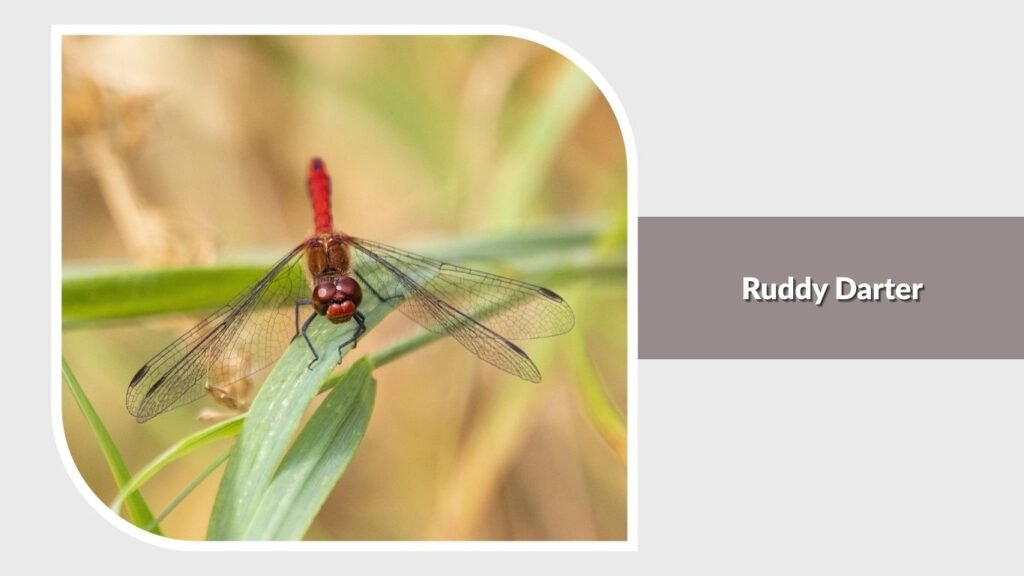
The Ruddy Darter is a compact European dragonfly recognized by the deep red coloration of mature males and the yellow-brown appearance of females. It is particularly associated with shallow, vegetation-rich waters and can often be found resting on reeds, grass, or low vegetation close to breeding sites.
Identification
- Mature males develop a deep blood-red abdomen
- Females are yellowish to brown
- Black legs
- Relatively narrow abdomen
- Reddish face in mature males
- Clear wings with dark wing marks
- Smaller and slimmer than some similar red darters
Habitat and Distribution
Ruddy Darters inhabit ponds, marshes, drainage ditches, shallow lakes, and slow-moving waterways. They are widespread through much of Europe and extend eastward into western Asia. They generally favor sunny wetlands with abundant emergent vegetation and relatively still water.
Behavior and Diet
These dragonflies often hunt from low perches. They make rapid flights to capture mosquitoes, small flies, midges, and other flying insects before returning to vegetation. Males patrol breeding areas and may confront other males that enter their territory. Adults frequently bask in sunny places to raise their body temperature.
Lifespan and Life Cycle
Females deposit eggs over shallow water, often while accompanied by a male. The eggs eventually produce aquatic nymphs that feed on insect larvae and other small aquatic prey. After developing through several molts, mature nymphs leave the water and emerge as winged adults. The adult phase generally occupies only a small portion of the dragonfly’s total lifespan.
3. Red-veined Darter
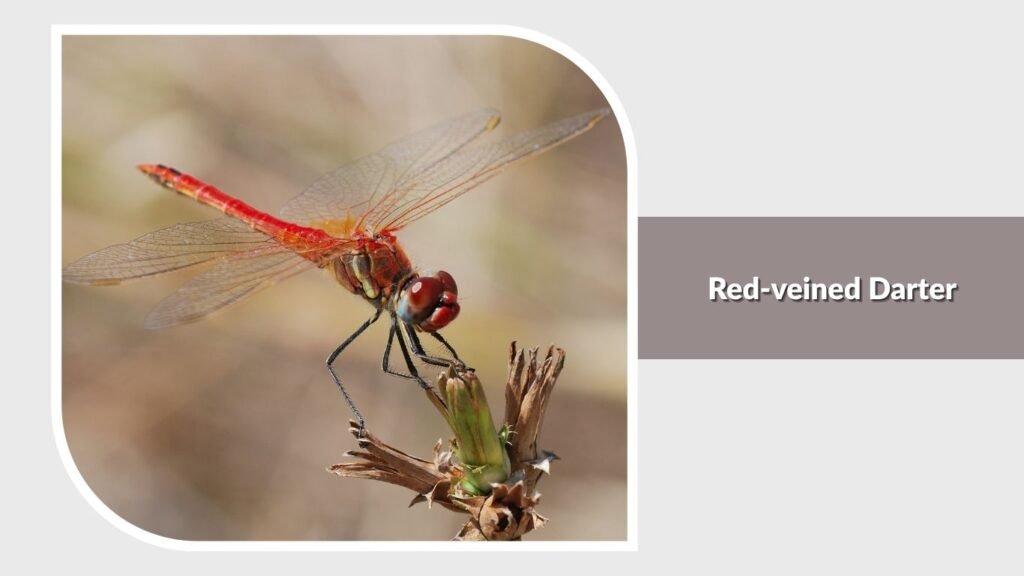
The Red-veined Darter is a colorful dragonfly known for the reddish veins visible in the wings of mature males. It is an active and highly mobile species capable of dispersing considerable distances, sometimes appearing far beyond its regular breeding range during favorable weather.
Identification
- Mature males have a bright red abdomen
- Red or reddish wing veins
- Blue-gray lower portions of the eyes
- Yellowish patches near the hindwing bases
- Females are generally yellow-brown
- Pale stripe may be visible along the thorax
- Medium-sized, streamlined body
Habitat and Distribution
Red-veined Darters favor shallow, warm bodies of water, including temporary pools, ponds, lagoons, reservoirs, and marshes. They occur across Africa, southern Europe, the Middle East, and much of Asia. Migrating or dispersing individuals may also appear farther north during warm summers.
Behavior and Diet
This species is a capable flyer and may travel considerable distances between breeding habitats. Adults hunt mosquitoes, midges, flies, and other small airborne insects. Males often patrol stretches of shoreline and chase rivals, while females spend more time away from water except when mating and laying eggs.
Lifespan and Life Cycle
Eggs are deposited over water, after which aquatic nymphs hatch and begin feeding on small invertebrates. Development can be relatively rapid in warm temporary habitats. Once mature, the nymph climbs above the waterline, sheds its final skin, and emerges as an adult. Adults usually live several weeks, depending on weather, predation, and food availability.
4. Scarlet Skimmer
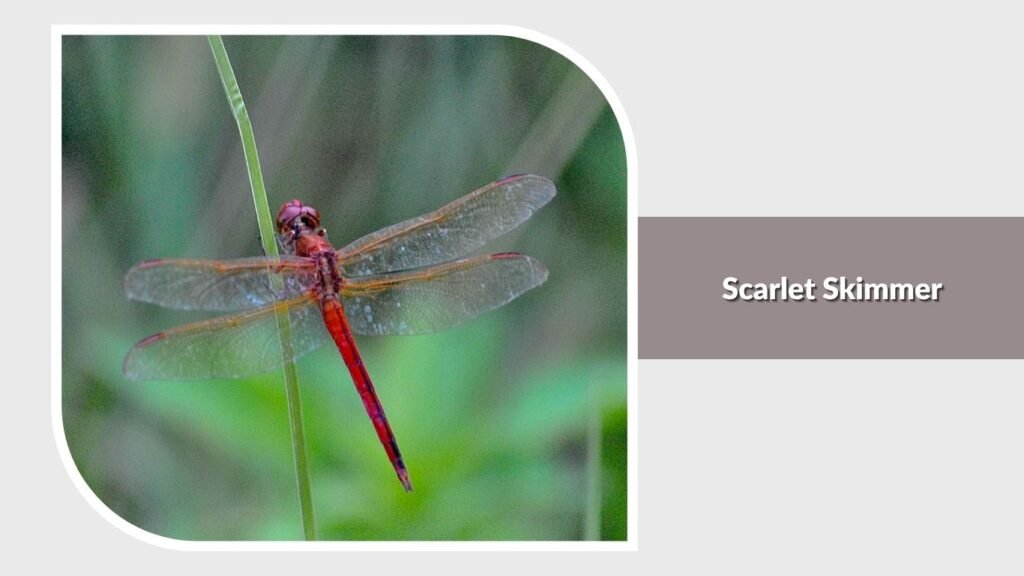
The Scarlet Skimmer is an eye-catching Asian dragonfly whose mature males become almost completely vivid red. It is frequently seen near ponds, streams, rice fields, canals, and other freshwater habitats, where males often perch in open sunny locations.
Identification
- Mature males are intensely red
- Red abdomen, thorax, face, and legs
- Females are typically yellowish or brown
- Broad abdomen
- Clear wings with small dark marks
- Large compound eyes
- Strong sexual color difference
Habitat and Distribution
Scarlet Skimmers occur widely across South, Southeast, and East Asia. They inhabit ponds, wetlands, rice paddies, streams, reservoirs, canals, and other open freshwater environments. They adapt well to disturbed habitats and may occur close to farms, villages, parks, and urban water bodies.
Behavior and Diet
Males often select an exposed perch and repeatedly return to it after catching prey or confronting another dragonfly. Their diet consists mainly of flying insects such as mosquitoes, gnats, small flies, and other tiny arthropods. They are visual predators with fast flight and excellent aerial maneuverability.
Lifespan and Life Cycle
Females lay eggs in freshwater, sometimes touching the surface repeatedly with the abdomen during flight. Aquatic nymphs live among vegetation and bottom debris, feeding on mosquito larvae and other small organisms. After completing development, the nymph emerges from the water and molts into an adult. Adults generally survive for several weeks to a few months.
5. Flame Skimmer
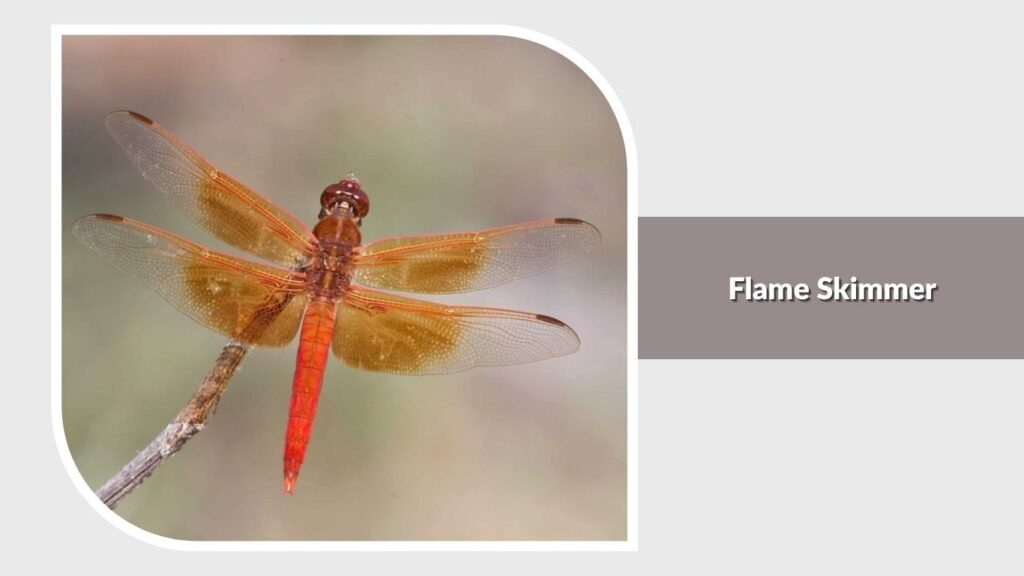
The Flame Skimmer is one of the most conspicuous red-orange dragonflies of western North America. Mature males are intensely orange-red, creating a flame-like appearance when perched in bright sunlight. They are commonly associated with warm ponds, springs, streams, and artificial water features.
Identification
- Males are bright orange to flame-red
- Orange coloration extends into the wing bases
- Females are generally paler yellow-orange
- Broad abdomen
- Reddish-orange face
- Clear outer portions of the wings
- Medium to large skimmer dragonfly
Habitat and Distribution
Flame Skimmers are primarily found in the southwestern United States and Mexico. They favor warm water habitats such as desert ponds, hot springs, slow streams, irrigation channels, and ornamental ponds. They may thrive even in relatively dry landscapes as long as permanent water is available.
Behavior and Diet
Males are strongly territorial and commonly perch on twigs, reeds, fences, and other elevated objects near water. They launch quickly to chase rivals or intercept prey. Their diet includes mosquitoes, flies, midges, and other flying insects. Their strong flight allows them to capture prey directly in the air.
Lifespan and Life Cycle
Eggs develop in freshwater, producing predatory aquatic nymphs. These nymphs remain underwater while feeding and growing through repeated molts. When ready to transform, they climb onto vegetation or another surface and emerge as winged adults. Adults typically live several weeks or longer during favorable warm conditions.
6. Neon Skimmer
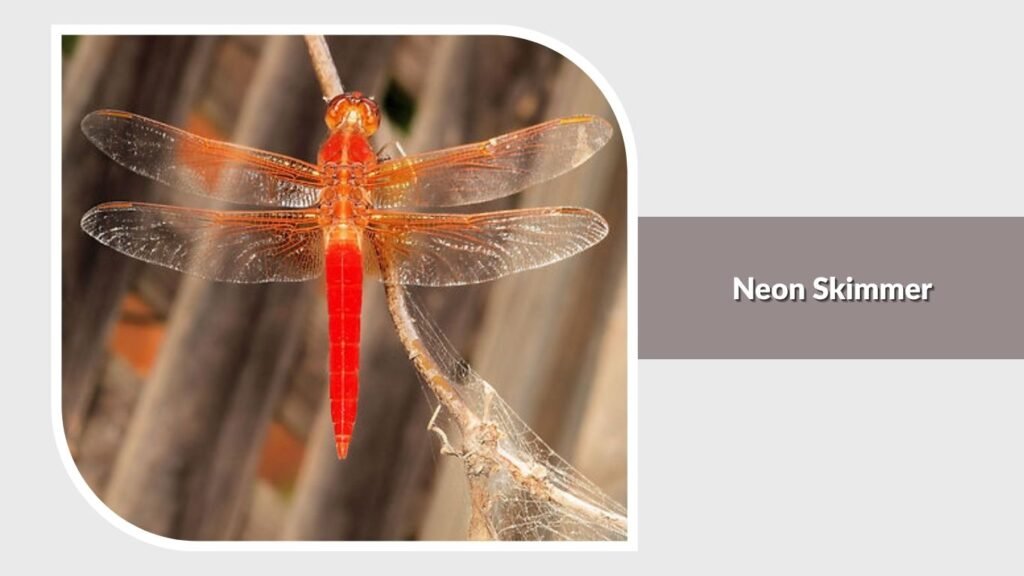
The Neon Skimmer is a brilliant red-pink dragonfly known for the striking coloration of mature males. It is a familiar sight around ponds and slow waterways in parts of North and Central America. Its bright body can make it easy to spot when it rests on exposed vegetation near water.
Identification
- Mature males are vivid reddish-pink
- Thorax and abdomen are brightly colored
- Females are usually more orange-brown
- Clear wings with darker basal coloration
- Large reddish eyes
- Sturdy body
- Often appears brighter than surrounding vegetation
Habitat and Distribution
Neon Skimmers inhabit ponds, marshes, slow streams, canals, and other still or gently moving freshwater environments. They occur primarily in the southern United States, Mexico, Central America, and surrounding regions. Sunny habitats with vegetation and open perches are particularly attractive to adults.
Behavior and Diet
Males are conspicuous perchers and frequently defend territories along the water’s edge. They repeatedly leave a perch to chase other dragonflies or capture insects before returning. Their prey includes mosquitoes, midges, small flies, and other airborne insects that can be intercepted during short, rapid flights.
Lifespan and Life Cycle
Females deposit eggs over water, where the developing nymphs spend their early lives. Nymphs are aquatic predators that consume insect larvae and other small prey. Following a series of molts, the mature nymph leaves the water and completes its final transformation into an adult dragonfly. Adult longevity is usually measured in weeks or a few months.
7. Roseate Skimmer
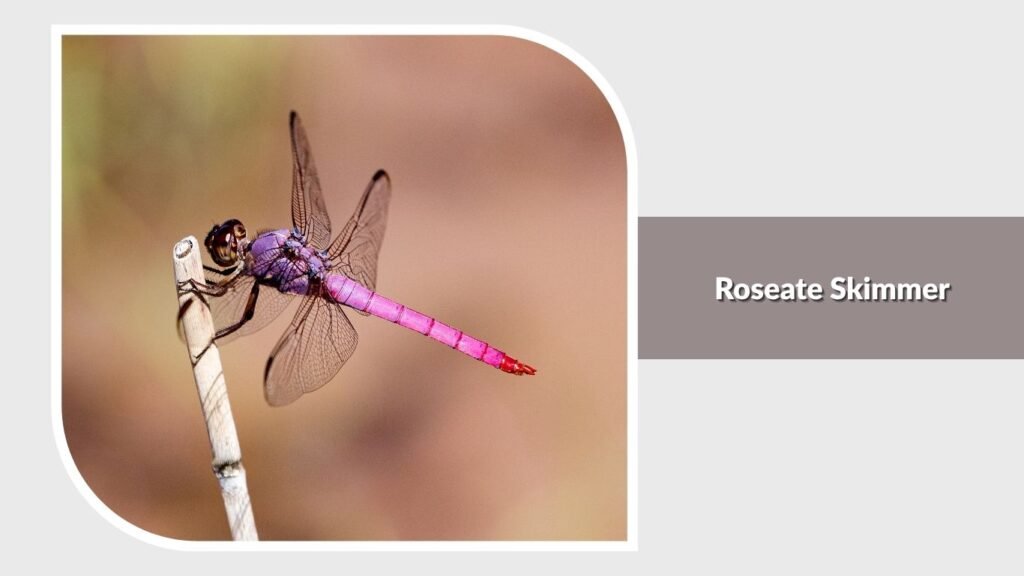
The Roseate Skimmer is easily recognized by the beautiful pink, rose, or violet-red coloration of mature males. It is widespread through warmer areas of the Americas and commonly occupies ponds, ditches, canals, and temporary wetlands. Its unusual coloration makes it one of the most recognizable skimmer dragonflies.
Identification
- Mature males are rose-pink to purple-red
- Thorax may have a violet or lavender tone
- Females are generally golden-brown
- Dark marks near the wing tips
- Long, relatively slender abdomen
- Large reddish or brownish eyes
- Medium-sized skimmer
Habitat and Distribution
Roseate Skimmers occur throughout much of the southern United States, Mexico, Central America, the Caribbean, and South America. They use ponds, marshes, drainage ditches, canals, reservoirs, and temporary pools. They readily occupy newly created or disturbed wetlands.
Behavior and Diet
Adults often perch conspicuously on bare twigs or vegetation. Males defend territories and make repeated flights over the water while searching for females or chasing rivals. Like other dragonflies, they are aerial predators and consume mosquitoes, flies, midges, and many other small flying insects.
Lifespan and Life Cycle
After mating, females deposit eggs over freshwater. Nymphs develop underwater and feed on aquatic insects and other small organisms. Once fully developed, they climb onto vegetation and undergo their final molt. The newly emerged adult initially has softer, duller coloration, which becomes stronger as it matures. Adult life generally lasts several weeks.
8. Cardinal Meadowhawk
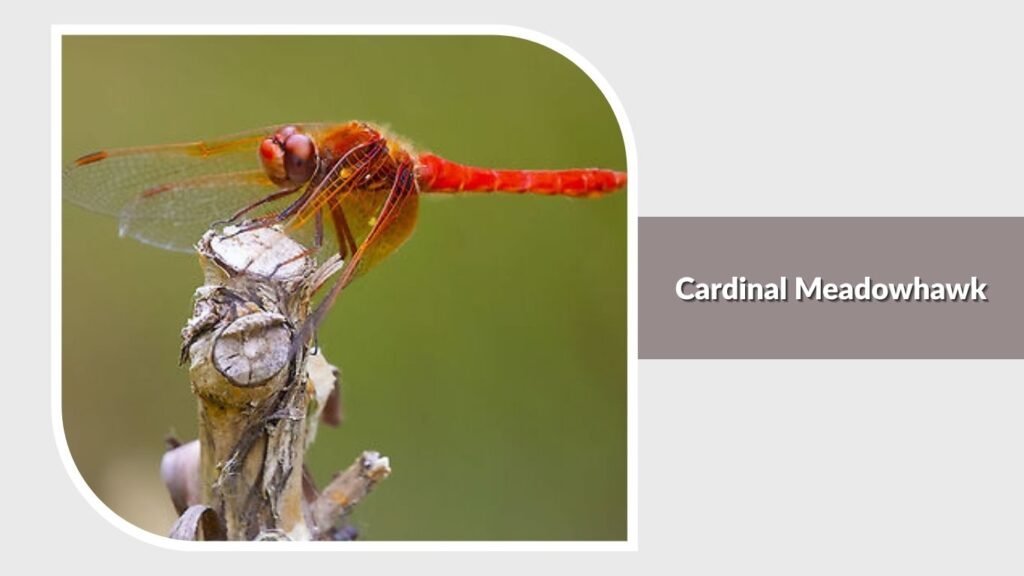
The Cardinal Meadowhawk is a brilliantly colored North American dragonfly named for the rich red body of mature males. It is commonly found around ponds, marshes, springs, and slow streams, particularly in western regions. Males can often be seen perching on reeds or twigs while watching for prey and rivals.
Identification
- Mature males have a vivid cardinal-red abdomen
- Thorax may also become strongly red
- Females are yellow-brown to reddish
- Clear wings
- Dark or reddish wing marks
- Medium-sized body
- Large reddish-brown eyes
Habitat and Distribution
Cardinal Meadowhawks occur mainly in western North America, including parts of the United States and nearby regions. They favor ponds, marshes, slow streams, springs, and wetland edges with reeds and other emergent plants. Adults frequently use nearby shrubs and grasslands for resting and hunting.
Behavior and Diet
Males often defend small territories close to water and choose elevated perches that provide a clear view of passing insects. They feed on mosquitoes, midges, flies, and other small flying insects. Their fast aerial attacks help them capture prey efficiently, while their bright coloration makes mature males particularly conspicuous on sunny days.
Lifespan and Life Cycle
Females lay eggs in or around suitable freshwater habitats. Aquatic nymphs hatch and spend most of their development underwater, where they hunt small aquatic animals. After growing through multiple stages, the mature nymph climbs from the water and transforms into an adult. Adults usually remain active for several weeks, mating, hunting, and reproducing before completing their life cycle.
9. Cherry-faced Meadowhawk
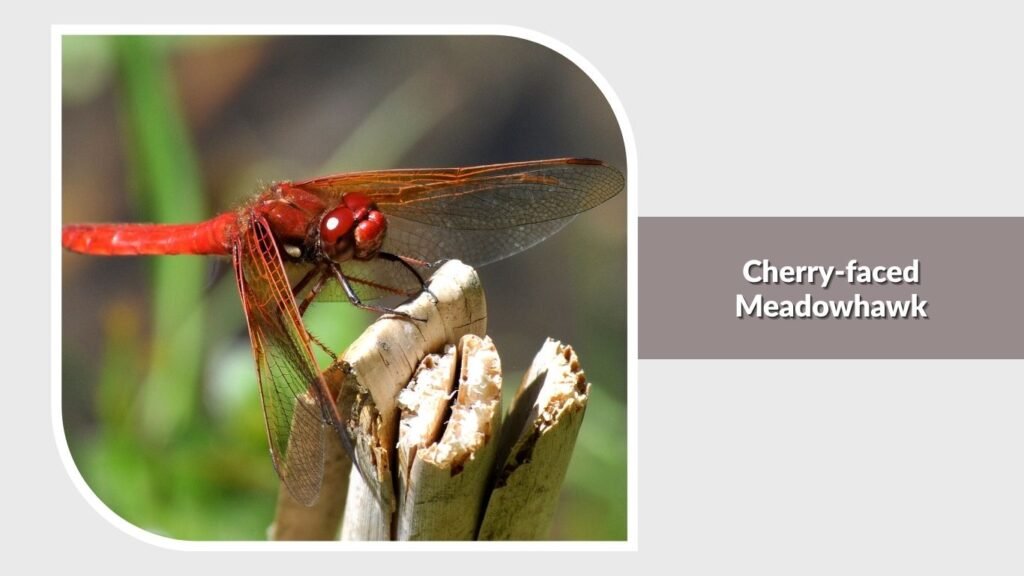
The Cherry-faced Meadowhawk is a bright red dragonfly found across much of North America. Mature males develop a vivid cherry-red face and abdomen, while females and immature males are generally more yellowish or brown. It is commonly seen around ponds, marshes, lakeshores, and slow-moving wetlands where adults perch on low vegetation and watch for prey.
Identification
- Mature males have a cherry-red face
- Bright red abdomen
- Females are yellow-brown to reddish
- Clear wings with small dark marks
- Medium-sized meadowhawk
- Slender abdomen
- Dark legs
- Large reddish-brown eyes
Habitat and Distribution
Cherry-faced Meadowhawks occur widely across Canada and the northern and central United States. They favor ponds, marshes, bogs, shallow lakes, and slow streams with abundant vegetation. Adults may also travel into nearby meadows and woodland edges to hunt.
Behavior and Diet
These dragonflies frequently perch on grasses, reeds, and exposed twigs. From these positions, they launch into the air to intercept mosquitoes, midges, small flies, and other insects. Males may defend areas near breeding water and chase competing dragonflies from favored perches.
Lifespan and Life Cycle
Females deposit eggs around shallow water or damp areas that later flood. Aquatic nymphs hatch and develop underwater, where they feed on small invertebrates. After repeated molts, mature nymphs leave the water and emerge as adults. Adults generally remain active for several weeks during the warmer months.
10. Ruby Meadowhawk
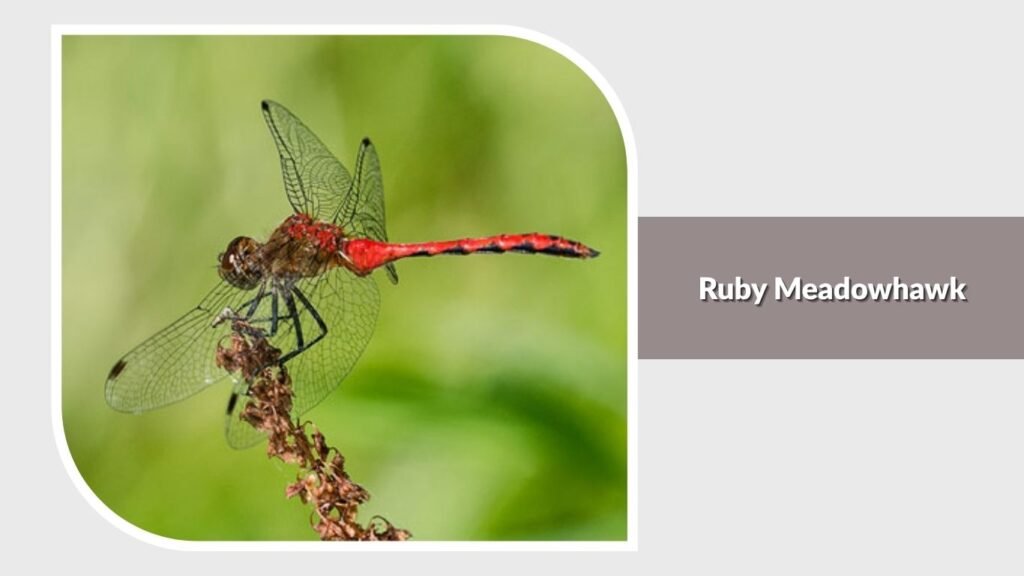
The Ruby Meadowhawk is a striking red dragonfly whose mature males display rich ruby-colored bodies. It is commonly associated with wetlands, ponds, and marshy environments in North America. Like other meadowhawks, it often spends time perched on vegetation rather than constantly patrolling the water.
Identification
- Mature males are deep ruby-red
- Females are yellowish or brown
- Slender abdomen
- Clear wings
- Dark wing marks
- Dark legs
- Large compound eyes
- Medium-sized dragonfly
Habitat and Distribution
Ruby Meadowhawks inhabit ponds, marshes, shallow lakes, bogs, and slow-moving waterways. They occur primarily across northern portions of North America. Adults often move away from the water and use nearby grasslands or woodland edges for feeding and resting.
Behavior and Diet
Adults are sit-and-wait hunters. They choose exposed perches and quickly fly out when small insects pass nearby. Their diet includes mosquitoes, midges, gnats, flies, and other soft-bodied flying insects. Males may become territorial during the breeding season.
Lifespan and Life Cycle
Eggs are laid near or over water. Once hatched, the aquatic nymphs remain underwater and feed on insect larvae and other small prey. They grow through multiple molts before climbing out of the water to complete their transformation. Adults usually live only a few weeks to a few months.
11. Red-veined Meadowhawk
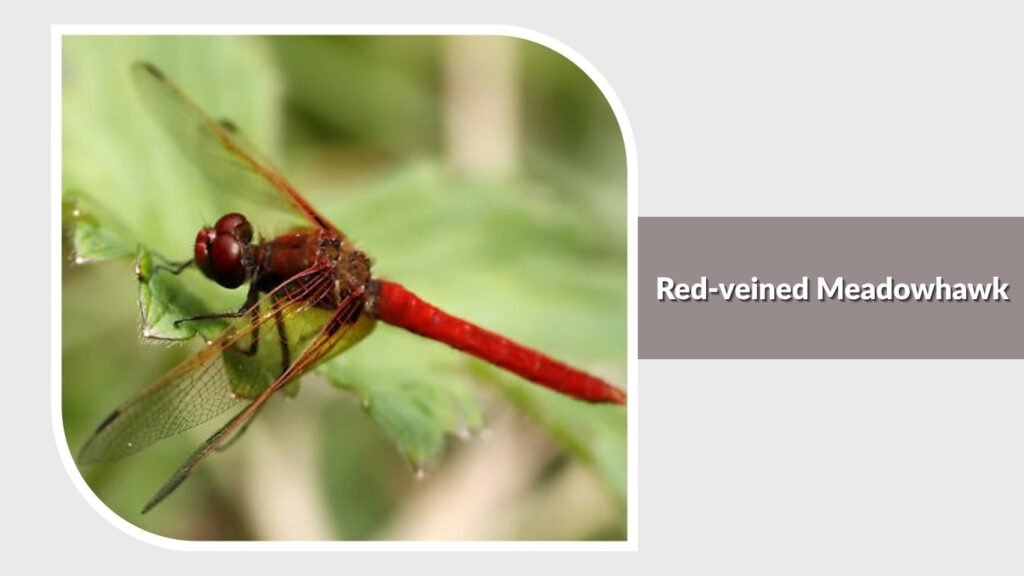
The Red-veined Meadowhawk is a reddish dragonfly known for the warm coloration of mature males and reddish tones that may appear along the wing veins. It occupies shallow freshwater habitats and surrounding vegetation, where adults often rest on stems and low branches.
Identification
- Mature males have a red abdomen
- Reddish coloration may extend into wing veins
- Females are yellow-brown
- Clear wings
- Slender body
- Dark legs
- Reddish face in mature males
- Medium-sized meadowhawk
Habitat and Distribution
Red-veined Meadowhawks are usually associated with ponds, marshes, wet meadows, shallow lakes, and slow streams. They prefer sunny habitats with emergent vegetation that provides resting and mating sites.
Behavior and Diet
Adults spend much of their time perched rather than flying continuously. They capture small insects during quick aerial flights and return to nearby stems or twigs. Mosquitoes, midges, flies, and other tiny flying insects make up much of their diet.
Lifespan and Life Cycle
Females scatter eggs into suitable wet areas. Aquatic nymphs hatch and spend most of their development beneath the water. They hunt mosquito larvae and other aquatic invertebrates before eventually crawling onto vegetation to molt into adults. The adult stage usually lasts several weeks.
12. White-faced Meadowhawk
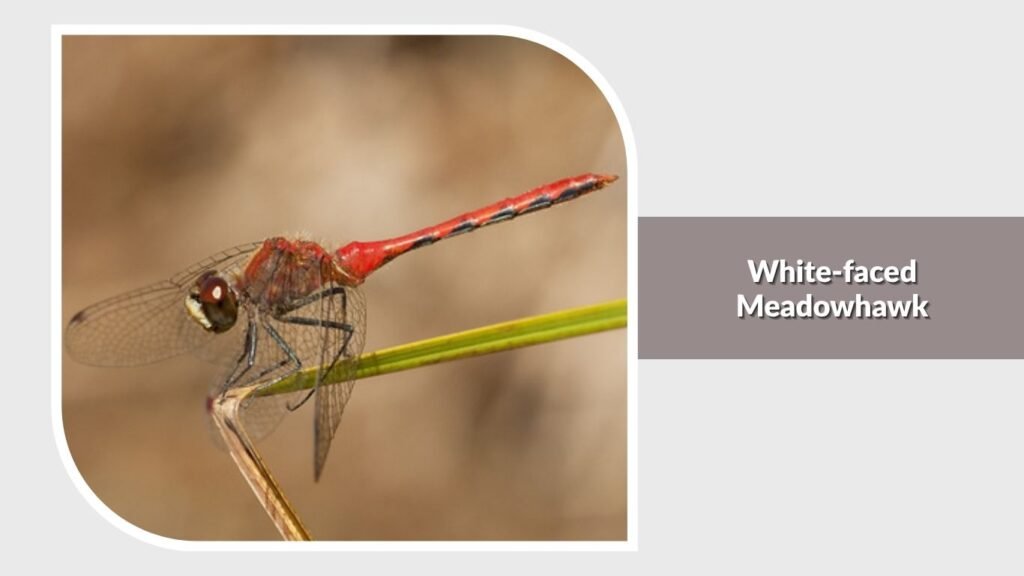
The White-faced Meadowhawk is a distinctive North American dragonfly whose pale face contrasts strongly with the red body of mature males. It is most often found around ponds, bogs, marshes, and wetland edges in cooler regions.
Identification
- Pale or whitish face
- Mature males develop a bright red abdomen
- Females are brownish or yellow
- Black legs
- Dark thorax markings
- Clear wings
- Dark wing spots
- Compact meadowhawk shape
Habitat and Distribution
White-faced Meadowhawks are widespread across much of Canada and the northern United States. They prefer shallow ponds, marshes, bogs, and wetlands with abundant shoreline vegetation. Adults can also be encountered some distance from water in meadows and forest clearings.
Behavior and Diet
These dragonflies often perch low on grass, shrubs, or reeds. They fly out to catch mosquitoes, midges, small flies, and other insects before returning to a nearby resting place. Males may defend small breeding territories near the water.
Lifespan and Life Cycle
Females lay eggs over damp soil or shallow water. The eggs survive until conditions are suitable for hatching. Aquatic nymphs develop underwater and prey on small aquatic organisms. Once mature, they emerge above the waterline and transform into winged adults.
13. Variegated Meadowhawk
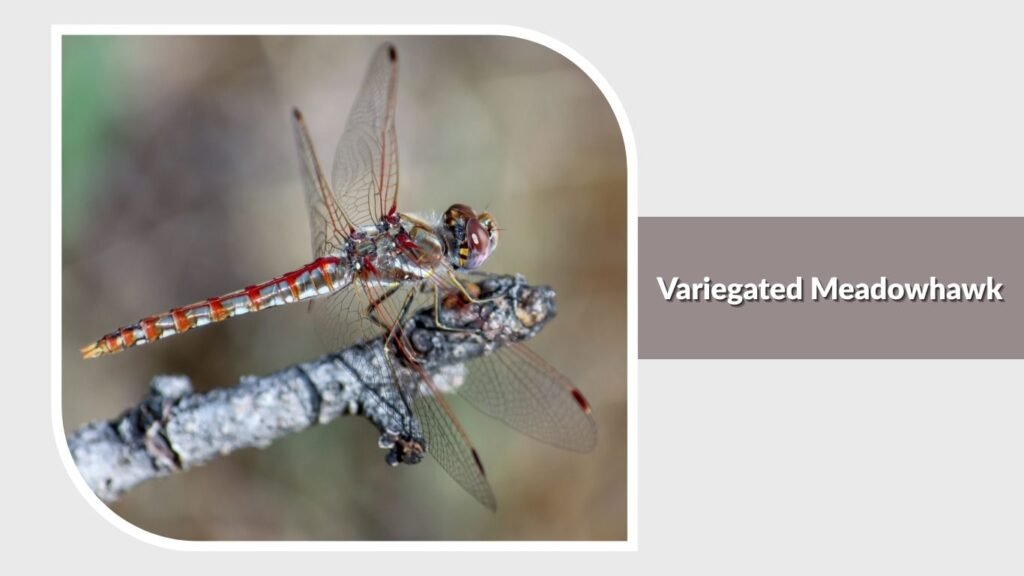
The Variegated Meadowhawk is a colorful and highly mobile dragonfly that combines red, yellow, brown, and dark markings. Mature males develop strong reddish coloration, while females and immature individuals are paler and more patterned. This species is known for long-distance movements and can appear far from its normal breeding areas.
Identification
- Mature males are predominantly red
- Yellow and dark side markings
- Pale spots along the abdomen
- Clear wings with colored patches near the bases
- Females are yellow-brown
- Red or brown eyes
- Medium-sized body
- Distinctive patterned appearance
Habitat and Distribution
Variegated Meadowhawks are widespread across western North America and may travel far beyond their usual range. They breed around ponds, reservoirs, marshes, temporary pools, and slow waterways. Temporary wetlands can be especially important.
Behavior and Diet
They are strong flyers and often migrate or disperse considerable distances. Adults feed on mosquitoes, flies, midges, and other small insects captured in flight. Males may patrol open water or use perches around breeding habitats.
Lifespan and Life Cycle
Females lay eggs over shallow water or wet ground. Nymph development can be relatively rapid, allowing the species to use temporary pools before they dry out. Mature nymphs climb from the water and molt into adults. The adult stage generally lasts several weeks.
14. Autumn Meadowhawk
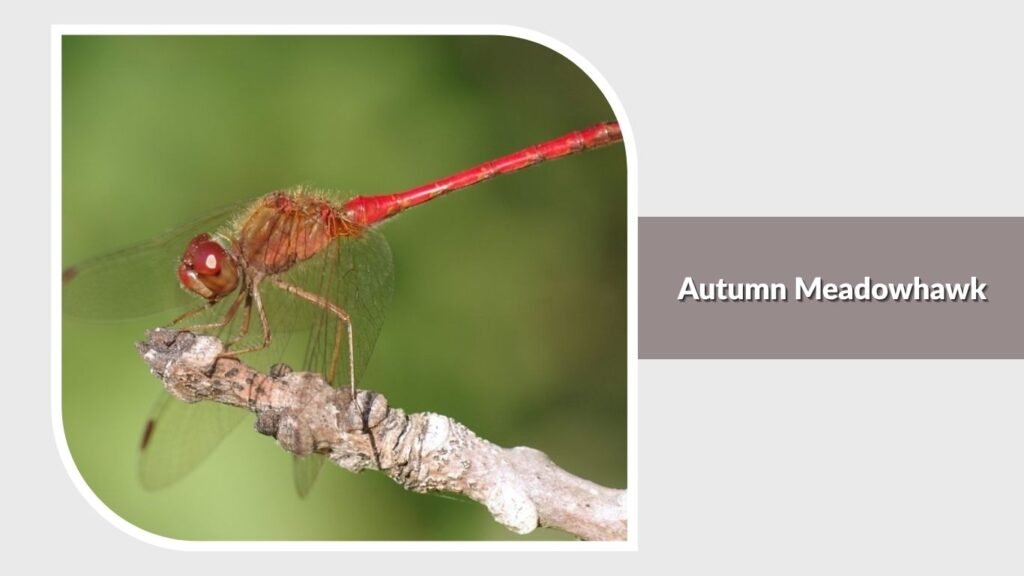
The Autumn Meadowhawk is named for its late-season activity and is often one of the last dragonflies seen before winter. Mature males become bright red, while females remain yellowish or brownish. It is commonly found near ponds and wetlands but may also wander into gardens and open fields.
Identification
- Mature males have a red abdomen
- Females are yellow-brown
- Yellowish legs
- Pale face
- Slender body
- Clear wings
- Small dark wing marks
- Medium-small meadowhawk
Habitat and Distribution
Autumn Meadowhawks occur across much of eastern and central North America. They inhabit ponds, marshes, slow streams, and lake edges. Adults may remain active well into autumn, especially during warm sunny days.
Behavior and Diet
These dragonflies often bask on sun-warmed rocks, leaves, fences, and other surfaces during cooler weather. They feed on mosquitoes, gnats, midges, and other small flying insects. Their ability to remain active late in the season distinguishes them from many other meadowhawks.
Lifespan and Life Cycle
Eggs are usually deposited around shallow water or damp shoreline areas. Aquatic nymphs hatch and develop underwater before emerging during the warmer part of the year. Adults appear later than many other dragonfly species and may survive until the first periods of sustained cold weather.
15. Red Saddlebags
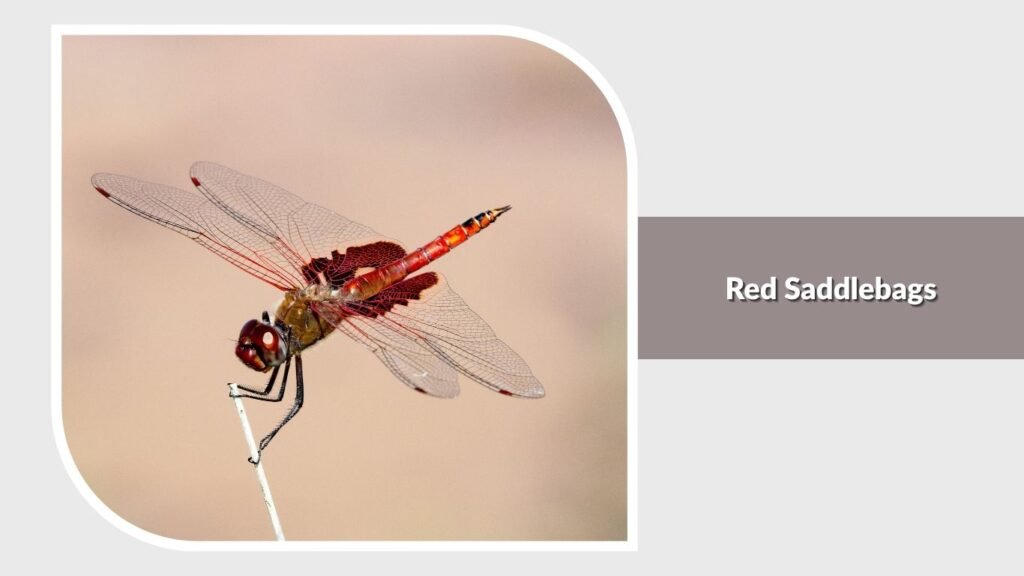
The Red Saddlebags is a fast-flying red dragonfly named for the dark reddish patches near the bases of its hindwings. These colored wing patches resemble saddlebags when the dragonfly is viewed from above. It is a strong flier and is frequently seen over ponds, lakes, marshes, and open fields.
Identification
- Bright red body in mature males
- Large reddish patches on hindwings
- Long, slender abdomen
- Broad wings
- Dark eyes
- Females are more brownish
- Strong, streamlined body
- Distinctive “saddle” wing patches
Habitat and Distribution
Red Saddlebags occur widely across warmer parts of North, Central, and South America. They use ponds, lakes, reservoirs, marshes, and temporary pools for breeding. Adults may also travel far from water during feeding or migration.
Behavior and Diet
Unlike many perch-oriented meadowhawks, Red Saddlebags spend considerable time flying. They patrol over open water and fields while catching mosquitoes, flies, midges, and other aerial insects. They may also join mixed groups of dragonflies during periods of migration.
Lifespan and Life Cycle
Females scatter eggs directly over water during flight. The aquatic nymphs hatch and develop as predators, feeding on insect larvae and other small organisms. After completing development, nymphs climb onto vegetation and emerge as adults. The adult stage usually lasts several weeks to a few months.
16. Carolina Saddlebags
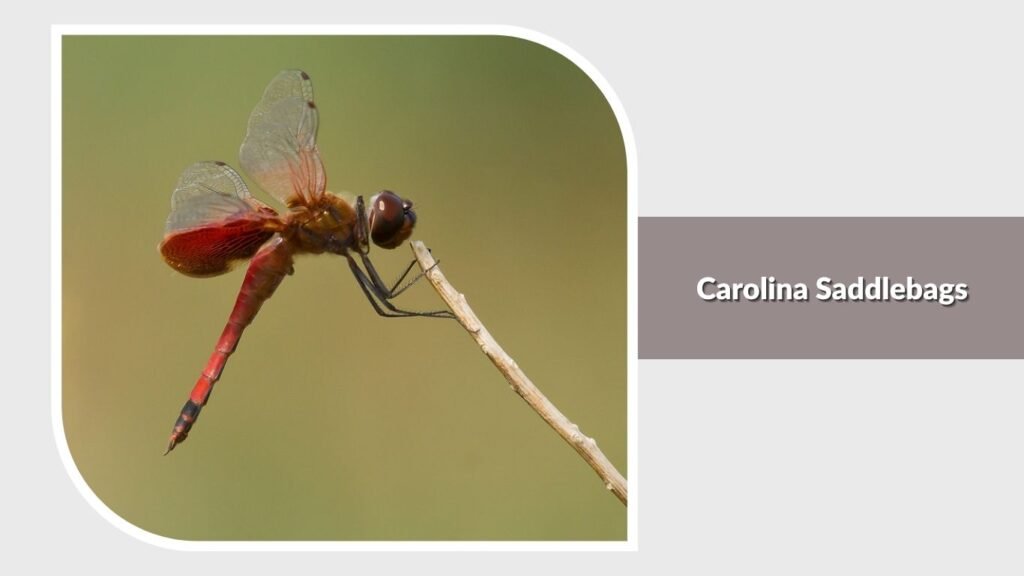
The Carolina Saddlebags is a striking red dragonfly found mainly in eastern North America. Mature males have a vivid red body and large red patches at the bases of the hindwings. Its strong flight and distinctive wing markings make it relatively easy to recognize around ponds and lakes.
Identification
- Mature males have a bright red abdomen
- Large red patches on hindwings
- Reddish-brown thorax
- Dark wing tips may be present
- Females are duller brown or reddish
- Long abdomen
- Broad, powerful wings
- Large dark eyes
Habitat and Distribution
Carolina Saddlebags are found primarily in the eastern and southeastern United States. They favor ponds, lakes, marshes, reservoirs, and slow waterways with open areas for flying. Adults can also be found in fields and clearings away from water.
Behavior and Diet
This species is a powerful aerial hunter. Adults spend long periods flying over open spaces while pursuing mosquitoes, flies, midges, and other small insects. Males may patrol breeding areas repeatedly and can become territorial around suitable water.
Lifespan and Life Cycle
Females lay eggs directly into the water, often while flying with or near a male. The aquatic nymphs live among vegetation and bottom debris, feeding on small aquatic prey. After completing their development, they emerge from the water and transform into adults. Adults remain active through the warm season and usually live several weeks to a few months.
17. Red-mantled Saddlebags
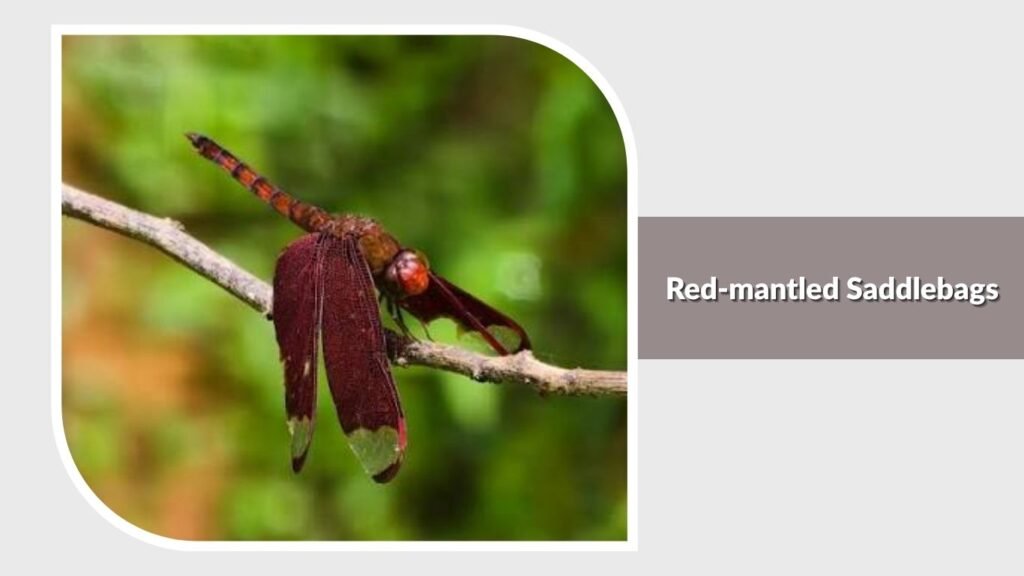
The Red-mantled Saddlebags is a striking red skimmer dragonfly recognized by the dark reddish patches at the bases of its hindwings. These markings resemble a pair of saddlebags when the insect is flying. Mature males are predominantly red, while females tend to be lighter brown or orange. The species is a powerful flier and is widely distributed through North America, Central America, and the Caribbean.
Identification
- Mature males have a bright red body
- Females are generally pale orange or brown
- Dark red patches occur at the hindwing bases
- Transparent wings have reddish veins
- Final abdominal segments are dark
- Long, streamlined abdomen
- Broad hindwings adapted for gliding
- Medium-sized skimmer dragonfly
Habitat and Distribution
Red-mantled Saddlebags use ponds, lakes, marshes, temporary pools, and other open freshwater habitats. Adults frequently travel well away from their breeding sites and can be encountered flying over parks, fields, gardens, and other open areas. Their range extends across much of North and Central America and into the Caribbean.
Behavior and Diet
These dragonflies are exceptionally strong aerial hunters. Instead of spending most of the day resting, they may glide for extended periods while searching for prey. Mosquitoes, midges, flies, and other small winged insects are captured during flight. Their broad hindwings make them particularly effective at sustained gliding.
Lifespan and Life Cycle
Females deposit eggs over suitable freshwater habitats. Aquatic nymphs hatch and spend their developmental period hunting insect larvae and other small aquatic animals. Mature nymphs eventually climb above the water and molt into winged adults. Adults generally spend several weeks to a few months hunting, mating, and reproducing.
18. Scarlet Percher
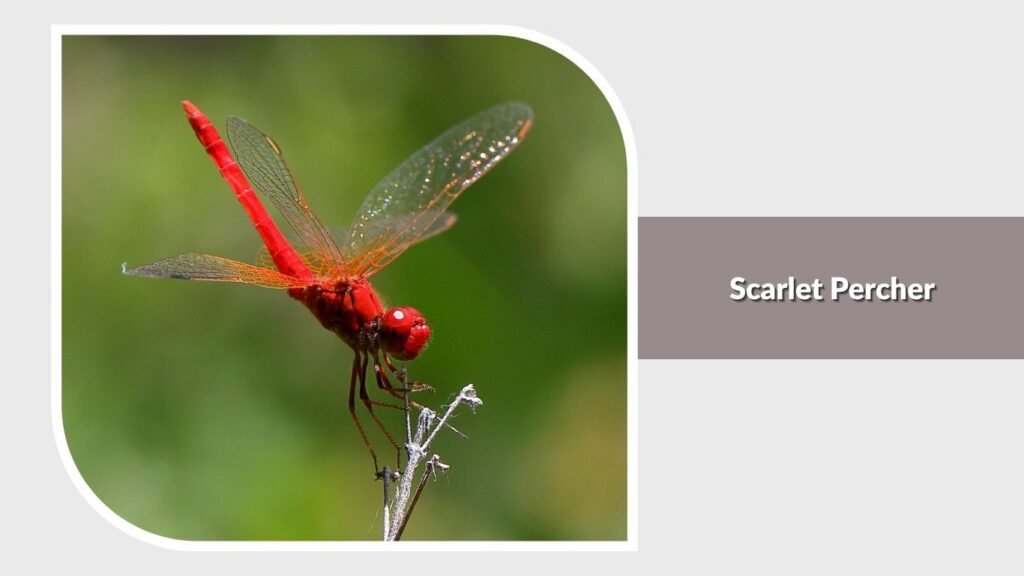
The Scarlet Percher is a small but exceptionally colorful dragonfly. Mature males develop brilliant scarlet-red bodies, while females are usually yellow to ochre. True to its name, the species frequently spends time perched on rocks, twigs, and other exposed surfaces near water. It occurs across much of Australia as well as several islands and regions of the southwest Pacific.
Identification
- Mature males are brilliant scarlet-red
- Females are generally yellow-ochre
- Slender red abdomen in males
- Red compound eyes
- Transparent wings
- Colored patches occur near the wing bases
- Small, compact skimmer body
- Approximately 35 mm long
Habitat and Distribution
Scarlet Perchers favor hot, sunny freshwater habitats. They occur around rivers, streams, ponds, and lakes, particularly where exposed rocks provide convenient perching locations. Their distribution includes most of Australia except Tasmania, as well as Timor, New Guinea, Vanuatu, and New Caledonia.
Behavior and Diet
Adults are classic perch hunters. A Scarlet Percher may sit on a warm rock or twig, launch quickly after passing prey, and then return to the same location. Small flies, mosquitoes, midges, and other airborne insects make up much of the adult diet. Males also chase rivals from preferred breeding territories.
Lifespan and Life Cycle
Eggs are laid in freshwater, where predatory nymphs develop beneath the surface. The nymphs consume small aquatic organisms and grow through repeated molts. Once mature, they climb onto vegetation, rocks, or other surfaces and emerge as adults. The adult stage is relatively short compared with the aquatic part of the life cycle.
19. Red Pondhawk
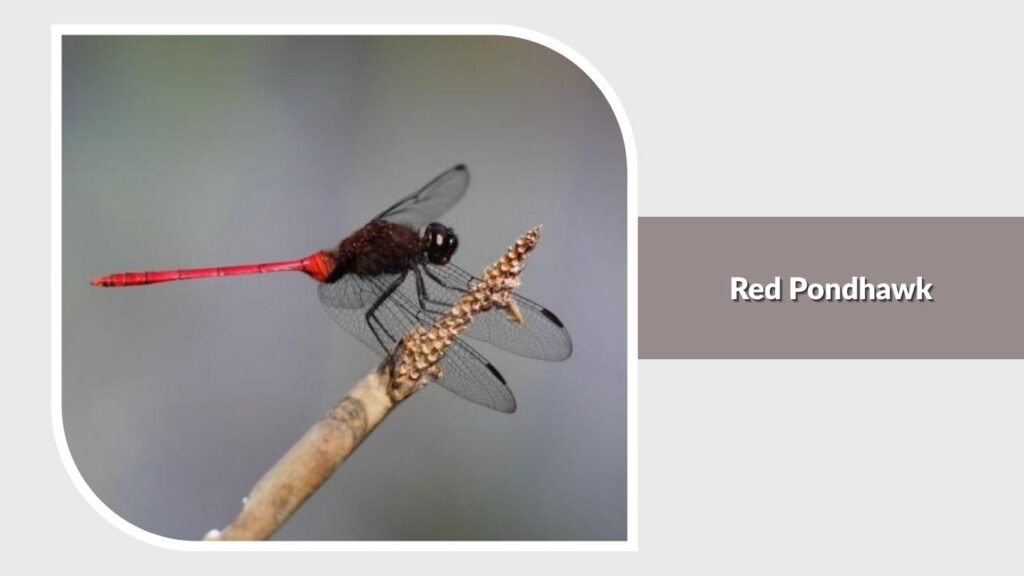
The Red Pondhawk is a tropical American dragonfly belonging to the genus Erythemis. Mature males develop strong reddish coloration, while females are generally more muted. Like other pondhawks, it is a capable predator that hunts around freshwater habitats and nearby vegetation. The species occurs in Central and South America.
Identification
- Mature males have a bright reddish abdomen
- Females are more orange or brownish
- Thorax may appear reddish-brown in males
- Clear, transparent wings
- Dark compound eyes
- Strong legs used for capturing prey
- Robust skimmer-like body
- Medium-sized dragonfly
Habitat and Distribution
Red Pondhawks are associated with tropical freshwater environments such as ponds, marshes, lagoons, wetland edges, and other still or slowly moving waters. Records extend across Central America and much of northern and tropical South America. Vegetation along the shoreline provides resting and hunting areas.
Behavior and Diet
The Red Pondhawk is an active predator capable of capturing mosquitoes, midges, flies, and other insects in the air. Adults may hunt from exposed perches or patrol short stretches of habitat. Males often remain close to productive breeding water where they watch for females and competing males.
Lifespan and Life Cycle
Females deposit eggs into freshwater, where aquatic nymphs hatch and begin their predatory lives. Nymphs feed on insect larvae and other small aquatic creatures while growing through successive molts. When development is complete, the nymph leaves the water and transforms into an adult. Adults then focus primarily on feeding, mating, and reproduction.
20. Crimson Marsh Glider
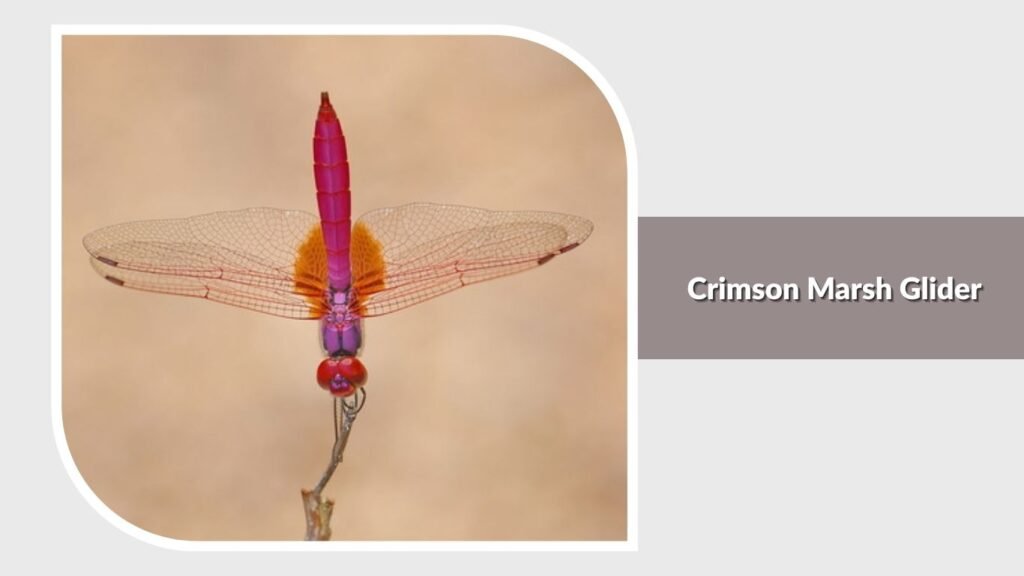
The Crimson Marsh Glider is a brilliantly colored Asian dragonfly whose mature males display a vivid crimson to violet-red body. Females are more olive-brown and heavily patterned. It is a familiar species around ponds, marshes, canals, and slow streams throughout much of the Indian subcontinent and Southeast Asia.
Identification
- Mature males are crimson to violet-red
- Thorax may have a purplish sheen
- Red wing veins in mature males
- Amber patches near the wing bases
- Females are olive to reddish-brown
- Female abdomen has prominent dark markings
- Dark legs
- Small to medium-sized dragonfly
Habitat and Distribution
Crimson Marsh Gliders occur around weedy ponds, tanks, marshes, canals, slow streams, and rivers. They are widespread across the Indian subcontinent and much of Southeast Asia, including Bangladesh, India, Nepal, Sri Lanka, Thailand, Malaysia, Indonesia, and neighboring regions.
Behavior and Diet
Adults frequently perch on grass stems, twigs, or reeds overlooking the water. From these positions they make rapid flights after mosquitoes, midges, gnats, and other small insects. Males become conspicuous around breeding areas and may repeatedly chase rival dragonflies.
Lifespan and Life Cycle
Females lay eggs into suitable freshwater habitats. The aquatic nymphs develop among submerged plants, sediment, and shallow vegetation while feeding on small aquatic prey. After passing through several molts, mature nymphs leave the water and emerge as adults. Warm climates may allow an extended flight season.
21. Red-veined Dropwing
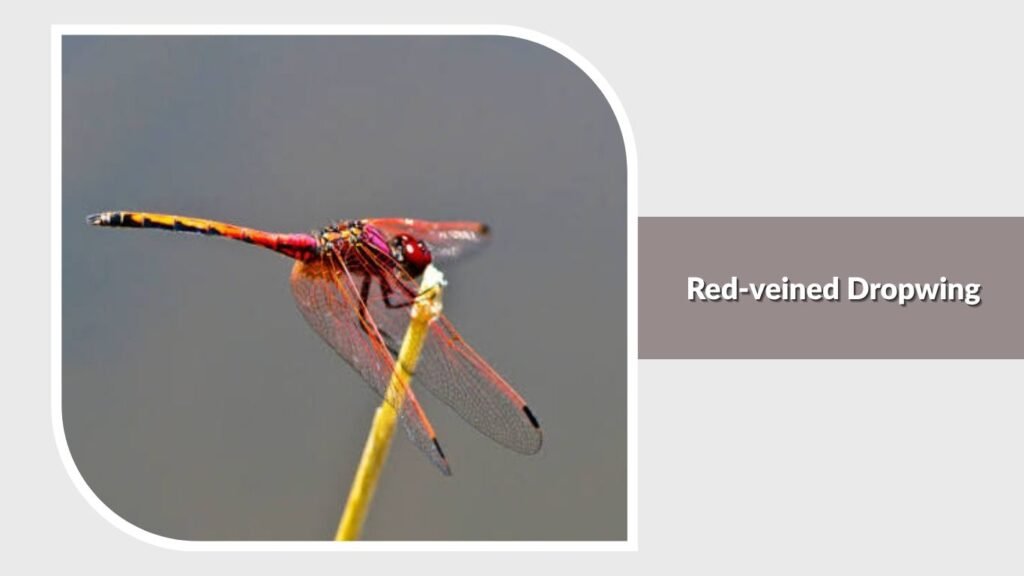
The Red-veined Dropwing is a small, bright red African dragonfly recognized by the reddish veins running through the wings of mature males. The thorax may carry a subtle purple wash, helping distinguish it from similar red dragonflies. It is frequently encountered close to freshwater, where adults use exposed sunny perches.
Identification
- Mature males are bright red
- Reddish wing veins
- Thorax may show a purple wash
- Females have stronger dark abdominal patterns
- Clear wings
- Black or dark legs
- Compact body
- Length can reach about 38 mm
Habitat and Distribution
Red-veined Dropwings are widespread across much of Africa. They inhabit rivers, streams, ponds, reservoirs, and other open freshwater environments, especially sites with plenty of sunshine and exposed vegetation or rocks for perching.
Behavior and Diet
The species gets the “dropwing” name from a characteristic resting posture in which the wings may be held somewhat downward while perched. Adults are active hunters of mosquitoes, flies, midges, and other small aerial insects. Males frequently occupy sunny territories around water and chase competing dragonflies away.
Lifespan and Life Cycle
The female lays eggs in freshwater, beginning an aquatic developmental phase. Nymphs live underwater and prey on aquatic insects and other small animals. They undergo numerous molts as they grow. Eventually, a mature nymph climbs above the water, sheds its final nymphal skin, and emerges as an adult dragonfly.
22. Scarlet Grenadier
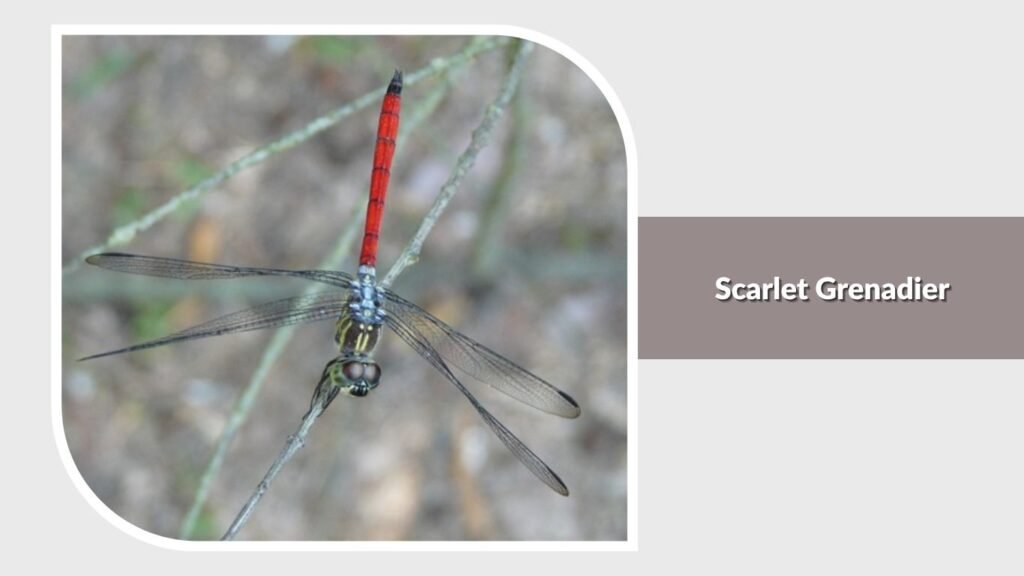
The Scarlet Grenadier is a colorful tropical dragonfly also known as the Asiatic Blood-tail. Mature males have an especially distinctive abdomen that is red through most of its length but becomes black at the tip. It is widespread from South and Southeast Asia through parts of Australasia and commonly occurs around forested freshwater habitats.
Identification
- Male abdomen is predominantly bright red
- Final abdominal segments are black
- Narrow, straight-sided abdomen
- Dark brown thorax
- Yellow stripes along the thorax
- Females have a brownish-red abdomen
- Clear wings
- Medium-sized dragonfly
Habitat and Distribution
Scarlet Grenadiers occur around marshes, ponds, shallow forest pools, slow streams, and other waters surrounded by vegetation. Their broad distribution extends from India and Southeast Asia to Australia and numerous Pacific islands. They are particularly associated with wooded and forested habitats.
Behavior and Diet
Adults frequently perch around forest edges and vegetation near water. Like other skimmer dragonflies, they hunt small insects such as mosquitoes, midges, flies, and gnats. Their sharp vision allows them to detect moving prey and intercept it quickly during short aerial flights.
Lifespan and Life Cycle
Females deposit eggs in suitable freshwater breeding habitat. Aquatic nymphs develop in ponds, marshes, streams, and shallow forest pools, feeding on smaller aquatic organisms. After completing their nymphal growth, they leave the water and undergo the final molt into adults. Adults may remain active for weeks or months under favorable tropical conditions.
23. Red Basker
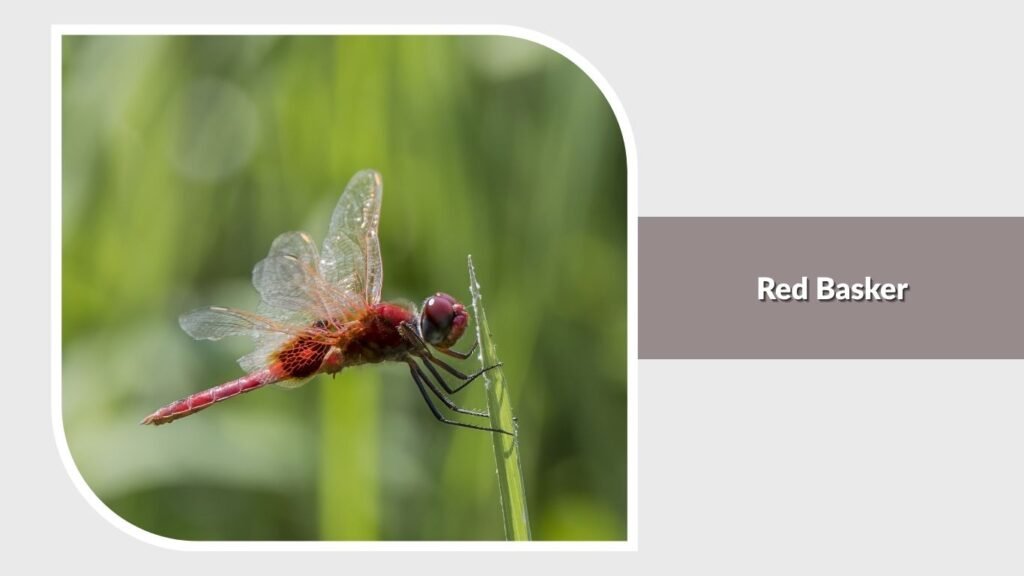
The Red Basker is a medium-sized African dragonfly with a deep red body and conspicuous dark patches near the bases of its hindwings. Mature males are particularly vivid, while females are generally duller and more rufous. It is widespread across much of sub-Saharan Africa and commonly inhabits vegetated still-water environments.
Identification
- Mature males are deep red
- Females are dull rufous
- Dark patches at the hindwing bases
- Hindwing patches are highly noticeable
- Clear outer portions of the wings
- Strong, robust body
- Length reaches about 44 mm
- Wingspan may reach around 75 mm
Habitat and Distribution
Red Baskers favor freshwater lakes, pans, dams, marshes, and slow sections of rivers. They are especially attracted to still water containing reeds, sedges, and other abundant vegetation. The species occurs widely through sub-Saharan Africa, particularly in warmer regions.
Behavior and Diet
Red Baskers are effective perch hunters. They often sit conspicuously on reeds or bushes before darting into the air to capture insects or chase rivals. Their diet includes mosquitoes, flies, midges, and other flying insects. During intense heat, adults may point their abdomen toward the sun, reducing the surface area exposed directly to sunlight.
Lifespan and Life Cycle
After mating, females deposit eggs into freshwater. Aquatic nymphs develop among plants and bottom material while feeding on small aquatic organisms. Once fully grown, a nymph crawls above the surface and molts into its adult form. Adults spend their remaining lives hunting, establishing territories, mating, and producing the next generation.
24. Cardinal Redskimmer
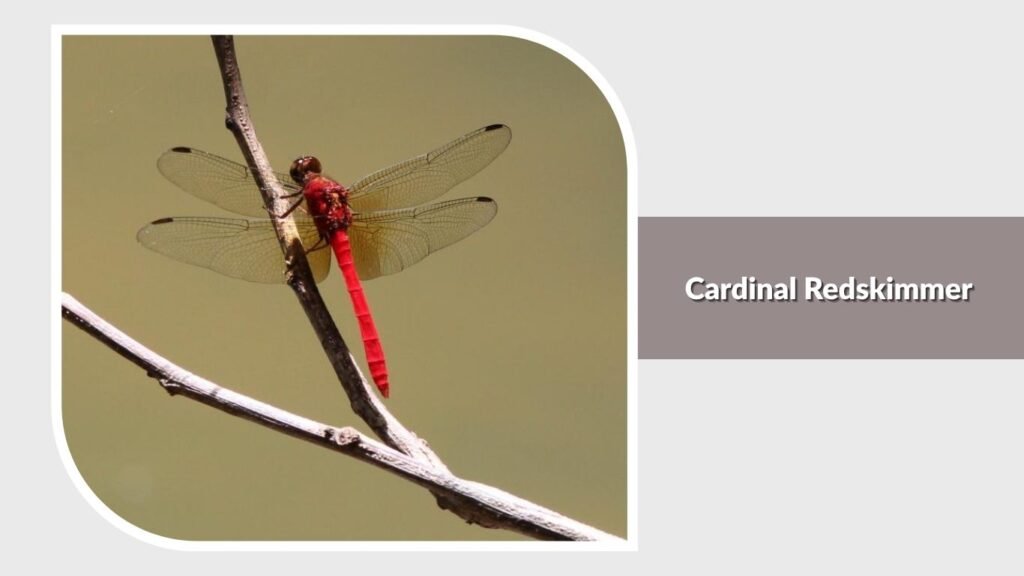
The Cardinal Redskimmer is a vividly colored Neotropical dragonfly associated with South America. Mature males display the intense red coloration suggested by the name, making them conspicuous when resting around tropical freshwater habitats. The species belongs to the skimmer family Libellulidae and is part of the primarily Neotropical genus Rhodopygia.
Identification
- Mature males display strong cardinal-red coloration
- Long reddish abdomen
- Reddish thorax
- Large compound eyes
- Four transparent wings
- Dark wing spots
- Strong skimmer-like body
- Females are generally less intensely colored
Habitat and Distribution
Cardinal Redskimmers occur in South America and are associated with tropical freshwater environments. Suitable habitats may include ponds, marshes, wetlands, slow waterways, and forest-edge waters. Members of the genus are especially characteristic of the Neotropical region.
Behavior and Diet
Adults are visual predators that capture small flying insects. Mosquitoes, midges, flies, and similar prey can be intercepted during rapid flights from a perch or while patrolling near water. Mature males may defend productive areas where females arrive to breed, while females commonly spend more time away from the immediate shoreline.
Lifespan and Life Cycle
Cardinal Redskimmers follow the typical dragonfly life cycle. Eggs hatch into aquatic nymphs that live beneath the water and prey on other small organisms. Nymphs develop through repeated molts before climbing from the water and transforming into flying adults. Adults usually represent the shorter part of the life cycle and concentrate on feeding and reproduction.
25. Little Scarlet
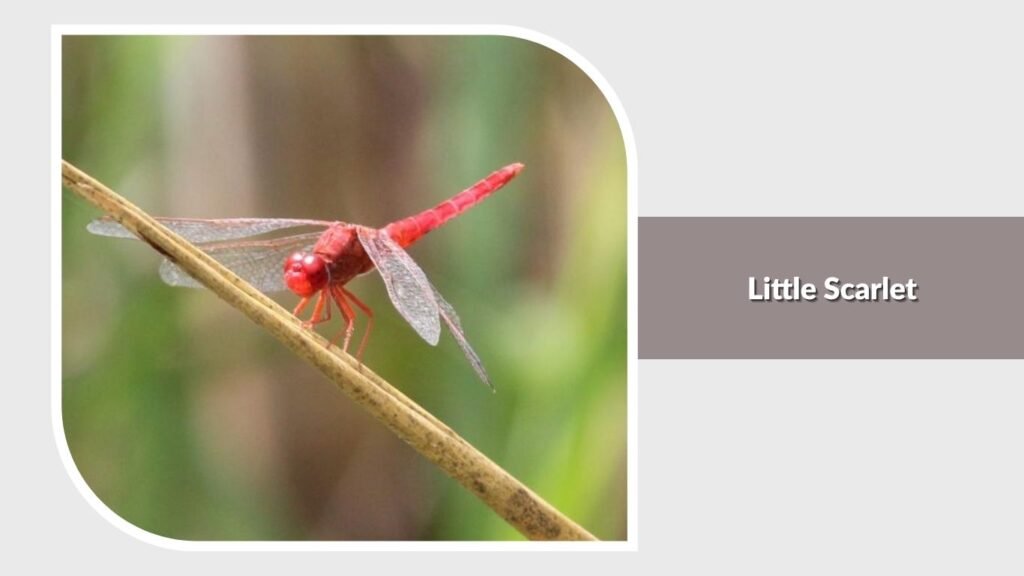
The Little Scarlet is a small, brilliantly colored dragonfly found across much of sub-Saharan Africa and neighboring regions. Mature males range from pinkish-red to vivid scarlet, while females are generally more golden-brown. Also known as the Small Scarlet or Slim Scarlet-darter, this species is particularly associated with sunny freshwater habitats and often rests on stones or bare ground beside streams.
Identification
- Mature males are bright red to pinkish-red
- Females have more golden or brown coloration
- Body length is roughly 35–38 mm
- Abdomen is relatively narrow and pointed
- Fine dark markings may appear along the abdomen
- Short reddish or yellowish-red wing spots
- Orange coloring may occur near the hindwing bases
- Compact build compared with the similar Broad Scarlet
Habitat and Distribution
Little Scarlets occur widely across Africa south of the Sahara, including Madagascar, and extend into the Levant and southern Arabian Peninsula. They use various freshwater habitats but are particularly associated with open rocky streams containing pools. Suitable environments range from relatively dry bushland to tropical landscapes as long as appropriate freshwater breeding sites are available.
Behavior and Diet
Adults frequently select sunny perches close to water. Unlike some red dragonflies that spend much of their time resting on tall vegetation, Little Scarlets are often found sitting on stones or exposed ground beside rocky streams. From these positions they make rapid flights to capture small flying insects such as mosquitoes, midges, gnats, and flies before returning to a nearby perch. Mature males also defend breeding areas from competing dragonflies.
Lifespan and Life Cycle
Like other dragonflies, the Little Scarlet undergoes incomplete metamorphosis. Eggs develop in freshwater and hatch into aquatic nymphs, which spend their early lives hunting small aquatic organisms. The nymphs grow through repeated molts before climbing from the water and shedding their final skin to become winged adults. Adults then concentrate on feeding, establishing territories, mating, and laying eggs, completing the cycle.
FAQs
1. Why are some dragonflies red?
Bright red coloration is particularly common in mature males of several dragonfly species. Color can help with species recognition and communication, and in some species males become noticeably redder as they mature.
2. Are red dragonflies dangerous?
No. Red dragonflies are not dangerous to people. They do not have a venomous sting and generally avoid human contact. Their strong jaws are designed for catching small insect prey.
3. What do red dragonflies eat?
Adult red dragonflies commonly eat mosquitoes, midges, gnats, flies, moths, and other small flying insects. Their aquatic nymphs feed on insect larvae and other small aquatic animals.
4. Where do red dragonflies live?
Depending on the species, red dragonflies can inhabit ponds, marshes, lakes, streams, rivers, temporary pools, wetlands, and even artificial water bodies. Some prefer still water, while others specialize in flowing streams.
5. How long do red dragonflies live?
The adult stage commonly lasts several weeks to a few months, depending on species and environmental conditions. However, much of a dragonfly’s overall life is spent underwater as an aquatic nymph before it develops into the familiar flying adult.