

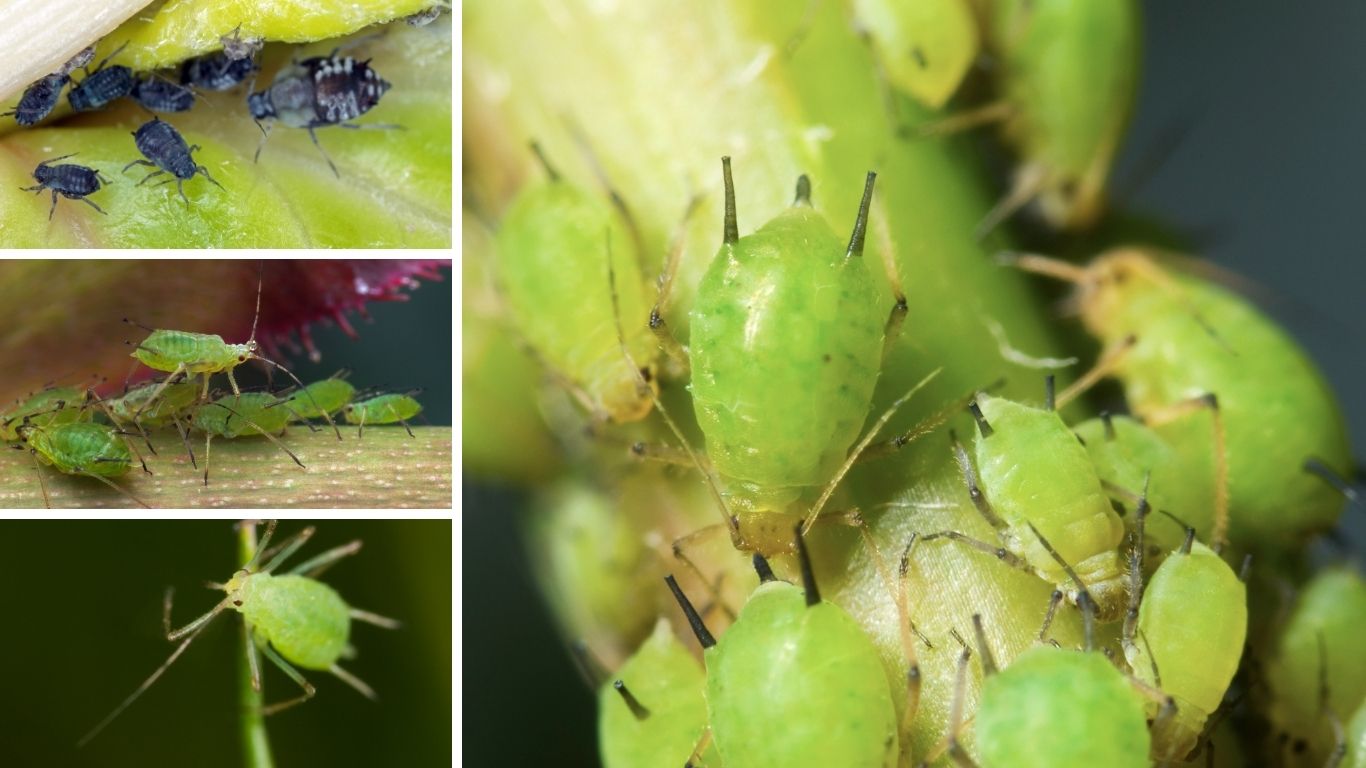
Aphids are tiny but troublesome pests that infest a wide variety of plants, from vegetables and fruit trees to flowers and ornamentals. With over 4,000 known species, only a few cause serious damage. This guide introduces 20 of the most common types of aphids, helping you recognize them by appearance, preferred host plants, and behavior, so you can better protect your garden or crops from infestations.
1. Green Peach Aphid

Green peach aphids (Myzus persicae) are among the most widespread and adaptable aphid species, known to infest over 400 plant species. They are particularly problematic in vegetable gardens and commercial crops due to their rapid reproduction and ability to transmit plant viruses.
Identification
- Pale green, yellow-green, or pink in color
- Soft-bodied and pear-shaped
- About 1.5–2.0 mm long
- Antennae are as long as the body
- Found in clusters on young leaves, buds, and stems
Habitat and Host Plants
They prefer peach trees, leafy vegetables, and nightshade plants like tomatoes, potatoes, and peppers. They’re commonly seen on undersides of leaves or around new growth.
Behavior
Green peach aphids reproduce quickly and can form large colonies in a short time. They feed by sucking plant sap, which causes leaves to curl, yellow, or drop. They also excrete sticky honeydew that encourages sooty mold growth.
Damage Risk
Besides direct feeding damage, they are serious vectors of more than 100 plant viruses, making them a critical concern for crop health.
2. Black Bean Aphid

Black bean aphids (Aphis fabae) are a common pest of many garden and field crops, especially legumes. They are named for their preference for broad beans but feed on a wide variety of host plants.
Identification
- Shiny black or dark green body
- Around 1.5–2.5 mm long
- Short legs and antennae
- Found in dense clusters on stems, buds, and undersides of leaves
- Nymphs are dark with a grayish waxy coating
Habitat and Host Plants
These aphids are commonly found on fava beans, beets, spinach, and some ornamental plants. They prefer tender plant parts and are most active during spring and early summer.
Behavior
They feed in colonies and cause wilting, stunted growth, and curling of leaves. Like other aphids, they secrete honeydew that attracts ants and promotes mold.
Damage Risk
Heavy infestations can significantly reduce yields in crops like beans and sugar beets. Their presence also increases the risk of viral transmission between plants.
3. Cabbage Aphid

Cabbage aphids (Brevicoryne brassicae) are specialist pests that target plants in the Brassicaceae family, such as cabbage, broccoli, and cauliflower. They are easily recognized by their dense, grayish appearance due to a waxy coating.
Identification
- Gray-green body covered with white, waxy powder
- About 2.0–2.5 mm long
- Short antennae and rounded shape
- Found in dense colonies on leaves, stems, and flower buds
- Nymphs resemble adults but are smaller
Habitat and Host Plants
These aphids exclusively feed on cruciferous vegetables like cabbage, kale, Brussels sprouts, and mustard. Colonies often hide in the inner leaves or buds of the plant.
Behavior
They suck sap from plants, leading to distorted growth, yellowing leaves, and reduced head formation. The waxy coating helps protect them from predators and weather, making them harder to control.
Damage Risk
Cabbage aphids can cause direct feeding damage and reduce crop quality. They also contaminate edible parts, making affected vegetables unmarketable.
4. Potato Aphid

Potato aphids (Macrosiphum euphorbiae) are large, soft-bodied insects that feed on a variety of crops, not just potatoes. They are known for their green or pink coloration and fast reproductive rate.
Identification
- Green or pink in color with long legs and antennae
- Up to 3.5 mm in length—larger than most aphids
- Cornicles (tube-like structures) on the back are long and slender
- Found on undersides of leaves and plant stems
- Nymphs look like adults but are smaller and wingless
Habitat and Host Plants
While they prefer potatoes, they also feed on tomatoes, lettuce, beans, and ornamentals. They are most active during warm weather and favor the upper parts of plants.
Behavior
Potato aphids feed by piercing plant tissue and sucking sap, which weakens the plant and may cause leaf curling and yellowing. They also excrete honeydew, promoting mold growth.
Damage Risk
They are known vectors of several plant viruses, including potato virus Y (PVY) and lettuce mosaic virus, making early control essential.
5. Rose Aphid

Rose aphids (Macrosiphum rosae) are one of the most common pests found on rose plants. They feed on tender growth and buds, causing cosmetic and structural damage to ornamental roses.
Identification
- Light green or pinkish in color
- Slender, pear-shaped body up to 3 mm long
- Long antennae and legs
- Cornicles are prominent and dark-tipped
- Found in clusters on new shoots, buds, and flower stems
Habitat and Host Plants
Primarily found on rose bushes, though they may also infest other ornamental plants. They are most active during spring and early summer.
Behavior
Rose aphids feed on sap from young growth, leading to distorted leaves and buds. Heavy infestations can cause flowers to drop before opening. They also leave behind sticky honeydew.
Damage Risk
Though not typically life-threatening to plants, rose aphids can severely affect flowering and ornamental value if left unmanaged.
6. Woolly Apple Aphid

Woolly apple aphids (Eriosoma lanigerum) are recognized by the cottony white wax they produce. They infest apple trees and related species, damaging both roots and above-ground parts.
Identification
- Dark purple or brown aphids covered in white, woolly wax
- Around 2 mm long
- Colonies appear as fluffy, cotton-like patches on branches or roots
- Winged forms appear in summer
- Often hidden in bark crevices or root galls
Habitat and Host Plants
Most commonly found on apple trees, crabapples, and sometimes hawthorn. They infest above-ground growth as well as underground roots.
Behavior
They feed on bark and roots, causing swellings (galls), dieback, and weakening of trees. Their woolly coating helps protect them from predators and weather.
Damage Risk
Severe infestations may stunt tree growth, reduce fruit yield, and make trees more susceptible to disease and environmental stress.
7. Corn Leaf Aphid

Corn leaf aphids (Rhopalosiphum maidis) are common pests in cereal crops, especially corn and sorghum. They are often found in large numbers on the upper leaves and in the whorls of young corn plants.
Identification
- Dark green to blue-green in color
- Small, about 1.5–2.0 mm long
- Short black cornicles and dark-tipped legs
- Pear-shaped body with a short, blunt antenna
- Often found in dense clusters on the upper plant parts
Habitat and Host Plants
Primarily infest corn, sorghum, and other grasses. Also found on wheat, barley, and oats in some regions.
Behavior
These aphids cluster at the top of the plant and in the leaf whorls, feeding on plant sap. They excrete honeydew, which attracts ants and can lead to mold growth.
Damage Risk
Heavy infestations can lead to stunted growth, reduced yields, and the transmission of plant viruses such as maize dwarf mosaic virus.
8. Cotton Aphid

Cotton aphids (Aphis gossypii) are highly adaptable pests found on a wide range of plants, including cotton, cucurbits, citrus, and ornamentals. They are known for their rapid multiplication and resistance to some pesticides.
Identification
- Color ranges from pale yellow to dark green or almost black
- Small, about 1–2 mm long
- Pear-shaped body with short antennae
- Cornicles are short and slightly swollen
- Found on undersides of leaves and growing tips
Habitat and Host Plants
Infests cotton, cucumbers, melons, squash, citrus trees, hibiscus, and many greenhouse plants.
Behavior
Cotton aphids feed on sap and reproduce quickly, especially in warm climates. Their populations can grow explosively under ideal conditions. They also excrete honeydew, leading to sooty mold.
Damage Risk
They cause direct damage to crops and transmit several plant viruses. Yield loss, leaf curling, and poor fruit development are common symptoms.
9. Pea Aphid

Pea aphids (Acyrthosiphon pisum) are common pests of leguminous plants. They are especially troublesome in crops like peas, alfalfa, and clover, where they can cause both direct feeding damage and virus transmission.
Identification
- Light green or pink in color
- Relatively large, up to 4 mm long
- Long legs and antennae
- Cornicles are long and slender
- Found on stems, leaves, and flower buds in colonies
Habitat and Host Plants
Primarily infest peas, lentils, clover, alfalfa, and other legume crops. Most active during cooler months in spring and fall.
Behavior
They cluster on young shoots and flower buds, sucking sap and weakening plant growth. They are also known vectors of pea enation mosaic virus and alfalfa mosaic virus.
Damage Risk
Heavy infestations can lead to reduced yields, malformed pods, and stunted plants. Their rapid reproduction makes early control essential.
10. Melon Aphid

Melon aphids (Aphis gossypii, same species as cotton aphid) are a serious pest of cucurbits and other crops. This specific host-adapted form heavily infests melons, cucumbers, and squash.
Identification
- Typically pale yellow to dark green
- Small, around 1–2 mm long
- Cornicles are short and blunt
- Body shape is oval and soft-bodied
- Colonies form on the undersides of leaves and near growing tips
Habitat and Host Plants
Specializes in cucurbits like melons, cucumbers, squash, and pumpkins. Also found on other vegetables and ornamental plants.
Behavior
Feeds on the sap of young tissues, causing leaf curling, stunting, and yellowing. Their honeydew fosters mold growth, and they spread several mosaic viruses in cucurbits.
Damage Risk
Can severely impact fruit development and plant health, especially in greenhouse or high-density plantings. Virus transmission adds to the economic threat.
11. Russian Wheat Aphid

The Russian wheat aphid (Diuraphis noxia) is a highly destructive pest of cereal crops, particularly wheat and barley. Native to Eurasia, it has become invasive in several regions and is known for injecting toxic saliva that causes distinctive plant symptoms.
Identification
- Pale green, spindle-shaped body
- About 2 mm long
- Short cornicles and a unique double tail (cauda) at the rear
- No prominent dark markings
- Often hidden inside curled or rolled leaves
Habitat and Host Plants
Primarily attacks wheat, barley, oats, rye, and some wild grasses. Populations increase rapidly in dry, cool conditions and during early spring.
Behavior
Feeds by injecting toxic saliva that disrupts plant growth, causing white or purple streaking, leaf curling, and a “fish hook” appearance in leaf tips. It hides inside curled leaves, making detection difficult.
Damage Risk
Can cause major yield losses if not controlled early. Feeding damage reduces photosynthesis, weakens plants, and leads to poor grain development. Outbreaks are common in dryland farming regions.
12. Foxglove Aphid

Foxglove aphids (Aulacorthum solani) are increasingly recognized as serious pests in greenhouses and field crops. They attack a wide variety of plants, from vegetables to ornamentals, and are known for their virus transmission ability.
Identification
- Light green to pale yellow with a slightly translucent body
- Medium-sized, about 2–3 mm long
- Cornicles are pale and slightly swollen
- Legs and antennae are long and pale with dark tips
- Winged forms are common in high populations
Habitat and Host Plants
Feeds on potatoes, lettuce, peppers, ornamentals (like foxglove and chrysanthemum), and greenhouse crops. Prefers cooler climates and protected environments.
Behavior
Foxglove aphids feed on leaves, buds, and flowers, causing puckering, stunting, and leaf distortion. They also produce honeydew, leading to mold issues and attracting ants.
Damage Risk
Major threat in greenhouse environments due to rapid reproduction and wide host range. Known to spread several plant viruses, including lettuce mosaic virus and potato virus Y.
13. Spirea Aphid

Spirea aphids (Aphis spiraecola) are common pests of ornamental plants and fruit trees, especially citrus and apple. They are often confused with green peach aphids but tend to prefer woody plants and ornamentals.
Identification
- Bright yellow-green body
- Small, about 1.5–2.0 mm long
- Short antennae and dark-tipped cornicles
- Nymphs are similar in appearance but smaller
- Found on young shoots and leaf undersides in tight clusters
Habitat and Host Plants
Feeds on spirea, citrus, apple, pear, and various ornamental shrubs. Common in landscapes, orchards, and nurseries.
Behavior
Spirea aphids form dense colonies on young growth, sucking sap and causing leaf curl, deformation, and reduced vigor. They are active throughout spring and summer.
Damage Risk
Though not always causing severe damage, heavy infestations reduce plant aesthetic value and weaken trees. They are also vectors of plant viruses like citrus tristeza virus.
14. Bird Cherry-Oat Aphid

Bird cherry-oat aphids (Rhopalosiphum padi) are major pests of cereal crops, particularly oats, barley, and wheat. They also play a key role in transmitting plant viruses, especially in early-season infestations.
Identification
- Olive green to dark green, round body
- About 2 mm long
- Reddish-brown patch at the base of cornicles
- Short legs and antennae
- Found on lower leaf surfaces and stem bases
Habitat and Host Plants
Primary hosts include bird cherry trees, while secondary hosts are grasses and cereal crops such as wheat, oats, and barley. Found in both temperate and subtropical regions.
Behavior
Feeds on phloem sap, causing yellowing and weakening of plants. It overwinters on woody hosts and migrates to cereals in spring. Colonies grow quickly in mild weather.
Damage Risk
A major vector of Barley Yellow Dwarf Virus (BYDV), which reduces yields and grain quality. Even small populations early in the season can lead to serious crop losses.
15. Grain Aphid

The grain aphid (Sitobion avenae), also known as the English grain aphid, is a common pest of cereal crops in temperate regions. It primarily attacks wheat, barley, oats, and rye, feeding on the upper parts of the plant during grain development.
Identification
- Olive green to dark green body
- Around 2–3 mm long
- Long legs and antennae
- Dark-colored cornicles and a darker area at the rear of the abdomen
- Often found on wheat heads and upper leaves
Habitat and Host Plants
Common in cereal fields, especially wheat and barley. Prefers cool, moist conditions and appears in large numbers during the heading stage of grain crops.
Behavior
Grain aphids feed on developing grains and upper leaves, reducing photosynthesis and grain filling. They appear late in the season and can rapidly multiply during flowering and grain fill.
Damage Risk
Heavy infestations reduce grain quality and yield. They also transmit Barley Yellow Dwarf Virus, which can have long-lasting effects on plant growth and crop output.
16. Apple Grain Aphid

Apple grain aphids (Rhopalosiphum insertum) are pests of apple orchards during the early growing season. Though less destructive than other aphids, they can still affect leaf and shoot development in young trees.
Identification
- Small, pale green body
- About 1.5 mm long
- Round shape with short antennae
- Cornicles are short and barely visible
- Often cluster at shoot tips and leaf undersides
Habitat and Host Plants
Feeds mainly on apple trees but can also be found on pear and some stone fruits. Active in early spring when buds begin to swell and leaves emerge.
Behavior
They suck sap from new growth, causing leaves to curl and shoot tips to become distorted. Populations often decline as predators become active later in the season.
Damage Risk
Usually considered a minor pest, but can stunt growth in young apple trees and serve as an early-season food source for beneficial predators like lady beetles.
17. Sugarcane Aphid

The sugarcane aphid (Melanaphis sacchari) is an invasive pest that has become a major threat to sorghum crops in recent years. Though named for sugarcane, it now primarily affects grain sorghum and forage sorghum in North America and other regions.
Identification
- Light yellow, gray, or pale tan body
- About 1.5 mm long
- Dark legs, antennae, and cornicles
- Pear-shaped and soft-bodied
- Found on the underside of sorghum leaves in dense colonies
Habitat and Host Plants
Feeds on sugarcane, sorghum, and Johnson grass. Populations thrive in hot, humid environments and often explode rapidly during mid to late summer.
Behavior
Sugarcane aphids feed on leaf sap, causing yellowing, leaf rolling, and death of leaf tissue. Their sticky honeydew leads to heavy sooty mold buildup, which interferes with photosynthesis.
Damage Risk
They significantly reduce yield and forage quality in sorghum. Outbreaks can devastate fields quickly if not controlled, and their rapid spread makes them difficult to manage once established.
18. Willow-Carrot Aphid

The willow-carrot aphid (Cavariella aegopodii) is a migratory species that moves between willow trees (primary hosts) and herbaceous plants like carrots, parsley, and celery (secondary hosts).
Identification
- Small, pear-shaped body
- Pale green to bluish-green in color
- About 1.5–2 mm long
- Long antennae and short cornicles
- Winged forms common during migration
Habitat and Host Plants
Primary hosts are willow trees, where they overwinter. In spring and summer, they migrate to carrots, parsnips, dill, parsley, and related Apiaceae family plants.
Behavior
They feed in colonies on leaves and stems, sucking plant sap and weakening growth. Infestations often begin on lower leaves and spread quickly in cool, moist conditions.
Damage Risk
While direct feeding damage is usually mild, they are important vectors of carrot motley dwarf and other viral diseases, making them a serious concern for vegetable growers.
19. Large Milkweed Aphid

The large milkweed aphid (Aphis nerii), also known as the oleander aphid, is a bright orange aphid that feeds on milkweed and oleander plants. It is especially noticeable due to its striking coloration and dense colonies.
Identification
- Bright yellow to orange body with black legs and cornicles
- Around 2–2.5 mm long
- Winged and wingless forms may be present
- Often seen in large, visible groups on milkweed stems and pods
- Does not usually infest many other plant types
Habitat and Host Plants
Primarily feeds on milkweed species and oleander. Commonly found in gardens, roadsides, and butterfly habitats where milkweed grows.
Behavior
Feeds on sap from stems and leaves, producing copious honeydew that attracts ants and encourages sooty mold. These aphids do not typically migrate between plant species.
Damage Risk
While not usually fatal to host plants, heavy infestations can stress milkweed, deform flowers, and interfere with monarch butterfly reproduction by contaminating the plant.
20. Balsam Twig Aphid

The balsam twig aphid (Mindarus abietinus) is a pest of fir trees, particularly balsam and Fraser firs. It is a concern for Christmas tree growers due to the visible distortion it causes to new growth.
Identification
- Pale green, soft-bodied aphid
- Small, about 1–2 mm long
- Winged forms appear in spring and fall
- Often found in clusters on new shoots and needles
- Leaves behind shiny honeydew on twigs and needles
Habitat and Host Plants
Feeds primarily on fir trees, including balsam, Fraser, and white firs. Common in Christmas tree plantations and natural fir forests.
Behavior
Infests buds and shoots in early spring, sucking sap from developing growth. This leads to twisted needles and distorted shoots, reducing the aesthetic and commercial value of trees.
Damage Risk
Significant in nurseries and commercial fir plantations. While rarely fatal to trees, aesthetic damage lowers tree marketability and long-term growth.
