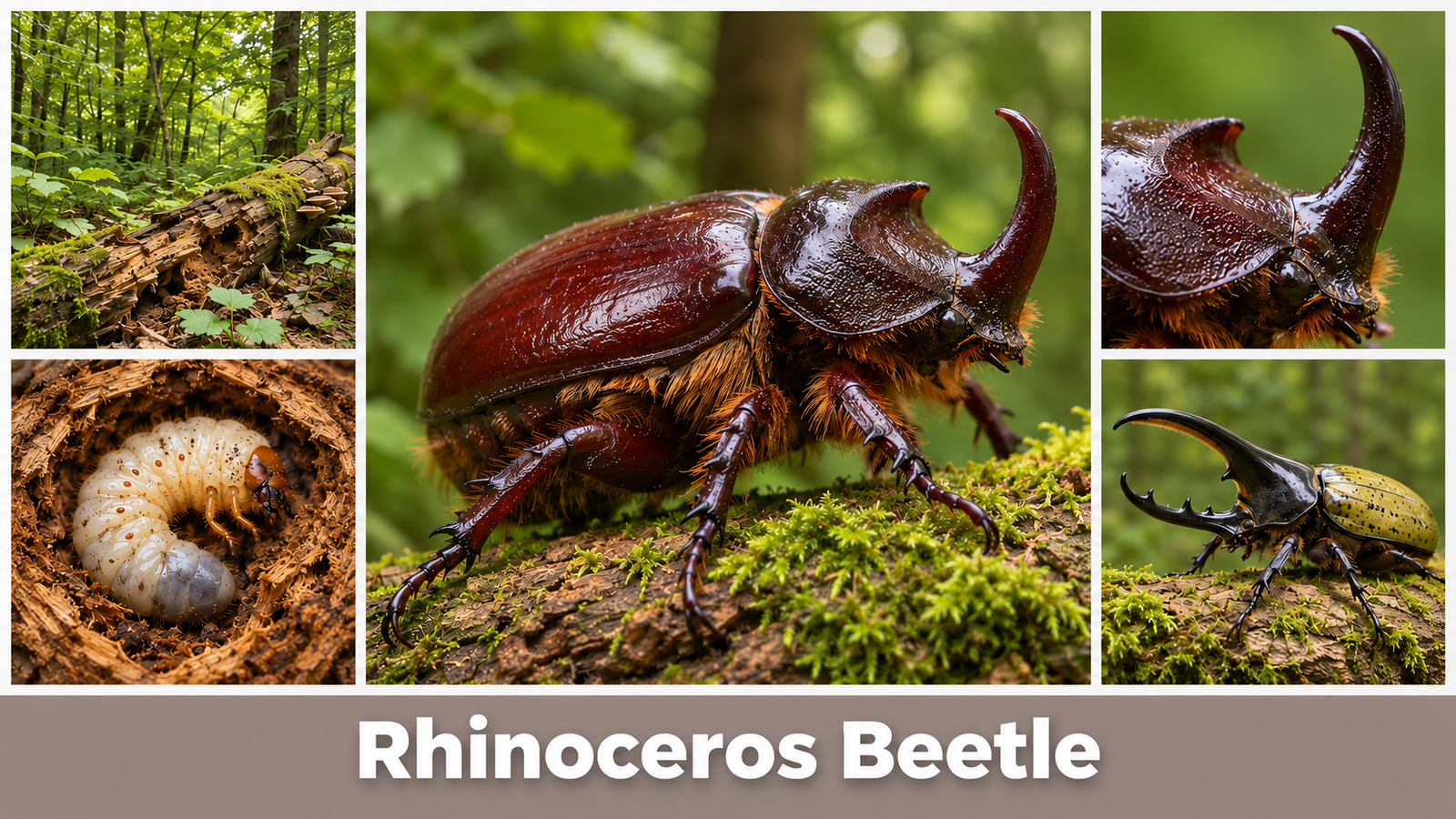
Rhinoceros beetles are large, sturdy insects best known for the horns that many males carry on their heads or thoraxes. These horns give the beetles their name and help males compete for access to mates. Despite their imposing appearance, most rhinoceros beetles spend their lives feeding on plant material, and their larvae often develop out of sight in rotting wood, compost, or soil rich in organic matter. The name covers many species, including Hercules beetles, elephant beetles, and the coconut rhinoceros beetle. Their size, diet, and effect on plants vary considerably by species.
What Is a Rhinoceros Beetle?
Rhinoceros beetles belong to the subfamily Dynastinae, a group within the scarab beetle family. They share several features with other scarabs, including hard wing covers, small antennae with fan-like tips, and a grub stage during which the body usually curls into a C shape. The largest and most noticeable species are often horned, but some rhinoceros beetles are relatively small and have only a short horn or raised bump.
Common names can be confusing because “rhinoceros beetle” may refer to the whole group or to a particular species found locally. A beetle emerging from a garden compost heap, for example, could have very different feeding habits from a coconut rhinoceros beetle discovered inside the crown of a palm.
How to Identify a Rhinoceros Beetle
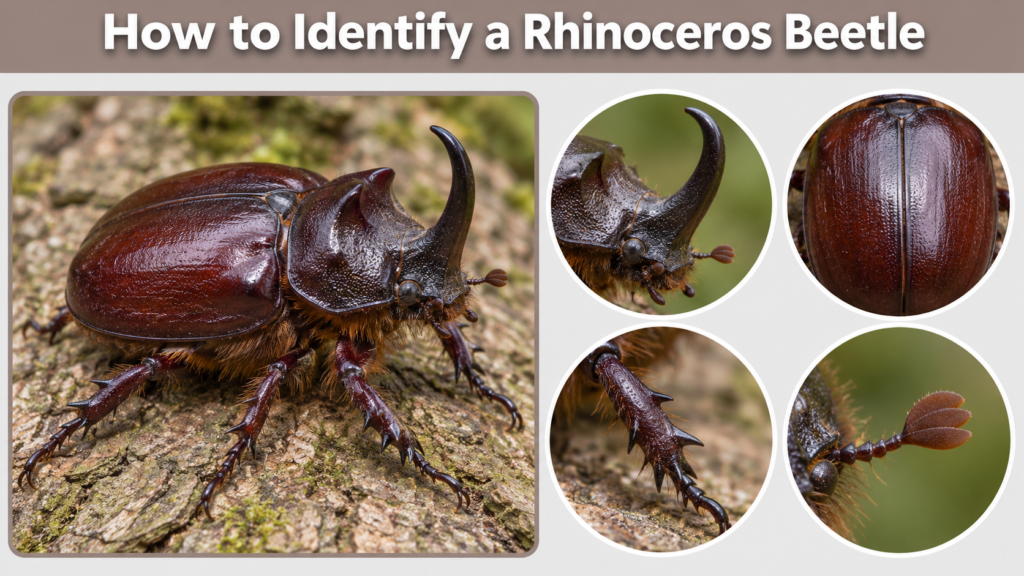
Start with the beetle’s overall shape, then look at the horns, wing covers, and legs. A large male with a curved horn is easy to recognize as a likely rhinoceros beetle, but females and smaller males can resemble several other kinds of scarabs. Knowing where the beetle was found can help narrow down the possibilities.
Key Identification Features
- Body: Thick, rounded, and usually oval when viewed from above.
- Color: Often black, reddish-brown, or dark brown. Some species have lighter wing covers or visible patches of fine hair.
- Horns: Often more prominent in males. Depending on the species, the horns may project from the head, the front of the thorax, or both.
- Wing covers: Two hardened covers meet along the middle of the back and protect the folded flight wings underneath.
- Legs: Strong and often spiny, with front legs suited to digging or pushing through loose material.
- Antennae: Short, with flattened segments at the tips that can spread like a small fan.
Male vs. Female Rhinoceros Beetles
Males generally have longer and more obvious horns than females of the same species. Some males have two horns that face each other like pincers. Females may have a small bump where the male’s horn would be, though the exact features vary. Horn size can also differ among males of the same species, so a short horn alone is an unreliable way to tell the sexes apart.
Where Do Rhinoceros Beetles Live?
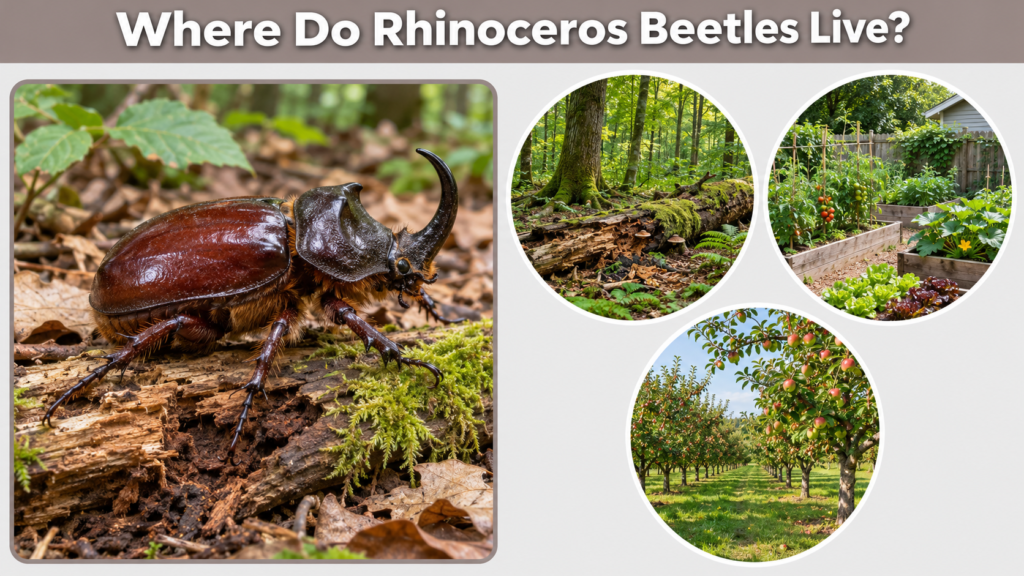
Rhinoceros beetles occur in tropical and temperate regions. You can find different species in forests, gardens, orchards, and agricultural areas. Many are easiest to spot near the organic material where their larvae develop. Depending on the species, this may be a decaying tree stump, a pile of wood chips, a compost heap, or soil containing decomposed leaves and wood.
Many adults are active after dark and may fly toward porch lights or other outdoor lighting. Finding one at a window or doorstep often tells you more about where it flew that evening than where it developed. A grub in a compost heap offers a different clue because it may have spent much of its larval life feeding there.
What Do Rhinoceros Beetles Eat?
Adult and larval rhinoceros beetles generally use different food sources. Many larvae feed in decaying organic matter, while adults of some species feed on soft fruit, tree sap, or living plant tissue. The diet depends on the species, and the type of damage, if any, depends on which life stage is present.
| Life stage | Typical food or feeding behavior |
|---|---|
| Egg | Develops without feeding on the surrounding material |
| Larva | Many feed on rotting wood, compost, or decomposing plant matter |
| Pupa | Stops feeding while it transforms into an adult |
| Adult | Depending on the species, may feed on sap, soft fruit, or living plant tissue |
The coconut rhinoceros beetle is an example of a species whose adults feed on living plants. They bore into palm crowns to reach tender tissue. As damaged leaves unfold, they can show V-shaped cuts along their edges or tips. The larvae typically develop in decaying material, so the places where adults cause damage and the places where their young grow can be quite different.
Rhinoceros Beetle Life Cycle
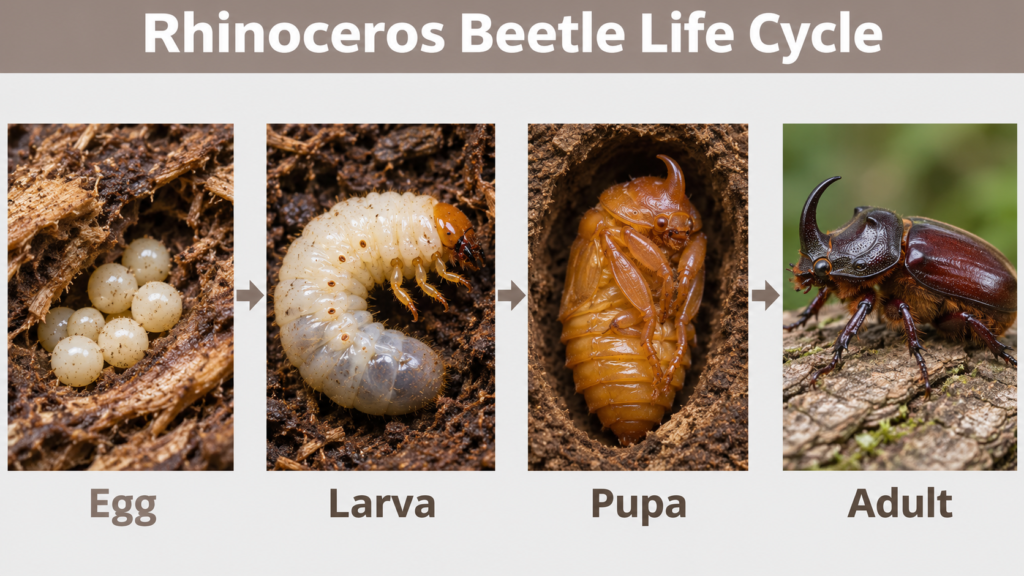
Rhinoceros beetles undergo complete metamorphosis. They pass through four stages: egg, larva, pupa, and adult. The time spent in each stage varies with the species and conditions such as temperature and food availability. People often encounter the grub and the adult in entirely different places, which can make it hard to connect the two.
Egg and Larval Stages
A female lays her eggs in a place that will provide food for the newly hatched grubs. For many species, that means soft, decaying wood or another moist, organic substrate. The larvae have a pale, curved body, a brown head, and three pairs of small legs near the head. They grow through successive molts as they feed.
The larval stage can account for much of the beetle’s life. Some species spend many months growing before they pupate. Because the grubs remain inside their food source, a gardener might first discover them while turning compost, moving old mulch, or breaking apart a rotten log.
Pupal and Adult Stages
A mature larva typically forms a chamber in the material where it has been developing. Inside, it becomes a pupa and develops adult features such as wing covers, legs, and, in many males, horns. The newly emerged adult has a soft outer body that gradually hardens before it becomes active.
Once above ground, adults can move between feeding and breeding sites. Many species fly despite their bulky bodies. Adult activity and lifespan differ among species, so the adult beetles you see during a particular season may represent only a brief portion of their full life cycle.
Why Do Rhinoceros Beetles Have Horns?
Male rhinoceros beetles often use their horns to compete with rivals. A male may slip his horn beneath another beetle and pry it away from a branch or feeding site. The shape and position of the horns affect how the beetle grips, pushes, or lifts its opponent. A horn projecting from the head works differently from a pair formed by projections on the head and thorax.
These contests help explain why males and females of the same species can look so different. They also explain why a horned male looks especially formidable up close, even though its usual targets are other beetles.
Are Rhinoceros Beetles Harmful to Gardens?
Finding a rhinoceros beetle or a large grub in compost often means the animal is using material that is already decomposing. Many rhinoceros beetle larvae help break down dead wood and plant debris. A grub found in a pile of decaying leaves therefore tells a different story from an adult found feeding inside a damaged palm.
If you find grubs near an injured plant, identify them before deciding what caused the damage. A C-shaped body is common among scarab larvae, including some species that feed on living roots. The location of the grub, the condition of the plant, and the type of feeding damage are more informative when considered together.
Common Types of Rhinoceros Beetles
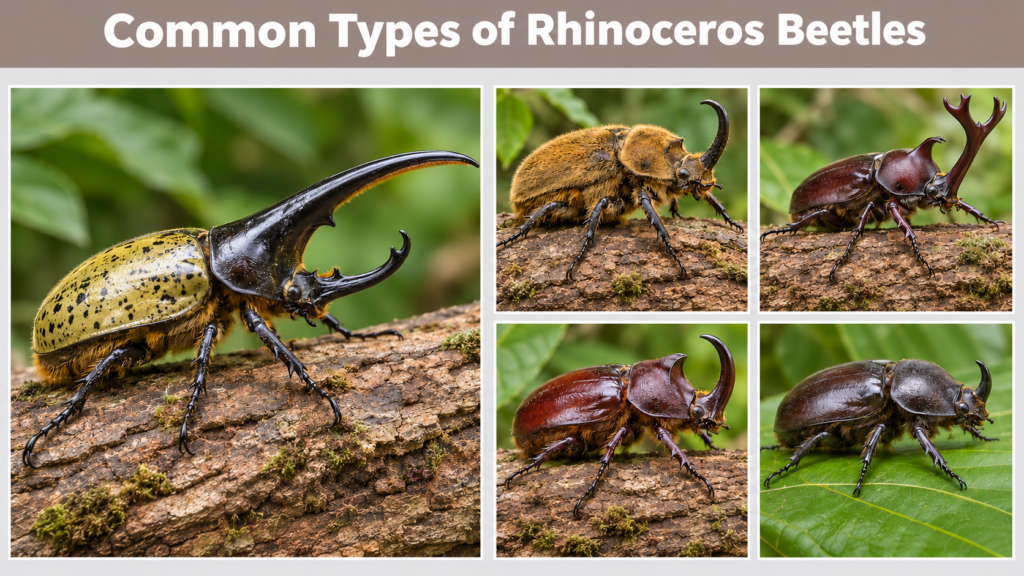
The table below shows how much these beetles can differ in appearance and where they are found. Their common names reflect features such as body size, horn shape, and association with particular plants.
| Type | Where found | Notable feature |
|---|---|---|
| Hercules beetle | Central and South America and parts of the Caribbean | Males have long opposing horns, and horn length contributes substantially to total length |
| Elephant beetle | Mexico, Central America, and parts of South America | Large, broad body often covered with fine hairs |
| Japanese rhinoceros beetle | Japan and other parts of East Asia | Males have a prominent forked head horn |
| European rhinoceros beetle | Across much of Europe and into parts of Asia and North Africa | Males have a single curved head horn, and larvae can develop in compost or decaying wood |
| Coconut rhinoceros beetle | Native to parts of Asia and introduced to some Pacific islands | Adults bore into the crowns of coconut and other palms |
Frequently Asked Questions
Do rhinoceros beetles bite or sting?
Rhinoceros beetles cannot sting, and bites are uncommon. A beetle may grip firmly with its hooked feet if you pick it up, which can feel like a scratch or pinch. Most of the time, you can observe it where it is or let it walk onto a leaf if you need to move it.
Can rhinoceros beetles fly?
Yes. Many species fly using thin wings hidden under their hard wing covers. Large adults can make a noticeable buzzing sound in flight, and some turn up around outdoor lights at night.
Why is there a rhinoceros beetle in my house?
An adult may fly toward a light and enter through an open door or window. A single sighting near a light usually suggests an accidental visitor. It can be moved outside using a cup and a piece of stiff paper.
How big do rhinoceros beetles get?
Size varies widely by species. Some adults measure only a few centimeters, while the largest male Hercules beetles can exceed 15 centimeters when the horn is included. When comparing sizes, check whether the measurement refers to the body alone or includes the horn.
What is the difference between a rhinoceros beetle and a stag beetle?
The prominent structures on a male stag beetle are enlarged jaws that open and close from side to side. A rhinoceros beetle’s horns are projections from the head or thorax. Looking at where the structures attach is the easiest way to tell them apart.