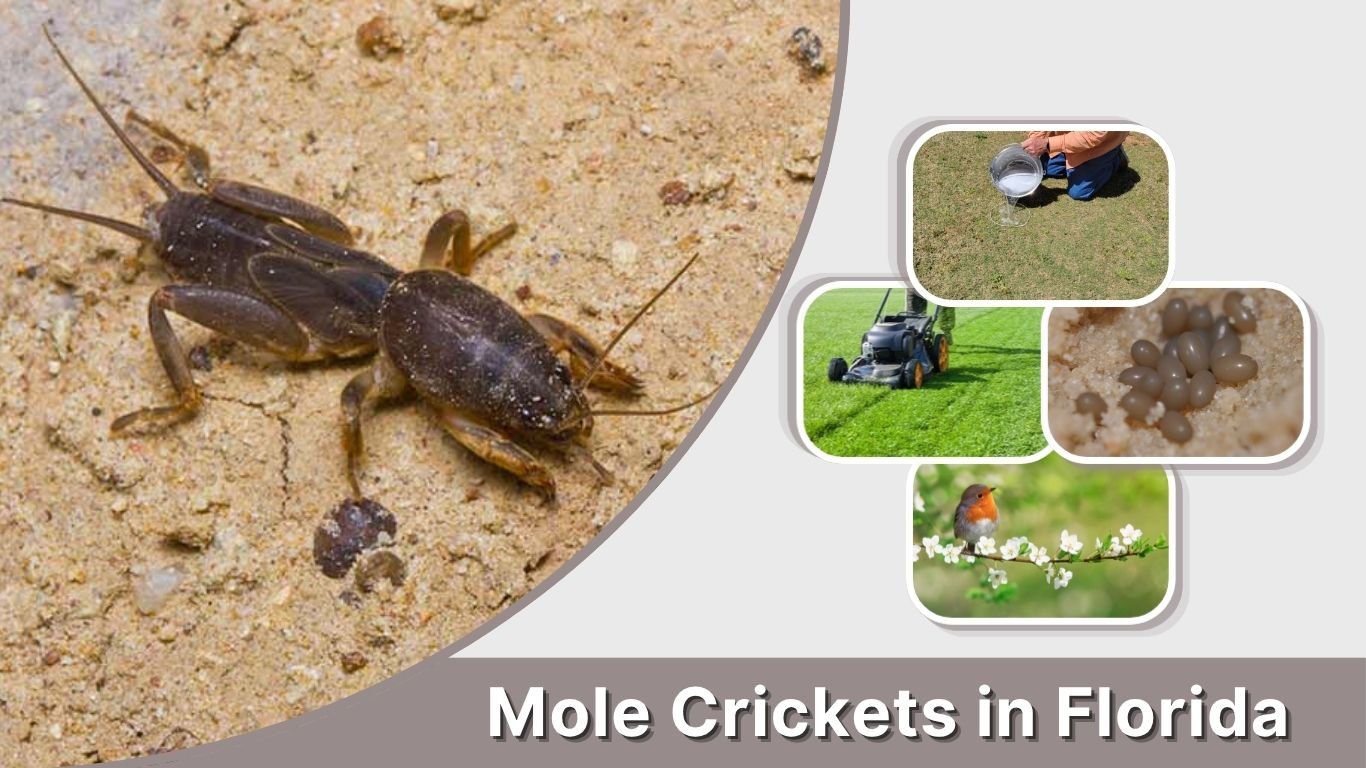
Mole crickets in Florida are troublesome lawn pests that spend most of their lives tunneling beneath the soil. Their digging and feeding can damage turf roots, loosen the soil, and create thinning or brown patches across lawns. Florida has three invasive pest species—the tawny, southern, and short-winged mole cricket—along with a native northern mole cricket that generally is not considered a pest. Understanding their signs, life cycle, and treatment timing can make mole cricket control much more effective.
What Types of Mole Crickets Live in Florida?
Florida is home to several mole cricket species, but they do not all cause the same level of lawn damage. Three invasive species are considered important pests, while the native northern mole cricket usually causes little concern. Correct identification helps determine whether treatment is actually necessary and prevents harmless insects from being controlled unnecessarily.
Common Florida Mole Cricket Species
The four main species include:
- Tawny mole cricket (Neoscapteriscus vicinus) – a serious turf pest that feeds heavily on plant material.
- Southern mole cricket (Neoscapteriscus borellii) – tunnels extensively and feeds partly on other insects.
- Short-winged mole cricket (Neoscapteriscus abbreviatus) – an invasive plant-feeding species with limited flight ability.
- Northern mole cricket (Neocurtilla hexadactyla) – a native species that generally is not considered an important turf pest.
UF/IFAS identifies the first three as Florida’s primary pest mole crickets.
What Does a Florida Mole Cricket Look Like?
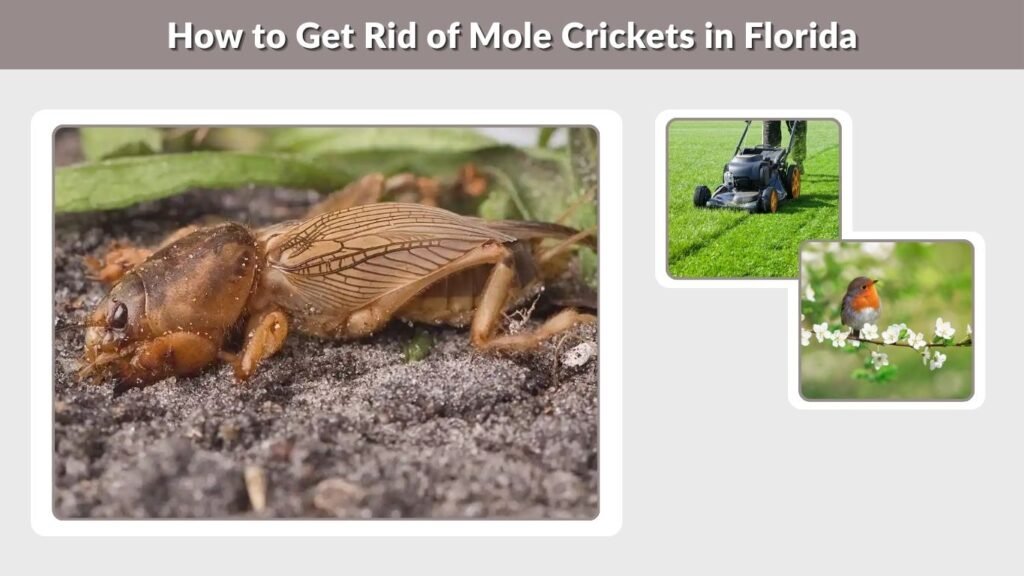
Mole crickets have cylindrical brown bodies and unusually broad front legs that resemble small digging hands. These specialized legs allow them to move rapidly through loose soil.
Adults are typically much easier to recognize than ordinary field crickets because of their powerful forelegs. They spend much of their time underground, so homeowners often notice turf damage before seeing the insects themselves.
Florida Mole Cricket Damage
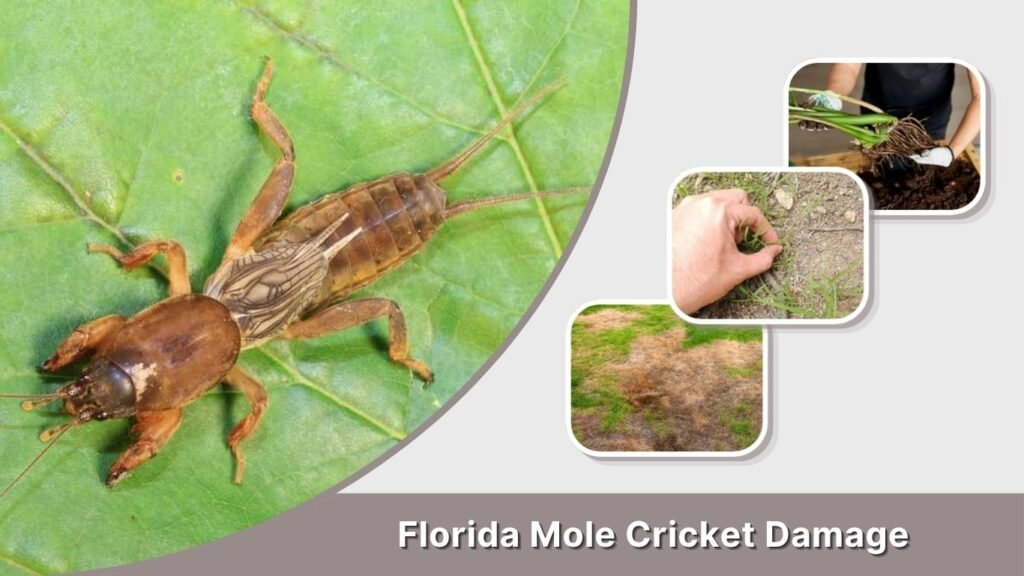
Mole cricket damage comes from both tunneling and feeding. As insects travel immediately beneath the soil surface, they disturb grass roots and push soil upward. Some species also directly consume roots and shoots. Turf may gradually become thin, loose, dry, or brown, while weeds can move into damaged areas.
Signs of Mole Cricket Damage
Look for:
- Irregular brown or thinning patches of grass
- Raised soil or small surface ridges
- Spongy or loosened turf
- Grass that pulls up easily
- Damaged or severed roots
- Small tunnel openings
- Increased weed growth in damaged areas
- Birds, raccoons, or armadillos digging for insects
Wildlife searching for mole crickets can sometimes cause additional turf disturbance beyond the original insect damage.
What Do Mole Cricket Tunnels Look Like?
Their tunnels commonly appear as narrow ridges immediately beneath the soil surface. The disturbed ground may look somewhat like miniature mole tunnels, although the responsible insect is completely unrelated to the mammal called a mole.
During heavy infestations, numerous intersecting tunnels can loosen turf enough that grass becomes poorly rooted and easily displaced.
Mole Cricket Life Cycle in Florida
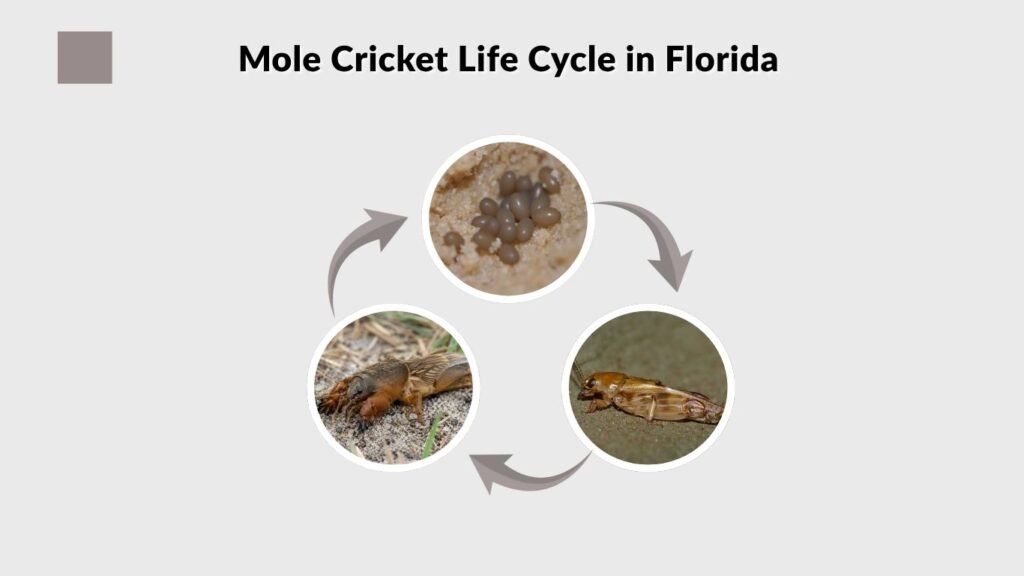
Florida’s warm climate allows mole crickets to remain active for much of the year. According to UF/IFAS, pest mole crickets generally produce one generation annually, with eggs commonly laid during April and May. Activity and visible damage can occur at other times, however, especially during spring and again from late summer into early fall.
Mole Cricket Life Cycle
Their annual development generally follows this pattern:
- Adults become active: Mature crickets tunnel, call, mate, and may fly between sites.
- Eggs are laid: Females place eggs underground, commonly during spring.
- Nymphs hatch: Young mole crickets resemble small adults but lack fully developed wings.
- Nymphs grow: They molt repeatedly while feeding and tunneling.
- Adults develop: Mature crickets become larger and more difficult to control.
- The cycle repeats: Adults reproduce and start another generation.
Young nymphs are important targets for management because they are smaller and generally easier to control than mature adults.
When Are Mole Crickets Active in Florida?
Mole crickets can remain active year-round in Florida. UF/IFAS notes especially noticeable activity and damage during March through June and again from late August into early October. They are primarily nocturnal and do much of their tunneling, calling, and flying at night.
How to Check a Florida Lawn for Mole Crickets
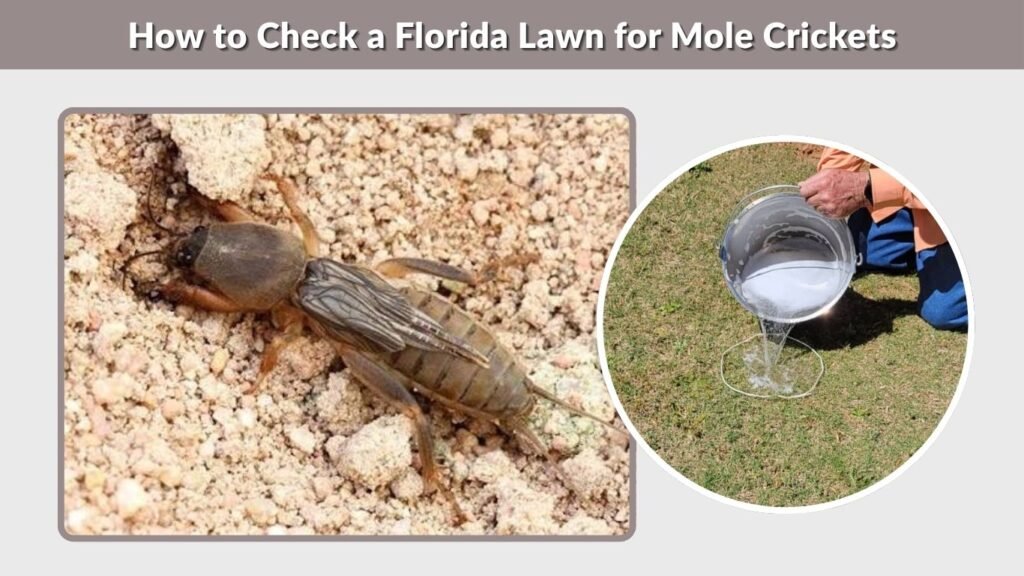
Brown grass does not automatically mean mole crickets are responsible. Drought, diseases, chinch bugs, grubs, and other problems can create similar symptoms. Checking the soil for live crickets before applying treatment helps confirm the cause and reduces unnecessary pesticide applications.
Soap Flush Test
UF/IFAS recommends a simple flushing method:
- Choose an area showing suspected damage.
- Mix about 1.5 fluid ounces of liquid dishwashing soap with 2 gallons of water.
- Pour it evenly over approximately 4 square feet of turf.
- Watch the area for about three minutes.
- Count any mole crickets that emerge.
UF/IFAS states that finding roughly two to four mole crickets during this test can justify corrective action.
Inspecting the Lawn
Examine damaged areas during early morning or after irrigation, when surface tunnels may be easier to recognize. You can also look for loose soil and grass that separates easily from its roots.
Testing several locations is preferable to assuming an entire lawn is infested based on one damaged spot.
How to Get Rid of Mole Crickets in Florida
Complete elimination is usually unrealistic, so management focuses on reducing populations below damaging levels. Florida’s long-running biological-control programs have also introduced natural enemies that suppress invasive mole crickets. Combining monitoring, good turf maintenance, biological control, and targeted treatments is generally preferable to routine whole-lawn spraying.
Mole Cricket Control Methods
Useful strategies include:
- Confirm activity before treating.
- Target young nymphs rather than waiting for large adults.
- Maintain healthy turf through proper mowing and irrigation.
- Avoid excessive watering that keeps soil unnecessarily wet.
- Treat only infested areas when practical.
- Follow all insecticide label directions.
- Protect beneficial insects and natural enemies.
- Recheck damaged locations after treatment.
UF/IFAS recommends monitoring rather than preventative spraying and notes that localized infestations can often be spot-treated with a small surrounding buffer.
Best Time to Treat Mole Crickets in Florida
Timing is critical. Treatments aimed at newly hatched and small nymphs are generally more effective than waiting until the insects have become large adults.
In North Florida, UF/IFAS specifically recommends beginning to scout for newly hatched mole crickets during late spring. Exact development can shift with region and weather, so inspecting the lawn is more reliable than treating automatically on a fixed calendar date.
Biological Control of Florida Mole Crickets
Florida has a long history of biological-control programs targeting invasive mole crickets. These programs introduced specialized natural enemies capable of locating the insects underground or attacking them when they reached the surface. Biological control does not necessarily eliminate every cricket, but it can provide ongoing suppression without repeated homeowner treatments.
Larra Wasps
The parasitoid wasp Larra bicolor is an important natural enemy of Florida’s invasive mole crickets. Adult wasps feed on nectar, while females locate mole crickets and lay eggs on them.
After hatching, the developing wasp larva feeds on its host and ultimately kills it. Maintaining flowering plants that provide nectar can help support beneficial insects already present in the landscape.
Should You Use Insecticide?
Insecticides remain an option when mole crickets are actively damaging turf, but treatment should follow confirmed identification and label directions.
Avoid treating an entire property simply because a single cricket was found. Targeting active areas reduces pesticide use and helps preserve beneficial organisms. Product choices and application restrictions can change, so homeowners should follow the current Florida label for the specific turfgrass and site being treated.
Which Florida Grass Is Resistant to Mole Crickets?
No commonly used Florida turfgrass is completely immune to mole cricket damage. UF/IFAS notes that mole crickets can damage any turfgrass species, although bahiagrass and bermudagrass are particularly favored.
Protecting Florida Turf
Reducing lawn stress can improve its ability to recover from moderate feeding and tunneling. Mow at the correct height for the grass species, irrigate appropriately, avoid excessive fertilization, and investigate brown patches before automatically applying insecticide.
Healthy turf will not prevent every mole cricket, but it can reduce the visible impact of low populations.
FAQs
1. Are mole crickets common in Florida?
Yes. Mole crickets occur throughout Florida, and three invasive species are important turf pests: tawny, southern, and short-winged mole crickets. Florida also has a native northern mole cricket that generally is not considered a significant pest.
2. When should you treat mole crickets in Florida?
Treatment is most effective when young nymphs are present rather than after they become large adults. Begin scouting during the hatch period and confirm activity before treating. Timing differs somewhat between North, Central, and South Florida because temperatures influence development.
3. How do I know if my Florida lawn has mole crickets?
Look for loose turf, surface tunnels, raised soil, thinning grass, and irregular brown patches. A soap flush can confirm their presence by forcing underground mole crickets to the surface within a few minutes.
4. What grass do mole crickets damage in Florida?
Mole crickets can injure essentially any Florida turfgrass. However, UF/IFAS reports that bahiagrass and bermudagrass are particularly attractive to them. Damage results from both underground tunneling and feeding on plant roots or shoots.
5. Why are mole crickets sometimes found dead outside in Florida?
Dead mole crickets may result from natural enemies, disease, environmental stress, pesticide exposure, or normal mortality. Florida also has established biological-control organisms that attack invasive mole crickets, so finding an occasional dead cricket does not necessarily mean a chemical treatment was recently applied.