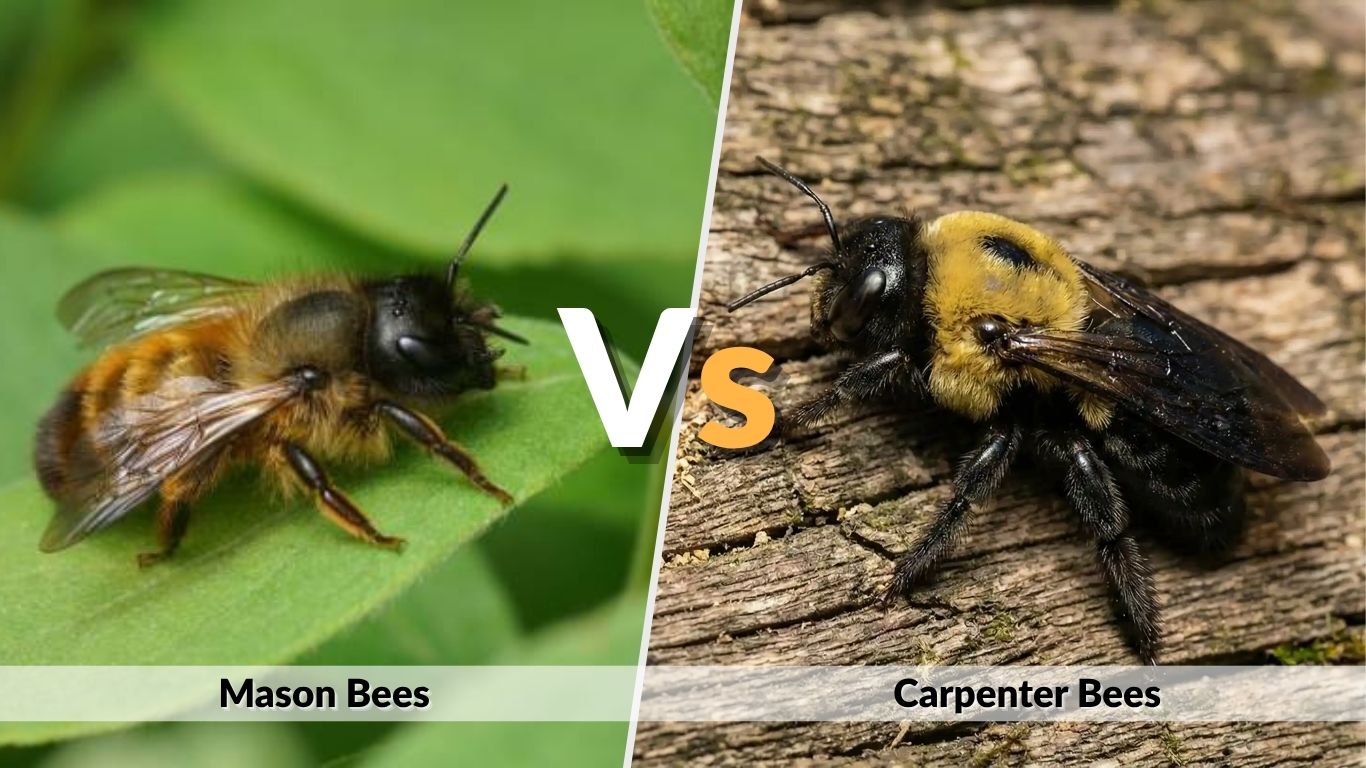
Mason bees, carpenter bees, honey bees, and bumblebees can look similar at first, but they behave very differently. Mason bees are gentle solitary pollinators that use existing holes and seal nests with mud. Carpenter bees are larger bees that can drill into wood. Honey bees live in colonies and make honey, while bumblebees form smaller seasonal colonies. This guide explains how to identify each one by appearance, nesting habits, pollination value, sting risk, and possible home or garden concerns.
Quick Comparison: Mason Bees vs Other Bees
Many bee identification problems start because different bees visit the same flowers. The fastest way to compare them is by looking at body size, nesting style, and behavior near wood or nest entrances. Mason bees are usually solitary cavity nesters, while carpenter bees, honey bees, and bumblebees each have different nesting patterns and risk levels.
Bee Comparison Table
| Bee Type | Nest Type | Social or Solitary | Main Clue |
| Mason bee | Existing holes sealed with mud | Solitary | Mud-plugged nest holes |
| Carpenter bee | Tunnels drilled into wood | Solitary | Round holes in wood |
| Honey bee | Wax comb hive | Social | Large colony and honey |
| Bumblebee | Ground or cavity nest | Social | Big fuzzy body |
| Leafcutter bee | Holes sealed with leaf pieces | Solitary | Cut leaf circles |
Fast Identification Clues
- Mason bee: Small, fuzzy, gentle, seals holes with mud.
- Carpenter bee: Larger, often shiny abdomen, drills wood.
- Honey bee: Golden-brown, social, lives in a hive.
- Bumblebee: Large, round, very fuzzy, seasonal colony.
- Leafcutter bee: Uses leaf pieces to seal nest cells.
- Wasp or yellow jacket: Smoother body, narrow waist, more defensive.
- Hoverfly: Looks like a bee but has one pair of wings.
Mason Bee vs Carpenter Bee
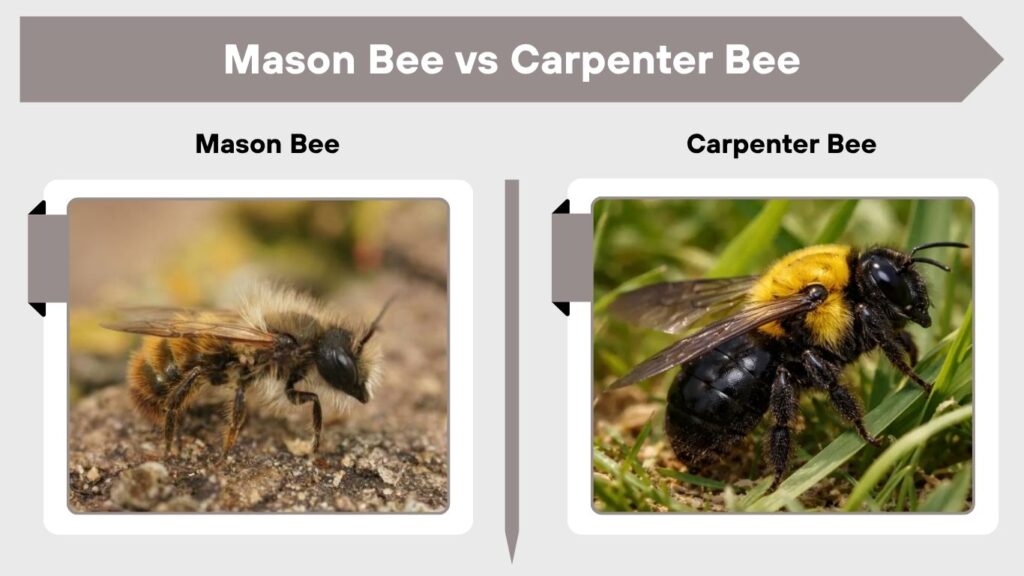
Mason bees and carpenter bees are often confused because both may appear around wood, holes, gardens, and outdoor structures. The biggest difference is damage. Mason bees use existing holes and do not drill into wood. Carpenter bees can chew round tunnels into wood, especially soft, bare, or weathered wood.
Size and Appearance
Carpenter bees are usually larger than mason bees and may look similar to bumblebees. Many carpenter bees have a shiny black abdomen with less hair. Mason bees are usually smaller, compact, and often dark, blue-black, greenish, or metallic. They may look less noticeable because they move quickly between flowers and nest holes.
Nesting Behavior
Mason bees use ready-made cavities such as reeds, tubes, drilled blocks, beetle holes, or cracks. They build small chambers inside the tunnel and seal each one with mud. Carpenter bees make their own tunnels by chewing into wood. You may see a round entrance hole, sawdust below the hole, or staining under the nest site.
Mason Bee vs Carpenter Bee Table
| Feature | Mason Bee | Carpenter Bee |
| Wood damage | Does not drill wood | Can drill wood |
| Nest material | Mud partitions | Chewed wood tunnel |
| Size | Usually smaller | Usually larger |
| Abdomen | Often fuzzy or metallic | Often shiny and black |
| Sting risk | Very low | Low, females can sting |
| Best clue | Mud-sealed holes | Round wood holes |
Mason Bees vs Honey Bees
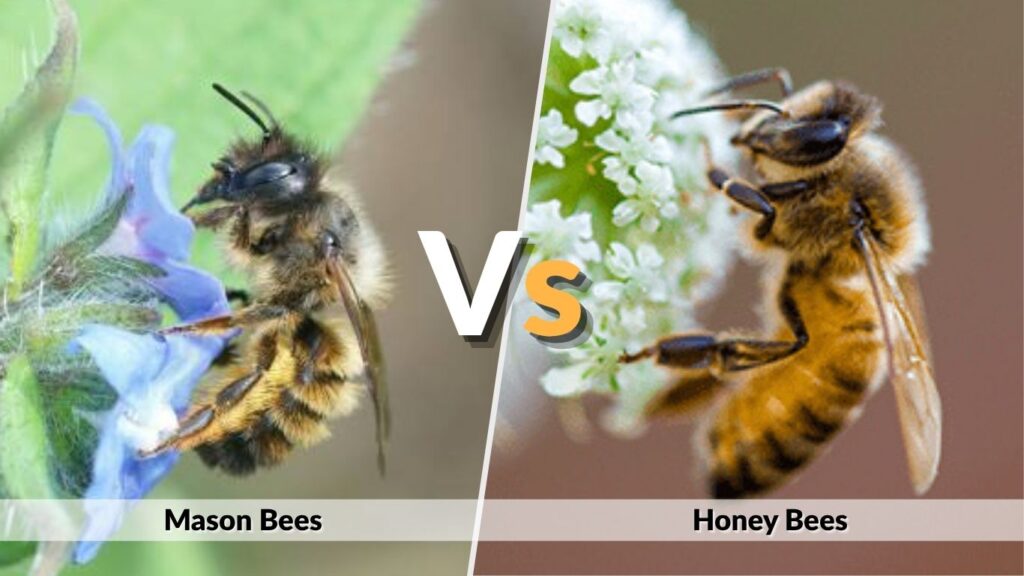
Mason bees and honey bees are both valuable pollinators, but they live very different lives. Honey bees form large colonies with a queen, workers, drones, wax comb, and stored honey. Mason bees are solitary. Each female mason bee works alone to build nest chambers and provide food for her young.
Colony vs Solitary Life
Honey bees live in organized colonies that may contain thousands of bees. They work together, defend the hive, store honey, and care for brood. Mason bees do not have a worker colony. A female mason bee finds a tunnel, adds pollen and nectar, lays an egg, builds a mud wall, and repeats the process.
Mason Bee vs Honey Bee Pollination
Mason bees are excellent early spring pollinators, especially for fruit trees and garden flowers. They often work in cooler weather and move quickly between blossoms. Honey bees are also important pollinators, especially in large farms and managed hives. The difference is scale: honey bees work as large colonies, while mason bees work as efficient solitary pollinators.
Do Mason Bees Make Honey?
Mason bees do not make honey for people to harvest. They collect nectar and pollen only to feed their young. Honey bees make and store honey because their colony must survive through times when flowers are not available.
Mason Bee vs Leafcutter Bee
Mason bees and leafcutter bees are close relatives and both are solitary cavity-nesting bees. They may use similar nest boxes, tubes, reeds, or drilled holes. The easiest difference is the material used inside the nest. Mason bees use mud, while leafcutter bees use cut pieces of leaves or petals.
Nest Material Difference
A mason bee nest is usually sealed with dried mud. A leafcutter bee nest may show green or brown leaf pieces at the entrance. If you see neat circular cuts on garden leaves, leafcutter bees may be nearby. These cuts usually do not seriously harm healthy plants.
Size and Appearance
Both bees are usually small to medium-sized and may be hard to identify while flying. Leafcutter bees often carry pollen under the abdomen, so the underside may look yellow or orange. Mason bees may carry pollen on the underside too, depending on species, but their mud-sealed nest is the better clue.
Tube Use
Both mason bees and leafcutter bees can use nesting tubes. Mason bees are usually more active in spring, while many leafcutter bees are more common later in warm weather. A good bee house may support both if it has clean, dry, correctly sized nesting cavities.
Mason Bee vs Bumblebee
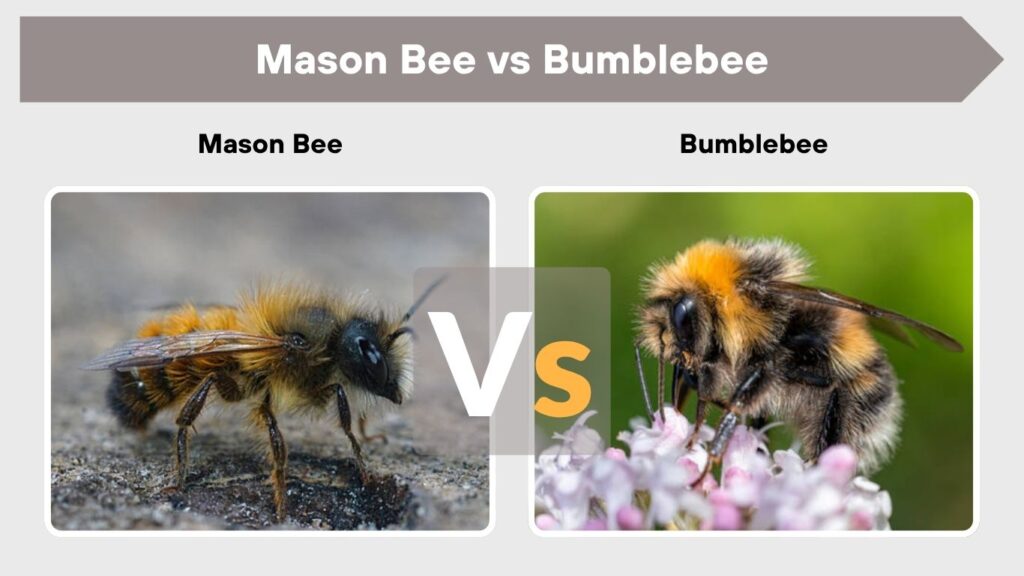
Mason bees and bumblebees are both helpful pollinators, but they are easy to separate once you compare size, body shape, and nesting behavior. Bumblebees are usually much larger, rounder, and very fuzzy. Mason bees are smaller solitary bees that use holes, reeds, tubes, or cracks and seal their nest chambers with mud.
Body Size and Shape
Bumblebees are usually bigger and heavier than mason bees. They often have a round, fuzzy body with yellow, black, orange, or white markings. Mason bees are usually smaller, compact, and less fluffy. Some mason bees look dark blue, black, greenish, or metallic, which can make them look different from common striped bees.
Nest Type
Bumblebees live in small seasonal colonies with a queen and workers. Their nests may be underground, in thick grass, compost piles, bird boxes, or wall cavities. Mason bees do not have a queen-worker colony. Each female builds her own nest tunnel and seals each egg chamber with mud.
Sting and Behavior
Both bees are usually peaceful when left alone. Bumblebees may defend their nest if it is disturbed, stepped on, or dug up. Mason bees are less defensive because they do not guard a large colony. Female mason bees can sting, but they rarely do unless handled roughly.
Mason Bee vs Wasp, Yellow Jacket, and Mud Wasp
Many people mistake mason bees for wasps or yellow jackets because they see small flying insects near holes, flowers, or walls. The best clues are body shape, hair, and behavior. Mason bees are usually fuzzy pollinators, while wasps and yellow jackets often have smoother bodies, narrow waists, and more defensive nest behavior.
Mason Bee vs Wasp
Mason bees are built for collecting pollen. They often look fuzzier and more compact than wasps. Wasps are usually slimmer, smoother, and more predatory. A mason bee visits flowers for pollen and nectar, while many wasps hunt insects or search for sugary foods.
Mason Bee vs Yellow Jacket
Yellow jackets are social wasps and can become defensive around their nests. They often have bright yellow-and-black patterns, smooth bodies, and narrow waists. Mason bees are solitary and much calmer. They do not build large defensive colonies and usually ignore people.
Mason Bee vs Mud Wasp Nest
Mason bees and mud wasps may both use mud, but their nests are different. Mason bees seal chambers inside small holes or tubes. Mud wasps often build visible mud nests on walls, under eaves, or in sheltered places. Mud wasps also stock prey for their young, while mason bees provide pollen and nectar.
Mason Bee vs Fly or Hoverfly
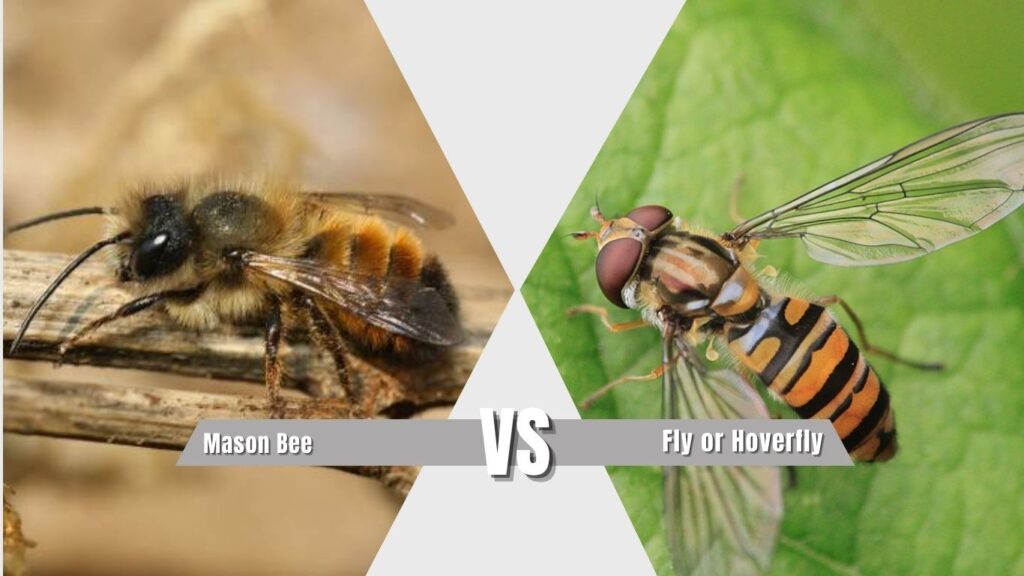
Mason bees and hoverflies can both visit flowers, so they are sometimes confused. Hoverflies are flies that mimic bees for protection. They do not sting and do not make bee nests. Mason bees are true bees, collect pollen for their young, and may use nesting tubes or natural cavities.
Hoverfly vs Orchard Mason Bee
An orchard mason bee has two pairs of wings, longer antennae, and pollen-carrying hairs. A hoverfly has only one pair of wings, short antennae, and very large eyes. Hoverflies often hover in one place, while mason bees move quickly from flower to flower.
Mason Bees vs Flies
Use these quick clues to tell them apart:
- Bees have two pairs of wings
- Flies have one pair of wings
- Bees usually have longer antennae
- Flies often have very large eyes
- Bees collect pollen for their young
- Hoverflies often hover in place
- Flies do not seal nest holes with mud
Male vs Female Mason Bee
Male and female mason bees have different roles during the nesting season. Males usually emerge first in spring and wait near nest sites for females. Females do the nesting work. They collect pollen and nectar, lay eggs, build mud walls, and seal the tunnel entrance.
Male Mason Bee
Male mason bees are often smaller than females. In some species, males may have lighter facial hairs. Males do not build nest cells, collect food for young, or sting. Their main role is to mate with females after emergence.
Female Mason Bee
Female mason bees are responsible for nesting. A female finds a suitable tunnel, gathers pollen and nectar, lays an egg, and builds a mud wall. She repeats this until the tunnel is full. Females can sting, but they are very gentle and rarely sting people.
Mason Bee Drone vs Worker
The word “drone” is usually used for male honey bees. Mason bees do not have workers like honey bees do. A male mason bee is simply a male solitary bee. A female mason bee does her own nesting work without a worker colony.
Mason Bee vs Mining Bee, Sweat Bee, and Other Solitary Bees
Mason bees are only one type of solitary bee. Many other native bees also live alone and pollinate flowers. Mining bees often nest in the ground, sweat bees may be tiny and metallic, and leafcutter bees use leaf pieces. The best clues are nest location, body shape, and nesting material.
Mining Bee vs Mason Bee
Mining bees usually dig nests in the ground. You may see small soil mounds or holes in bare patches of earth. Mason bees usually use existing cavities, tubes, reeds, or holes in wood. They do not dig long soil tunnels.
Sweat Bee vs Mason Bee
Sweat bees are often small and may be metallic green, blue, or dark. Some nest in the ground, while others use cavities. Mason bees are also sometimes metallic, so identification can be tricky. Nest behavior is often the best clue.
Solitary Bees vs Mason Bees
All mason bees are solitary bees, but not all solitary bees are mason bees. Solitary bees include mason bees, leafcutter bees, mining bees, sweat bees, and many others. Most are beneficial pollinators and should be protected when they are not causing a real problem.
FAQs
Are mason bees and carpenter bees the same?
No, mason bees and carpenter bees are not the same. Mason bees use existing holes and seal nest chambers with mud. Carpenter bees can chew round tunnels into wood. Carpenter bees are usually larger, while mason bees are smaller and more compact.
Do mason bees damage wood like carpenter bees?
Mason bees do not drill into wood or create new holes. They use existing cavities, tubes, reeds, or cracks. Carpenter bees can bore into soft or weathered wood, so round holes and sawdust are stronger signs of carpenter bee activity.
Are mason bees better pollinators than honey bees?
Mason bees are excellent early spring pollinators, especially for fruit trees and garden plants. Honey bees are better for large-scale pollination because they live in big colonies. Both are valuable, but mason bees and honey bees pollinate in different ways.
How can you tell a mason bee from a leafcutter bee?
The easiest clue is the nesting material. Mason bees seal their nest holes with mud. Leafcutter bees use small pieces of leaves or petals. If you see round cuts on leaves and leaf pieces in nest tubes, it may be a leafcutter bee.
Are mason bees dangerous like wasps or yellow jackets?
Mason bees are not dangerous like defensive wasps or yellow jackets. They are solitary, gentle bees and rarely sting. Yellow jackets are social wasps and may defend their nest aggressively. Mason bees usually ignore people when visiting flowers or nest boxes.