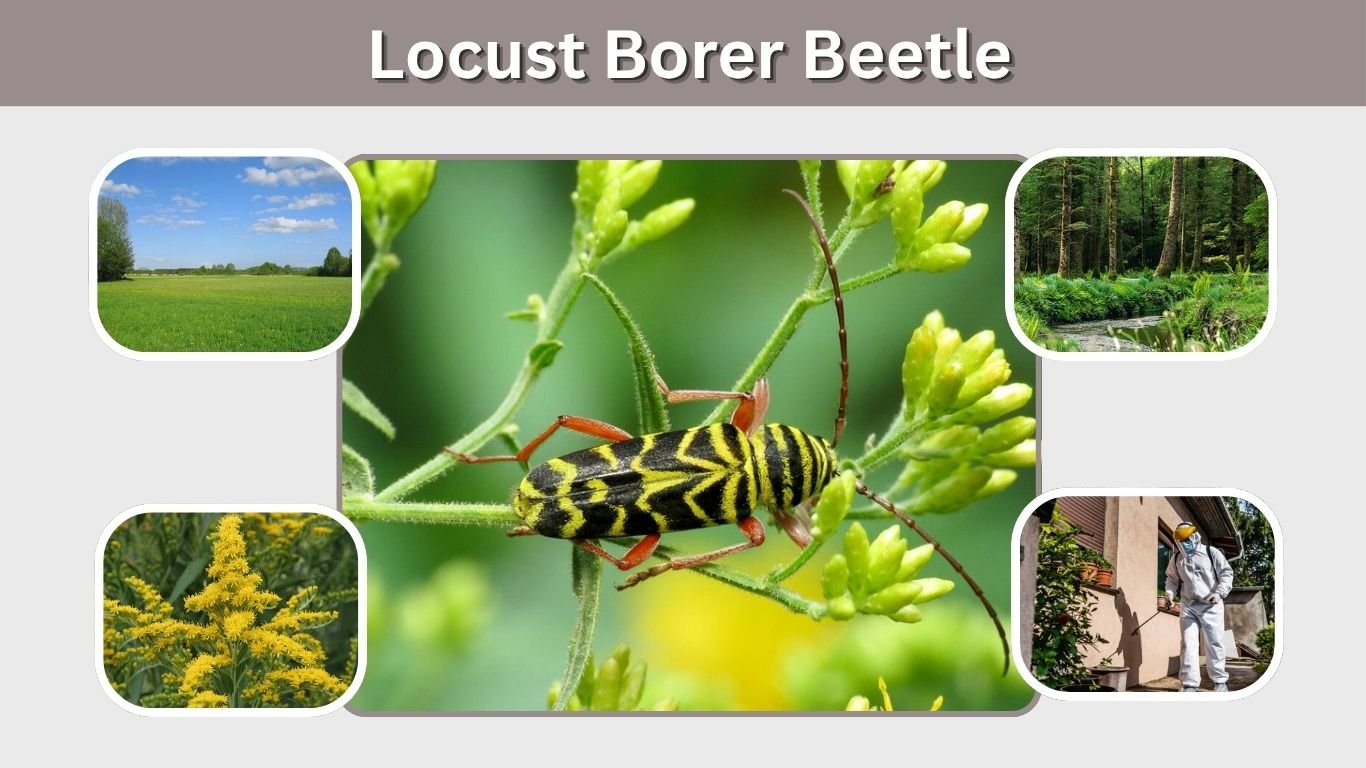
The locust borer (Megacyllene robiniae) is a black-and-yellow longhorn beetle commonly found around black locust trees across North America. Its bright markings resemble those of a wasp, but this beetle is not venomous and generally poses little danger to humans. While adults feed on goldenrod flowers, their larvae tunnel into black locust wood, sometimes causing serious structural damage. Understanding locust borer identification, bite risks, habitat, life cycle, tree damage, and control methods helps homeowners protect valuable trees and distinguish this insect from similar beetles.
What Is a Locust Borer Beetle?
The locust borer is a native North American wood-boring insect belonging to the family Cerambycidae and order Coleoptera. Its scientific name is Megacyllene robiniae.
This species is closely associated with black locust trees (Robinia pseudoacacia), where its larvae develop inside the bark and wood.
Adult locust borers are commonly observed during late summer and early autumn, particularly on flowering goldenrod plants.
Unlike many wood-boring beetles that attack various tree species, the locust borer specializes in black locust and its ornamental cultivars.
Locust Borer Beetle Identification
Locust borer beetles have striking black-and-yellow markings that resemble the coloration of wasps or hornets. Their elongated bodies and long antennae distinguish them from most true wasps.
Although their appearance suggests a stinging insect, locust borers are actually longhorn beetles.
Physical Characteristics
- Size: Adults measure approximately ½–1 inch long.
- Body color: Glossy black with bright yellow markings.
- Wing covers: Yellow bands form a distinctive W-shaped pattern.
- Antennae: Long, black, and segmented.
- Legs: Usually reddish-brown.
- Body shape: Elongated, narrow, and somewhat cylindrical.
- Wings: Hardened outer covers protect the flying wings.
- Activity: Most noticeable during late summer and fall.
Locust Borer Larvae Identification
Locust borer larvae are creamy-white, legless grubs with enlarged front body segments and dark head capsules.
Mature larvae grow approximately 1 inch long and remain concealed inside black locust wood.
Their feeding creates galleries within the trunk and branches. Because larvae rarely leave their tunnels, they are usually discovered when infested wood is cut or split.
Where Do Locust Borers Live?
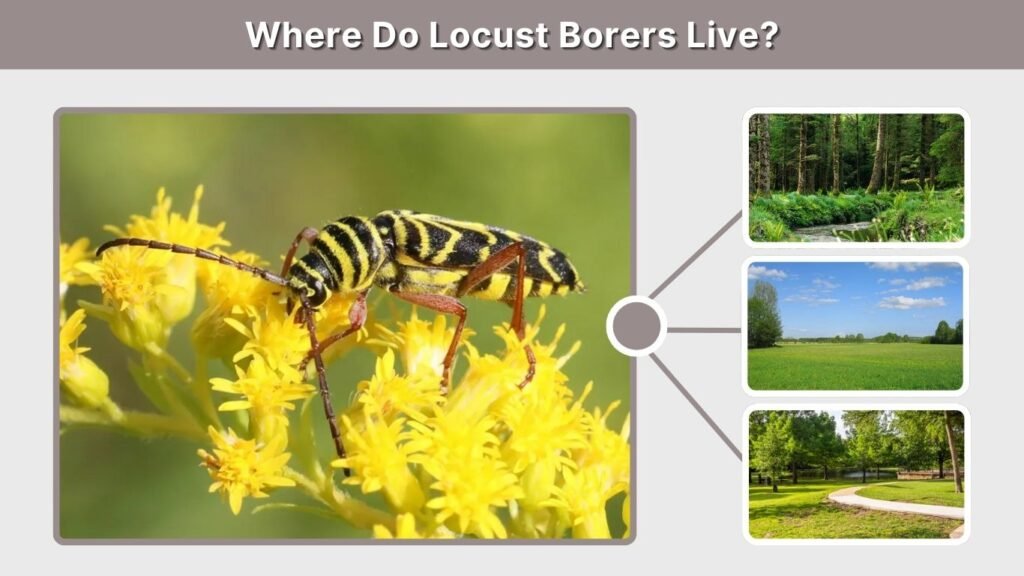
Locust borers occur throughout much of North America, particularly where black locust trees grow naturally or have been planted.
Their distribution includes the eastern United States, portions of the Midwest, and western areas where suitable host trees have become established.
Locust Borer Habitat and Range
Common habitats include woodlands, roadside plantings, open fields, parks, and residential landscapes containing black locust trees.
These beetles occur in states such as Michigan, Ohio, Wisconsin, Pennsylvania, South Carolina, and Texas. They may also occur in Colorado, Montana, and other western locations where black locust has been planted.
Adult beetles frequently visit goldenrod flowers in sunny areas during late summer.
Are Locust Borers Invasive?
The locust borer is native to North America and is not considered an introduced invasive insect within its native range.
However, its distribution has expanded into areas where black locust trees have been planted outside their original range.
Although the beetle can damage trees, it remains part of North America’s native insect fauna.
What Do Locust Borer Beetles Eat?

Locust borers have different feeding habits during their adult and larval stages.
Adults mainly visit flowers, while larvae feed inside black locust trees. The larvae cause nearly all significant tree damage.
Adult Locust Borer Diet
Adult locust borer beetles primarily feed on goldenrod pollen and nectar.
They are often seen crawling across yellow flowers during late summer, where their black-and-yellow bodies blend surprisingly well with the surrounding blossoms.
Their flower visits may also contribute to pollination.
What Do Locust Borer Larvae Eat?
Locust borer larvae feed on tissues inside black locust trees.
Young larvae initially tunnel beneath the bark. As they mature, they bore into deeper woody tissues, creating extensive galleries.
This internal feeding weakens branches and trunks, making heavily infested trees vulnerable to structural damage.
Locust Borer Life Cycle
The locust borer undergoes complete metamorphosis, developing through egg, larva, pupa, and adult stages.
Unlike some wood-boring beetles that require several years to mature, locust borers generally complete one generation annually.
Four Stages of Development
- Egg stage: Female beetles lay eggs in bark crevices and around wounds on black locust trees during late summer and autumn.
- Larval stage: Newly hatched larvae enter the bark and create small chambers where they overwinter. They resume feeding during spring and tunnel deeper into the wood.
- Pupal stage: Mature larvae form pupal chambers within their tunnels during midsummer. Their bodies gradually transform into adults.
- Adult stage: Adult beetles emerge during late summer, feed on goldenrod flowers, mate, and deposit eggs.
When Are Locust Borers Most Active?
Adult locust borers are commonly active from August through October, although emergence varies with temperature and geographic location.
They often feed on flowers during daylight and visit black locust trunks to locate suitable egg-laying sites.
Locust Borer Damage to Black Locust Trees
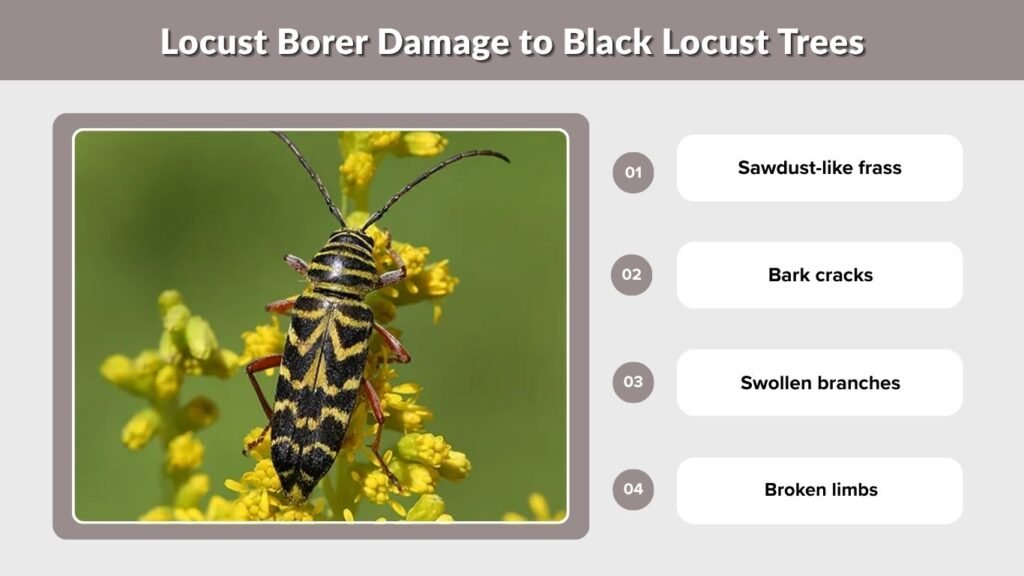
Locust borer larvae can cause significant damage by tunneling through the trunks and branches of black locust trees.
Their galleries weaken internal wood and may interfere with normal tree growth. Repeated infestations can reduce timber quality and increase the risk of branch breakage.
Signs of Locust Borer Infestation
Common warning signs include:
- Sawdust-like frass: Fine wood debris accumulating around bark openings.
- Bark cracks: Openings or damaged areas around larval tunnels.
- Swollen branches: Irregular swellings caused by the tree’s response to injury.
- Broken limbs: Weakened branches may snap during storms.
- Crown dieback: Heavily infested trees may develop thinning or dead branches.
- Exit holes: Openings appear when adult beetles emerge from the wood.
Do Locust Borers Kill Trees?
Severe locust borer infestations can weaken or eventually kill black locust trees.
Young, stressed, or poorly growing trees are particularly vulnerable. Drought, mechanical injuries, and unfavorable soil conditions may increase susceptibility.
Healthy, vigorous trees are generally better able to withstand infestations.
Locust Borer vs. Honey Locust Borer
Locust borers and honey locust borers are different insects that attack different host trees.
The common locust borer (Megacyllene robiniae) attacks black locust, while the honey locust borer (Agrilus difficilis) develops in honey locust trees.
| Feature | Locust Borer | Honey Locust Borer |
| Scientific name | Megacyllene robiniae | Agrilus difficilis |
| Family | Cerambycidae | Buprestidae |
| Adult appearance | Black with yellow bands | Dark metallic, slender |
| Main host | Black locust | Honey locust |
| Larval damage | Tunnels into wood | Tunnels beneath bark |
| Adult activity | Late summer and fall | Late spring through summer |
| Main concern | Structural weakening | Vascular damage and dieback |
Honey Locust Flatheaded Borer Damage
Honey locust borers are flatheaded wood-boring beetles whose larvae develop beneath the bark.
Their feeding creates winding galleries that interfere with the movement of water and nutrients.
Stressed honey locust trees are particularly susceptible, and severe infestations may cause branch dieback or tree decline.
Locust Borer vs. Painted Hickory Borer
The painted hickory borer (Megacyllene caryae) closely resembles the locust borer because both species display yellow markings against a black background.
However, their host trees and seasonal activity provide important identification clues.
| Feature | Locust Borer | Painted Hickory Borer |
| Scientific name | Megacyllene robiniae | Megacyllene caryae |
| Main host | Black locust | Hickory and other hardwoods |
| Adult season | Late summer and fall | Spring |
| Body pattern | Black with yellow bands | Black with yellowish bands |
| Main damage | Living black locust wood | Stressed or recently cut wood |
Painted hickory borers commonly appear during April and May, while locust borers are more frequently observed later in the year.
Do Locust Borer Beetles Bite or Sting?
Locust borer beetles do not sting and are not venomous.
Although their black-and-yellow coloration resembles that of a wasp, they lack the stinging structures found in bees and wasps.
Their chewing mouthparts could potentially deliver a small defensive pinch if handled roughly, but biting humans is not typical behavior.
They are not considered medically dangerous.
Why Is a Locust Borer Beetle in My House?
Locust borers are outdoor insects and do not normally establish household infestations.
An adult may occasionally enter through an open door or window, especially when black locust trees are nearby.
Another possibility is mistaken identification. Painted hickory borers closely resemble locust borers and can emerge from infested firewood brought indoors.
If several beetles appear inside, examining nearby firewood and confirming the insect species is more useful than immediately applying pesticides.
How to Get Rid of Locust Borers
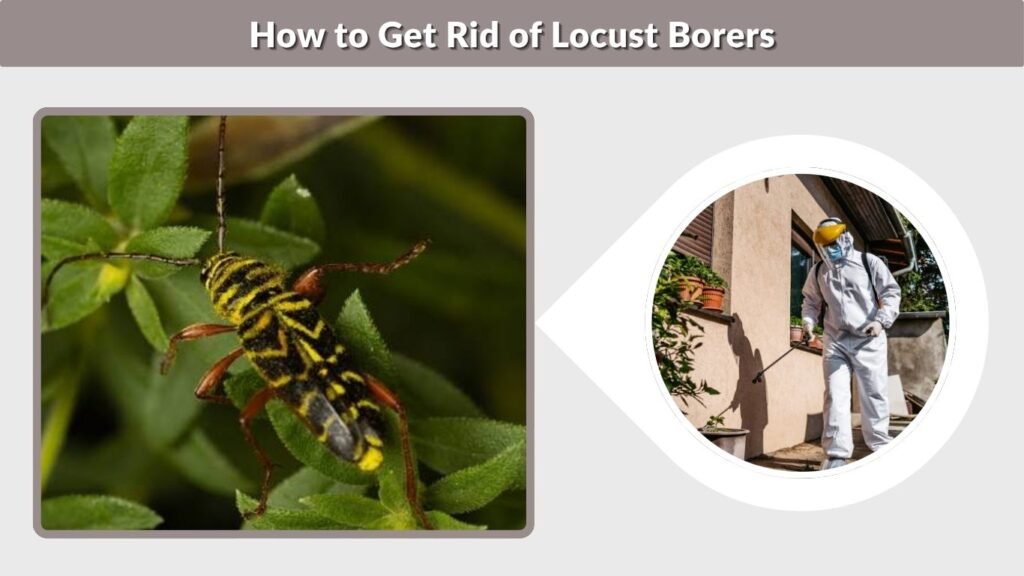
Effective locust borer control focuses on keeping black locust trees healthy, preventing injuries, and managing damaged branches.
Because larvae develop deep inside wood, established infestations are difficult to eliminate with ordinary surface treatments.
Natural Locust Borer Control Methods
- Maintain tree health: Provide sufficient water during extended dry periods.
- Prevent bark injuries: Avoid damaging trunks with lawn equipment.
- Prune damaged branches: Remove seriously infested limbs when appropriate.
- Dispose of infested wood: Chip or otherwise dispose of affected branches according to local recommendations.
- Inspect vulnerable trees: Check bark openings, branches, and trunks for frass.
- Encourage natural predators: Woodpeckers and other wildlife can help reduce borer populations.
- Seek professional assessment: Have severely weakened trees inspected for structural hazards.
Chemical Locust Borer Treatment
Preventive insecticide treatments may help protect valuable black locust trees when applied at the appropriate time.
Treatments generally target adults or newly hatched larvae before they penetrate deeply into the wood.
Once larvae establish themselves inside the heartwood, ordinary bark sprays are unlikely to reach them.
Only use products registered for the identified pest and tree species, following local regulations and label directions. Avoid spraying goldenrod flowers, which are important food sources for pollinators.
FAQs
1. Are Locust Borer Beetles Poisonous?
No, locust borer beetles are not poisonous or venomous. Their yellow-and-black markings imitate the appearance of stinging insects, but they lack stingers. They are generally harmless to humans, although unnecessary handling should be avoided to prevent defensive pinching.
2. Do Locust Borers Attack Purple Robe Locust Trees?
Yes, Purple Robe locust trees can suffer damage from locust borers. These ornamental trees are closely related to black locust and are susceptible to borer infestations. Maintaining healthy growth and monitoring trunks for damage can help reduce potential problems.
3. Can Locust Borers Damage Redbud Trees?
The true locust borer primarily attacks black locust trees and does not normally infest redbuds. If similar-looking beetles appear on a redbud, they may be visiting flowers or nearby vegetation. Accurate identification is necessary before assuming an infestation.
4. What Animals Eat Locust Borer Beetles?
Woodpeckers are important natural enemies of locust borers because they can locate larvae inside damaged wood. Other insect-eating birds and predators may consume exposed adults. Natural predators help regulate populations but may not prevent serious infestations in vulnerable trees.
5. Can Locust Borers Be Found in Firewood?
Yes, locust borer larvae can remain inside infested black locust wood after a tree is cut. However, beetles emerging from mixed hardwood firewood may be painted hickory borers instead. These insects generally do not establish infestations in dry household structures.