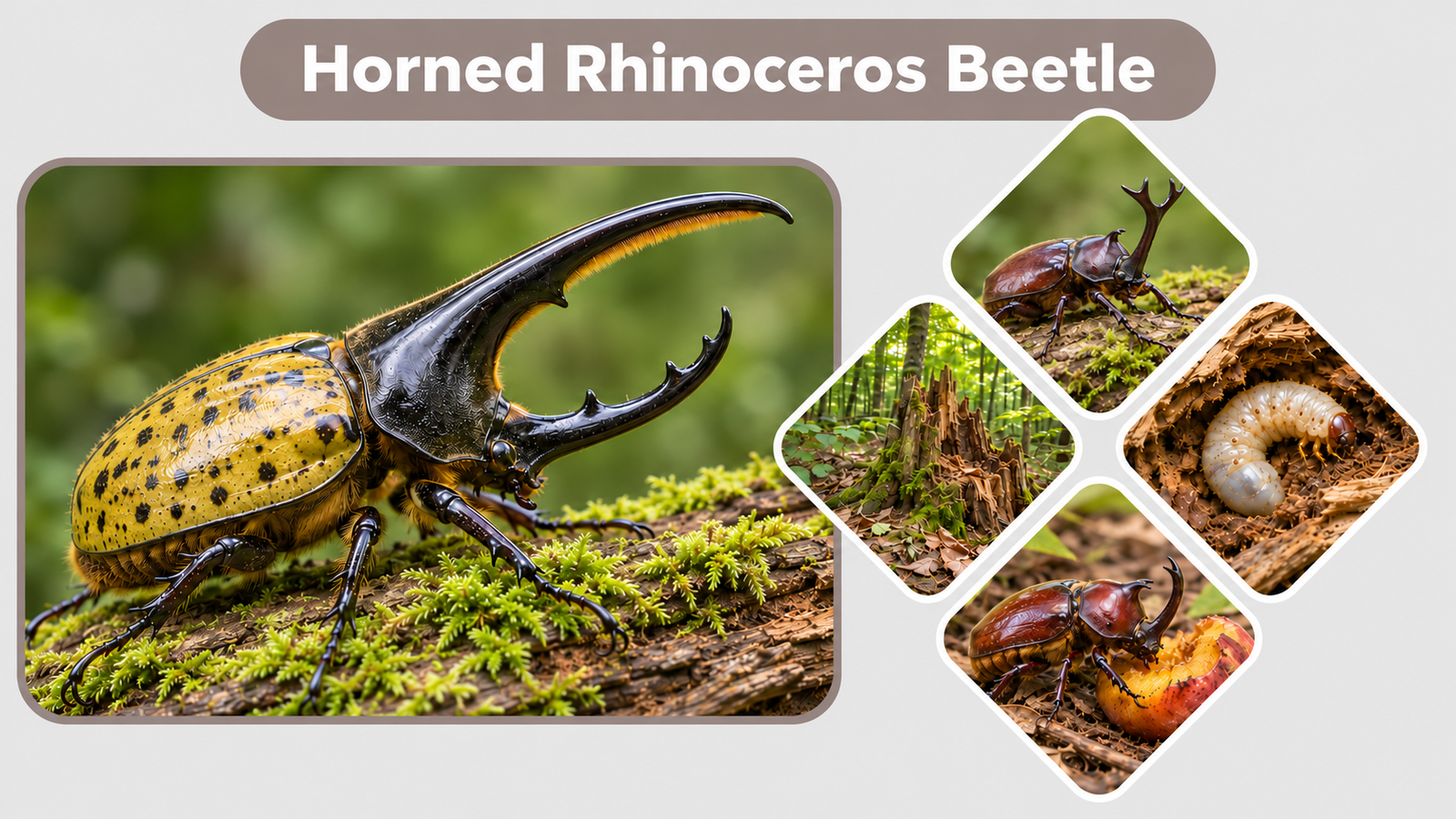
A horned rhinoceros beetle can be easy to recognize and surprisingly hard to identify. Its thick body and prominent horn give it a distinctive shape, but several beetle species share those features. A long, forked horn may point to a Japanese rhinoceros beetle, while a spotted beetle with two opposing horns in the eastern United States may be an eastern Hercules beetle. Where you found the beetle matters as much as what it looks like. This guide explains how to identify these insects, what they eat, why males have horns, and when a beetle sighting might signal a problem.
What Is a Horned Rhinoceros Beetle?
The name horned rhinoceros beetle refers to beetles in the subfamily Dynastinae, part of the scarab beetle family. The group includes Hercules beetles, elephant beetles, ox beetles, and the Japanese rhinoceros beetle. Many species have a bulky body, strong legs, and a head or thorax that bears a horn. Males typically have the most prominent horns. Females often have a smooth head or a small bump, although horn development varies by species.
How to Identify a Rhinoceros Beetle
- Body shape: Look for a broad, rounded body with a thick section behind the head.
- Horn position: Check whether the horn grows from the head, the thorax just behind it, or both.
- Horn shape: Record whether the horn is straight, curved, forked, or paired with another horn.
- Wing covers: Note whether they are glossy black, reddish brown, olive, or marked with dark spots.
- Size: If possible, estimate both the body length and the full length including the horn.
- Location: Record where you found it. The country or state often narrows the possibilities more than color alone.
Male vs. Female Rhinoceros Beetles
Start by comparing the head and thorax. In many familiar species, a male has a long horn and a female has a small bump or an unarmed head. Horn size can vary considerably among males of the same species, so a short horn alone gives you limited information. In the coconut rhinoceros beetle, both sexes can have a visible horn, which makes it especially important to use other features.
Some females also differ from males in color or surface texture. For example, a female Hercules beetle is generally dark, while males often have lighter wing covers with dark markings. Compare those traits with the beetle’s location before settling on an identification.
Common Types of Horned Rhinoceros Beetles
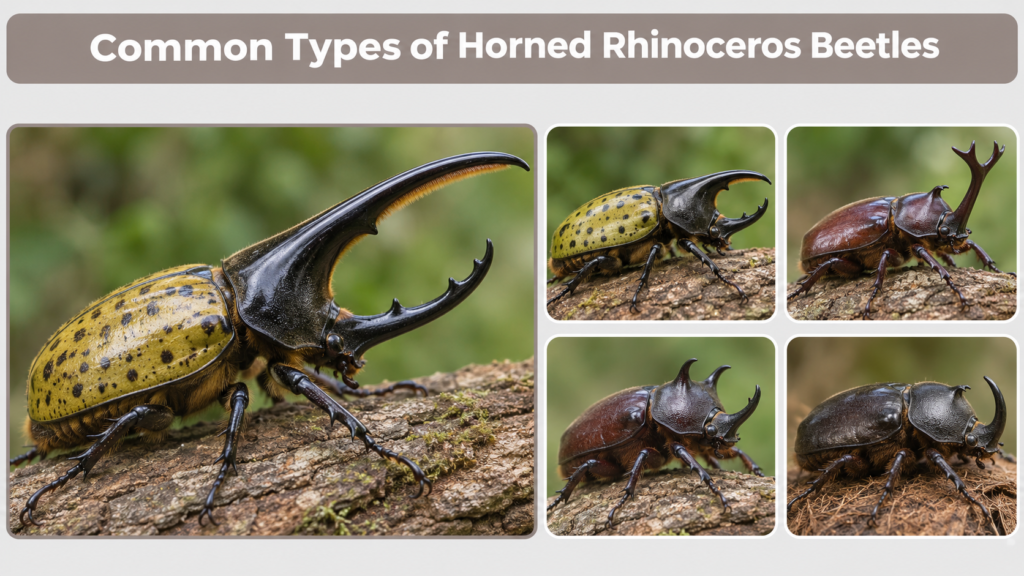
Rhinoceros beetles occur across much of the world, especially in tropical regions. The table compares five species people commonly encounter in photos or identification guides. Horn descriptions refer to typical males unless otherwise noted.
| Beetle | Scientific name | Typical range | Useful identification clue |
|---|---|---|---|
| Hercules beetle | Dynastes hercules | Central and South America and parts of the Caribbean | Two long horns project forward like pincers |
| Eastern Hercules beetle | Dynastes tityus | Eastern and central United States | Paired horns and often olive or tan wing covers with dark spots |
| Japanese rhinoceros beetle | Trypoxylus dichotomus | East Asia | Long head horn with a forked tip |
| Ox beetle | Strategus aloeus | Southern United States and parts of tropical America | Large males often have three projections on the thorax |
| Coconut rhinoceros beetle | Oryctes rhinoceros | Native to parts of Asia and introduced elsewhere, including Pacific islands | Dark body and a single curved head horn that can occur in both sexes |
How Big Do Rhinoceros Beetles Get?
Size varies widely. A large male Hercules beetle can reach around 6 inches (15 centimeters) in total length, with the horns accounting for a substantial portion. Other species are considerably smaller. Two beetles may have similar body lengths and look very different in a side-by-side photo because one has a much longer horn.
For a useful size comparison, measure from the front of the head to the tip of the abdomen, then take a second measurement that includes the horn. If the beetle is alive, you can photograph it beside a ruler while it rests on a flat surface.
Where Do Horned Rhinoceros Beetles Live?
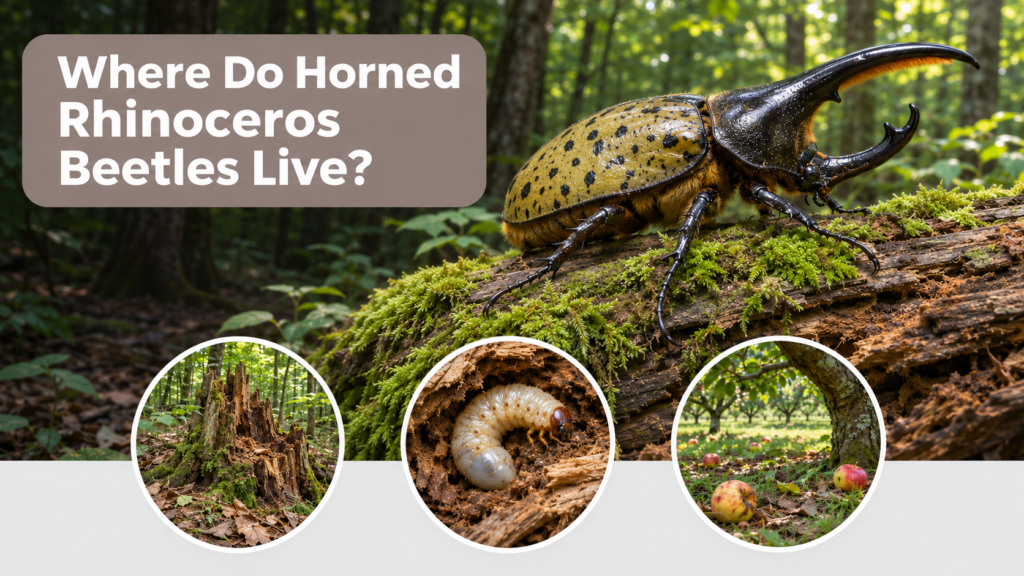
Depending on the species, rhinoceros beetles live in forests, wooded yards, orchards, and other places with suitable food and breeding material. A single beetle may use several parts of a habitat during its life. An adult might feed at a sap flow on a living tree, while its larvae develop inside a nearby rotting stump.
Where Adults and Grubs Are Found
Many adults are active after dark and shelter during the day. Some fly to porch lights, so a beetle on a doorstep may have arrived from nearby woodland. Their hard outer wing covers lift to reveal the folded flight wings underneath. Even large, heavy-looking adults can fly.
Grubs are more likely to turn up when you break apart a rotten log, move old wood chips, or turn a compost pile. A rhinoceros beetle grub is typically thick and cream-colored, with a brown head and a body that curls into a C shape. Many other scarab grubs look similar. The material around the grub can provide a clue, but species identification usually requires a closer look.
What Do Horned Rhinoceros Beetles Eat?
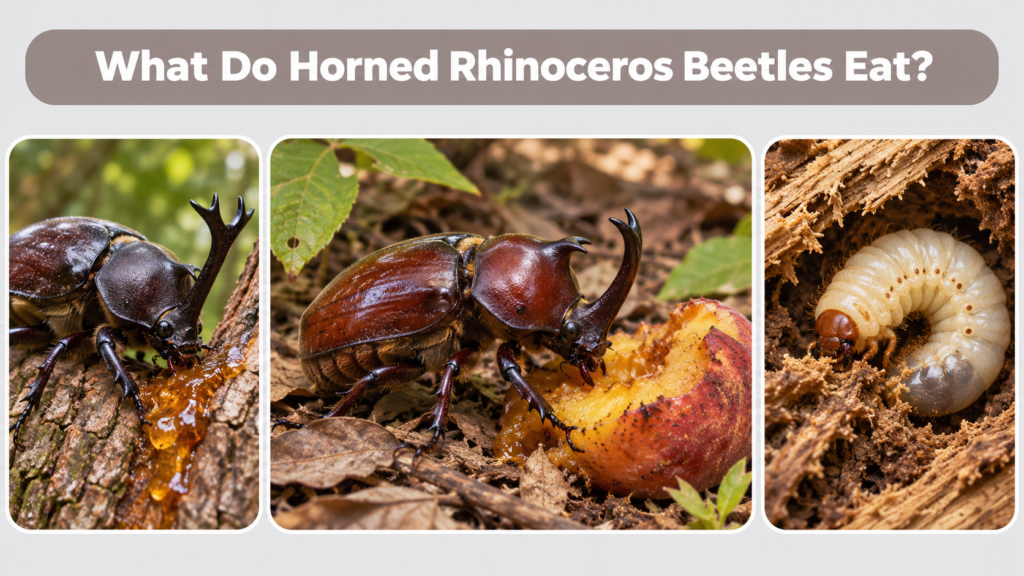
Diet depends on the species and life stage. Adults of familiar forest species often feed on tree sap or ripe and fallen fruit. The larvae of many species develop on decaying wood or other decomposing plant material. These food sources explain why adults and grubs are often found in different places.
Adult Beetle Diet
Sap can collect at tree wounds and attract several beetles to the same spot. Fallen fruit can also provide food once it softens. In the Japanese rhinoceros beetle, shared feeding sites have another role. Males compete for positions at sap flows that attract females.
The coconut rhinoceros beetle has a different feeding habit. Adults bore into the crowns of living palms and feed on developing tissue. As damaged fronds unfold, they can reveal characteristic V-shaped cuts. This feeding behavior is one reason identifying the species matters when you find a horned beetle near coconut or oil palms.
What Rhinoceros Beetle Larvae Eat
Many rhinoceros beetle larvae feed as they tunnel through soft, decaying wood. Others develop in leaf litter, compost, or decomposing plant debris. Their feeding helps break down organic material. The size of a full-grown grub can be surprising, especially in larger species such as the Hercules beetle.
Finding a grub in compost gives you a reason to check what it is feeding on before deciding whether it is a pest. A grub deep inside a crumbling log and a grub found among damaged lawn roots may look alike at first glance. Their surroundings provide important context.
Rhinoceros Beetle Life Cycle and Lifespan
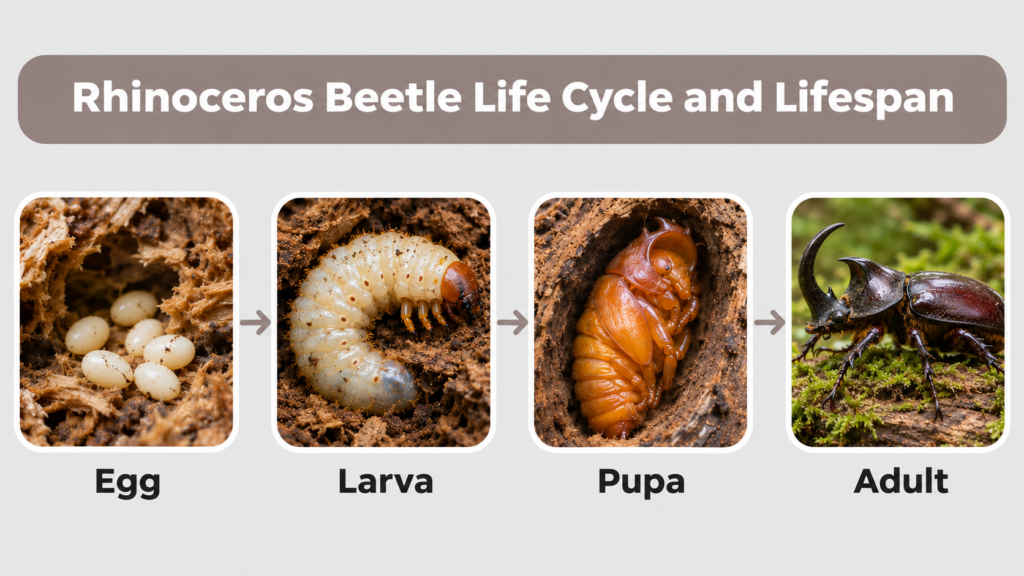
Rhinoceros beetles pass through four stages: egg, larva, pupa, and adult. Development time varies with species, temperature, and food quality. The larval stage can last many months and may extend beyond a year in some larger species. Adult life can last several months, with substantial variation among species and conditions.
From Egg to Adult
The female lays eggs in material that can support her offspring, such as rotten wood or decomposing plant debris. After hatching, the larva feeds and sheds its outer skin as it grows. A well-fed grub may eventually become much heavier than its appearance as a new hatchling would suggest.
When ready to pupate, the larva forms a chamber in the material around it. Inside, it develops the legs, wings, and other features of an adult beetle. A newly emerged adult is initially soft and may remain sheltered as its outer covering hardens. That sheltered period makes the beetle easy to miss even in a spot where it has been developing for months.
Why Do Rhinoceros Beetles Have Horns?
Male rhinoceros beetles use their horns mainly in contests with other males. Depending on the species, a male can slide its horn beneath a rival, lift it, and push it off a branch, trunk, or feeding spot. A Japanese rhinoceros beetle uses its forked horn to get under a rival, while a male Hercules beetle can grip another beetle between its two opposing horns. The shape of the horn helps explain how each species fights.
Are Horned Rhinoceros Beetles Dangerous or Harmful?
Rhinoceros beetles do not sting or use their horns to deliver venom. A beetle may grip firmly with its hooked feet if you pick it up. If one is trapped indoors, an easy way to move it is to let it crawl onto a piece of cardboard or into a container.
Most chance encounters involve a beetle passing through or visiting a light. Repeated sightings around palms, especially alongside fresh V-shaped cuts in emerging fronds, warrant closer identification because the coconut rhinoceros beetle can damage the growing crown. A single beetle near a porch light or a grub in decaying wood often has a different explanation.
Frequently Asked Questions
Is a Hercules beetle a rhinoceros beetle?
Yes. Hercules beetles belong to the rhinoceros beetle subfamily. The name Hercules beetle often refers to Dynastes hercules, while the eastern Hercules beetle is a separate species, Dynastes tityus.
Can female rhinoceros beetles have horns?
Yes. Females of many species have a bump or a much smaller projection than males. Female coconut rhinoceros beetles can have a clearly visible horn.
Can horned rhinoceros beetles fly?
Yes. Adults fly using thin hind wings tucked beneath their hard wing covers. Some species fly at night and are attracted to outdoor lights.
Do rhinoceros beetles bite people?
Bites are uncommon. If a beetle grips your skin with its feet, the small hooks can feel like a pinch. Letting it walk onto a surface makes it easier to release.
Why did I find a rhinoceros beetle near my house?
An outdoor light may have attracted it. Nearby trees, old stumps, or decaying plant material can also explain why rhinoceros beetles live in the area.