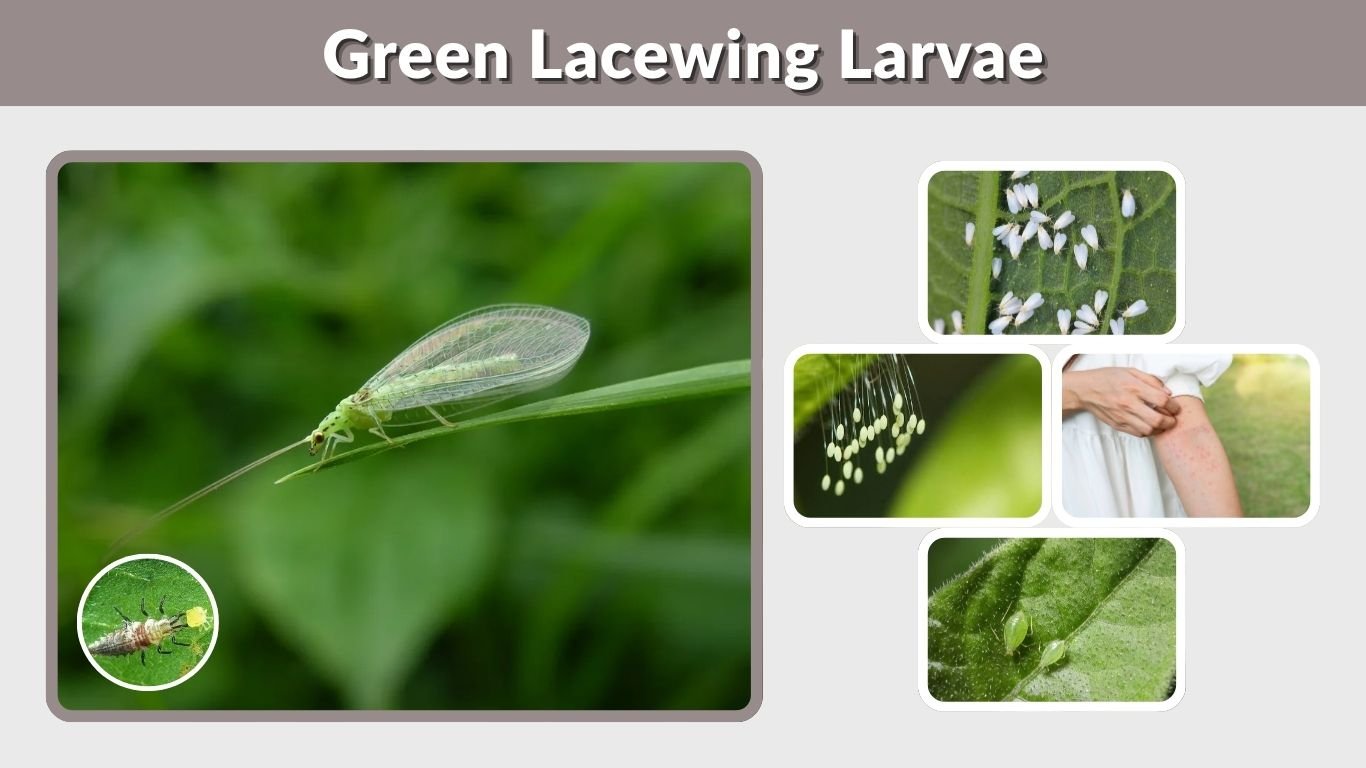
Green lacewing larvae are among the most useful predatory insects found in gardens, farms, greenhouses, and landscapes. Although the delicate green adults look harmless, their larvae are aggressive hunters equipped with large, curved jaws for capturing small pests. Because they consume aphids, mealybugs, whiteflies, thrips, mites, insect eggs, and other soft-bodied prey, gardeners often call them “aphid lions.”
Green lacewing larvae may look intimidating, and some even cover themselves with pieces of debris as camouflage. However, they are primarily beneficial insects. Understanding what they look like, what they eat, whether they bite, and how their life cycle works can help you recognize and protect these valuable garden predators.
What Are Green Lacewing Larvae?
Green lacewings belong to the insect family Chrysopidae within the order Neuroptera. The larva is the immature stage between the egg and pupa.
Unlike the graceful winged adult, a lacewing larva has an elongated body, long legs, and prominent curved mouthparts. It spends most of its time searching vegetation for prey.
The larval stage is especially valuable for pest control because it actively hunts other arthropods.
Quick Identification
Green lacewing larvae typically have:
- An elongated, somewhat flattened body
- Cream, tan, gray, or brownish coloration
- Dark or reddish markings
- Three pairs of legs
- Large curved, sickle-shaped jaws
- A tapered abdomen
- Short hairs or bristles along the body
- Fast movement compared with many caterpillars
Despite their name, green lacewing larvae are not necessarily green. The familiar pale-green coloration usually becomes obvious in the adult stage. College of Agricultural Sciences
What Do Green Lacewing Larvae Look Like?
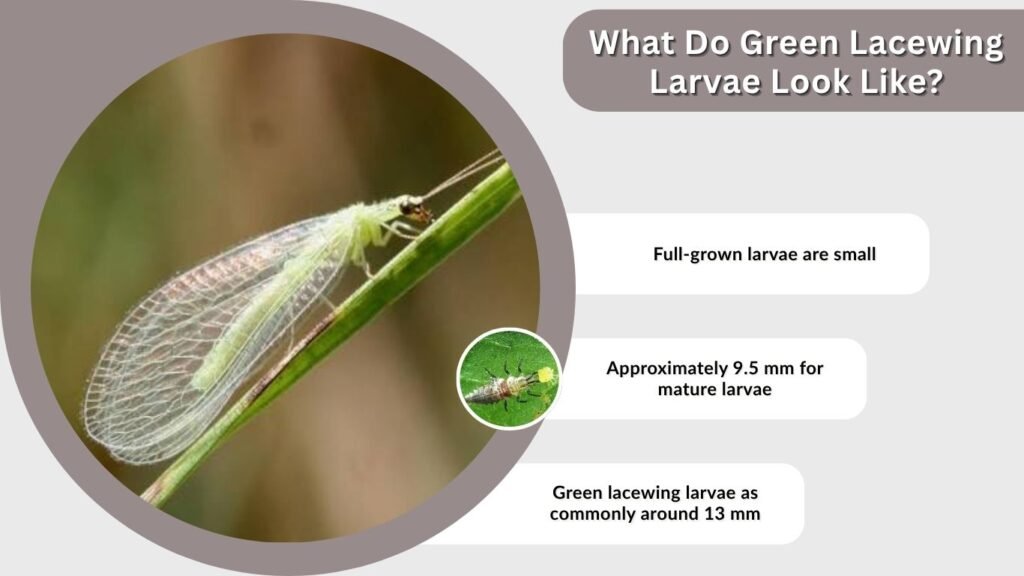
A green lacewing larva can initially resemble a tiny alligator, beetle larva, or caterpillar. The easiest identifying feature is the pair of long jaws extending forward from its head.
These jaws are designed for predation rather than chewing leaves. The larva grabs prey and feeds through its specialized mouthparts.
Full-grown larvae are small. Utah State University reports approximately 9.5 mm for mature larvae, while Colorado State University describes green lacewing larvae as commonly around 13 mm, or about half an inch, illustrating some variation among species and descriptions.
| Feature | Green Lacewing Larva | Adult Green Lacewing |
|---|---|---|
| Body | Elongated, alligator-like | Slender |
| Typical color | Tan, cream, brownish | Pale green |
| Wings | None | Two pairs |
| Jaws | Large and curved | Much less conspicuous |
| Main role | Predator | Varies by species |
| Common location | On plants near prey | Plants, flowers, lights |
What Do Green Lacewing Larvae Eat?
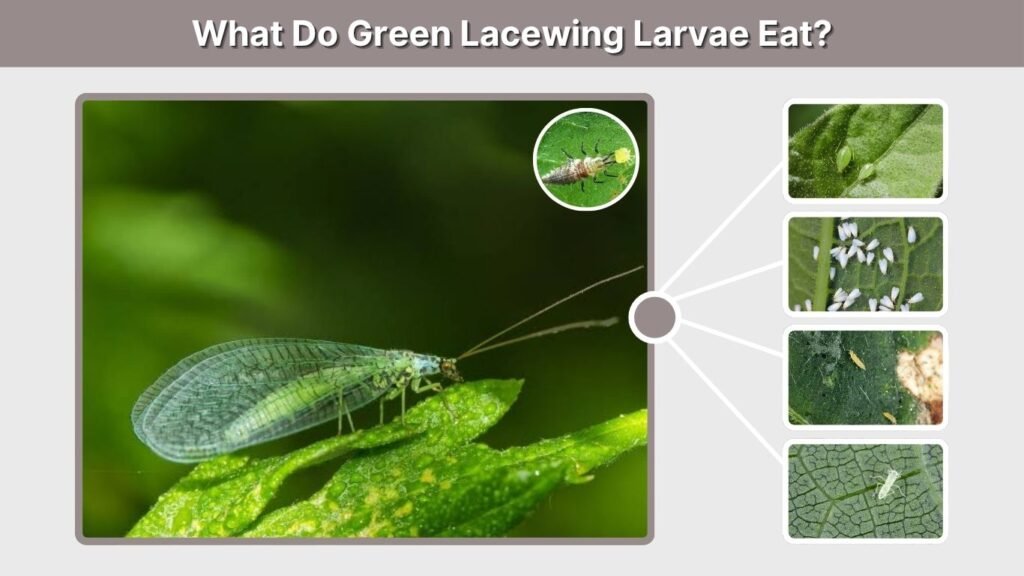
Green lacewing larvae are generalist predators, meaning they can attack several kinds of small arthropods rather than depending on a single prey species.
Their diet commonly includes:
- Aphids
- Mealybugs
- Whiteflies
- Thrips
- Spider mites and other mites
- Scale insects
- Leafhoppers
- Psyllids
- Small caterpillars
- Beetle larvae
- Insect eggs
They may even become cannibalistic when food is scarce or populations are crowded.
Green Lacewing Larvae and Aphid Control
Aphids are among their best-known prey. This is why lacewing larvae are often called aphid lions.
They move across leaves and stems searching for aphid colonies, grasp individual aphids with their curved jaws, and feed on them. University of Minnesota Extension notes that lacewing larvae can consume large numbers of aphids during their larval life.
Because of this appetite, lacewings are important natural enemies of aphids in gardens and agricultural systems.
How Do Green Lacewing Larvae Kill Their Prey?
Their jaws are much more than simple pincers.
Lacewing larvae use paired, curved mouthparts to seize small prey. Digestive saliva is introduced, helping liquefy the prey’s internal tissues so the larva can consume the contents.
This feeding style makes them efficient predators of small, soft-bodied pests.
They may wander continuously across vegetation, raising and moving their heads while searching for something they can capture.
Debris-Carrying Green Lacewing Larvae
One of the strangest forms is the debris-carrying lacewing larva, sometimes nicknamed a junk bug.
These larvae place material on their backs, which can include:
- Plant fragments
- Bits of bark
- Lichen
- Insect remains
- Empty aphid skins
- Other environmental debris
Their bodies have specialized hairs that help hold this material in place.
Why Do They Carry Debris?
The debris functions primarily as camouflage and protection.
Instead of looking like an exposed insect larva, the predator may resemble a tiny moving piece of plant litter. This can make it harder for predators—or even some prey—to recognize it. Debris-carrying behavior occurs in certain green lacewing larvae and is one of their most remarkable adaptations.
If you see a tiny pile of debris slowly walking across a leaf, take a closer look before assuming it is dirt.
Do Green Lacewing Larvae Bite Humans?
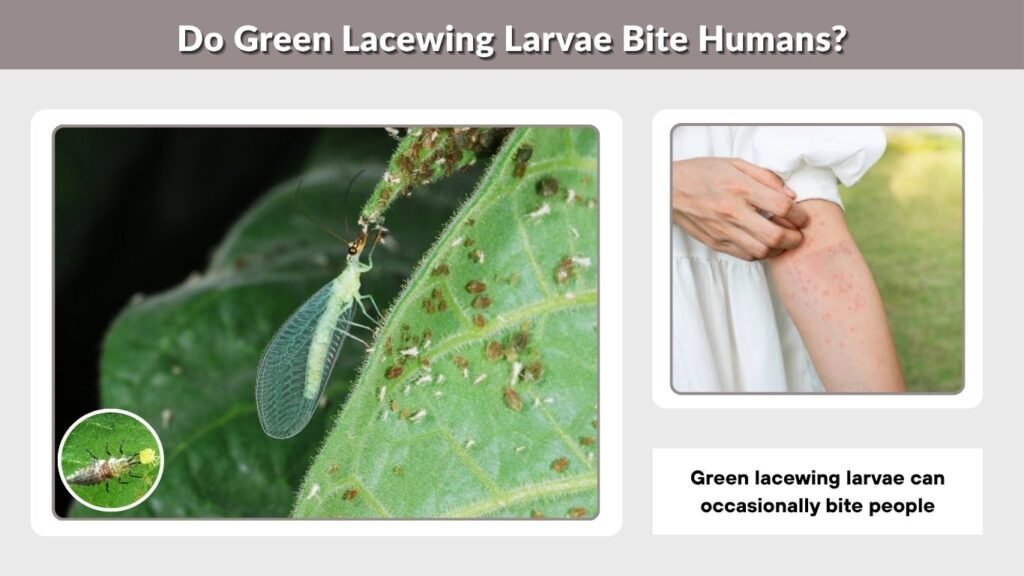
Green lacewing larvae can occasionally bite people, but such bites are uncommon and generally minor.
They do not seek humans as food and do not feed on blood. Accidental bites may happen when a larva becomes trapped against the skin or is handled. University of Kentucky notes that such bites are rare and typically cause only minor skin irritation, while Mississippi State University describes a mild, short-lived stinging sensation.
What Does a Green Lacewing Larvae Bite Feel Like?
Possible effects can include:
- Brief stinging
- Mild redness
- Localized itching
- Minor irritation
Texas A&M entomology information also documents occasional human bites and notes that irritation may result from saliva introduced during feeding behavior.
You generally do not need to worry about lacewing larvae you see on plants. Avoid pressing or handling them directly, and allow them to continue hunting pests.
Can a Lacewing Bite Cause an Allergic Reaction?
Most reported lacewing larva bites produce only temporary localized irritation. Severe reactions are not regarded as a normal consequence of these encounters.
If unusual or significant symptoms develop after any insect bite, particularly symptoms that extend beyond minor local irritation, appropriate medical evaluation is sensible.
Green Lacewing Larvae Life Cycle
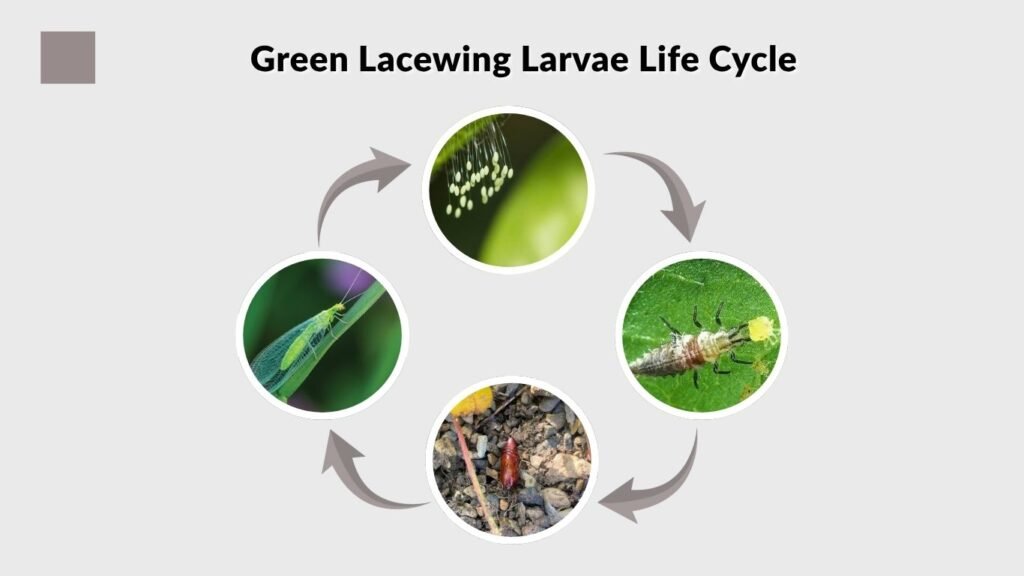
Green lacewings undergo complete metamorphosis, passing through four distinct stages:
Egg → Larva → Pupa → Adult
In warm conditions, development from egg to adult can take roughly four to six weeks, although temperature, species, and environmental conditions affect the timing. UC IPM
Eggs
Green lacewing eggs are especially distinctive.
Females typically place individual eggs at the ends of slender stalks attached to leaves or other surfaces. The eggs are very small and can initially appear white, yellowish, or greenish.
Females frequently lay eggs where prey is available, giving newly hatched larvae immediate access to food.
Larvae
After hatching, the larvae begin hunting.
They pass through three larval instars and may remain larvae for roughly two to three weeks under suitable conditions. Utah State University Extension
This is typically the most important predatory stage.
Pupa
A mature larva creates a small silken cocoon and pupates inside it. The cocoon may appear as a small pale or whitish sphere attached to protected vegetation.
Adult
The adult eventually emerges with a slender green body, long antennae, prominent eyes, and large transparent wings containing a delicate network of veins.
Depending on the species, adults may consume nectar, pollen, honeydew, or insects.
Green Lacewing Larvae in the House
Finding an occasional green lacewing larva indoors usually does not mean your house is infested.
A larva may accidentally enter:
- Through an open window
- On houseplants
- Through doors or screens
- On cut flowers or garden produce
Adults are also attracted to lights and sometimes wander indoors.
Lacewings do not normally establish damaging household infestations. If you find a larva inside, you can gently move it outdoors onto vegetation rather than killing it.
Green Lacewing Larvae for Garden Pest Control
Because they hunt many common plant pests, green lacewing larvae are commercially produced for biological pest control, especially in greenhouses and smaller growing systems.
They may be useful against pests such as:
- Aphids
- Mealybugs
- Thrips
- Whiteflies
- Mites
- Scale insects
Their broad diet makes them useful when several soft-bodied pest species are present at the same time.
Buying and Releasing Green Lacewing Larvae
Green lacewings may be sold commercially as eggs or live larvae. When purchasing them, choose the life stage based on how quickly pest control is needed.
Larvae are already active predators and begin searching for prey after release.
When releasing commercially purchased lacewings:
- Follow the supplier’s release rate.
- Place them close to pest populations.
- Distribute them among affected plants.
- Avoid broad-spectrum insecticides around release sites.
- Ensure prey is available.
- Manage ants when they are protecting aphid colonies.
Ants can interfere with lacewing biological control because some ants defend aphids against predators. Colorado State University specifically notes the importance of ant management when releasing lacewing larvae.
Are Green Lacewing Larvae Good or Bad?
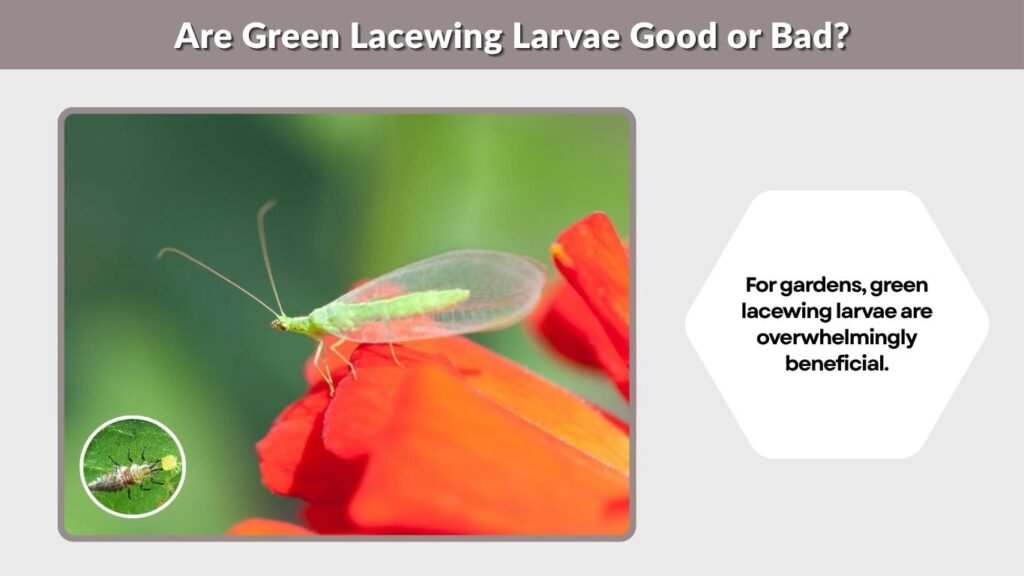
For gardens, green lacewing larvae are overwhelmingly beneficial.
They do not feed on healthy plant foliage. Instead, they actively hunt organisms that can damage plants.
Their major benefits include:
- Natural aphid control
- Whitefly predation
- Mealybug control
- Thrips predation
- Consumption of mites
- Feeding on insect eggs
- Reducing reliance on pesticides
Preserving naturally occurring lacewings can therefore be an important part of integrated pest management. Flowering plants can also support adult natural enemies by providing nectar and pollen.
FAQs
What do green lacewing larvae look like?
Green lacewing larvae are small, elongated predators with six legs, tapered bodies, dark markings, and large curved jaws extending from the head. Despite the name, the larvae are often tan, cream, gray, or brown rather than bright green. College of Agricultural Sciences
What do green lacewing larvae eat?
They primarily eat small arthropods such as aphids, mealybugs, whiteflies, thrips, mites, scale insects, leafhoppers, small caterpillars, and insect eggs. Their broad prey range makes them valuable biological-control predators.
Do green lacewing larvae bite?
They can occasionally bite people, particularly when trapped against the skin or handled. Such bites are rare and generally cause only brief stinging, redness, or minor irritation. They do not normally seek humans or feed on blood.
How big are green lacewing larvae?
Full-grown larvae are generally around 3/8 to 1/2 inch long, although size varies among species. They have elongated bodies and unusually prominent curved jaws for their small size.
Why do some green lacewing larvae carry debris?
Certain species cover their backs with plant fragments, insect remains, and other debris. This material acts as camouflage and helps conceal the larva while it moves through vegetation hunting prey.