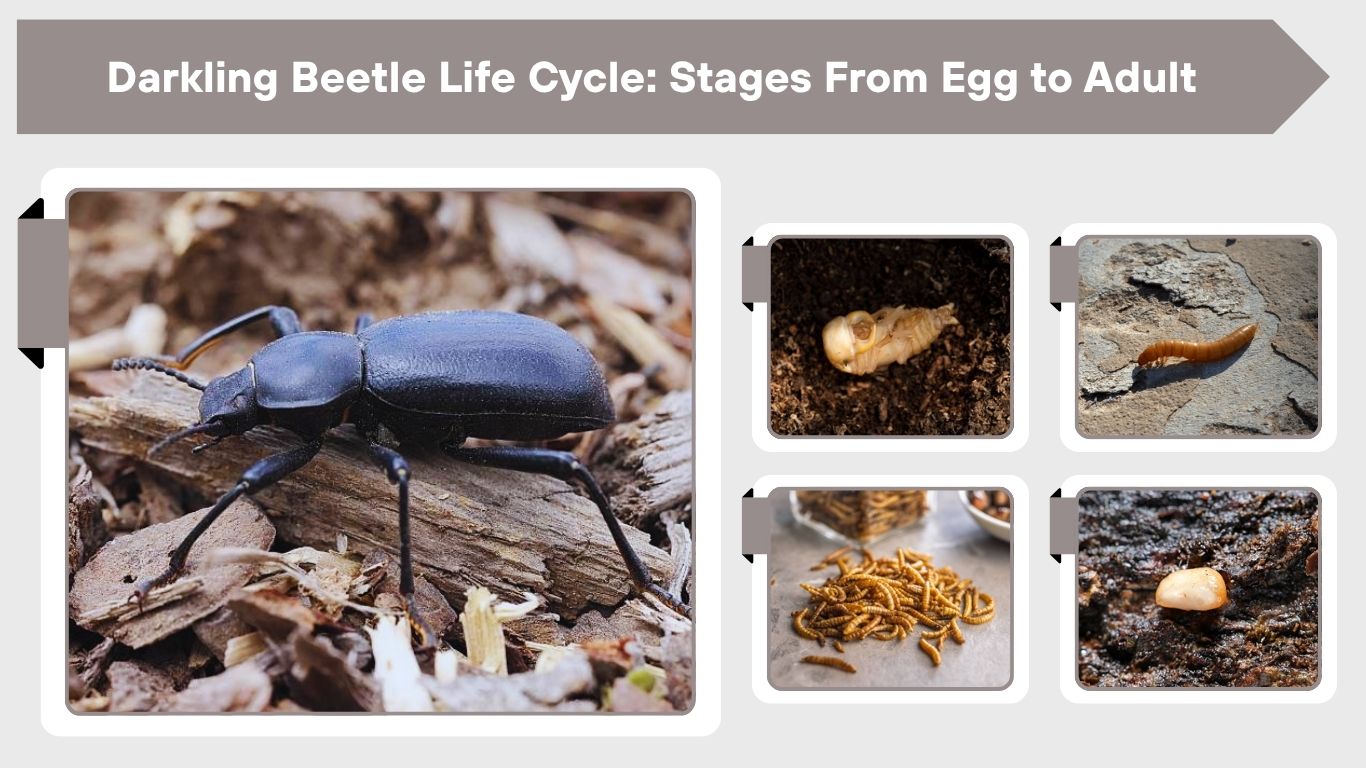
The darkling beetle life cycle is a fascinating example of complete metamorphosis, where an insect transforms through four distinct stages before reaching adulthood. These beetles are commonly found in nature, classrooms, and even pet care environments because of their connection to mealworms.
Understanding their life cycle is important for students, researchers, and anyone dealing with insects, whether for educational or practical purposes. Each stage plays a unique role in growth, survival, and reproduction, making the darkling beetle a great model for studying insect development.
What Is a Darkling Beetle?
Darkling beetles belong to the Tenebrionidae family, a large group of insects found in many parts of the world. They are typically dark brown or black in color and are known for their hard outer shell and slow movement.
One of the most well-known examples of darkling beetles is the adult form of mealworms. What many people call “mealworms” are actually the larval stage of these beetles.
These insects are commonly found in soil, under rocks, in decaying plant matter, and in stored grains. They play an important role in breaking down organic materials and recycling nutrients in the environment.
Darkling Beetle Life Cycle Explained
The life cycle of a darkling beetle follows a process called complete metamorphosis. This means the insect passes through four separate stages, each with a different form and function.
The four stages are: egg, larva, pupa, and adult. Each stage is essential for development, and the transformation between stages is dramatic.
Unlike insects that gradually grow into adults, darkling beetles completely change their body structure at each phase. This process allows them to adapt to different roles, such as feeding, growing, and reproducing.
Stages of the Darkling Beetle Life Cycle

Egg Stage
The life cycle begins when a female darkling beetle lays eggs in a suitable environment. These eggs are usually placed in soil, grain, or other organic materials where food is readily available for the larvae once they hatch.
The eggs are tiny, white, and difficult to see without close inspection. A single female can lay dozens to hundreds of eggs over time, increasing the chances of survival for the species.
Depending on environmental conditions such as temperature and humidity, the eggs typically hatch within a few days to a couple of weeks. Warmer conditions usually speed up the hatching process.
Larva Stage (Mealworm Stage)
After hatching, the beetle enters the larval stage, commonly known as the mealworm stage. This is the longest and most active part of the life cycle.
The larvae are elongated, segmented, and yellowish-brown in color. They have a hard outer surface and resemble small worms, which is why they are often called mealworms.
During this stage, the larvae focus on feeding and growing. They consume organic materials such as grains, decaying plants, and other nutrient-rich substances. As they grow, they shed their outer skin multiple times in a process called molting.
This stage can last several weeks to a few months, depending on environmental factors. The larva stores energy during this time, which is essential for the next stage of development.
Pupa Stage
Once the larva has grown enough, it enters the pupa stage. This is a transformation phase where the insect undergoes major internal and external changes.
The pupa does not feed or move much during this stage. Instead, its body is reorganizing to form the adult beetle. The appearance changes significantly, with the development of legs, wings, and other adult features.
This stage usually lasts from one to several weeks. Environmental conditions, especially temperature, play a big role in how quickly the transformation is completed.
Adult Beetle Stage
After the pupal stage, the adult darkling beetle emerges. At first, the beetle may appear lighter in color, but it gradually darkens as its outer shell hardens.
Adult beetles are more focused on reproduction than feeding. They mate and lay eggs, starting the life cycle again. While they do eat, their feeding activity is less intense compared to the larval stage.
Adult darkling beetles can live for several months, depending on their environment. During this time, they continue the cycle by producing the next generation.
How Long Is the Darkling Beetle Life Cycle?
The length of the darkling beetle life cycle can vary depending on environmental conditions, but it generally takes anywhere from 8 weeks to several months to complete.
Each stage has a different duration. The egg stage is usually the shortest, lasting from a few days to about two weeks. The larva stage, however, is the longest and can continue for several weeks or even months, depending on temperature and food availability.
The pupa stage typically lasts one to three weeks, while the adult stage can last several months. Warmer temperatures and a steady food supply usually speed up development, while colder conditions slow the process down.
Darkling Beetle Life Cycle Diagram (Explained)
The life cycle of a darkling beetle follows a simple circular pattern, which can be visualized step by step.
It begins with eggs laid in soil or organic material. These eggs hatch into larvae, which feed and grow over time. After reaching full size, the larvae transform into pupae, where major body changes occur. Finally, adult beetles emerge, reproduce, and lay new eggs to restart the cycle.
This continuous cycle allows darkling beetles to survive and adapt in different environments, especially where food sources are available.
Mealworm and Darkling Beetle Life Cycle Connection

One of the most interesting aspects of the darkling beetle life cycle is its connection to mealworms.
Mealworms are not a separate species—they are actually the larval stage of darkling beetles. This stage is widely used in science classrooms, pet feeding, and even farming because of its high nutritional value.
As mealworms grow, they eventually stop feeding and enter the pupal stage. After completing transformation, they emerge as adult darkling beetles. This connection makes it easier for people to observe the full life cycle in a controlled environment.
Factors That Affect the Life Cycle

Several environmental factors can influence how quickly or slowly a darkling beetle develops.
Temperature
Temperature is one of the most important factors. Warmer conditions speed up development, allowing the insect to move through its life stages more quickly. In colder environments, the process slows down significantly.
Food Availability
A steady supply of food helps larvae grow faster and healthier. Limited food sources can delay development and reduce survival rates.
Humidity
Moderate humidity levels are ideal for development. Extremely dry or overly moist conditions can negatively affect eggs and larvae.
Environment
Clean, stable environments promote healthy growth, while crowded or disturbed conditions may impact the life cycle. Controlled environments, like laboratories or farms, often produce faster and more predictable results.
Interesting Facts About the Darkling Beetle Life Cycle
The darkling beetle life cycle includes several unique features that make it interesting for study and observation.
- They undergo complete metamorphosis, just like butterflies
- The larva (mealworm) stage is the longest and most active
- They can adapt to dry environments, especially desert regions
- A single female can lay hundreds of eggs during her lifetime
These traits make darkling beetles highly adaptable and successful in many environments.
FAQs
What is the life cycle of a darkling beetle?
The darkling beetle goes through four stages: egg, larva, pupa, and adult. Each stage has a unique role in development, allowing the insect to grow, transform, and reproduce effectively.
How long does a darkling beetle life cycle take?
The full life cycle usually takes between 8 weeks and several months. Factors like temperature, food supply, and environment can speed up or slow down the process.
Are mealworms the same as darkling beetles?
Mealworms are actually the larval stage of darkling beetles. They eventually transform into pupae and then into adult beetles as part of their life cycle.
Where do darkling beetles lay eggs?
Female darkling beetles lay their eggs in soil, grain, or organic materials. These locations provide food and protection for the larvae after they hatch.
Why is the larva stage important?
The larva stage is the main feeding and growth phase. During this time, the insect stores energy needed for transformation into the adult stage, making it the most critical part of the life cycle.