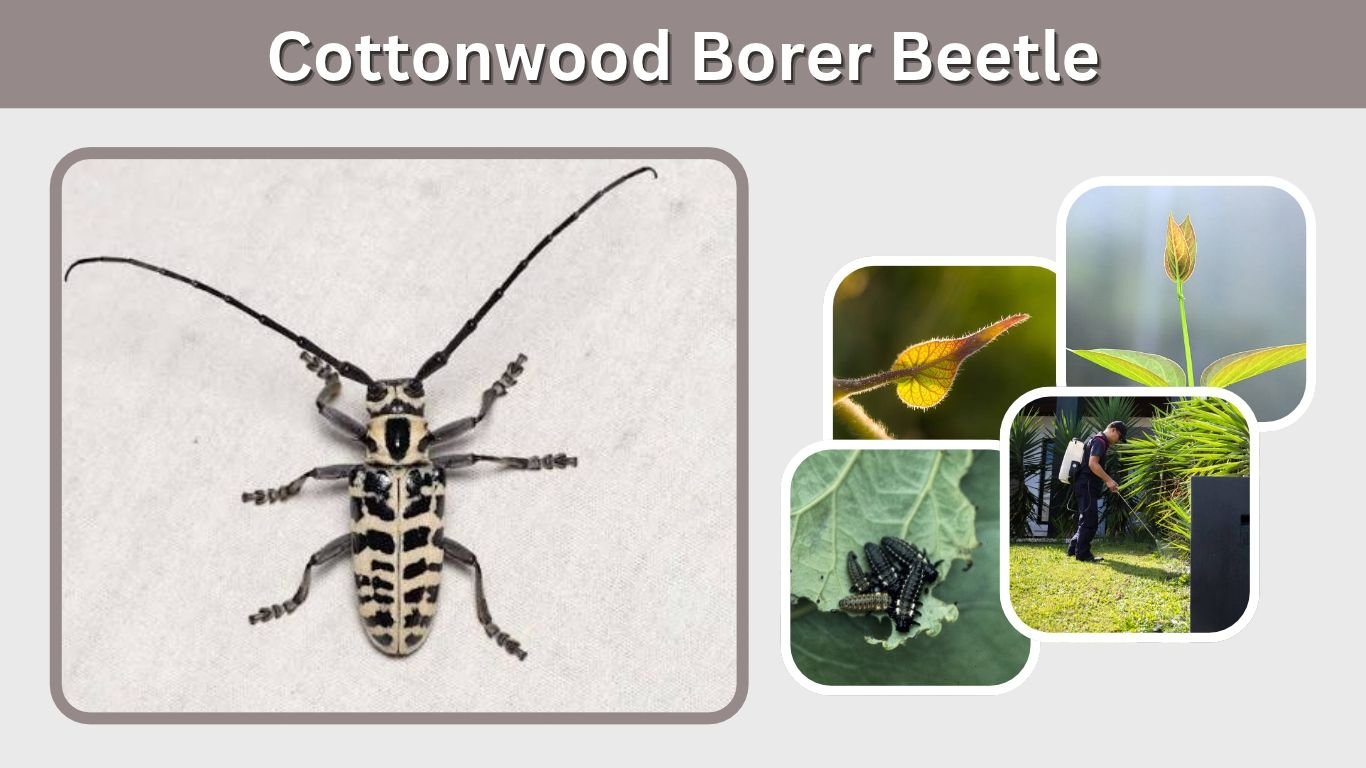
The cottonwood borer (Plectrodera scalator) is a large black-and-white longhorn beetle found throughout parts of the United States. Its striking checkered pattern and extremely long antennae make it one of the most recognizable beetles associated with cottonwood trees. Although adults mainly feed on tender shoots, their larvae can cause serious damage by tunneling into tree roots and lower trunks. Cottonwood borers are especially common in Texas, Oklahoma, and surrounding regions. Understanding their appearance, life cycle, feeding habits, and control methods can help protect vulnerable trees from infestations.
What Is a Cottonwood Borer?
The cottonwood borer is a wood-boring beetle belonging to the family Cerambycidae, commonly called longhorn beetles. Its scientific name is Plectrodera scalator.
This species is native to North America and primarily attacks cottonwood, poplar, and willow trees.
Adult beetles are often seen during summer, while their larvae develop inside the roots and lower trunks of living trees.
Although cottonwood borers are not dangerous to humans, heavy larval infestations can weaken young trees and increase their risk of breaking.
What Does a Cottonwood Borer Look Like?
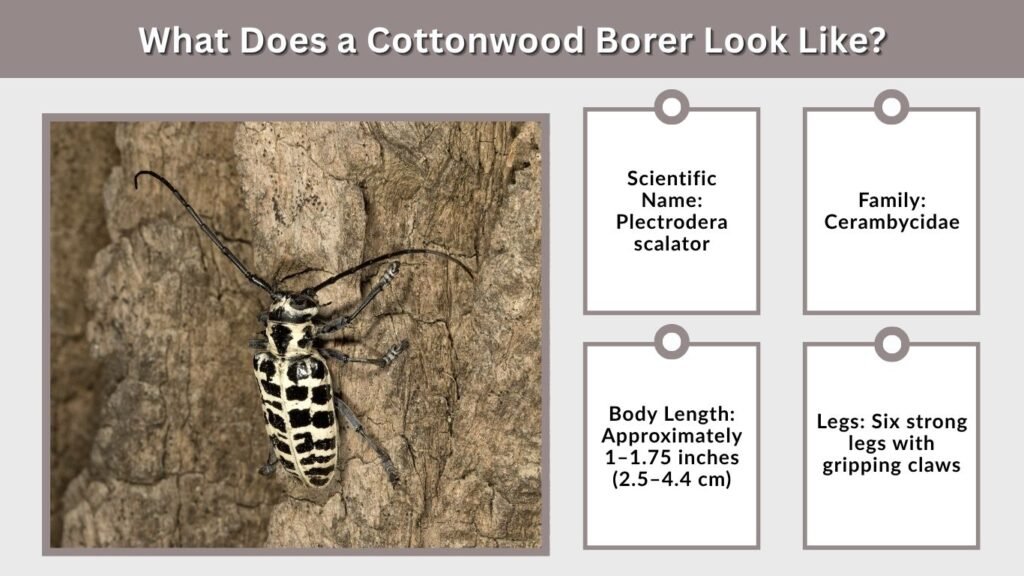
Cottonwood borers are large, elongated beetles with distinctive black-and-white markings. Their bodies display irregular patches of black surrounded by dense white hairs, creating a checkered appearance.
Their unusually long antennae are another important identification feature.
Cottonwood Borer Identification
- Scientific Name: Plectrodera scalator
- Family: Cerambycidae
- Body Length: Approximately 1–1.75 inches (2.5–4.4 cm)
- Body Color: Black with irregular white patches and stripes
- Antennae: Long, segmented, and approximately as long as the body or longer
- Legs: Six strong legs with gripping claws
- Wings: Hardened black-and-white wing covers protecting functional flight wings
- Body Shape: Elongated, robust, and slightly cylindrical
Male cottonwood borers generally have proportionally longer antennae than females.
Where Do Cottonwood Borer Beetles Live?
Cottonwood borers inhabit areas containing suitable host trees, particularly cottonwoods growing along rivers, streams, and floodplains.
Their geographic distribution includes much of the eastern and central United States, especially the Great Plains and Mississippi River Valley.
Cottonwood Borers in Texas and Oklahoma
Cottonwood borers are particularly noticeable in Texas and Oklahoma, where cottonwood trees grow along waterways and in natural woodland habitats.
Adults commonly appear from late spring through summer, feeding on young shoots and searching for suitable breeding locations.
They also occur in Kansas, Louisiana, and other states containing cottonwood and poplar trees.
What Do Cottonwood Borers Eat?
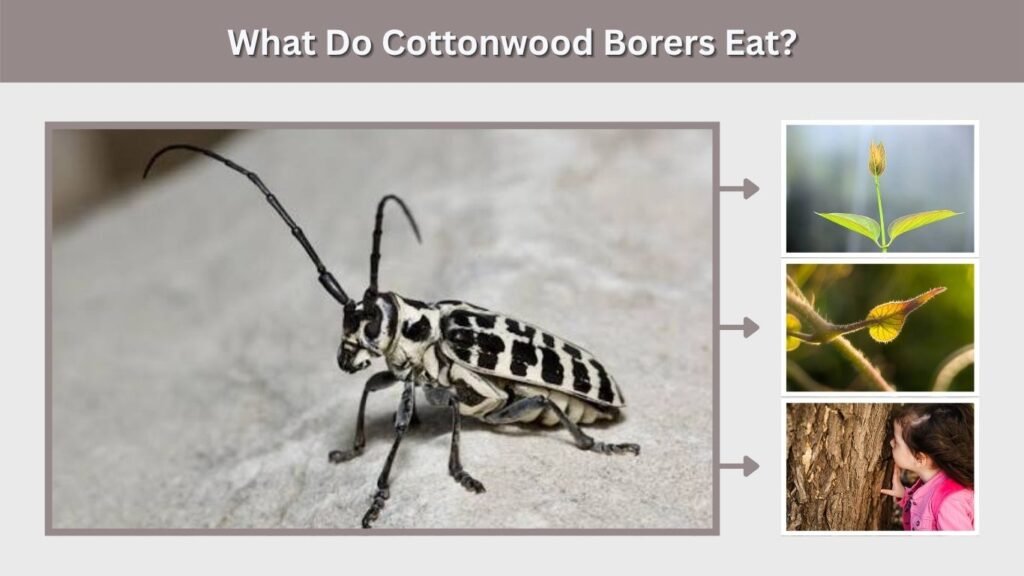
Cottonwood borers feed on living tree tissues, but adults and larvae consume different parts of their host plants.
Adult beetles primarily feed on tender shoots, leaf stalks, and young bark.
Their feeding can cause small branches to shrivel, turn dark, or break.
Larvae cause more serious damage because they tunnel beneath bark and into the wood near tree roots.
Cottonwood is their primary host, although poplars and willows can also support their development.
Cottonwood Borer Life Cycle
Cottonwood borers undergo complete metamorphosis, developing through egg, larva, pupa, and adult stages.
Their life cycle usually takes approximately two years, although development varies with environmental conditions.
Four Stages of Development
- Egg Stage: Female beetles dig around the tree base and deposit eggs in small openings chewed into the bark near or below ground level.
- Larval Stage: Eggs hatch after approximately two to three weeks. The larvae tunnel downward through the inner bark and eventually enter the roots.
- Pupal Stage: Mature larvae create chambers inside their tunnels and transform into pupae, generally during spring.
- Adult Stage: Fully developed beetles emerge from the tree, reach the soil surface, and begin feeding and reproducing.
Adult cottonwood borers generally live for several weeks, while the larval stage occupies most of their development.
What Do Cottonwood Borer Larvae Look Like?
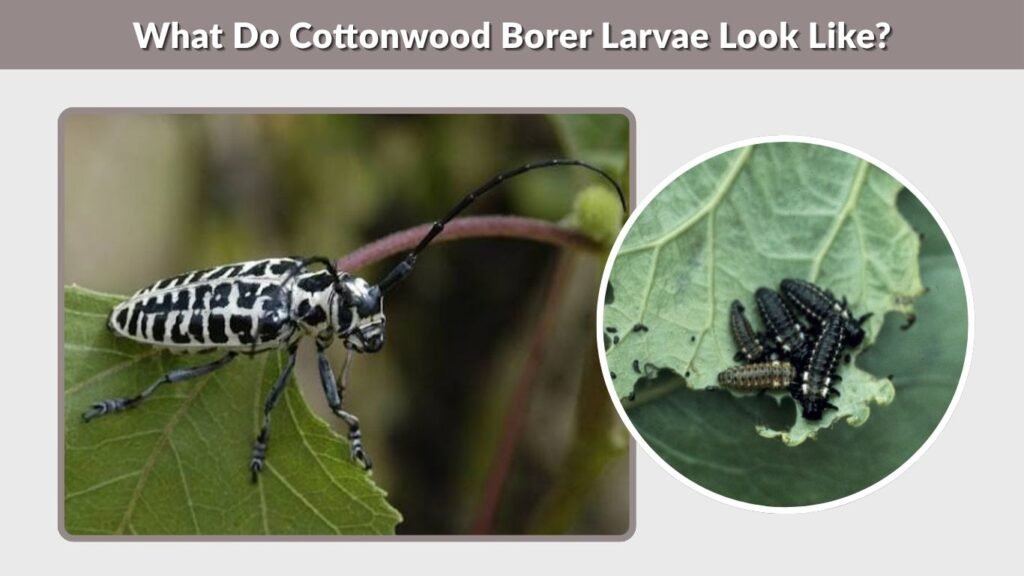
Cottonwood borer larvae are large, pale, legless grubs that develop inside living wood.
Their bodies are creamy white or yellowish, with distinctly segmented, elongated shapes.
Mature larvae may reach approximately 1.5–2 inches long.
Unlike adult beetles, larvae remain mostly hidden underground or inside the tree’s root system.
They use strong mouthparts to tunnel through inner bark and wood, creating galleries that gradually become larger.
These feeding tunnels can weaken the structural connection between the trunk and roots, particularly in younger trees.
What Damage Do Cottonwood Borers Cause?
Cottonwood borer damage occurs mainly near the root collar, where the trunk meets the roots.
Larvae may tunnel through vital tissues and partially or completely girdle young trees, interrupting water and nutrient transport.
Signs of Cottonwood Borer Damage
- Wilting Shoots: Young branches may shrivel or die after adult feeding.
- Sawdust-Like Material: Frass may accumulate around openings near the tree base.
- Root Damage: Larval tunnels weaken major roots and surrounding wood.
- Reduced Growth: Heavily infested young trees may grow poorly.
- Structural Weakness: Damaged trees can break during strong winds.
- Tree Decline: Severe infestations may eventually kill vulnerable trees.
Young cottonwoods in nurseries and plantations are particularly susceptible.
Mature trees often tolerate lighter infestations without immediately displaying serious symptoms.
Do Cottonwood Borer Beetles Bite?
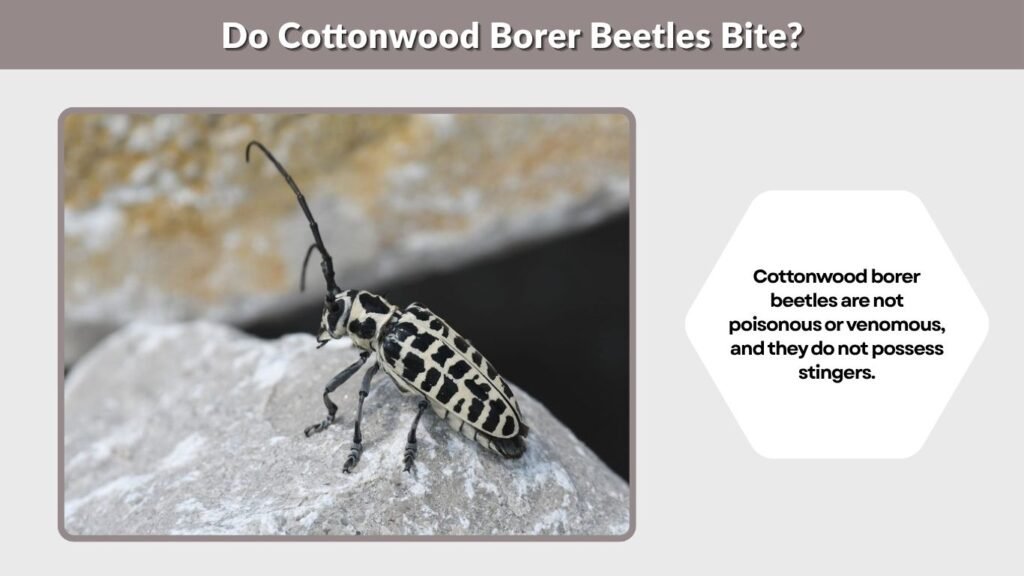
Cottonwood borer beetles are not poisonous or venomous, and they do not possess stingers.
However, adults have strong chewing mouthparts and may deliver a painful pinch if handled or trapped against the skin.
They do not actively seek humans to bite and are primarily concerned with feeding and reproduction.
Are Cottonwood Borers Dangerous?
Cottonwood borers are primarily dangerous to susceptible trees rather than people.
Their larvae can weaken roots and lower trunks, increasing the likelihood of structural failure.
Avoid picking up adult beetles with bare hands. If one enters your home, gently guide it into a container and release it outdoors.
How to Get Rid of Cottonwood Borer Beetles
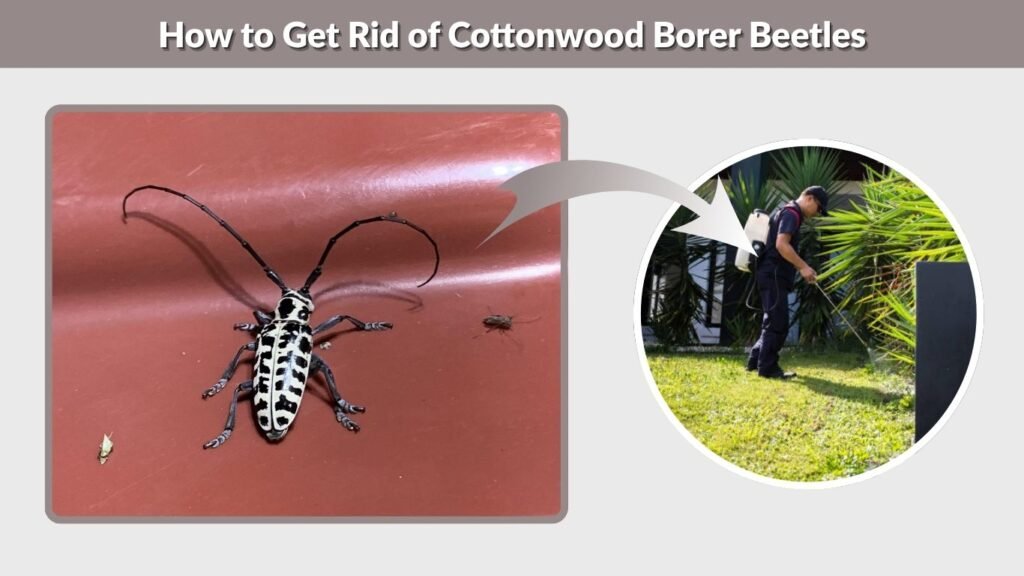
Controlling cottonwood borers requires protecting vulnerable trees and addressing infestations before extensive larval damage develops.
Because larvae remain concealed beneath bark and inside roots, surface insecticide applications may not reach them.
Cottonwood Borer Control Methods
- Inspect Tree Bases: Examine susceptible cottonwood, poplar, and willow trees for frass and damaged bark.
- Maintain Tree Health: Provide appropriate watering and avoid unnecessary environmental stress.
- Protect Young Trees: Monitor recently planted trees during the beetle’s breeding season.
- Remove Adult Beetles: Hand-remove accessible adults when practical, using gloves.
- Avoid Root Injuries: Protect the root collar and major roots from mechanical damage.
- Seek Professional Treatment: Consult a certified arborist about confirmed infestations and locally approved treatments.
- Replace Severely Damaged Trees: Consider professional removal when structural integrity is seriously compromised.
There is no universal insecticide treatment suitable for every infestation. Treatment effectiveness depends on beetle development, tree condition, and product labeling.
Can Cottonwood Borer Beetles Fly?
Yes, adult cottonwood borer beetles can fly. Their functional hindwings remain folded beneath their hardened wing covers when they are resting.
Adults use flight to locate host trees, food sources, and potential mates.
Despite their relatively large bodies, they can move between trees during the warmer months.
Cottonwood borers may also produce faint squeaking sounds when disturbed, a behavior found in various longhorn beetles.
FAQs
1. Are Cottonwood Borer Beetles Poisonous?
No, cottonwood borer beetles are not poisonous or venomous. They do not have stingers and generally pose little danger to humans. However, their strong mouthparts may cause a painful pinch if they are handled roughly.
2. Do Cottonwood Borer Beetles Live in Texas?
Yes, cottonwood borers are found throughout suitable habitats in Texas. They are particularly associated with cottonwood trees growing along rivers and streams. Adults usually become active during late spring and summer when temperatures are favorable.
3. How Long Does a Cottonwood Borer Live?
The cottonwood borer generally requires approximately two years to complete its life cycle. Most of this time is spent developing as a larva inside tree roots and lower trunks. Adults typically survive for several weeks.
4. Can Cottonwood Borers Kill Trees?
Yes, severe cottonwood borer infestations can kill young or weakened trees. Larvae tunnel through roots and lower trunks, potentially girdling vital tissues. Mature trees generally tolerate lighter infestations better, although extensive damage may compromise their structural stability.
5. What Is the Best Treatment for Cottonwood Borers?
The best treatment depends on the severity of the infestation and the tree’s condition. Maintaining tree health, monitoring young trees, and obtaining professional arborist advice are important. Severe infestations may require specialized treatment or removal.