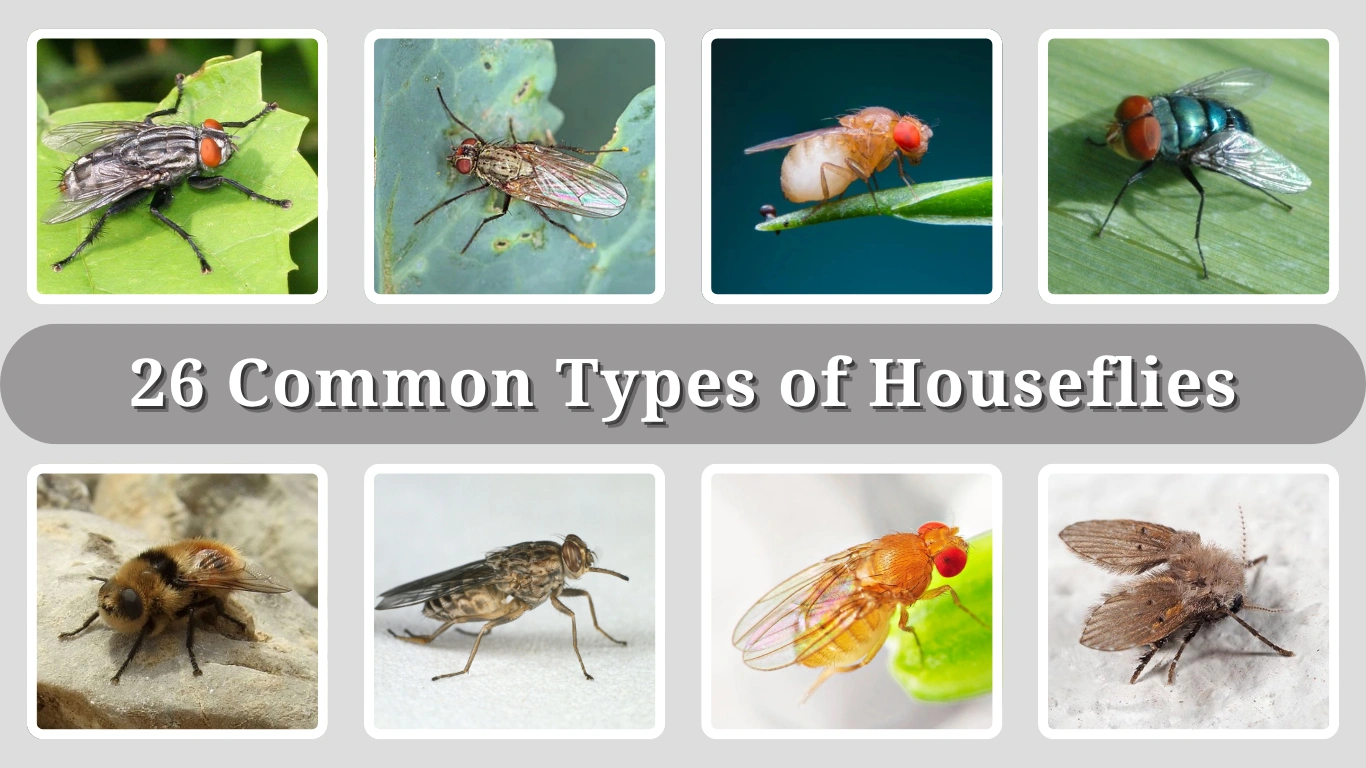
Flies are among the most widespread insects on Earth, found in nearly every environment where humans and animals live. While some species play vital roles in decomposition and pollination, others pose serious health risks by spreading diseases and contaminating food. This guide explores 26 common types of houseflies and related species, detailing their identification traits, habitats, behaviors, and dangers. Understanding these flies not only helps in recognizing infestations but also in adopting effective control and prevention measures for healthier surroundings.
1. House Fly (Musca domestica)

The house fly is the most common fly species found in human habitations worldwide. It is often associated with unsanitary conditions, thriving around waste, garbage, and decaying organic matter. Despite its small size, this insect plays a major role in spreading numerous diseases.
Identification
- Size: 6–7 mm in length
- Color: Grayish body with four dark stripes on the thorax
- Eyes: Large and reddish, especially prominent in males
- Wings: Transparent with minimal veins; wings rest flat over the body when at rest
- Antennae: Short and feathery
Habitat
House flies are found almost everywhere humans live. They prefer warm environments and breed in moist, decaying organic matter such as garbage, manure, and food waste. Indoors, they thrive in kitchens, animal shelters, and waste disposal areas.
Behavior and Feeding
House flies are day-active insects and are attracted to light and odors. They cannot bite; instead, they feed by sponging up liquid or semi-liquid substances, often regurgitating digestive fluids to liquefy solid food before consumption. Their quick flight and short life cycle (typically 2–4 weeks) make infestations hard to control.
Risks and Dangers
House flies are known carriers of over 60 different pathogens, including bacteria like E. coli, Salmonella, and Shigella. They contaminate food and surfaces, leading to food poisoning, diarrhea, cholera, and typhoid fever. Continuous infestations may also lead to serious hygiene issues in both homes and commercial areas.
2. Stable Fly (Stomoxys calcitrans)

The stable fly, also known as the biting house fly, closely resembles the common house fly but differs in one major aspect — it bites humans and animals to feed on blood. This species is a serious pest in livestock environments, causing stress, reduced productivity, and potential disease transmission.
Identification
- Size: 6–8 mm in length
- Color: Grayish body with dark spots on the abdomen
- Mouthparts: Prominent piercing proboscis used for bloodsucking
- Wings: Spread slightly apart when at rest (unlike the house fly)
- Behavioral trait: Often found on the lower parts of animals, especially legs
Habitat
Stable flies prefer warm, moist environments where organic matter and animal waste mix — such as barns, stables, dairy farms, and compost piles. They also breed in decaying vegetation, manure, and wet hay, making livestock facilities ideal for reproduction.
Feeding and Behavior
Unlike house flies, stable flies are blood feeders. Both males and females bite, usually during daylight hours. They attack the legs and flanks of animals, often in swarms, and their bites are painful. They are persistent, returning repeatedly until they obtain a blood meal.
Risks and Dangers
Stable flies are vectors of animal diseases such as anaplasmosis, equine infectious anemia, and trypanosomiasis. Their bites cause irritation, blood loss, and reduced weight gain in livestock. In humans, bites can lead to allergic reactions, itching, and secondary infections. Persistent infestations can have major economic impacts on animal farms.
3. Blow Fly (Calliphora vomitoria)

The blow fly, commonly called the bluebottle fly, is known for its metallic sheen and loud buzzing sound. These flies are often the first to arrive at decomposing organic matter, making them crucial in forensic science for estimating time of death.
Identification
- Size: 10–14 mm in length
- Color: Metallic blue or green sheen on the body
- Wings: Clear with light veins; held horizontally at rest
- Antennae: Short with a feathered arista
- Distinct feature: Hairy body with a shiny abdomen
Habitat
Blow flies are commonly found near decaying meat, carcasses, and waste areas. They prefer outdoor environments but can enter homes attracted by strong odors. Their larvae, known as maggots, develop in animal carcasses and rotting organic matter.
Feeding and Behavior
Adult blow flies feed on nectar, rotting meat, and decaying organic materials. They are among the first insects to colonize a dead body, often within hours of death. Their rapid breeding cycle and sensitivity to decay stages make them important indicators in forensic investigations.
Risks and Dangers
Blow flies are vectors of diseases due to their contact with decomposing material and human food sources. They can transmit bacteria causing food poisoning, dysentery, and infections. Infestation in livestock wounds (myiasis) can lead to severe tissue damage and loss of productivity.
4. Green Bottle Fly (Lucilia sericata)

The green bottle fly is a strikingly metallic-green insect known for its role in decomposition and, interestingly, in medical maggot therapy. While often considered a pest, it also plays a positive role in waste breakdown and wound cleaning.
Identification
- Size: 10–14 mm in length
- Color: Bright metallic green or bronze sheen
- Wings: Transparent and slightly iridescent
- Eyes: Large, reddish-brown compound eyes
- Body texture: Smooth and glossy compared to other blow flies
Habitat
Green bottle flies inhabit gardens, garbage dumps, slaughterhouses, and dead animal remains. They are particularly common during warm summer months and thrive in environments rich in decaying organic material.
Feeding and Behavior
Adults feed on honey, nectar, carrion, and feces, while larvae consume decaying flesh. In medical settings, sterile maggots of Lucilia sericata are used to clean necrotic wounds, as they eat only dead tissue without harming living cells.
Risks and Dangers
Although beneficial in medicine, green bottle flies can spread pathogens if they land on food or open wounds. They are associated with myiasis (tissue infestation) in both animals and humans and may contaminate food sources, leading to gastrointestinal illnesses.
5. Blue Bottle Fly (Calliphora vicina)

The blue bottle fly is closely related to the blow fly and is recognizable by its metallic blue coloration and loud buzzing flight. Commonly found near decaying organic matter, it is both a nuisance pest and a forensic indicator species due to its predictable development on carcasses.
Identification
- Size: 10–12 mm in length
- Color: Metallic blue abdomen with a dull gray thorax
- Eyes: Large reddish compound eyes
- Wings: Transparent with light brown veins
- Distinctive trait: Emits a loud, deep buzz while flying indoors
Habitat
Blue bottle flies are most abundant in urban and rural areas with access to decaying materials such as meat, garbage, and carrion. They often enter homes in search of food or breeding sites, especially during cooler months when outdoor sources are scarce.
Feeding and Behavior
Adults feed on rotting meat, animal carcasses, and fecal matter, while larvae thrive in decaying tissues. They play a major role in decomposition and are among the first species to arrive at dead bodies, making them invaluable in forensic entomology.
Risks and Dangers
These flies are known carriers of pathogenic bacteria, including E. coli and Salmonella. They can contaminate food through contact with decayed substances. In animals, they may cause flystrike (myiasis), leading to infection and tissue damage. Indoors, their presence often indicates unsanitary conditions or dead rodents nearby.
6. Flesh Fly (Sarcophaga carnaria)

The flesh fly is a large, grayish fly that lives up to its name by laying larvae (not eggs) directly onto decaying flesh, open wounds, or dung. It is a common species associated with carrion and is often found near meat-processing areas and dead animals.
Identification
- Size: 10–14 mm in length
- Color: Gray with three dark longitudinal stripes on the thorax
- Abdomen: Checkered or spotted black and gray pattern
- Eyes: Reddish-brown and widely spaced
- Wings: Clear, resting flat when not in use
Habitat
Flesh flies are typically found near carcasses, garbage dumps, and outdoor meat sources. They prefer warm climates and can be found both outdoors and indoors, particularly in meat shops, kitchens, and near decaying organic matter.
Feeding and Behavior
Adult flesh flies feed on liquids from decaying flesh, feces, and sugary substances. Females are larviparous, meaning they deposit live maggots instead of eggs. This allows them to reproduce quickly and gives their larvae a survival advantage in decomposition sites.
Risks and Dangers
Flesh flies are potential vectors of disease-causing microorganisms, including bacteria responsible for dysentery and intestinal infections. Some species can also cause myiasis in humans and animals, where larvae invade living tissue. Their presence indoors is a strong indicator of decomposing material or animal carcasses nearby.
7. Cluster Fly (Pollenia rudis)

The cluster fly, sometimes called the attic fly, is a sluggish species often seen indoors during cooler months. Unlike the common house fly, cluster flies do not breed in human food waste but instead develop in the soil where earthworms live.
Identification
- Size: 7–10 mm in length
- Color: Dark gray with golden-yellow hairs on the thorax
- Wings: Overlap slightly when at rest
- Flight behavior: Slow and noisy; often seen flying toward windows
- Distinctive feature: Emits a characteristic sweet, musty odor when crushed
Habitat
Cluster flies prefer temperate climates and are frequently found in rural homes and buildings. During autumn, they enter houses seeking shelter in attics, wall voids, and upper rooms, forming large groups or “clusters” for overwintering.
Feeding and Behavior
Adults feed primarily on nectar and plant sap, not on decaying matter. They are slow fliers and become inactive in cool temperatures. In spring, they leave their indoor hiding spots to reproduce outdoors, where females lay eggs near earthworm burrows.
Risks and Dangers
While cluster flies do not spread disease, they are a nuisance pest in homes due to their tendency to overwinter in large numbers. Dead flies can attract other insects, and their droppings or odor may cause minor hygiene concerns.
8. Drain Fly (Psychoda alternata)

The drain fly, also known as the moth fly or sewer gnat, is a small, fuzzy insect that thrives in damp environments with organic buildup. Despite its moth-like appearance, it belongs to the true fly family Psychodidae.
Identification
- Size: 1.5–5 mm in length
- Color: Gray to tan, with a hairy body and wings
- Wings: Heart-shaped and covered in fine hairs, giving a fuzzy look
- Flight: Weak and erratic, often hovering near sinks or drains
- Larvae: Slim, worm-like, found in drain sludge and organic film
Habitat
Drain flies inhabit bathroom and kitchen drains, septic tanks, and sewage systems. They breed in the organic film inside pipes or stagnant water areas, especially where moisture and decaying material accumulate.
Feeding and Behavior
Adults feed on organic matter, algae, and sewage residues, while larvae thrive in decaying sludge. They are most active at night and often rest on bathroom walls or near drain openings during the day.
Risks and Dangers
Drain flies are not major disease carriers, but large infestations can signal plumbing issues or unsanitary conditions. They may contaminate food or surfaces indirectly and cause allergic reactions in sensitive individuals due to shed hairs and dead body fragments.
9. Fruit Fly (Drosophila melanogaster)

The fruit fly, also known as the vinegar fly, is a small insect commonly seen hovering around ripened or fermenting fruits and vegetables. It’s one of the best-known species in genetics research due to its simple DNA and rapid life cycle.
Identification
- Size: 2–4 mm in length
- Color: Yellowish-brown with red or dark eyes
- Wings: Transparent and slightly longer than the body
- Body shape: Rounded abdomen and short antennae
- Distinctive feature: Quick, erratic flight patterns around food sources
Habitat
Fruit flies are found wherever fermenting fruit, vegetables, or sugary liquids exist — such as kitchens, bars, restaurants, and garbage bins. They breed in overripe fruit, empty bottles, mop buckets, and drains containing organic residue.
Feeding and Behavior
Adults feed on fermenting or rotting organic material and are strongly attracted to yeast and alcohol odors. Females lay hundreds of eggs on moist surfaces of decaying fruit, and larvae develop quickly, completing their life cycle in about a week under warm conditions.
Risks and Dangers
Fruit flies are nuisance pests rather than dangerous ones. However, they can spread bacteria and mold spores onto food, leading to contamination. In food-processing areas, infestations can cause economic losses and health code violations.
10. Phorid Fly (Megaselia scalaris)

The phorid fly, often referred to as the humpbacked fly, is a small, resilient pest known for its hunched appearance and erratic movement. It breeds in a wide variety of decaying materials, making it a persistent indoor invader.
Identification
- Size: 0.5–5 mm in length
- Color: Yellowish-brown to black
- Body shape: Distinctive humped thorax
- Wings: Clear and held flat over the abdomen
- Behavioral trait: Runs rapidly across surfaces before taking flight
Habitat
Phorid flies inhabit moist, decaying organic matter such as drains, garbage, decomposing animals, and sewage leaks. They are particularly common in hospitals, food establishments, and mortuaries where organic residues are present.
Feeding and Behavior
Adults feed on organic liquids and decaying matter, while larvae can survive in extreme environments, including coffins and medical waste. They reproduce quickly and can infest wall cavities, plumbing systems, and other hidden spaces.
Risks and Dangers
Phorid flies are significant in healthcare environments, where they can transmit pathogens from contaminated materials to sterile surfaces or wounds. In addition, their presence in morgues or medical facilities can cause serious hygiene concerns and damage reputations due to their association with decay and unsanitary conditions.
11. Snipe Fly (Rhagio scolopaceus)

The snipe fly is a slender, predatory species found near moist habitats such as forests, meadows, and riverbanks. Unlike many household pests, snipe flies are primarily outdoor insects and play a role in controlling other small insect populations.
Identification
- Size: 8–12 mm in length
- Color: Yellowish to brown body with darker markings
- Wings: Clear with distinctive dark spots or bands
- Legs: Long and slender, adapted for quick flight and perching
- Distinctive feature: Beak-like proboscis used for feeding on other insects
Habitat
Snipe flies are found in damp, shaded environments — especially near streams, ponds, and woodlands. They prefer humid conditions and often rest on vegetation or tree trunks, waiting for prey.
Feeding and Behavior
Adult snipe flies are predators of smaller insects, while larvae feed on decomposing organic material in soil or leaf litter. They are active during the day, often seen darting or hovering in sunny patches near water.
Risks and Dangers
Snipe flies pose no major threat to humans and rarely bite. However, in rare cases, their bite may cause mild skin irritation. They are considered beneficial insects due to their predatory nature, helping control populations of other pests.
12. Horse Fly (Tabanus bovinus)

The horse fly is one of the largest and most aggressive blood-feeding flies. Females feed on the blood of mammals, including livestock and humans, while males feed mainly on nectar. Their painful bites and disease-carrying potential make them a serious pest in rural and farming areas.
Identification
- Size: 15–25 mm in length
- Color: Brownish or gray body with large iridescent eyes
- Wings: Clear or slightly smoky with strong veins
- Mouthparts: Scissor-like, designed to cut skin and draw blood
- Flight: Strong and fast; can chase animals over long distances
Habitat
Horse flies are found in wet, grassy areas such as marshes, ponds, fields, and near livestock farms. They require water sources for their larvae, which develop in mud or moist soil.
Feeding and Behavior
Female horse flies are daytime biters that target large mammals for blood meals necessary for egg production. Their bites are painful and persistent, often causing animals to panic or reduce grazing. Males, on the other hand, feed on flower nectar and plant juices.
Risks and Dangers
Horse flies can transmit serious livestock diseases, including anthrax, tularemia, and equine infectious anemia. Their bites may cause allergic reactions, swelling, and secondary infections in humans. Heavy infestations can lead to stress, weight loss, and reduced milk production in farm animals.
13. Deer Fly (Chrysops relictus)

The deer fly is a small, aggressive biting fly known for its painful bite and attraction to humans and animals. These flies are active in warm, humid environments and are notorious pests in forests and near bodies of water.
Identification
- Size: 6–10 mm in length
- Color: Yellowish-brown with dark bands on wings
- Eyes: Large, brightly colored (green or gold) with iridescent patterns
- Wings: Distinctive dark markings forming bands or spots
- Body: Compact, with strong legs for quick takeoff
Habitat
Deer flies are found in wooded areas, wetlands, and near lakes or streams, especially during summer. They prefer sunlit clearings and are most active in hot, humid weather.
Feeding and Behavior
Female deer flies feed on blood from mammals, including humans, horses, and cattle. Their bites are painful and persistent, as they use blade-like mouthparts to cut the skin. Males, by contrast, feed on nectar and pollen. Both sexes are strong fliers and are attracted to movement and dark-colored clothing.
Risks and Dangers
Deer flies are vectors of tularemia (rabbit fever) and Loa loa (African eye worm) in tropical regions. Their bites can cause itching, swelling, and allergic reactions. They are major outdoor pests that disrupt recreation and livestock grazing.
14. Black Fly (Simulium spp.)

The black fly is a small, humpbacked insect known for its painful bites and swarming behavior near rivers and streams. Though tiny, their presence can cause severe irritation and even transmit dangerous parasites.
Identification
- Size: 1–5 mm in length
- Color: Black or dark gray body
- Shape: Distinctive humpbacked thorax
- Wings: Short and broad; held flat over the body when resting
- Antennae: Short, with thick segments
Habitat
Black flies breed in fast-flowing streams and rivers, where larvae attach to rocks or vegetation underwater. Adults emerge in huge numbers during spring and early summer, especially in forested and mountainous regions.
Feeding and Behavior
Only female black flies bite, requiring blood to develop eggs. They target mammals and birds, often attacking the head, neck, and ears. Males feed exclusively on nectar. Swarms can travel long distances and make outdoor activities unbearable.
Risks and Dangers
Black flies are known vectors of Onchocerciasis (river blindness) in some tropical regions. Even where disease transmission doesn’t occur, their bites can lead to intense itching, swelling, allergic reactions, and toxic shock in severe infestations. Livestock attacked by large swarms may suffer from blood loss, stress, and suffocation.
15. Sand Fly (Phlebotomus papatasi)

The sand fly is a small, delicate, and hairy insect most active during twilight hours. Despite their tiny size, sand flies are significant disease vectors, transmitting parasites responsible for leishmaniasis and other infections.
Identification
- Size: 2–3 mm in length
- Color: Pale yellow to light brown
- Wings: Covered in fine hairs, held upright in a “V” shape when resting
- Body: Slender and densely hairy
- Flight: Short, hopping movements rather than long-distance flight
Habitat
Sand flies thrive in warm, tropical and subtropical regions, often near rodent burrows, tree holes, caves, and human dwellings. They prefer humid, shaded areas and are most active at dusk and nighttime.
Feeding and Behavior
Female sand flies feed on blood from mammals, birds, and reptiles, while males feed on nectar and plant juices. They are weak fliers, moving in short hops close to the ground. Their bites are stealthy and often go unnoticed until irritation begins.
Risks and Dangers
Sand flies are notorious for spreading leishmaniasis, a serious parasitic disease that causes skin sores and organ damage. Their bites cause itching, redness, and swelling, and in severe cases, may lead to secondary infections or allergic reactions. Control is difficult due to their small size and nocturnal activity.
16. Tsetse Fly (Glossina morsitans)

The tsetse fly is an African species famous for transmitting trypanosomiasis, commonly known as sleeping sickness in humans and nagana in animals. It is a robust, blood-feeding insect found primarily in sub-Saharan regions.
Identification
- Size: 6–14 mm in length
- Color: Yellowish-brown to dark brown
- Wings: Fold directly over one another when at rest (like scissors)
- Proboscis: Prominent and protruding forward from the head
- Distinctive trait: Hatchet-shaped cell visible in wing veins
Habitat
Tsetse flies inhabit woodlands, savannas, and riverine forests across central and southern Africa. They prefer shady areas with high humidity and are usually found near water sources and animal resting sites.
Feeding and Behavior
Both male and female tsetse flies feed exclusively on blood, primarily from mammals but also from reptiles and birds. They are active during the day and locate hosts using sight and body heat. Females are viviparous, giving birth to live larvae rather than laying eggs.
Risks and Dangers
Tsetse flies are vectors of Trypanosoma parasites, which cause African sleeping sickness in humans and nagana in livestock. Infected individuals experience fever, fatigue, confusion, and neurological decline, which can be fatal if untreated. Their presence severely impacts agriculture and livestock production in endemic regions.
17. Bot Fly (Dermatobia hominis)

The bot fly, also known as the human bot fly, is a parasitic insect infamous for its larval stage that develops under the skin of mammals — including humans. While adults are harmless, their larvae can cause painful infestations known as myiasis.
Identification
- Size: 12–18 mm in length
- Color: Metallic blue-gray with yellowish hairs on the thorax
- Wings: Clear and sturdy, built for short flights
- Body: Robust, resembling a bumblebee
- Larvae: Cream-colored, thick-bodied, and spined
Habitat
Bot flies are found in tropical and subtropical regions of Central and South America. Adults are typically seen near forests, farms, and grasslands, but they rely on other insects (like mosquitoes) to deliver their eggs to hosts.
Feeding and Behavior
Adult bot flies do not feed; their primary purpose is reproduction. Females attach their eggs to blood-feeding insects. When the host (human or animal) is bitten, the larva burrows into the skin, feeding on tissue and developing in a breathing hole for several weeks before emerging to pupate in the soil.
Risks and Dangers
Bot fly larvae cause painful swellings, itching, and infections in the skin. While not usually life-threatening, infestations can be extremely uncomfortable and may lead to secondary bacterial infections. In animals, heavy infestations reduce productivity and can lead to tissue damage.
18. Warble Fly (Hypoderma bovis)

The warble fly is a parasitic species affecting cattle and other large mammals, where its larvae form lumps under the skin known as warbles. Though adults resemble harmless bees, their larvae can cause significant economic losses in livestock industries.
Identification
- Size: 12–15 mm in length
- Color: Hairy, bee-like body — yellowish-brown with black markings
- Wings: Transparent and strong
- Larvae: Thick, segmented, and parasitic beneath the host’s skin
- Flight behavior: Loud buzzing when flying near hosts
Habitat
Warble flies inhabit pastures, farmlands, and open countryside, especially in temperate regions of Europe, Asia, and North America. They are most active during warm months when cattle are grazing outdoors.
Feeding and Behavior
Adult warble flies do not bite or feed. Females lay eggs on the hairs of cattle legs. After hatching, larvae penetrate the skin and migrate through the body, eventually settling beneath the skin on the back where they form lumps (warbles). Once mature, they exit the host and pupate in the soil.
Risks and Dangers
Warble fly infestations lead to hide damage, weight loss, reduced milk production, and infection risk. In severe cases, larval migration through vital organs can be fatal. While humans are rarely affected, accidental infestations may cause painful skin lesions or eye infections.
19. Lesser House Fly (Fannia canicularis)

The lesser house fly is a smaller relative of the common house fly and is often seen circling lazily in the middle of rooms, especially during warm months. Though less notorious than its cousin, it can still spread bacteria and cause nuisance indoors.
Identification
- Size: 4–6 mm in length
- Color: Grayish body with faint dark stripes on the thorax
- Wings: Narrower than those of the common house fly; rest roof-like over the body
- Eyes: Large, reddish, and close together in males
- Flight pattern: Slow, circular motion around lights or in the center of rooms
Habitat
Lesser house flies are found worldwide, favoring warmer climates and human habitations. They breed in decaying organic material, especially animal manure, compost, and garbage, and are often seen in barns, poultry houses, and kitchens.
Feeding and Behavior
Adults feed on liquid or semi-liquid organic matter, including waste and sugary substances. Males are territorial, often flying in characteristic circles, while females rest near breeding sites to lay eggs. Their life cycle is shorter in warm environments, leading to quick infestations.
Risks and Dangers
Though they do not bite, lesser house flies can transmit bacteria and pathogens through contact with food or surfaces, including E. coli and Salmonella. Their presence is also a sign of unsanitary waste accumulation, particularly in agricultural or animal housing environments.
20. Latrine Fly (Fannia scalaris)

The latrine fly, sometimes called the dirty fly, closely resembles the lesser house fly but is more strongly associated with filth and decaying waste. It is a common pest in areas with poor sanitation and organic waste buildup.
Identification
- Size: 5–7 mm in length
- Color: Dark gray with a dull sheen
- Body: Slightly flattened, with bristly legs and thorax
- Wings: Translucent with faint veins; held roof-like when resting
- Larvae: Flattened, spiny, and adapted for moist, dirty environments
Habitat
Latrine flies breed in human and animal feces, garbage, and decaying organic waste. They are found around latrines, drains, compost heaps, and manure piles. Indoors, they may emerge from poorly maintained plumbing or waste systems.
Feeding and Behavior
Adults feed on organic liquids and waste residues, often congregating in areas of high moisture and decay. They are poor fliers and tend to crawl or hover near breeding sites. Larvae thrive in semi-liquid waste, completing development rapidly in warm conditions.
Risks and Dangers
Latrine flies are known vectors of pathogenic bacteria and parasites, capable of transmitting dysentery, typhoid, and cholera. Their strong association with fecal matter makes them indicators of poor hygiene and potential health hazards in both homes and food-handling areas.
21. Vinegar Fly (Drosophila simulans)

The vinegar fly is a close relative of the common fruit fly (Drosophila melanogaster) and shares its preference for fermenting fruits and liquids. It is frequently seen in homes, restaurants, and markets, where ripe or rotting produce is abundant.
Identification
- Size: 2–3 mm in length
- Color: Light brown to tan with red eyes
- Wings: Transparent and slightly longer than the body
- Body: Small, rounded abdomen with faint horizontal lines
- Behavioral trait: Frequently hovers over decaying or sugary substances
Habitat
Vinegar flies thrive in kitchens, bars, fruit stalls, and wineries. They breed in fermenting fruits, spilled beverages, vinegar residues, and drains containing organic film. Even small traces of fruit juice or alcohol can attract them indoors.
Feeding and Behavior
Adults feed on yeast and microorganisms found on rotting fruit surfaces. Females lay eggs on fermenting matter, and larvae develop within days. They are extremely sensitive to smell, allowing them to detect food from long distances.
Risks and Dangers
Vinegar flies are not direct disease carriers, but their constant contact with decaying material makes them potential vectors of bacteria and fungi. In food industries, they contaminate products and disrupt fermentation processes, leading to economic and hygiene problems.
22. Moth Fly (Clogmia albipunctata)

The moth fly, also known as the drain moth or filter fly, is a tiny, fuzzy insect that resembles a small moth. Despite its harmless nature, its presence indoors can indicate plumbing or drainage issues.
Identification
- Size: 2–5 mm in length
- Color: Grayish or brown with fine hairs covering the body and wings
- Wings: Heart-shaped, held roof-like over the body when resting
- Body: Short and rounded with a soft, fuzzy appearance
- Flight: Weak and fluttering, often near sinks or bathroom drains
Habitat
Moth flies breed in moist organic matter found in drains, sewage systems, and plumbing leaks. They thrive in bathrooms, kitchens, and basements where humidity and organic buildup are common.
Feeding and Behavior
Adults feed on organic residues, algae, and fungi growing in drains and damp areas. They are nocturnal and tend to rest on walls near their breeding sites. Larvae live in the slimy film of drains, feeding on decomposing organic matter.
Risks and Dangers
Moth flies are nuisance pests rather than health threats, but heavy infestations can suggest drain blockages or sewage leaks. In hospitals and food facilities, their presence can lead to sanitation concerns. Some individuals may experience allergic reactions to airborne fly fragments or dust.
23. Flesh-Eating Fly (Wohlfahrtia magnifica)

The flesh-eating fly, also known as the screwworm fly or flesh bot fly, is infamous for its larval stage, which invades the tissues of living animals. This parasitic behavior causes wound myiasis, a serious condition affecting both livestock and humans.
Identification
- Size: 6–10 mm in length
- Color: Gray body with three dark stripes on the thorax
- Wings: Clear and slightly iridescent
- Eyes: Large and reddish-brown
- Larvae: White or cream-colored, tapered, and equipped with mouth hooks
Habitat
Flesh-eating flies are common in rural and farming environments, particularly in southern Europe, Africa, and Asia. They prefer warm, dry climates and are drawn to open wounds, body orifices, and decaying flesh where larvae can thrive.
Feeding and Behavior
Adults feed on nectar and fluids from wounds, while females deposit larvae directly onto living or dead tissue. The larvae burrow into flesh, feeding on body fluids and tissue for several days before dropping to the ground to pupate.
Risks and Dangers
These flies cause traumatic myiasis, which leads to severe pain, infection, and tissue destruction. Infestations can kill livestock or require surgical removal in humans. They are also capable of transmitting pathogenic bacteria through open wounds, making them a serious veterinary and medical concern.
24. Cabbage Fly (Delia radicum)

The cabbage fly, sometimes called the cabbage root maggot, is a destructive pest targeting cruciferous plants such as cabbage, broccoli, and cauliflower. Its larvae feed on plant roots, causing significant agricultural losses.
Identification
- Size: 5–7 mm in length
- Color: Ash gray with a slender body
- Wings: Clear with narrow veins; rest flat over the body
- Antennae: Short and dark
- Larvae: Legless, white maggots up to 8 mm long
Habitat
Cabbage flies inhabit gardens, farms, and fields where Brassica crops are grown. They prefer cool, moist soil, and their eggs are laid at the base of plants. The larvae develop underground, feeding on root tissues.
Feeding and Behavior
Adult flies feed on nectar and plant sap, while larvae attack the roots of young plants, causing wilting and stunted growth. Severe infestations can kill seedlings or reduce crop yields drastically.
Risks and Dangers
Though harmless to humans, cabbage flies are serious agricultural pests. Their larvae cause root damage, plant death, and secondary fungal infections in crops. Preventive measures like crop rotation, soil treatment, and insect netting are essential to control their population.
25. Eye Fly (Siphunculina funicola)

The eye fly, sometimes called the eye-seeking fly, is a tiny insect notorious for its habit of feeding on eye secretions, sweat, and wounds of humans and animals. These flies are particularly troublesome in tropical and subtropical regions.
Identification
- Size: 2–3 mm in length
- Color: Gray or dark brown with shiny thorax
- Wings: Transparent, held slightly apart when resting
- Eyes: Large, reddish compound eyes
- Distinctive trait: Frequently lands on faces, especially near eyes and nose
Habitat
Eye flies thrive in humid, rural environments, particularly near livestock farms, villages, and paddy fields. They are most active during hot and sunny weather, gathering in swarms around people and animals.
Feeding and Behavior
These flies feed on tears, mucus, sweat, and other bodily secretions. They are attracted to facial moisture and wounds, landing repeatedly to lap up fluids. Unlike bloodsucking flies, they do not bite but can still cause discomfort and irritation.
Risks and Dangers
Eye flies are vectors of conjunctivitis (eye infections) and other bacterial diseases such as Haemophilus and Moraxella species. Their constant irritation can lead to secondary infections and reduced productivity in agricultural workers or livestock. In severe cases, they contribute to the spread of trachoma, a contagious eye disease.
26. Filter Fly (Psychodidae family)

The filter fly, also known as the sewer fly or drain fly, is a small, fuzzy insect similar in appearance to the moth fly. These flies are commonly found in areas with stagnant water, sludge, and organic buildup, such as bathrooms and sewage systems.
Identification
- Size: 2–4 mm in length
- Color: Gray to black with a dense covering of fine hairs
- Wings: Broad, leaf-shaped, and held roof-like when resting
- Body: Compact and fuzzy, resembling a tiny moth
- Flight pattern: Short, erratic movements; weak fliers
Habitat
Filter flies breed in organic-rich wastewater, including drains, sewage tanks, sump pits, and septic systems. They are especially common in damp basements and restrooms where plumbing issues exist.
Feeding and Behavior
Adults feed on organic residues and decomposing matter, while larvae inhabit the slime and sludge inside drains, feeding on bacteria and fungi. They are mostly nocturnal and attracted to light, often resting on bathroom walls or near sinks.
Risks and Dangers
Filter flies are not direct disease carriers, but large infestations can indicate plumbing leaks or sewage contamination. In hospitals and food-processing areas, they are considered sanitation pests, potentially spreading microbes and allergens from dirty water systems. Regular drain cleaning and moisture control are essential for prevention.