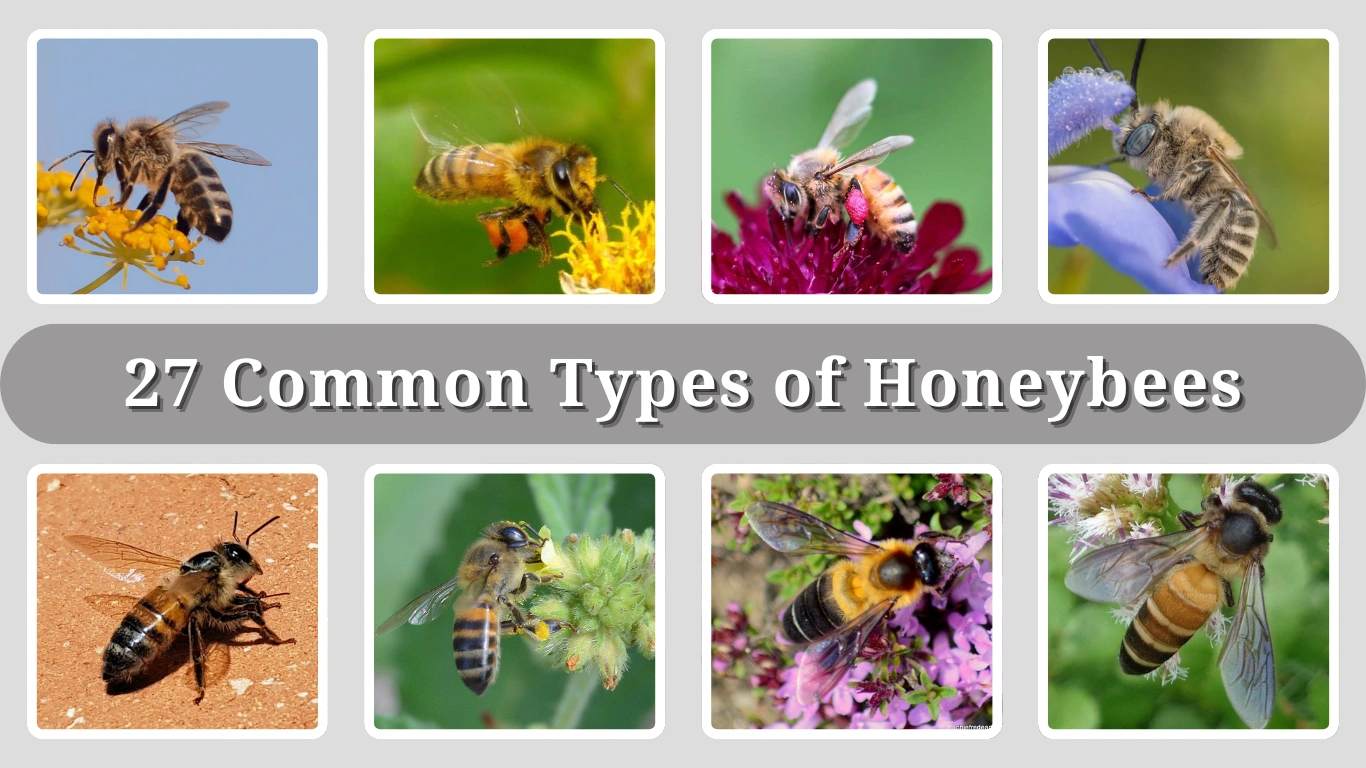
Honeybees are among the most vital insects on Earth, responsible for pollinating crops, producing honey, and sustaining biodiversity. Across the world, various honeybee species and subspecies have evolved to thrive in different climates — from tropical forests to mountain ranges and arid deserts. This guide explores 27 common types of honeybees, highlighting their unique traits, habitats, behaviors, and lifecycles that together showcase the incredible diversity of the genus Apis.
1. Apis mellifera (Western Honeybee)

The Apis mellifera, commonly known as the Western Honeybee or European Honeybee, is the most widespread and economically important bee species in the world. It’s the primary species used in modern beekeeping for honey production and crop pollination. Native to Europe, Africa, and parts of Asia, it has been introduced to every continent except Antarctica.
Identification
- Scientific Name: Apis mellifera
- Common Name: Western Honeybee / European Honeybee
- Size: Workers ~12–15 mm long; Queens up to 20 mm
- Color: Ranges from golden brown to dark brown with black bands
- Body: Covered in fine hairs aiding in pollen collection
- Wings: Two pairs of transparent wings with visible veins
- Antennae: Elbowed and highly sensitive to scent and vibrations
- Stinger: Present in females (workers), barbed and used once
Habitat
Apis mellifera naturally inhabits temperate to tropical regions, nesting in hollow trees, rock crevices, and man-made hives. With domestication, they thrive in diverse environments — from farmlands to urban gardens. They prefer areas abundant in flowering plants for nectar and pollen collection.
Behaviors
Western Honeybees are highly social insects, living in colonies that can contain 20,000 to 80,000 individuals. Each colony is divided into three castes — queen, workers, and drones — each with specific roles.
They communicate using the “waggle dance”, a movement pattern that conveys the direction and distance of food sources. They are also known for their strong defensive behavior when protecting the hive and cooperative efforts in temperature regulation.
Lifecycle & Lifespan
The lifecycle of Apis mellifera consists of four stages: egg, larva, pupa, and adult.
- Queen: Can live up to 3–5 years, continuously laying eggs.
- Worker Bees: Live 4–6 weeks in summer and several months in winter.
- Drones: Live for a few weeks, dying after mating or being expelled from the hive.
The colony operates year-round, with population size fluctuating seasonally based on food availability and climate.
2. Apis cerana (Eastern Honeybee)

The Apis cerana, also known as the Eastern Honeybee or Asiatic Honeybee, is native to southern and eastern Asia. It is closely related to Apis mellifera but is smaller and more adapted to tropical and subtropical environments. This species has been domesticated for centuries and plays a vital role in pollination across Asia.
Identification
- Scientific Name: Apis cerana
- Common Name: Eastern Honeybee / Asiatic Honeybee
- Size: Workers around 10–12 mm; queens up to 18 mm
- Color: Darker than A. mellifera, with narrow yellow bands
- Body: Slender, with fine hair and a glossy abdomen
- Wings: Slightly shorter and more rounded than A. mellifera
- Antennae: Sensitive and adapted to humid climates
- Stinger: Present in workers; less aggressive compared to A. mellifera
Habitat
Apis cerana thrives in tropical and subtropical Asia, especially in countries like India, China, Japan, and Indonesia. It prefers forested and agricultural landscapes with abundant flowering plants. Nests are often found in tree hollows, rock crevices, or traditional log hives made by local beekeepers.
Behaviors
This species is known for being gentler and more disease-resistant than A. mellifera. It exhibits swarming behavior to form new colonies and is highly effective at pollinating local crops. Apis cerana performs a simplified waggle dance for communication and is skilled at defending against predators like hornets. Colonies are smaller, usually containing 5,000–20,000 bees.
Lifecycle & Lifespan
The lifecycle follows four stages: egg, larva, pupa, and adult.
- Queen: Lives 2–3 years, laying eggs daily.
- Workers: Live 4–6 weeks in active seasons.
- Drones: Survive only a few weeks, dying after mating.
Colonies adapt quickly to seasonal changes and can survive monsoon or cold conditions by reducing activity.
3. Apis dorsata (Giant Honeybee)

The Apis dorsata, known as the Giant Honeybee, is one of the largest honeybee species in the world. Native to South and Southeast Asia, it is renowned for building massive, open-air combs on high tree branches or cliff faces. Its honey, often called wild honey, is highly valued.
Identification
- Scientific Name: Apis dorsata
- Common Name: Giant Honeybee
- Size: Workers 17–20 mm; queens up to 22 mm
- Color: Dark brown with distinct yellow bands
- Body: Robust and covered with thick hair
- Wings: Long and strong, enabling long-distance foraging
- Antennae: Well-developed for scent detection
- Stinger: Powerful and used collectively in defense
Habitat
This species inhabits tropical forests, cliffs, and tall trees across India, Nepal, Thailand, and Indonesia. Apis dorsata prefers open nesting sites high above the ground to avoid predators. It migrates seasonally in search of flowering plants and suitable nesting locations.
Behaviors
Apis dorsata is highly defensive and forms large colonies with up to 50,000 bees. They construct single, massive combs exposed to the open air. When threatened, they display a defensive behavior known as “shimmering”, where thousands of bees flick their abdomens in unison to deter predators. They are excellent pollinators for forest and agricultural plants.
Lifecycle & Lifespan
The lifecycle mirrors other honeybee species: egg, larva, pupa, and adult.
- Queen: Lives up to 3 years.
- Workers: Average lifespan of 6–8 weeks.
- Drones: Die shortly after mating.
Colonies reproduce through swarming, and new queens establish fresh nests after mating flights. The species’ seasonal migration helps maintain genetic diversity and ecological balance.
4. Apis florea (Dwarf Honeybee)

The Apis florea, commonly known as the Dwarf Honeybee or Red Dwarf Honeybee, is among the smallest species of honeybees. Native to southern and southeastern Asia, it is recognized for its small size and open-air nesting behavior. These bees produce modest amounts of honey and play an essential role in pollination in tropical ecosystems.
Identification
- Scientific Name: Apis florea
- Common Name: Dwarf Honeybee / Red Dwarf Honeybee
- Size: Workers 7–10 mm; queens up to 12 mm
- Color: Reddish-brown with pale bands
- Body: Small and delicate with fine hair
- Wings: Short and transparent
- Antennae: Long relative to body size, aiding navigation
- Stinger: Present but rarely used due to non-aggressive nature
Habitat
Apis florea prefers warm, dry, and tropical environments, commonly found in India, Thailand, and other parts of Southeast Asia. It builds single, small, exposed combs on shrubs or low tree branches, usually shaded by leaves. The species avoids dense forests and high altitudes, thriving in open habitats with abundant wildflowers.
Behaviors
This bee is non-aggressive and avoids confrontation. Colonies are relatively small, containing a few thousand individuals. They are skilled in thermoregulation by clustering around the comb and fanning their wings. Communication includes a simplified dance language similar to that of A. mellifera, adapted to their open-nest lifestyle. They frequently migrate short distances when food becomes scarce.
Lifecycle & Lifespan
The lifecycle includes the standard stages of egg, larva, pupa, and adult.
- Queen: Lives about 1–2 years.
- Workers: Live 3–5 weeks during active seasons.
- Drones: Live until mating, typically a few weeks.
Colonies reproduce through swarming, often establishing new nests within a short radius of the parent colony.
5. Apis andreniformis (Black Dwarf Honeybee)

The Apis andreniformis, also known as the Black Dwarf Honeybee, is another small honeybee species native to Southeast Asia. It closely resembles Apis florea but can be distinguished by its darker coloration and slightly different nesting habits.
Identification
- Scientific Name: Apis andreniformis
- Common Name: Black Dwarf Honeybee
- Size: Workers about 8–10 mm; queens up to 13 mm
- Color: Predominantly dark brown or black with faint bands
- Body: Slender and shiny with short hair
- Wings: Transparent with light brown veins
- Antennae: Shorter than A. florea, highly responsive to scent
- Stinger: Small, rarely used; colony generally docile
Habitat
This species is distributed across Thailand, Malaysia, Indonesia, and southern China. It inhabits lowland forests, gardens, and agricultural zones, nesting in small trees or shrubs. The nests are usually built in shaded, protected spots to avoid direct sunlight.
Behaviors
Apis andreniformis forms small colonies, usually numbering 2,000–5,000 bees. The species is less migratory compared to A. florea and prefers stable nesting sites. They demonstrate coordinated defensive behavior, producing shimmering waves across the comb surface when threatened. They are efficient pollinators of tropical plants and show a preference for native flora.
Lifecycle & Lifespan
The lifecycle is similar to other honeybee species: egg, larva, pupa, and adult.
- Queen: Lifespan ranges from 1–2 years.
- Workers: Typically live for 4–6 weeks.
- Drones: Short lifespan, dying post-mating.
Colonies multiply by swarming, with the old queen departing alongside a group of workers to establish a new nest nearby.
6. Apis laboriosa (Himalayan Giant Honeybee)

The Apis laboriosa, known as the Himalayan Giant Honeybee, is the world’s largest honeybee species. It is native to the mountainous regions of the Himalayas, thriving at high altitudes between 1,200 and 3,500 meters. Famous for producing the so-called “mad honey”, this species is prized for both its honey and its ecological importance in high mountain ecosystems.
Identification
- Scientific Name: Apis laboriosa
- Common Name: Himalayan Giant Honeybee
- Size: Workers 20–22 mm; queens up to 25 mm
- Color: Dark brown to black with thick golden hair on the thorax
- Body: Sturdy and heavily built for cold mountain climates
- Wings: Long and strong, adapted for thin air and high winds
- Antennae: Medium-length, sensitive to high-altitude floral scents
- Stinger: Long and powerful; colony is extremely defensive
Habitat
This species inhabits cliff faces and rocky outcrops in the Himalayan regions of Nepal, Bhutan, India, and Tibet. They build massive single combs under overhangs, often hundreds of feet above ground to avoid predators. Their nests are oriented to maximize sunlight and are exposed to open air.
Behaviors
Apis laboriosa is known for its seasonal migration — colonies move vertically between altitudes as flowers bloom at different elevations. They exhibit aggressive defense mechanisms, attacking in large numbers when threatened. Their “mad honey” is produced from nectar of Rhododendron flowers, containing grayanotoxins that cause mild hallucinogenic effects in humans. Despite their aggression, they are vital pollinators in high-mountain ecosystems.
Lifecycle & Lifespan
The lifecycle mirrors other Apis species: egg, larva, pupa, and adult.
- Queen: Lives 2–3 years.
- Workers: Live 6–8 weeks in active periods.
- Drones: Die after mating or at the end of the breeding season.
Colonies are active in warmer months and enter a semi-dormant phase during winter, with migration ensuring survival through changing climates.
7. Apis koschevnikovi (Koschevnikov’s Honeybee)

The Apis koschevnikovi, commonly called Koschevnikov’s Honeybee, is a lesser-known species native to Borneo and parts of Southeast Asia. It inhabits tropical rainforests and is closely related to Apis cerana, although it remains distinct in behavior and genetics.
Identification
- Scientific Name: Apis koschevnikovi
- Common Name: Koschevnikov’s Honeybee
- Size: Workers 10–11 mm; queens up to 17 mm
- Color: Reddish-brown with faint abdominal banding
- Body: Compact and covered with dense orange-brown hair
- Wings: Medium-length and translucent
- Antennae: Highly sensitive for tropical foraging
- Stinger: Barbed and used defensively when disturbed
Habitat
This species is found in lowland tropical rainforests of Borneo, Sumatra, and Peninsular Malaysia. They prefer tree hollows or natural cavities as nesting sites and are rarely domesticated due to their shy, forest-dwelling habits. The dense jungle canopy provides them with the humidity and shade they need to thrive.
Behaviors
Apis koschevnikovi is non-aggressive and reclusive, avoiding human interaction. Colonies are small, usually fewer than 10,000 bees, and display strong defensive clustering behavior when threatened. They are highly efficient pollinators of forest flora, contributing significantly to rainforest biodiversity. Their waggle dance is slower and more subtle compared to A. mellifera.
Lifecycle & Lifespan
Like other honeybees, their lifecycle passes through egg, larva, pupa, and adult stages.
- Queen: Lives about 2 years.
- Workers: Live around 4–6 weeks.
- Drones: Live several weeks until mating.
The colonies reproduce by swarming, and new queens take over when older ones die or leave. Their populations remain localized, rarely spreading beyond dense forest zones.
8. Apis nigrocincta (Philippine Honeybee)

The Apis nigrocincta, known as the Philippine Honeybee, is a tropical honeybee species native to the Philippines and parts of Indonesia. It shares many similarities with Apis cerana but differs genetically and behaviorally, particularly in its reproductive patterns and nesting preferences.
Identification
- Scientific Name: Apis nigrocincta
- Common Name: Philippine Honeybee
- Size: Workers around 10–12 mm; queens up to 17 mm
- Color: Dark brown to black with orange-yellow abdominal bands
- Body: Moderately hairy and compact
- Wings: Shorter and rounded compared to A. cerana
- Antennae: Sensitive and adapted for humid climates
- Stinger: Barbed; used only once during defense
Habitat
This species inhabits tropical forests and lowland agricultural zones of Mindanao, Sulawesi, and neighboring islands. It prefers tree hollows and protected cavities for nesting. Unlike A. cerana, it avoids open environments and thrives in shaded, humid regions with dense vegetation.
Behaviors
Apis nigrocincta is known for its highly organized colony structure and unique mating behavior, where multiple drones mate with a single queen (polyandry) — rare among Asian honeybees. Colonies are moderately defensive and smaller than A. mellifera, with populations around 5,000–15,000 bees. They are effective pollinators of tropical fruit trees, contributing to local agriculture and biodiversity.
Lifecycle & Lifespan
Like other honeybees, the lifecycle consists of four stages: egg, larva, pupa, and adult.
- Queen: Lives 2–3 years, laying thousands of eggs during peak seasons.
- Workers: Live 4–6 weeks, depending on workload.
- Drones: Live a few weeks and die after mating.
Colonies reproduce by swarming, and the new queens establish nearby colonies. The species shows adaptability to environmental fluctuations and disease resistance.
9. Apis nuluensis (Bornean Honeybee)

The Apis nuluensis, commonly called the Bornean Honeybee, is a rare species endemic to Borneo’s highlands. Closely related to Apis cerana, it was recognized as a distinct species in the 1990s due to its genetic and morphological differences. It is a vital pollinator in the island’s montane ecosystems.
Identification
- Scientific Name: Apis nuluensis
- Common Name: Bornean Honeybee
- Size: Workers 10–12 mm; queens up to 18 mm
- Color: Dark brown with reddish-golden hairs
- Body: Compact, with dense hair adapted for cooler highland climates
- Wings: Broad and semi-transparent
- Antennae: Medium length, sensitive to mountain flora scents
- Stinger: Barbed; used in defense
Habitat
Apis nuluensis is found in mountain forests of Borneo, particularly around Mount Kinabalu and its surrounding ranges. It builds nests in tree cavities or rock crevices, preferring cool, moist environments. Its limited range makes it an ecologically specialized species, dependent on native highland flowers.
Behaviors
This species is gentle and non-aggressive, focusing on efficient foraging in cooler climates. Colonies are small to medium-sized, typically 10,000–20,000 bees. Apis nuluensis shows unique foraging adaptations—they can fly in misty, low-light conditions common in high altitudes. Communication relies on a refined waggle dance suited to confined nesting spaces.
Lifecycle & Lifespan
Their lifecycle follows the typical pattern of egg, larva, pupa, and adult.
- Queen: Lives about 2 years.
- Workers: Average lifespan of 5–6 weeks.
- Drones: Live a few weeks and die post-mating.
Colonies propagate via swarming, with limited dispersal due to geographic isolation. The species plays a critical ecological role in maintaining mountain forest pollination networks in Borneo.
10. Apis indica (Indian Honeybee)

The Apis indica, commonly known as the Indian Honeybee, is native to the Indian subcontinent and is often considered a subspecies of Apis cerana. It is one of the most common domesticated bees in South Asia and is crucial for honey production and crop pollination across India, Bangladesh, Nepal, and Sri Lanka.
Identification
- Scientific Name: Apis indica
- Common Name: Indian Honeybee
- Size: Workers 10–12 mm; queens around 17 mm
- Color: Yellowish-brown with black bands on the abdomen
- Body: Slender, covered with short golden hairs
- Wings: Shorter and rounded, adapted for short-range foraging
- Antennae: Sensitive to floral odors and humidity
- Stinger: Present in workers, less aggressive than A. mellifera
Habitat
Apis indica thrives in tropical and subtropical regions, particularly in forests, farmlands, and gardens. It builds nests in tree cavities, wall crevices, or man-made wooden hives. This adaptability allows it to flourish in both rural and urban settings.
Behaviors
This species is gentle and adaptable, making it a favorite among local beekeepers. Colonies are small, usually 5,000–10,000 bees, and show strong nest-site fidelity. The bees are active throughout the year except during monsoons. Their communication system involves a simple waggle dance to indicate food sources, and they are efficient at pollinating local crops and fruit trees.
Lifecycle & Lifespan
The lifecycle includes four stages: egg, larva, pupa, and adult.
- Queen: Lives about 2–3 years, laying eggs continuously.
- Workers: Live 4–6 weeks, performing tasks from nursing to foraging.
- Drones: Live only until mating season ends.
Colonies reproduce via swarming, with new queens leading offshoot colonies nearby. The species is known for rapid colony regeneration after seasonal disturbances.
11. Apis mellifera ligustica (Italian Honeybee)

The Apis mellifera ligustica, or Italian Honeybee, is one of the most popular subspecies of Apis mellifera used in modern beekeeping. Originally native to Italy, it has been introduced globally for its docile nature, high honey production, and adaptability to various climates.
Identification
- Scientific Name: Apis mellifera ligustica
- Common Name: Italian Honeybee
- Size: Workers 12–14 mm; queens up to 20 mm
- Color: Golden-yellow with light brown abdominal bands
- Body: Sleek and covered with fine golden hair
- Wings: Clear with strong venation
- Antennae: Sensitive, used for navigation and communication
- Stinger: Barbed, used once; colony is mild-tempered
Habitat
Originally from southern Europe, A. m. ligustica is now found in North America, Australia, and Asia, thanks to widespread domestication. It thrives in temperate climates, building hives in wooden boxes, logs, or natural cavities. It is especially efficient in regions with long blooming seasons.
Behaviors
The Italian Honeybee is known for being gentle, highly productive, and excellent at foraging. Colonies are large, often exceeding 60,000 bees, and maintain high brood populations throughout spring and summer. They show strong swarming control and hygienic behavior, making them resistant to some diseases. They are prolific nectar gatherers, producing light, high-quality honey.
Lifecycle & Lifespan
Their lifecycle includes egg, larva, pupa, and adult stages.
- Queen: Lives 3–4 years, producing thousands of eggs per day in peak season.
- Workers: Live about 6 weeks during active seasons; longer in winter.
- Drones: Live a few weeks and die after mating.
The colonies remain active year-round in favorable climates and are well-suited for managed beekeeping operations due to their calm temperament and adaptability.
12. Apis mellifera carnica (Carniolan Honeybee)

The Apis mellifera carnica, commonly known as the Carniolan Honeybee, originates from the Balkan region of Europe, especially Slovenia, Austria, and parts of Hungary. It is one of the most popular subspecies of Apis mellifera used in modern apiculture due to its calm temperament, winter hardiness, and efficient honey production.
Identification
- Scientific Name: Apis mellifera carnica
- Common Name: Carniolan Honeybee
- Size: Workers 12–14 mm; queens around 18–20 mm
- Color: Dark brown or grayish with light banding on the abdomen
- Body: Covered in dense gray hairs, giving a silvery appearance
- Wings: Long and narrow, allowing smooth, energy-efficient flight
- Antennae: Medium length, adapted for scent detection and navigation
- Stinger: Present; colonies are very gentle and rarely sting
Habitat
Native to central and southeastern Europe, A. m. carnica thrives in temperate and mountainous regions. It prefers forests, valleys, and meadows with abundant flowering plants. Beekeepers have successfully introduced it to North America, New Zealand, and other regions, where it adapts well to variable climates.
Behaviors
Carniolan Honeybees are renowned for their gentle nature and excellent foraging efficiency, even in cool or cloudy weather. They regulate colony growth dynamically, expanding rapidly in spring and reducing brood production in winter. Their low aggression and swarming control make them ideal for managed beekeeping. They exhibit strong hygienic behavior, which helps prevent diseases and pests like Varroa mites.
Lifecycle & Lifespan
The lifecycle includes egg, larva, pupa, and adult stages.
- Queen: Lives 3–5 years, laying up to 2,000 eggs per day.
- Workers: Live 5–6 weeks in summer and several months in winter.
- Drones: Live for a few weeks, dying after mating.
Colonies overwinter effectively due to low food consumption, making them excellent for regions with cold winters.
13. Apis mellifera caucasica (Caucasian Honeybee)

The Apis mellifera caucasica, or Caucasian Honeybee, is native to the Caucasus Mountains between the Black and Caspian Seas. It is known for its long proboscis, which allows it to collect nectar from deep flowers, and for producing large amounts of propolis — a resinous substance used to seal hive gaps.
Identification
- Scientific Name: Apis mellifera caucasica
- Common Name: Caucasian Honeybee
- Size: Workers 12–14 mm; queens up to 20 mm
- Color: Dark gray with fine silver hairs
- Body: Slender and elongated, with a long proboscis (6.7–7.2 mm)
- Wings: Broad and strong for mountainous flight
- Antennae: Sensitive and adapted for floral scent recognition
- Stinger: Barbed; colony temperament is calm but can be defensive when provoked
Habitat
Native to high-altitude regions of Georgia, Armenia, and Turkey, A. m. caucasica is adapted to cool and humid mountain climates. It builds hives in tree cavities and cliffs, and when domesticated, thrives in wooden hives in temperate regions. It prefers areas with long flowering periods.
Behaviors
Caucasian Honeybees are known for being gentle, steady foragers, and excellent propolis producers. Their long tongues allow them to access nectar sources other bees cannot reach. However, they are slow to build up colonies in spring compared to Italian bees. They maintain strong hive defense and use propolis extensively, which can make hive inspections challenging. They also display low swarming tendencies, beneficial for beekeepers.
Lifecycle & Lifespan
Their lifecycle includes the same four stages: egg, larva, pupa, and adult.
- Queen: Can live up to 4–5 years, laying prolifically in summer.
- Workers: Live 5–7 weeks during foraging seasons; longer in cold months.
- Drones: Survive a few weeks and die after mating.
Due to their adaptation to cooler climates, A. m. caucasica colonies are favored in mountainous and temperate areas where nectar sources are abundant but variable.
14. Apis mellifera scutellata (African Honeybee)

The Apis mellifera scutellata, commonly known as the African Honeybee, is native to central and southern Africa. It is known for its resilience, high productivity, and strong defensive behavior. When interbred with European bees in South America, it gave rise to the well-known Africanized Honeybee, often referred to as the “killer bee.”
Identification
- Scientific Name: Apis mellifera scutellata
- Common Name: African Honeybee
- Size: Workers 11–13 mm; queens up to 19 mm
- Color: Golden to dark brown with faint banding
- Body: Sleek and agile, with short fine hairs
- Wings: Narrow, enabling quick and strong flight
- Antennae: Short to medium length, excellent for scent detection
- Stinger: Barbed; aggressive when defending hive
Habitat
Native to sub-Saharan Africa, A. m. scutellata thrives in savannas, forests, and agricultural regions. It prefers warm, tropical, and semi-arid climates, building nests in tree hollows, rock crevices, or abandoned animal burrows. The species’ adaptability allows it to survive in harsh, fluctuating environments.
Behaviors
This bee is known for being highly defensive, responding quickly and in large numbers to perceived threats. However, it is also an excellent forager, able to exploit sparse floral resources efficiently. Colonies are smaller than those of A. m. mellifera, typically 20,000–40,000 bees, but they reproduce rapidly. They have high swarming and absconding tendencies, often relocating when resources decline. Their aggressive nature makes them challenging for managed beekeeping, though they produce high-quality honey in the wild.
Lifecycle & Lifespan
Their lifecycle includes egg, larva, pupa, and adult stages.
- Queen: Lives about 2–3 years.
- Workers: Live 4–6 weeks in active seasons.
- Drones: Die shortly after mating.
Colonies regenerate quickly and can recover from population loss faster than most honeybee subspecies, ensuring survival under variable environmental conditions.
15. Apis mellifera capensis (Cape Honeybee)

The Apis mellifera capensis, or Cape Honeybee, is native to the Cape region of South Africa. It is unique among honeybees because worker bees can reproduce parthenogenetically, meaning they can produce female offspring without mating. This remarkable ability has significant evolutionary and ecological implications.
Identification
- Scientific Name: Apis mellifera capensis
- Common Name: Cape Honeybee
- Size: Workers 11–13 mm; queens around 17–19 mm
- Color: Dark brown to black with lighter abdominal rings
- Body: Compact, with fine grayish hair
- Wings: Slightly translucent and medium-length
- Antennae: Well-developed for communication and scent detection
- Stinger: Barbed; colony is generally calm unless disturbed
Habitat
The Cape Honeybee inhabits the Western and Eastern Cape regions of South Africa, favoring coastal plains, shrublands, and fynbos vegetation zones. It nests in tree cavities and rock shelters, and in managed hives under moderate temperatures and steady nectar availability.
Behaviors
The A. m. capensis is distinguished by its social parasitism — worker bees can invade other colonies and reproduce, sometimes taking over host hives. Colonies are typically calm and manageable, making them suitable for controlled beekeeping. They exhibit strong hygienic behavior, efficiently removing diseased brood, and are capable pollinators of native and agricultural plants.
Lifecycle & Lifespan
The species undergoes the standard honeybee development stages: egg, larva, pupa, and adult.
- Queen: Lives about 3–4 years, though worker reproduction can replace her.
- Workers: Can live up to 6 weeks, sometimes longer in cooler months.
- Drones: Live a few weeks and die after mating.
Due to their ability to reproduce without a queen, Cape Honeybees can maintain colony strength under stressful conditions, though their parasitic tendencies can threaten nearby colonies.
16. Apis mellifera mellifera (European Dark Honeybee)

The Apis mellifera mellifera, also called the European Dark Honeybee or Black Bee, is one of the oldest subspecies of Apis mellifera. Native to northern and western Europe, it is known for its dark coloration, strong adaptation to cold climates, and resilience to harsh environmental conditions.
Identification
- Scientific Name: Apis mellifera mellifera
- Common Name: European Dark Honeybee / Black Bee
- Size: Workers 12–14 mm; queens up to 20 mm
- Color: Dark brown to nearly black with minimal banding
- Body: Stocky and densely haired
- Wings: Short and broad, adapted for strong flight in cold weather
- Antennae: Medium length, highly sensitive to scent
- Stinger: Barbed; colonies can be defensive when provoked
Habitat
This species inhabits northern and western Europe, including the UK, France, Germany, and Scandinavia. It prefers temperate and cool climates, nesting in tree hollows, rock crevices, and managed wooden hives. Its thick body hair and dark color help it retain heat, making it ideal for colder environments.
Behaviors
European Dark Honeybees are robust and cold-tolerant, capable of foraging in low temperatures and overcast conditions. They exhibit strong hive defense but are also efficient foragers in poor weather. Colonies are slow to build up in spring but maintain excellent overwintering survival. They produce moderate amounts of honey with high sugar content and low moisture, suitable for long-term storage.
Lifecycle & Lifespan
The lifecycle includes egg, larva, pupa, and adult stages.
- Queen: Lives 3–5 years, laying eggs during warm months.
- Workers: Live 4–6 weeks in summer, up to several months in winter.
- Drones: Live a few weeks, dying after mating.
Their colonies are smaller than those of southern honeybees but are efficient at conserving resources through the winter.
17. Apis mellifera lamarckii (Egyptian Honeybee)

The Apis mellifera lamarckii, or Egyptian Honeybee, is native to the Nile Valley and surrounding deserts. This subspecies has been known since ancient times, with depictions found in Egyptian hieroglyphs. It is small, agile, and adapted to the hot, arid environments of North Africa.
Identification
- Scientific Name: Apis mellifera lamarckii
- Common Name: Egyptian Honeybee
- Size: Workers 9–11 mm; queens about 15 mm
- Color: Yellowish-brown with black bands
- Body: Slender with short hair, well-suited for hot climates
- Wings: Short and narrow for quick flight
- Antennae: Short, adapted for high temperature environments
- Stinger: Barbed; colonies are defensive and alert
Habitat
The Egyptian Honeybee inhabits Egypt, Sudan, and parts of Libya, thriving in arid and semi-arid environments. It nests in mud walls, rock crevices, and man-made hives near water sources or cultivated fields. Due to its desert adaptation, it can survive extreme heat but requires consistent nectar availability.
Behaviors
This bee is known for being highly active, heat-tolerant, and resistant to diseases. It is smaller and less productive in honey yield than European species but exceptionally efficient at pollination in hot climates. Colonies are defensive and prone to frequent swarming, which helps them colonize new areas rapidly. They maintain smaller colonies of around 5,000–10,000 bees.
Lifecycle & Lifespan
The species undergoes the typical bee developmental stages: egg, larva, pupa, and adult.
- Queen: Lives 2–3 years and lays steadily year-round if nectar is available.
- Workers: Live 4–5 weeks in active periods.
- Drones: Live briefly, dying post-mating.
The A. m. lamarckii plays a crucial role in desert and oasis ecosystems, contributing to the pollination of native and agricultural plants despite harsh conditions.
18. Apis mellifera syriaca (Syrian Honeybee)

The Apis mellifera syriaca, commonly called the Syrian Honeybee, is a Middle Eastern subspecies native to Syria, Lebanon, Jordan, and parts of Israel and Palestine. It has adapted to the region’s hot summers and unpredictable nectar flows, making it one of the most heat-resistant and resilient honeybee types.
Identification
- Scientific Name: Apis mellifera syriaca
- Common Name: Syrian Honeybee
- Size: Workers 11–13 mm; queens up to 18 mm
- Color: Golden-yellow with brown banding
- Body: Slender, with moderate hair density
- Wings: Medium-sized, allowing quick, efficient flight in hot conditions
- Antennae: Medium length; highly responsive to floral scent changes
- Stinger: Barbed; colonies are known for aggressive defense behavior
Habitat
This bee thrives in dry, semi-arid, and Mediterranean regions of the Middle East. It nests in tree trunks, rock crevices, and mud walls, and adapts well to hot and arid climates with irregular rainfall. The A. m. syriaca has evolved to cope with nectar scarcity by conserving hive resources.
Behaviors
Syrian Honeybees are highly defensive, reacting quickly to disturbances, which helps them survive against predators. They have a strong tendency to swarm and abscond, especially during periods of drought or food shortage. Despite their aggression, they are excellent foragers and resilient to extreme heat. They also exhibit good hygienic behavior, reducing the spread of brood diseases.
Lifecycle & Lifespan
Like other honeybees, their lifecycle includes egg, larva, pupa, and adult stages.
- Queen: Lives about 2–3 years.
- Workers: Live 4–6 weeks during foraging seasons.
- Drones: Survive a few weeks until mating.
Colonies are smaller than European ones but can quickly rebuild when conditions improve, ensuring long-term survival in harsh environments.
19. Apis mellifera monticola (East African Mountain Honeybee)

The Apis mellifera monticola, or East African Mountain Honeybee, is a high-altitude subspecies native to the mountainous regions of Kenya and Tanzania, including Mount Kilimanjaro and Mount Kenya. It is well-adapted to cool, moist environments and plays an important role in pollinating montane vegetation.
Identification
- Scientific Name: Apis mellifera monticola
- Common Name: East African Mountain Honeybee
- Size: Workers 12–14 mm; queens up to 20 mm
- Color: Dark brown to black with minimal banding
- Body: Covered with thick hair for insulation against cold
- Wings: Broad and strong for stable flight in windy conditions
- Antennae: Shorter than average, adapted to detect mountain flora
- Stinger: Barbed; colonies show moderate defensiveness
Habitat
This subspecies inhabits high-altitude forests and alpine meadows at elevations between 1,500–3,000 meters. It builds nests in tree cavities and rocky shelters, taking advantage of the dense vegetation of East African mountain ranges. It thrives in cool, moist climates but struggles in hotter, drier regions.
Behaviors
Apis mellifera monticola is calm, industrious, and cold-tolerant, making it well-suited for mountain beekeeping. Colonies are moderately sized, usually around 30,000–40,000 bees, and have low swarming tendencies. They are efficient foragers even in misty or overcast conditions and show strong disease resistance. Their defensive behavior is mild compared to lowland African bees.
Lifecycle & Lifespan
The lifecycle consists of egg, larva, pupa, and adult stages.
- Queen: Lives up to 4 years, maintaining steady brood production.
- Workers: Live 5–7 weeks in active seasons; longer in cooler months.
- Drones: Live only for a few weeks, dying after mating.
Because of its gentle temperament and climate resilience, A. m. monticola has been used in breeding programs to improve European honeybee strains for cold tolerance and disease resistance.
20. Apis mellifera sahariensis (Saharan Honeybee)

The Apis mellifera sahariensis, known as the Saharan Honeybee, is a subspecies native to North Africa’s desert regions, particularly in Morocco and Algeria. It has evolved unique adaptations to survive in extremely arid environments with scarce floral resources and high temperatures.
Identification
- Scientific Name: Apis mellifera sahariensis
- Common Name: Saharan Honeybee
- Size: Workers 11–13 mm; queens up to 18 mm
- Color: Light yellow to golden brown with fine hairs
- Body: Slender and less hairy than temperate subspecies
- Wings: Long and narrow, adapted for fast flight in dry, hot air
- Antennae: Medium length, sensitive to sparse floral odors
- Stinger: Present; colonies are generally gentle but alert
Habitat
This bee inhabits oases, desert valleys, and semi-arid regions of the Sahara. It relies on acacia trees, date palms, and oasis flora for nectar and pollen. Nests are found in rock crevices, mud walls, and hollow trees near water sources. Its distribution is limited to isolated desert patches, where vegetation allows survival.
Behaviors
The Saharan Honeybee exhibits remarkable heat tolerance and water conservation abilities. Colonies are small, typically 5,000–10,000 bees, and have low honey production but high ecological importance. They forage during cooler hours of the day and can survive long nectar shortages by minimizing brood rearing. Their calm temperament and adaptability make them suitable for desert beekeeping in North Africa.
Lifecycle & Lifespan
The lifecycle consists of egg, larva, pupa, and adult stages.
- Queen: Lives 2–3 years, producing fewer eggs during droughts.
- Workers: Live 5–7 weeks, longer in cooler months.
- Drones: Short-lived, dying after mating.
Apis mellifera sahariensis is essential for the pollination of desert crops and wild plants, contributing to biodiversity in fragile ecosystems.
21. Apis mellifera anatoliaca (Anatolian Honeybee)

The Apis mellifera anatoliaca, or Anatolian Honeybee, is native to Turkey and parts of the Middle East. It is known for its resilience, strong foraging ability, and stable colony structure. This subspecies is important in Turkish beekeeping and has contributed genetics to many hybrid honeybee strains.
Identification
- Scientific Name: Apis mellifera anatoliaca
- Common Name: Anatolian Honeybee
- Size: Workers 12–14 mm; queens around 19–20 mm
- Color: Brown or gray with narrow light bands
- Body: Sturdy and well-haired, adapted for variable climates
- Wings: Broad and slightly translucent
- Antennae: Medium length, sensitive to environmental changes
- Stinger: Barbed; colonies are moderately defensive
Habitat
Native to central and western Turkey, this bee thrives in steppe regions, forests, and coastal plains. It adapts well to temperate and semi-arid climates and nests in tree hollows, rock crevices, and man-made hives. Its broad environmental tolerance allows it to flourish across diverse altitudes and floral conditions.
Behaviors
Apis mellifera anatoliaca is industrious, gentle, and productive. Colonies are large and maintain steady brood production throughout the year. The bees are excellent honey producers, known for collecting nectar from various floral sources, including sunflowers and wild herbs. They are relatively disease-resistant and capable of efficient thermoregulation, which helps them cope with both hot summers and cold winters.
Lifecycle & Lifespan
The lifecycle includes egg, larva, pupa, and adult stages.
- Queen: Lives 3–5 years, with consistent egg-laying capacity.
- Workers: Live 5–6 weeks during active seasons and longer in winter.
- Drones: Live only a few weeks, dying after mating.
Due to their adaptability and gentle temperament, Anatolian Honeybees are widely used in breeding programs and contribute significantly to sustainable beekeeping across Eurasia.
22. Apis mellifera intermissa (North African Honeybee)

The Apis mellifera intermissa, or North African Honeybee, is native to the Maghreb region, including Morocco, Algeria, and Tunisia. This subspecies is well adapted to the Mediterranean climate, showing strong resilience to heat and drought conditions.
Identification
- Scientific Name: Apis mellifera intermissa
- Common Name: North African Honeybee
- Size: Workers 11–13 mm; queens up to 19 mm
- Color: Dark brown to black with occasional orange bands
- Body: Slim and moderately hairy, adapted to hot, dry environments
- Wings: Medium-length, slightly darker in tone
- Antennae: Short and sturdy, responsive to environmental cues
- Stinger: Barbed; colonies are aggressive in defense
Habitat
This subspecies inhabits coastal and inland areas of North Africa, thriving in Mediterranean scrublands, semi-deserts, and agricultural valleys. Nests are built in rock crevices, hollow trees, and human-made hives near flowering vegetation. It endures long dry periods and fluctuating temperatures, making it a strong survivor in arid zones.
Behaviors
Apis mellifera intermissa is energetic and defensive, often compared to African bees in temperament. Despite their aggressiveness, they are excellent foragers with strong resistance to local diseases and parasites. Colonies are relatively small (10,000–30,000 bees) but exhibit fast spring buildup and frequent swarming behavior. They are efficient pollinators for citrus, olive, and other Mediterranean crops.
Lifecycle & Lifespan
Like other honeybee subspecies, their lifecycle consists of egg, larva, pupa, and adult stages.
- Queen: Lives 2–4 years, depending on conditions.
- Workers: Live 4–6 weeks in active periods.
- Drones: Live several weeks, dying after mating.
Although challenging for commercial beekeeping due to their defensive nature, their resilience and pollination efficiency make them ecologically vital in North Africa.
23. Apis mellifera adansonii (West African Honeybee)

The Apis mellifera adansonii, known as the West African Honeybee, is native to West and Central Africa, including Nigeria, Ghana, Cameroon, and Senegal. It is an energetic and heat-tolerant subspecies, closely related to Apis mellifera scutellata.
Identification
- Scientific Name: Apis mellifera adansonii
- Common Name: West African Honeybee
- Size: Workers 10–12 mm; queens up to 18 mm
- Color: Golden brown to black, with alternating dark bands
- Body: Lean and agile, designed for long foraging flights
- Wings: Narrow and clear, suitable for warm, humid climates
- Antennae: Short and robust, optimized for tropical flora detection
- Stinger: Barbed; colony defensive and highly reactive
Habitat
This subspecies thrives in tropical and subtropical regions of West Africa, where it nests in tree hollows, termite mounds, and roof cavities. It adapts well to savannas, forests, and agricultural zones, foraging across long distances to exploit seasonal flowering patterns.
Behaviors
Apis mellifera adansonii is known for being hardy, productive, and highly mobile. Colonies are small to medium-sized, typically 15,000–25,000 bees, and are frequent swarmers. They are capable of rapid colony recovery after losses and display strong resistance to pests and tropical diseases. However, they can be aggressive and quick to abandon the hive (abscond) when disturbed. Despite this, they are outstanding pollinators of tropical crops such as cocoa and oil palm.
Lifecycle & Lifespan
Their lifecycle comprises the standard stages: egg, larva, pupa, and adult.
- Queen: Lives 2–3 years, producing large numbers of offspring.
- Workers: Live 4–5 weeks during foraging seasons.
- Drones: Live until mating, then die.
The A. m. adansonii is a key pollinator in West African ecosystems, ensuring biodiversity and contributing to local agriculture despite its challenging temperament for managed beekeeping.
24. Apis mellifera unicolor (Madagascar Honeybee)

The Apis mellifera unicolor, commonly known as the Madagascar Honeybee, is native to Madagascar and nearby islands in the Indian Ocean. It is a tropical subspecies of Apis mellifera, uniquely adapted to humid, coastal, and forested environments.
Identification
- Scientific Name: Apis mellifera unicolor
- Common Name: Madagascar Honeybee
- Size: Workers 11–13 mm; queens up to 18 mm
- Color: Dark brown to nearly black with faint yellow banding
- Body: Compact, with fine, dense hair for tropical climates
- Wings: Medium-sized, translucent, suited for humid air conditions
- Antennae: Medium length, sensitive to floral humidity and scent
- Stinger: Barbed; colonies generally calm unless provoked
Habitat
Apis mellifera unicolor inhabits tropical forests, coastal plains, and highland regions of Madagascar, Réunion, and the Comoros Islands. Nests are found in tree hollows, wall crevices, and abandoned logs, often near rivers and flowering vegetation. It thrives in warm, moist climates but is less tolerant of prolonged drought.
Behaviors
This subspecies is gentle, adaptable, and strong in foraging. Colonies are medium-sized (15,000–25,000 bees) and highly efficient in tropical pollination, particularly for endemic flora and agricultural crops like vanilla and lychee. They show low swarming tendencies, making them favorable for beekeeping. The species is also known for its disease resistance and stable brood production throughout the year.
Lifecycle & Lifespan
The lifecycle includes egg, larva, pupa, and adult stages.
- Queen: Lives 3–4 years, maintaining steady reproduction.
- Workers: Live 5–7 weeks in active seasons.
- Drones: Live briefly, dying after mating.
Due to isolation, A. m. unicolor has remained genetically distinct, playing a key role in Madagascar’s ecosystem and honey industry.
25. Apis mellifera macedonica (Macedonian Honeybee)

The Apis mellifera macedonica, or Macedonian Honeybee, is a subspecies native to northern Greece, North Macedonia, and parts of Bulgaria. It is a hardy and efficient bee well-adapted to temperate and mountainous climates of southeastern Europe.
Identification
- Scientific Name: Apis mellifera macedonica
- Common Name: Macedonian Honeybee
- Size: Workers 12–14 mm; queens around 20 mm
- Color: Dark brown to black with subtle lighter bands
- Body: Robust, covered in dense grayish hairs
- Wings: Long and wide, suitable for mountainous terrain
- Antennae: Medium length, optimized for floral scent tracking
- Stinger: Barbed; colony shows moderate defensiveness
Habitat
This subspecies thrives in temperate and mountainous regions of the Balkans, preferring valleys, meadows, and forested slopes. It nests in tree hollows and wooden hives, and adapts well to cold winters and dry summers, typical of southeastern Europe’s climate.
Behaviors
Macedonian Honeybees are calm, industrious, and cold-tolerant, making them excellent for beekeeping in variable climates. Colonies are large and productive, with low swarming tendencies. They are good honey producers, especially from forest and meadow flowers, and are known for efficient overwintering. Their defensive behavior is mild, and they are disease-resistant, with strong brood hygiene.
Lifecycle & Lifespan
The lifecycle follows the typical four stages: egg, larva, pupa, and adult.
- Queen: Lives 3–5 years, laying up to 2,000 eggs daily during peak season.
- Workers: Live 5–6 weeks in summer, longer in winter.
- Drones: Live a few weeks, dying after mating.
Due to their balance of productivity, gentleness, and climate adaptability, A. m. macedonica is a valuable regional subspecies for European apiculture.
26. Apis mellifera arabiensis (Arabian Honeybee)

The Apis mellifera arabiensis, known as the Arabian Honeybee, is a subspecies native to the Arabian Peninsula and parts of East Africa, including Saudi Arabia, Yemen, Sudan, and Ethiopia. It is one of the smallest and most heat-tolerant honeybee subspecies, uniquely adapted to survive in extreme desert conditions.
Identification
- Scientific Name: Apis mellifera arabiensis
- Common Name: Arabian Honeybee
- Size: Workers 9–11 mm; queens around 15 mm
- Color: Golden yellow to dark brown with light abdominal bands
- Body: Small, sleek, and sparsely haired to reduce heat absorption
- Wings: Narrow and short, enabling quick flight in hot, dry air
- Antennae: Short, adapted for sensing limited floral cues in deserts
- Stinger: Barbed; colonies highly defensive under stress
Habitat
The Arabian Honeybee thrives in arid and semi-arid environments across the Arabian Peninsula and northeast Africa. Nests are usually built in rock crevices, cliffs, and cavities near oases or wadis. It is active even under extreme heat (up to 45°C / 113°F), foraging early in the morning and late in the afternoon when temperatures are lower.
Behaviors
This subspecies is highly adapted to desert life — conserving water, tolerating heat, and adjusting foraging times to avoid midday heat. Colonies are small, usually 5,000–10,000 bees, and have frequent swarming and absconding tendencies during droughts. While aggressive in defense, they are resilient and efficient at collecting nectar from sparse desert flora like acacia and sidr trees. Their honey is prized for its medicinal and high nutritional value.
Lifecycle & Lifespan
The lifecycle includes egg, larva, pupa, and adult stages.
- Queen: Lives 2–3 years, with peak egg-laying in spring.
- Workers: Live 4–5 weeks, shorter during extreme heat.
- Drones: Die after mating or at the end of the breeding season.
The A. m. arabiensis is a key pollinator in desert ecosystems, contributing to the survival of native plants and agricultural crops in one of the harshest environments on Earth.
27. Apis mellifera iberiensis (Iberian Honeybee)

The Apis mellifera iberiensis, or Iberian Honeybee, is native to the Iberian Peninsula, encompassing Spain and Portugal. It is one of the oldest European subspecies, genetically distinct and known for its adaptability to Mediterranean climates.
Identification
- Scientific Name: Apis mellifera iberiensis
- Common Name: Iberian Honeybee
- Size: Workers 12–14 mm; queens around 20 mm
- Color: Dark brown to black with reddish abdominal bands
- Body: Stocky, moderately hairy, adapted for warm climates
- Wings: Medium-length, translucent with light veins
- Antennae: Medium length, highly responsive to scent and vibrations
- Stinger: Barbed; colonies display variable temperament (gentle to defensive)
Habitat
This subspecies inhabits Mediterranean forests, grasslands, and farmlands of Spain and Portugal, thriving in hot, dry summers and mild winters. It nests in tree cavities, walls, cliffs, and man-made hives. It is particularly well adapted to seasonal drought and irregular nectar flow, allowing survival across diverse habitats.
Behaviors
Apis mellifera iberiensis is hardy, productive, and adaptive, known for excellent honey production from Mediterranean flora such as rosemary, thyme, and lavender. Colonies range from gentle to aggressive, with temperament often varying by region. They are active foragers even under high temperatures and display strong resistance to diseases and parasites. Swarming frequency is moderate, and colonies manage resources efficiently during dearth periods.
Lifecycle & Lifespan
The lifecycle follows the standard bee stages: egg, larva, pupa, and adult.
- Queen: Lives 3–4 years, laying steadily throughout warm seasons.
- Workers: Live 5–6 weeks in active periods, longer in winter.
- Drones: Live several weeks, dying after mating.
The A. m. iberiensis plays a vital role in Mediterranean agriculture and biodiversity, producing distinctive aromatic honeys and maintaining ecological balance in southern Europe.