

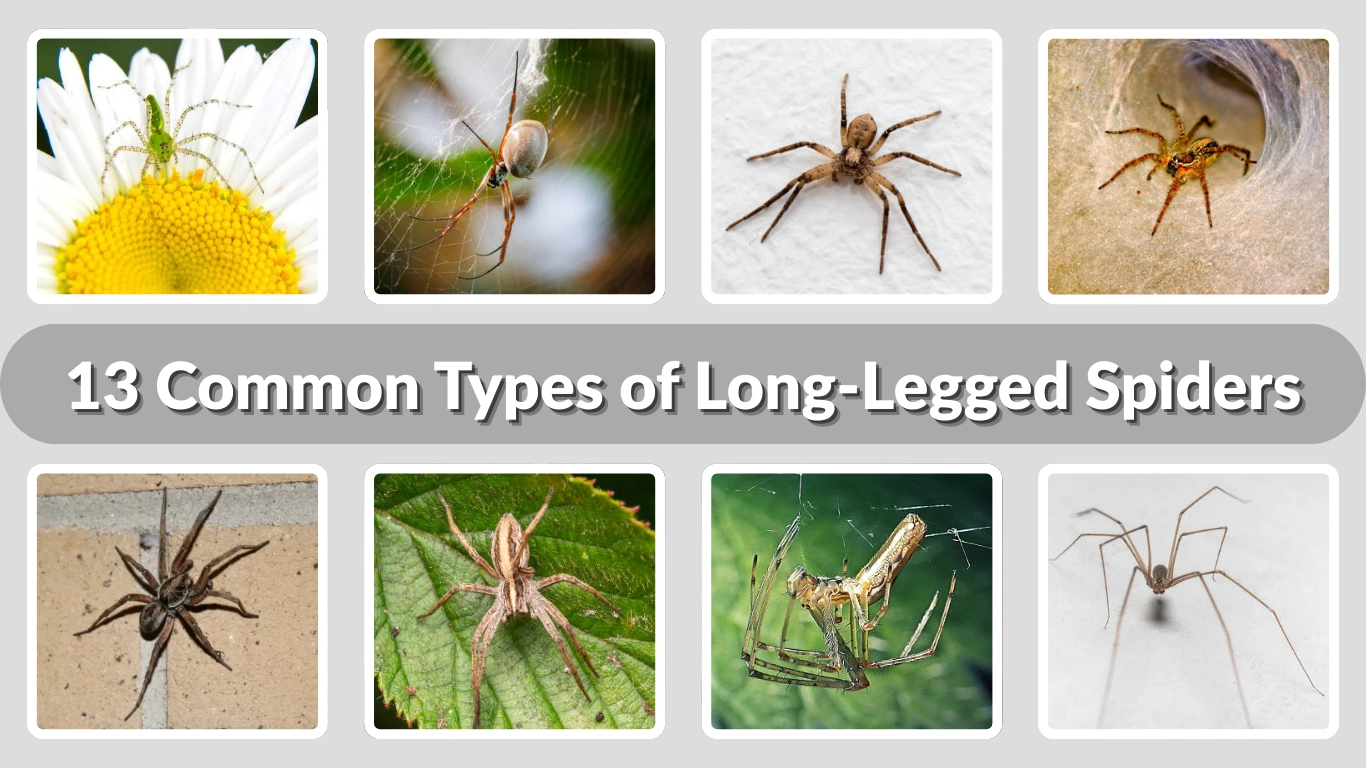
Long-legged spiders are easily recognized by their slender bodies and extended legs, making them appear larger and more intimidating than they actually are. These spiders can be found in homes, gardens, forests, and near water sources across the world. While many people confuse different species with one another, each type has unique traits, behaviors, and habitats that set it apart. Understanding these common long-legged spiders can help with identification and reduce unnecessary fear.
1. Cellar Spider

Cellar spiders are among the most common long-legged spiders found indoors worldwide. They are best known for their extremely thin legs, small bodies, and habit of hanging upside down in webs in corners, basements, and ceilings.
Identification
- Small, pale body with an elongated abdomen
- Extremely long, thin legs compared to body size
- Light tan, gray, or pale brown coloration
- Delicate, messy web usually built in corners
Size
Cellar spiders have small bodies, typically around 0.25–0.4 inches long, but their leg span can reach up to 2 inches, making them appear much larger.
Habitat
They are commonly found indoors, especially in basements, cellars, garages, crawl spaces, and quiet ceiling corners. Outdoors, they may live in caves, rock crevices, and sheltered structures.
Behavior
Cellar spiders are non-aggressive and harmless to humans. When disturbed, they often vibrate rapidly in their webs, making them difficult for predators to detect.
2. Harvestman

Harvestmen are long-legged arachnids often mistaken for true spiders, but they belong to a different order called Opiliones. They are commonly known as daddy longlegs and are frequently seen in gardens, forests, and damp outdoor areas.
Identification
- Rounded or oval body with no narrow “waist”
- Extremely long, slender legs
- Single, fused body segment
- Brown, gray, or tan coloration
Size
Harvestmen have small bodies, usually 0.1–0.3 inches long, while their leg span can extend up to 3 inches depending on the species.
Habitat
They are commonly found outdoors in gardens, leaf litter, forests, under logs, rocks, and around building foundations, especially in moist environments.
Behavior
Harvestmen do not build webs and are active wanderers. They are harmless to humans and often feed on small insects, decaying plant matter, and fungi.
3. Daddy Longlegs Spider

The daddy longlegs spider is a true spider species that closely resembles cellar spiders and is often confused with harvestmen. It is known for its fragile appearance, extremely long legs, and preference for indoor environments.
Identification
- Small, elongated body with a distinct narrow waist
- Very long, thin, delicate legs
- Pale yellow, light brown, or gray coloration
- Builds loose, irregular webs
Size
The body length is usually around 0.2–0.4 inches, while the leg span may reach up to 2 inches or more.
Habitat
Daddy longlegs spiders are most commonly found indoors in basements, ceilings, attics, and corners of rooms. Outdoors, they may inhabit sheds, caves, and sheltered structures.
Behavior
These spiders are non-aggressive and rarely bite humans. When threatened, they may vibrate in their webs, a behavior that helps deter predators.
4. Yellow Sac Spider

Yellow sac spiders are fast-moving, long-legged spiders commonly found in homes and gardens. They are known for their pale coloration and their habit of roaming rather than staying in webs.
Identification
- Pale yellow, cream, or light green body
- Slender body with long front legs
- Slightly darker mouthparts
- Lacks a visible web except for small silk sacs
Size
Yellow sac spiders typically measure 0.2–0.4 inches in body length, with legs that appear long in proportion to their body.
Habitat
They are found indoors on walls, ceilings, and corners, as well as outdoors on shrubs, tall grass, and garden plants. They often hide in small silk sacs during the day.
Behavior
These spiders are active hunters and do not rely on webs to catch prey. They may bite if threatened, but bites are usually mild and not dangerous.
5. Long-Jawed Orb Weaver

Long-jawed orb weavers are slender, long-legged spiders best known for their stretched bodies and elongated jaws. They are commonly found near water and vegetation where they build delicate orb-shaped webs.
Identification
- Very long, narrow body with an elongated abdomen
- Extremely long legs, often held stretched forward and backward
- Prominent, elongated jaws (chelicerae)
- Green, yellow, brown, or silvery coloration
Size
Their body length usually ranges from 0.3–0.6 inches, while their leg span makes them appear much larger.
Habitat
These spiders prefer outdoor habitats such as wetlands, ponds, grassy fields, gardens, and areas near streams or lakes where insects are abundant.
Behavior
Long-jawed orb weavers are harmless to humans. They typically rest stretched along plant stems during the day and rebuild their delicate webs at night to catch flying insects.
6. Nursery Web Spider

Nursery web spiders are large, long-legged spiders known for their strong legs and unique parental care behavior. They are often mistaken for wolf or fishing spiders due to their size and appearance.
Identification
- Large, elongated body with long, sturdy legs
- Brown or gray coloration with darker markings
- Two dark stripes running along the cephalothorax
- Hairy appearance
Size
Nursery web spiders typically measure 0.4–0.8 inches in body length, with a leg span that can exceed 2 inches.
Habitat
They are commonly found near water, in tall grasses, meadows, shrubs, and along woodland edges. They may also enter buildings occasionally.
Behavior
Unlike web-building spiders, nursery web spiders hunt actively. Females carry egg sacs in their jaws and later build a protective “nursery” web for their spiderlings.
7. Fishing Spider

Fishing spiders are large, long-legged spiders often found near water. They are well known for their ability to walk on water surfaces and capture aquatic prey.
Identification
- Large, flattened body with very long legs
- Brown, gray, or black coloration with pale markings
- Distinct light stripes or spots on the body and legs
- Hairy legs adapted for sensing vibrations
Size
Fishing spiders have body lengths ranging from 0.6–1 inch, with a leg span that can reach up to 3 inches or more.
Habitat
They are commonly found near ponds, streams, lakes, and wetlands. Some species may wander into nearby buildings, especially in damp areas.
Behavior
Fishing spiders are active hunters and do not rely on webs to catch prey. They can detect vibrations on water surfaces and feed on insects, tadpoles, and even small fish.
8. Wolf Spider

Wolf spiders are strong, long-legged hunters that are often seen running across the ground rather than sitting in webs. Their size and speed frequently cause them to be mistaken for more dangerous spiders.
Identification
- Robust, hairy body with long, powerful legs
- Brown, gray, or tan coloration with darker stripes
- Large, forward-facing eyes that reflect light
- Stocky appearance compared to web-building spiders
Size
Wolf spiders vary widely in size, typically ranging from 0.4–1.2 inches in body length, with a leg span that makes them appear larger.
Habitat
They are commonly found on the ground in gardens, grasslands, forests, fields, and around homes. Some species may enter buildings, especially during cooler months.
Behavior
Wolf spiders are active hunters that chase down prey instead of using webs. They are generally shy and avoid humans, biting only when trapped or threatened.
9. Giant House Spider

Giant house spiders are fast-moving, long-legged spiders commonly found inside homes, especially in cooler regions. They are known for their impressive speed and large size.
Identification
- Large brown body with long, slender legs
- Darker markings on the abdomen and cephalothorax
- Hairy appearance with banded legs
- Funnel-shaped web nearby
Size
These spiders typically measure 0.6–0.75 inches in body length, with a leg span that can reach up to 3 inches.
Habitat
Giant house spiders prefer indoor environments such as basements, garages, attics, and corners of rooms. Outdoors, they may live under rocks or in crevices.
Behavior
They are non-aggressive and usually flee when disturbed. Males often wander indoors in search of females, which is why they are frequently seen in homes.
10. Funnel Weaver Spider

Funnel weaver spiders are long-legged web builders best known for their sheet-like webs that narrow into a funnel-shaped retreat. They are very common in gardens and around buildings.
Identification
- Medium to large body with long, slender legs
- Brown or gray coloration with darker striping
- Two darker bands on the cephalothorax
- Creates a flat web with a funnel-shaped hiding spot
Size
Funnel weaver spiders usually measure 0.25–0.75 inches in body length, with leg spans that vary by species.
Habitat
They are commonly found in lawns, shrubs, gardens, fences, window wells, and building foundations. Some species frequently enter homes.
Behavior
These spiders wait at the funnel opening and rush out to capture prey that lands on the web. They are shy and rarely bite humans.
11. Huntsman Spider

Huntsman spiders are large, long-legged spiders known for their crab-like stance and incredible speed. Despite their intimidating size, they are generally harmless to humans.
Identification
- Large, flattened body with very long legs
- Legs extend sideways in a crab-like posture
- Brown, gray, or sandy coloration
- Smooth, less hairy appearance
Size
Huntsman spiders typically have body lengths of 0.6–1.2 inches, while their leg span can reach 4 inches or more.
Habitat
They are commonly found in warm regions, living under tree bark, rocks, and inside homes, especially behind furniture or wall spaces.
Behavior
Huntsman spiders do not build webs to catch prey. They actively hunt insects and often enter houses, where they help control pest populations.
12. Garden Orb Weaver

Garden orb weavers are long-legged spiders best known for their large, circular webs often seen in gardens and open outdoor spaces. They are among the most recognizable web-building spiders.
Identification
- Rounded or oval abdomen with bold markings
- Long, slender legs often banded with light and dark colors
- Brown, yellow, orange, or black coloration
- Large, symmetrical orb-shaped web
Size
Their body length usually ranges from 0.4–1 inch, with females being significantly larger than males.
Habitat
They are commonly found in gardens, fields, forests, and around outdoor lights where flying insects are abundant.
Behavior
Garden orb weavers are non-aggressive and rarely bite. They typically rebuild their webs daily and remain motionless at the center while waiting for prey.
13. Lynx Spider

Lynx spiders are agile, long-legged spiders commonly found on plants and shrubs. They are easily recognized by their spiny legs and alert hunting posture.
Identification
- Slender body with long, spiny legs
- Pointed abdomen and narrow cephalothorax
- Green, yellow, brown, or gray coloration
- Prominent leg spines visible even at a distance
Size
Lynx spiders typically measure 0.4–0.8 inches in body length, with legs that appear long and angular.
Habitat
They are commonly found in gardens, shrubs, tall grasses, and agricultural fields, where they blend in with vegetation.
Behavior
Lynx spiders are active hunters that do not build webs. They rely on speed and excellent vision to ambush insects and are generally harmless to humans.
FAQs
Are long-legged spiders dangerous to humans?
Most long-legged spiders are harmless to humans. While a few species can bite if threatened, their venom is generally mild and not medically significant. They usually prefer to avoid human contact and are more interested in catching insects.
What is the difference between daddy longlegs and cellar spiders?
Daddy longlegs can refer to different arachnids, including harvestmen and cellar spiders. Harvestmen are not true spiders and do not have venom, while cellar spiders are true spiders that build messy webs indoors.
Why do long-legged spiders enter houses?
Long-legged spiders often enter homes searching for food, shelter, or mates. Indoor environments provide stable temperatures and abundant insect prey, especially during cooler or wetter seasons.
Do long-legged spiders build webs?
Some long-legged spiders, such as cellar spiders and orb weavers, build webs to catch prey. Others, like wolf spiders, huntsman spiders, and lynx spiders, actively hunt without using webs.
Are long-legged spiders beneficial?
Yes, long-legged spiders are beneficial because they help control insect populations. They feed on flies, mosquitoes, and other household or garden pests, making them valuable contributors to natural pest control.
