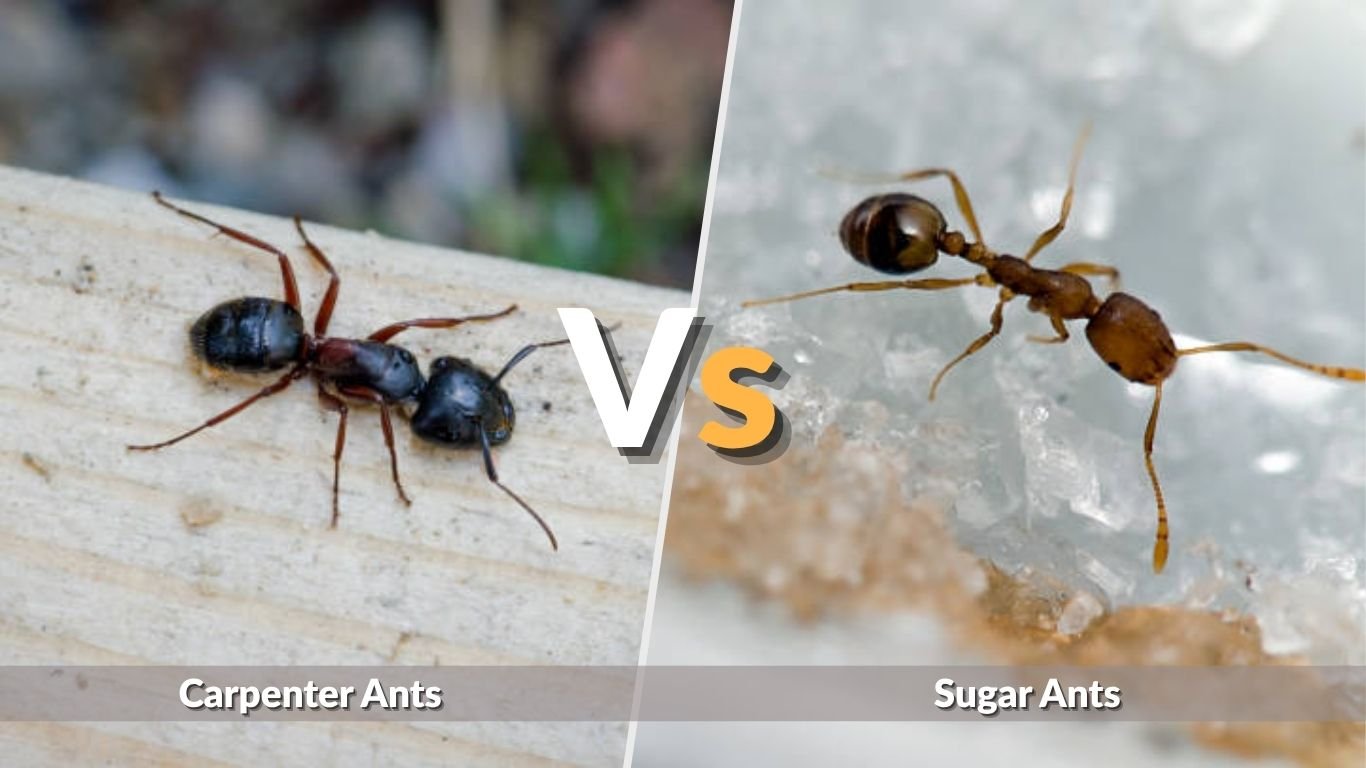
Carpenter ants and sugar ants can both show up in kitchens, bathrooms, walls, and around food, but they are not the same problem. Carpenter ants are larger ants that can excavate wood for nesting, while “sugar ants” usually refers to small household ants attracted to sweet foods. Correct identification matters because carpenter ants may point to moisture-damaged wood, while sugar ants are usually more of a food and nuisance issue.
Carpenter Ants vs Sugar Ants: Quick Comparison
Carpenter ants are usually easier to notice because of their large size and strong body. Sugar ants are usually much smaller and often appear in trails around crumbs, syrup, fruit, honey, or spilled drinks.
| Feature | Carpenter Ants | Sugar Ants |
| Size | Usually large, about 1/4–1/2 inch | Usually small, often 1/16–1/8 inch |
| Color | Black, reddish-black, brown, or red | Brown, dark brown, black, or light brown |
| Main concern | Wood nesting and structural risk | Food contamination and nuisance |
| Nesting area | Damp wood, wall voids, stumps, logs | Wall gaps, soil, under floors, near food/water |
| Food | Sweets, proteins, insects, honeydew | Mostly sweets, honeydew, and household foods |
Penn State lists odorous house ant workers at about 1/16 to 1/8 inch, while Rutgers lists carpenter ant workers at 6–13 mm, or about 1/4 to 5/8 inch.
What Are Carpenter Ants?
Carpenter ants are ants in the genus Camponotus. They are known for tunneling into wood to build nests. They do not eat wood like termites, but they remove wood to create smooth galleries and tunnels. Severe, long-term carpenter ant activity can weaken structural wood, especially when moisture problems are present.
Carpenter Ant Identification
- Large body compared with most indoor ants
- Usually black, reddish-black, brown, or red
- Bent antennae
- Narrow waist
- Smooth, rounded thorax profile
- Often seen at night while foraging
- May produce sawdust-like frass near nest openings
Carpenter ants are often found near bathrooms, kitchens, windows, roof leaks, damp wall voids, crawl spaces, decks, trees, logs, and stumps. If you see large ants repeatedly indoors, especially near wet wood, it may be a sign of a nest nearby.
What Are Sugar Ants?
“Sugar ants” is a common household name, not always one exact species. In many homes, people use this name for small ants attracted to sweets. Odorous house ants are one common example because they feed on sweets, honeydew, and household foods. University of Minnesota Extension says odorous house ants are about 1/10 inch long, brown to dark brown, and may smell unpleasant when crushed.
Sugar Ant Identification
- Small size, usually much smaller than carpenter ants
- Often seen in long trails
- Common around sugar, fruit, syrup, juice, honey, and crumbs
- May appear near sinks or moisture
- Usually more of a nuisance than a wood-damaging pest
- Some species give off a rotten coconut-like odor when crushed
Sugar ants can be annoying because they quickly form trails to food. However, they usually do not create the same wood-damage concern as carpenter ants.
Sugar Ant vs Carpenter Ant Size
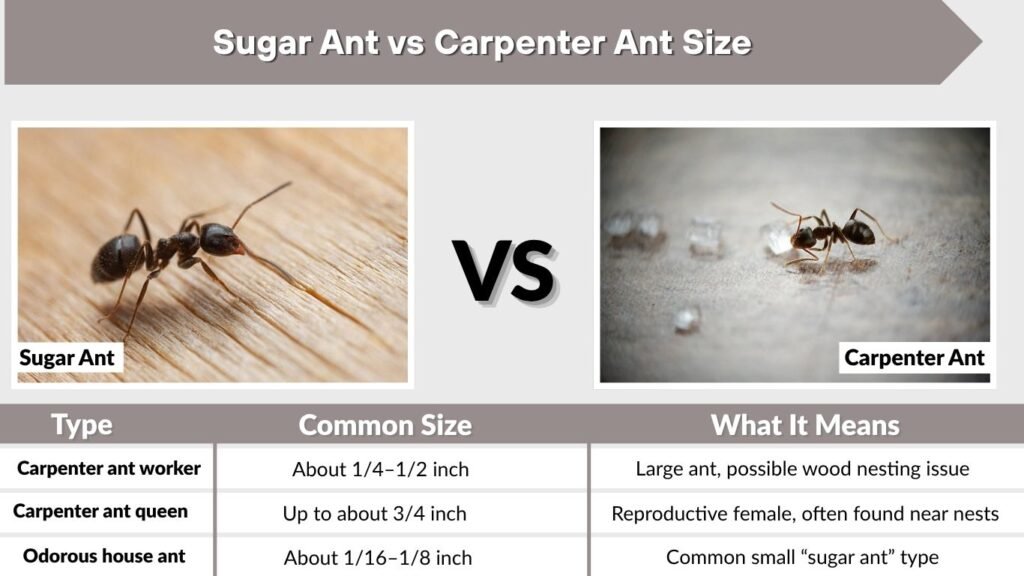
Size is one of the easiest ways to separate these ants. Carpenter ants are usually large enough that you can clearly see their body parts. Sugar ants are usually tiny and may look like small dots moving in a line.
| Type | Common Size | What It Means |
| Carpenter ant worker | About 1/4–1/2 inch | Large ant, possible wood nesting issue |
| Carpenter ant queen | Up to about 3/4 inch | Reproductive female, often found near nests |
| Odorous house ant | About 1/16–1/8 inch or around 1/10 inch | Common small “sugar ant” type |
| Tiny household sugar ants | Usually very small | Often attracted to food and moisture |
A large black ant in your home is more likely to be a carpenter ant than a sugar ant. A trail of very small ants around sweet food is more likely to be a sugar ant problem.
Nesting Differences
Carpenter ants and sugar ants also differ in where they nest. Carpenter ants are associated with wood, especially damp or damaged wood. Sugar ants may nest in wall voids, soil, cracks, under floors, or around moisture, depending on the species.
Where Carpenter Ants Nest
Carpenter ants may nest in:
- Moist wall voids
- Window and door frames
- Roof-damaged wood
- Bathroom or kitchen walls
- Crawl spaces
- Decks and porches
- Logs, stumps, and trees
NC State Extension notes that carpenter ant damage may include slit-like openings where ants push out sawdust and frass, and their galleries often follow the wood grain.
Where Sugar Ants Nest
Sugar ants may nest in:
- Soil near foundations
- Cracks around walls or floors
- Under slabs
- Wall voids
- Near kitchens and sinks
- Around food storage areas
- Outdoor mulch or landscape edges
They often enter homes for food and water rather than to excavate wood.
Damage: Which Ant Is Worse?
Carpenter ants are usually the bigger concern for homeowners because they can tunnel into wood. The damage is often slow, but it can become serious when the nest remains active for years. University of Minnesota Extension notes that structural wood can be weakened when carpenter ant damage is severe.
| Problem | Carpenter Ants | Sugar Ants |
| Damage wood | Yes, by excavating galleries | No, not normally |
| Eat wood | No | No |
| Contaminate food | Possible | Common |
| Indicate moisture issue | Often | Sometimes |
| Need urgent inspection | Yes, if recurring indoors | Usually less urgent |
| Best control focus | Find nest and fix moisture | Sanitation, sealing, baits |
Sugar ants are still frustrating, but they usually do not threaten structural wood. Their main issue is food contamination, indoor trails, and repeated kitchen or pantry invasions.
Food and Behavior Differences
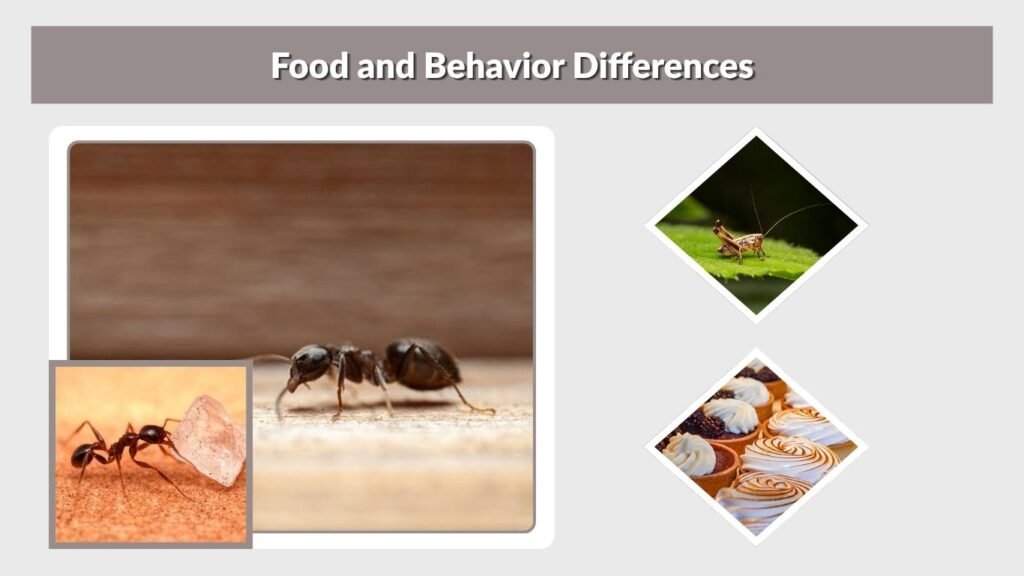
Both types of ants may eat sweet foods, so food preference alone is not enough for identification. Carpenter ants can feed on sweets, honeydew, insects, household scraps, and other foods. The University of Florida IFAS notes that carpenter ants feed on honeydew, household food scraps, insects, and other foods.
Sugar ants are more strongly associated with sweet foods. Penn State says odorous house ants mostly prefer sweets, while University of Minnesota Extension notes that many ant species feed on sweets and honeydew.
How to Tell Which Ant You Have
Start with size, then check location and behavior. If the ants are large and appear near wood, moisture, windows, walls, or frass, suspect carpenter ants. If the ants are tiny and trailing to sweet foods, suspect sugar ants.
Simple Identification Checklist
- Large ants: more likely carpenter ants
- Tiny ants in kitchen trails: more likely sugar ants
- Sawdust-like frass: strong carpenter ant clue
- Rotten coconut smell when crushed: possible odorous house ants
- Ants near damp wood: possible carpenter ants
- Ants around syrup, juice, or crumbs: possible sugar ants
- Winged ants indoors: may point to a mature ant colony nearby
How to Get Rid of Carpenter Ants vs Sugar Ants
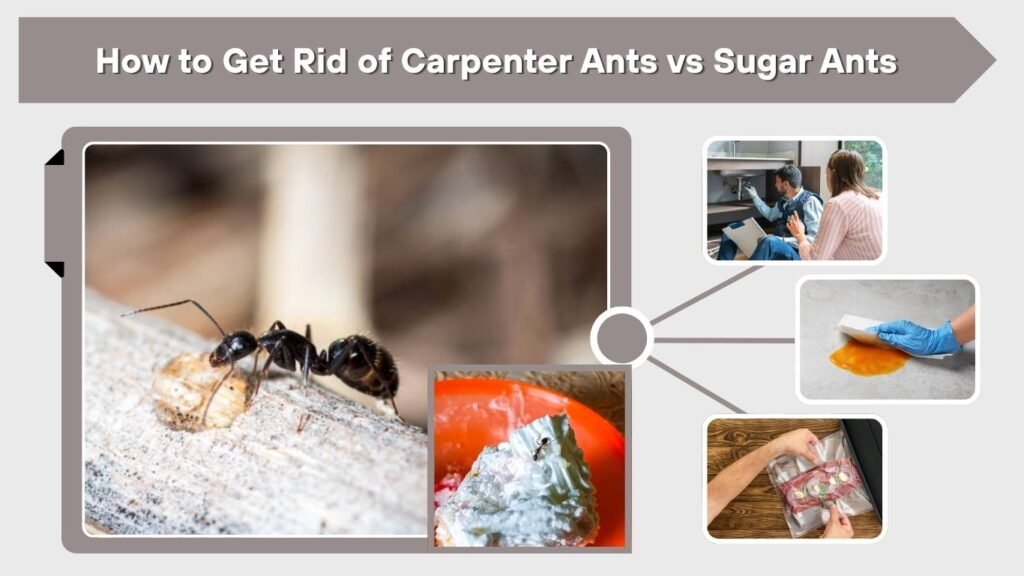
The control method depends on the ant. For carpenter ants, the key is finding the nest and correcting moisture. For sugar ants, sanitation and baiting are usually the main steps.
Carpenter Ant Control
For carpenter ants, inspect damp wood, wall voids, window frames, decks, stumps, and crawl spaces. Remove rotting wood, repair leaks, and follow ant trails at night. Baits can help, but a hidden nest may need professional treatment.
Sugar Ant Control
For sugar ants, clean spills, seal food, wipe ant trails, fix moisture, and use ant baits along trails. Avoid spraying directly over bait trails because sprays can scatter ants or stop them from carrying bait back to the colony.
FAQs
Are sugar ants the same as carpenter ants?
No, sugar ants and carpenter ants are not the same in most household pest situations. Carpenter ants are larger ants that can tunnel in wood. Sugar ants are usually small ants attracted to sweets and household foods. The name “sugar ant” can describe different small ant species.
How can I tell carpenter ants from sugar ants?
Look at size, location, and signs. Carpenter ants are much larger and may appear near damp wood, walls, windows, or frass. Sugar ants are usually tiny and often form trails to sweet foods, crumbs, fruit, syrup, or juice.
Do sugar ants damage wood?
Sugar ants usually do not damage wood. They are mostly a nuisance pest around food and moisture. Carpenter ants are the ants more strongly linked with wood tunneling. They do not eat wood, but they excavate it to create nesting galleries.
Which is worse, carpenter ants or sugar ants?
Carpenter ants are usually worse for a house because they can excavate wood and may indicate moisture damage. Sugar ants are usually less structurally serious, but they can contaminate food and become difficult to control if trails and nests are not treated.
Can carpenter ants be attracted to sugar?
Yes, carpenter ants can be attracted to sweet foods, honeydew, and household food scraps. That is why food attraction alone is not enough for identification. Use size, body shape, nesting area, and signs like frass to tell them apart.