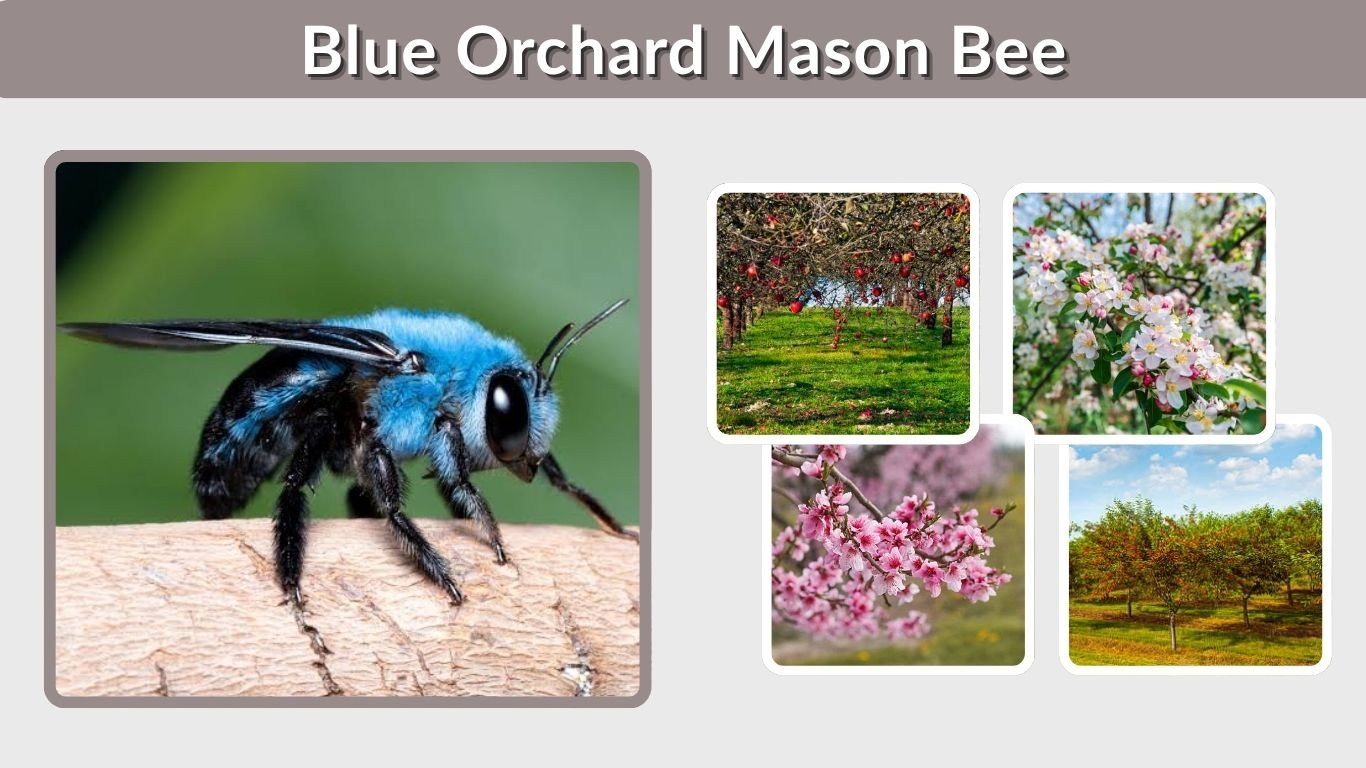
The blue orchard mason bee (Osmia lignaria) is a small native bee best known for its metallic blue color and exceptional ability to pollinate spring-blooming fruit trees. Often called the blue mason orchard bee or orchard mason bee, it is especially valuable in apple, cherry, pear, and plum orchards. Unlike honey bees, these bees are solitary and do not produce honey or live in large colonies. They nest inside natural cavities, hollow tubes, and specially designed bee houses, using mud to divide individual nesting chambers.
What Is a Blue Orchard Mason Bee?
The blue orchard mason bee is a solitary bee native to North America. Its scientific name is Osmia lignaria, and it belongs to the family Megachilidae. Despite being solitary, many females may nest close together when suitable nesting holes are available.
These bees become active during spring, when many fruit trees begin flowering. Their timing makes them particularly useful orchard pollinators.
Identification
You can recognize a blue orchard mason bee by several characteristics:
- Metallic dark blue or blue-black body
- Compact, slightly rounded appearance
- Dense hairs covering much of the body
- Usually around 7–14 mm long
- Females generally larger than males
- Pollen-carrying hairs beneath the female’s abdomen
- No obvious yellow-and-black pattern like many other bees
Their metallic coloring can look blue, black, or even slightly green depending on lighting.
Blue Orchard Mason Bee Size
Blue orchard mason bees are relatively small. Most are considerably smaller than large bumblebees and are roughly comparable in length to some smaller honey bees.
Females are typically larger and more robust than males. Male orchard mason bees may also have longer antennae and lighter facial hairs.
Because of their compact appearance, people sometimes mistake them for flies or small metallic insects until they see them visiting flowers.
Is a Blue Orchard Bee the Same as a Mason Bee?
Yes, the blue orchard bee is a type of mason bee.
“Mason bee” describes numerous bees in the genus Osmia. They receive this name because females commonly use mud or similar materials to construct walls between their nest chambers.
The blue orchard mason bee is one particular species and is among the best-known mason bees in North America because of its importance as an orchard pollinator.
Blue Orchard Mason Bee Range and Habitat
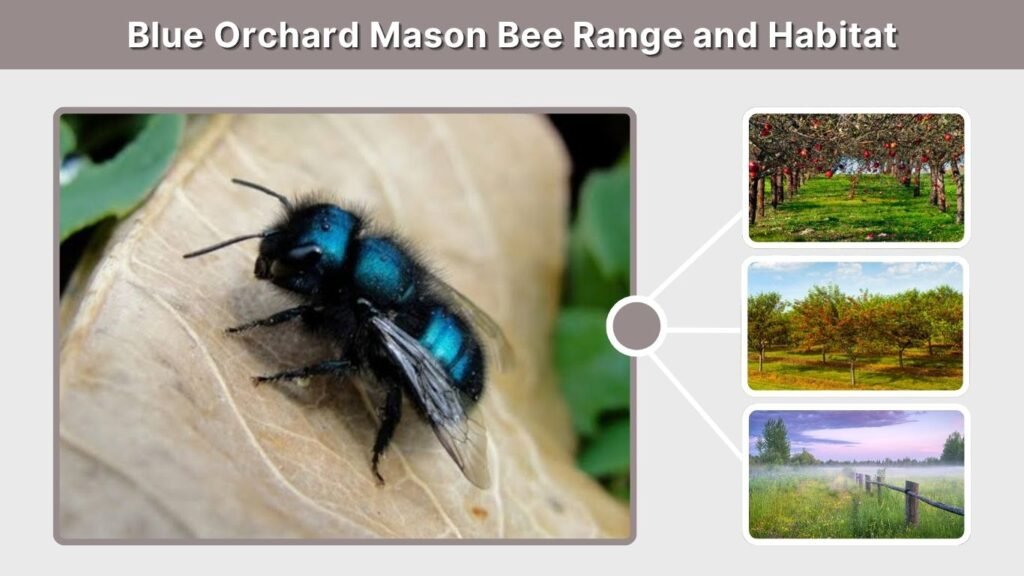
Blue orchard mason bees occur across significant portions of North America. They inhabit environments where flowering plants and suitable nesting cavities are available.
They are particularly noticeable during spring because adults emerge around the same period that many orchard trees and native plants begin flowering.
Where Do Blue Orchard Mason Bees Live?
These bees may be found around:
- Home gardens
- Apple orchards
- Cherry orchards
- Woodlands
- Forest edges
- Farms
- Parks
- Meadows
- Suburban landscapes
They need both flowers for food and cavities where females can build nests.
Natural nest sites may include holes left behind by wood-boring insects, hollow plant stems, cracks, and other narrow cavities.
Blue Orchard Mason Bee Native Range
Osmia lignaria is native to North America, with populations occurring across parts of the United States and Canada.
Different regional populations are adapted to their local climate. Their emergence is closely connected with spring temperatures and flowering periods.
Blue orchard mason bees can therefore be particularly useful for pollinating crops that bloom early in the growing season.
Blue Orchard Mason Bee in Virginia and Other States
Blue orchard mason bees can occur in many regions of the United States where appropriate nesting habitat and spring flowers are available.
Gardeners can improve local habitat by maintaining flowering plants, reducing unnecessary pesticide use, and providing clean nesting cavities.
However, whenever purchasing mason bees, using bees appropriate to the local region is generally preferable to moving populations long distances.
Blue Orchard Mason Bee Nest
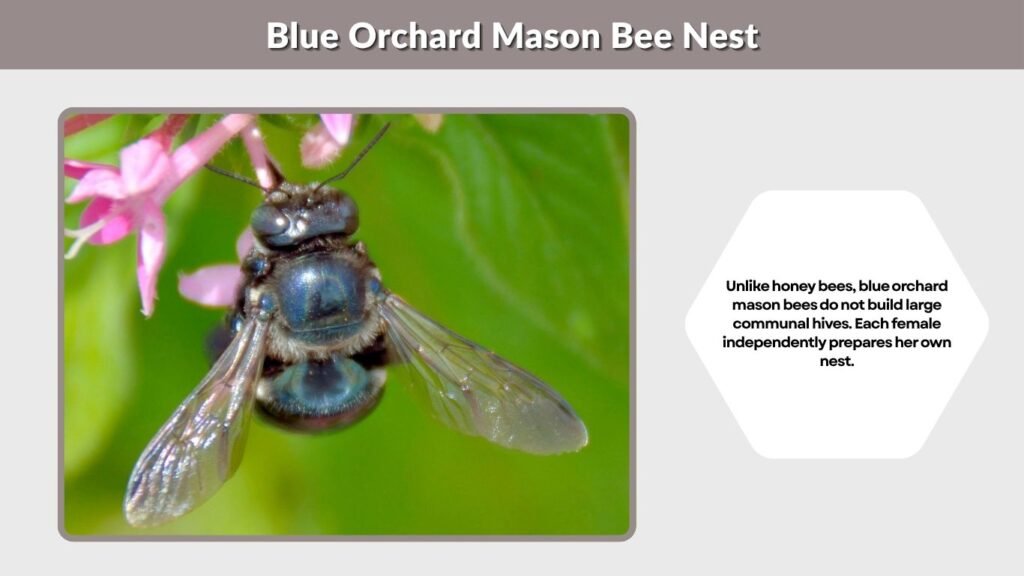
Unlike honey bees, blue orchard mason bees do not build large communal hives. Each female independently prepares her own nest.
She searches for an existing narrow cavity rather than excavating a large nest herself. Once she finds an appropriate space, she begins creating a series of individual chambers.
How Does the Female Build Her Nest?
The nesting process is remarkably organized.
A female gathers pollen and nectar and places the mixture at the back of a nesting cavity. She lays one egg on the food supply and then constructs a mud wall.
She repeats the process several times, producing a row of separate chambers.
The general sequence looks like this:
- Locate an empty nesting cavity.
- Collect pollen and nectar.
- Place food inside the cavity.
- Lay a single egg.
- Seal the chamber with mud.
- Repeat the process farther toward the entrance.
- Create a final protective mud seal.
This mud-building behavior explains the name “mason bee.”
Blue Orchard Mason Bee Tubes
Artificial nesting tubes can provide convenient nesting cavities for orchard mason bees.
Suitable nesting systems generally contain narrow tunnels where females can establish individual nests. Removable or replaceable nesting materials can also make seasonal cleaning and management easier.
A nesting tube should remain dry and protected from excessive rain while still allowing bees easy access.
Blue Orchard Mason Bee House
A mason bee house can attract local bees when placed correctly.
Choose a sheltered location that receives some morning sun. Mount the house firmly rather than allowing it to swing in the wind.
Nearby mud is also important because females require moist soil to construct their nesting partitions. A garden containing plenty of spring flowers provides the pollen and nectar they need.
Bee houses should also be maintained regularly. Neglected nesting materials may accumulate parasites, mites, mold, or other problems over several seasons.
Blue Orchard Mason Bee Life Cycle
The life cycle of a blue orchard mason bee generally follows the seasons. Adults are most visible during spring, while much of the remaining year is spent developing or resting inside nesting chambers.
Timing can vary depending on climate and local temperature.
Spring Emergence
Adults emerge when temperatures warm during spring.
Males usually emerge first. They remain near nesting sites and flowers while waiting for females.
Females emerge somewhat later, mate, and then begin searching for nesting cavities.
Nesting and Egg Laying
After mating, females spend several weeks gathering pollen, nectar, and mud.
Each nest chamber contains one egg and enough stored food to support the developing larva.
Interestingly, females can influence the sex of their offspring. Female eggs are commonly placed deeper inside the nesting tunnel, while male eggs are often positioned closer to the entrance.
Larval Development
The egg hatches into a larva inside the sealed chamber.
The larva consumes the pollen and nectar provision supplied by its mother. It then spins a cocoon and eventually develops into an adult.
The new adult normally remains protected inside the nest through colder months before emerging the following spring.
Blue Orchard Mason Bees in an Orchard
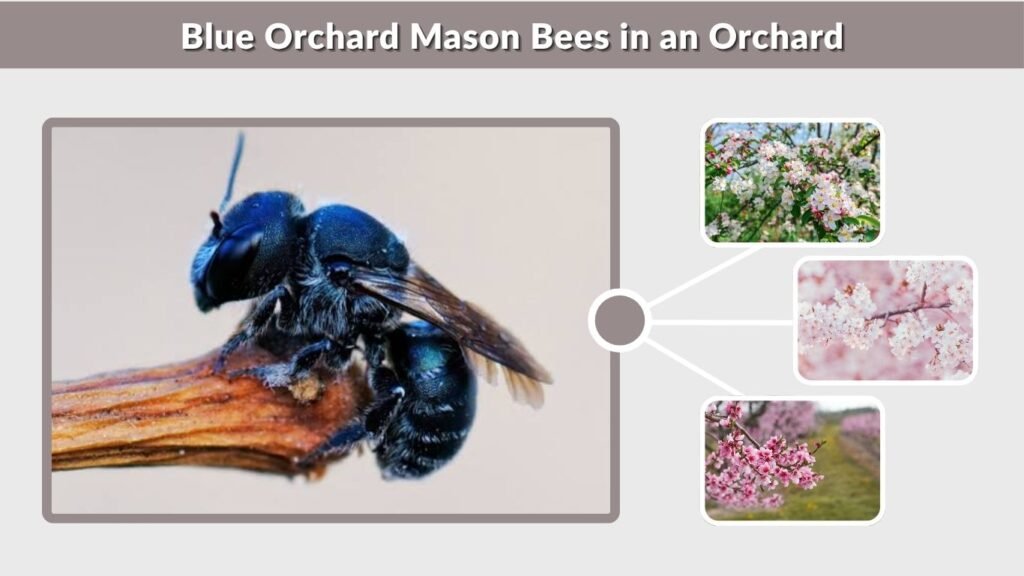
Blue orchard mason bees are highly valued because they are efficient pollinators of many spring fruit crops.
Unlike honey bees, which transport pollen mainly on specialized structures on their legs, mason bees collect much of their pollen on hairs beneath the abdomen. Pollen can therefore transfer readily between flowers as they forage.
Flowers and Crops They Pollinate
Blue orchard mason bees commonly visit:
- Apple blossoms
- Cherry blossoms
- Pear blossoms
- Plum blossoms
- Peach blossoms
- Apricot blossoms
- Native spring flowers
A blue orchard mason bee moving repeatedly between apple blossoms may carry pollen efficiently from one flower to another.
Why Orchard Growers Value Them
These bees are active during relatively cool spring weather and frequently move between flowers.
Their pollination behavior makes them useful alongside honey bees and other native pollinators. Supporting several different pollinator species can provide more consistent flower visitation throughout changing spring conditions.
Do Blue Orchard Mason Bees Sting?
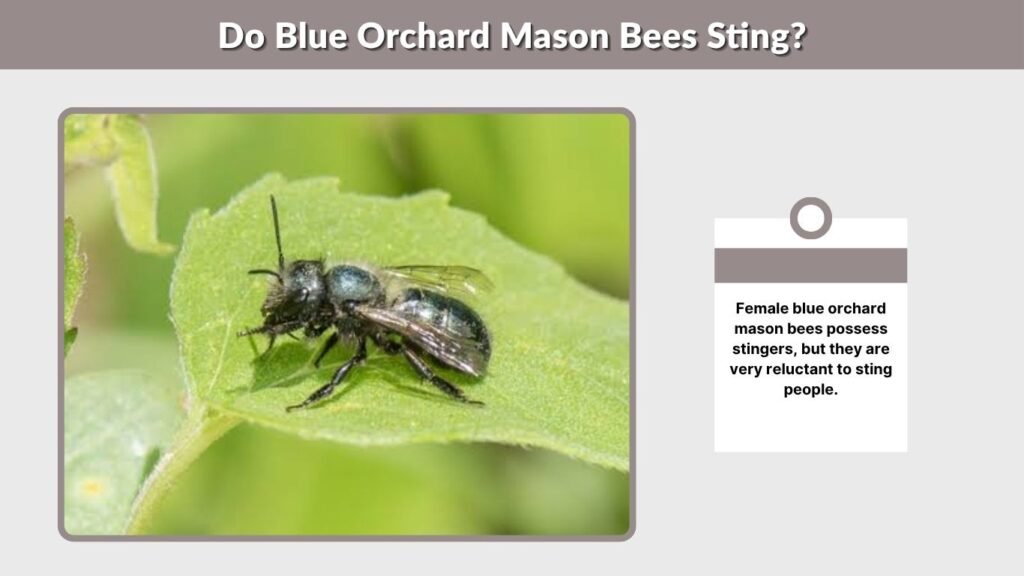
Female blue orchard mason bees possess stingers, but they are very reluctant to sting people.
Because they do not defend large colonies filled with stored honey, they are generally much less defensive around their nests than social bees or wasps.
Are Blue Orchard Mason Bees Aggressive?
No. They are normally peaceful around humans.
A female might sting if she is trapped, squeezed, or handled roughly, but simply walking near a nesting house is unlikely to provoke an attack.
Males cannot sting.
This gentle behavior is one reason mason bee houses are often used in home gardens.
What Does a Blue Mason Orchard Bee Sting Feel Like?
If a sting occurs, it may cause temporary pain, redness, itching, or swelling around the affected area.
Anyone who develops difficulty breathing, throat or facial swelling, dizziness, widespread hives, or other symptoms of a serious allergic reaction after any insect sting should seek emergency medical attention.
FAQs
Are blue orchard mason bees good for gardens?
Yes. They are beneficial native pollinators that visit fruit trees and many spring flowers. Providing suitable flowers and nesting habitat can encourage them to remain around a garden.
Do blue orchard mason bees make honey?
No. They collect nectar and pollen to feed their offspring but do not maintain large honey stores like honey bees.
When do blue orchard mason bees emerge?
They generally emerge during spring when temperatures become warmer and early fruit trees begin flowering. Exact timing depends on the local climate.
Where do blue orchard mason bees nest?
They use existing narrow cavities such as holes in wood, hollow stems, artificial nesting tubes, and properly maintained mason bee houses.
Can blue orchard mason bees sting?
Female blue orchard mason bees can sting, but they are very docile and rarely sting unless trapped or handled. Male mason bees cannot sting.