
A black widow spider web is usually messy, irregular, and stronger than it looks. Unlike orb-weaver spiders that make neat circular webs, black widows build tangled cobwebs in dark, quiet places. These webs may appear in garages, sheds, crawl spaces, woodpiles, outdoor furniture, or corners near the ground. Knowing what a black widow spider web looks like can help you identify possible risk areas and remove webs safely.
What Is a Black Widow Spider Web?
A black widow spider web is a sticky, tangled silk structure used for catching prey and sheltering the spider. It is often built close to the ground or in protected spaces where insects pass by. The web may look disorganized, but it is effective.
Black widows do not build the classic wheel-shaped web many people imagine. Their web is more like an uneven cobweb with strong strands running in different directions.
Why Black Widow Webs Look Messy
Black widow webs look messy because they are made for trapping insects in tight, hidden locations. The spider does not need a decorative or symmetrical pattern. Instead, it uses strong silk lines to create a trap.
The web may include sticky areas, support lines, and a retreat space where the spider hides. The female black widow often stays close to the web and waits for insects to become trapped.
Where the Spider Hides in the Web
A black widow may hide in a dark corner, crack, hole, or sheltered retreat attached to the web. It often stays out of sight during the day and becomes more active at night.
If you see a messy web in a dark area, do not reach into it with bare hands. Use caution until you confirm what made it.
What Does a Black Widow Spider Web Look Like?
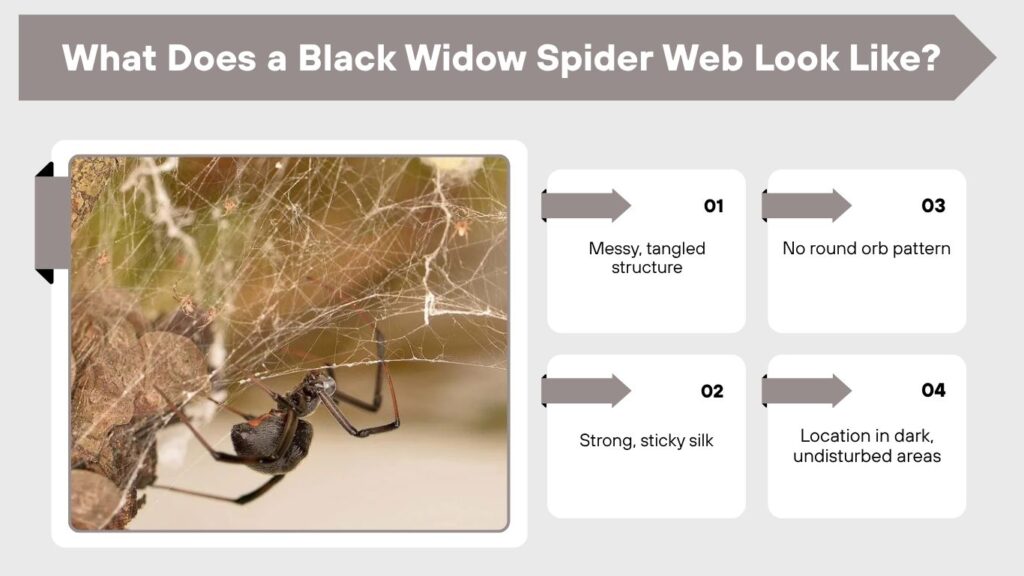
A black widow spider web usually looks like an irregular, tangled cobweb. It may stretch across corners, under objects, between stored items, or across low openings. The web can look dusty if it has been there for a while.
The strands may feel tougher than typical house spider webs. Black widow silk is known for being strong, which is why the web may not break as easily as expected.
Key Web Identification Signs
A possible black widow spider web may have:
- Messy, tangled structure
- No round orb pattern
- Strong, sticky silk
- Low or hidden placement
- Location in dark, undisturbed areas
- Nearby egg sacs
- A retreat space in a crack or corner
- Insects caught in the web
A web alone is not enough to confirm a black widow. Many cobweb spiders make similar-looking webs.
Black Widow Spider Web Pattern
The black widow spider web pattern is irregular. It may look like loose strands crossing in several directions. Some parts may be denser, while others may look like scattered trip lines.
This pattern helps the spider sense vibration when prey touches the silk. Once an insect is trapped, the spider comes out and wraps it.
Black Widow Spider Web Identification
Black widow spider web identification should include both the web and the surrounding clues. Since other spiders make messy cobwebs, you need to consider the location, silk strength, egg sacs, and spider appearance.
The most reliable sign is seeing the spider itself. Female black widows are usually shiny black with a rounded abdomen and a red hourglass marking on the underside. Some species or individuals may have red spots, broken markings, or lighter juvenile patterns.
Places to Check Carefully
Black widow webs are often found in quiet, protected areas such as:
- Garages
- Sheds
- Basements
- Crawl spaces
- Woodpiles
- Rock piles
- Outdoor furniture
- Water meter boxes
- Storage bins
- Under decks
- Fence corners
- Behind clutter
- Around trash cans
- Low corners near foundations
These spiders prefer places where they are not disturbed. If an area has not been cleaned or moved in a long time, inspect it before putting your hands there.
Black Widow Web in House
A black widow spider web in the house is less common than outdoor webs, but it can happen. Indoor webs may appear in basements, garages, closets, crawl spaces, utility rooms, or cluttered storage areas.
If you suspect a black widow web indoors, avoid touching it directly. Wear gloves, use a long-handled tool, and consider professional pest control if you find the spider, egg sacs, or repeated webs.
Black Widow Spider Web Strength
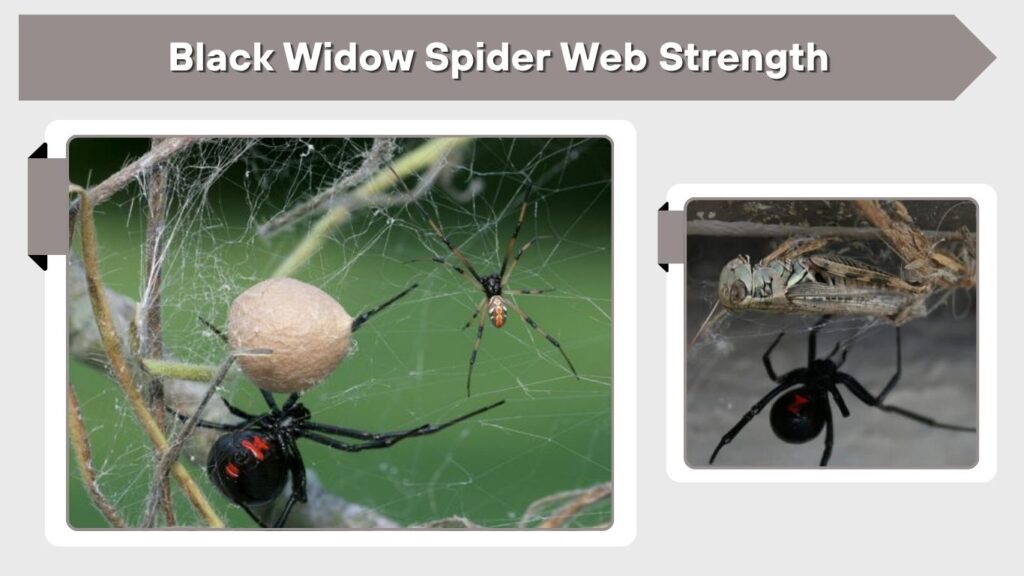
Black widow spider web strength is one reason these webs are interesting. The silk can be surprisingly tough compared with many other spider webs. This strength helps the spider catch struggling insects.
The web may feel more elastic or resistant when brushed with a stick. Still, you should never test a suspected black widow web with your bare fingers.
Why the Silk Is So Strong
Spider silk is made from proteins produced by the spider’s silk glands. Black widow silk is strong because it must hold prey and support the web in hidden, uneven spaces.
The silk may include different types of strands for support, trapping, and wrapping prey. This makes the web effective even if it looks messy.
Does a Strong Web Mean Black Widow?
Not always. Other spiders also make strong webs. Web strength can support suspicion, but it is not proof. Identification is stronger when the web is in a typical location and a black widow spider is seen nearby.
Black Widow Web vs False Black Widow Web
A false black widow spider web can look very similar to a true black widow web. False widows are also cobweb spiders, and they often build tangled, irregular webs in homes, sheds, and sheltered areas.
This is why many people misidentify spiders based only on web appearance.
| Feature | Black Widow Web | False Black Widow Web |
|---|---|---|
| Pattern | Irregular, tangled cobweb | Irregular, tangled cobweb |
| Location | Dark, quiet, low areas | Homes, corners, sheds, clutter |
| Silk | Strong and sticky | Also sticky and messy |
| Spider appearance | Shiny black female, red hourglass underside | Brown to dark body, no true red hourglass |
| Risk level | Medically significant bite possible | Usually less dangerous but may bite |
How to Tell the Difference
The spider is more important than the web. A true black widow female usually has a shiny black body and a red hourglass marking on the underside of the abdomen. A false widow is often brownish, purplish, or dark with different markings.
If you cannot identify the spider safely, do not handle it. Take a photo from a distance and ask a local extension office or pest professional.
Male Black Widow Spider Web
A male black widow spider may use silk, but females are the main web builders people notice. Males are smaller, lighter, and less dangerous than females. They often wander while searching for a mate.
A male may enter a female’s web during mating behavior. Since male black widows are small and less obvious, most webs people find are associated with females or juveniles.
Do Male Black Widows Make Webs?
Male black widows can produce silk, but they do not usually build the large, strong cobwebs that females use for long-term prey capture. Their webs or silk use may be smaller and less noticeable.
If you find a strong messy web in a hidden corner, a female spider is more likely than a male.
Northern and Western Black Widow Spider Webs
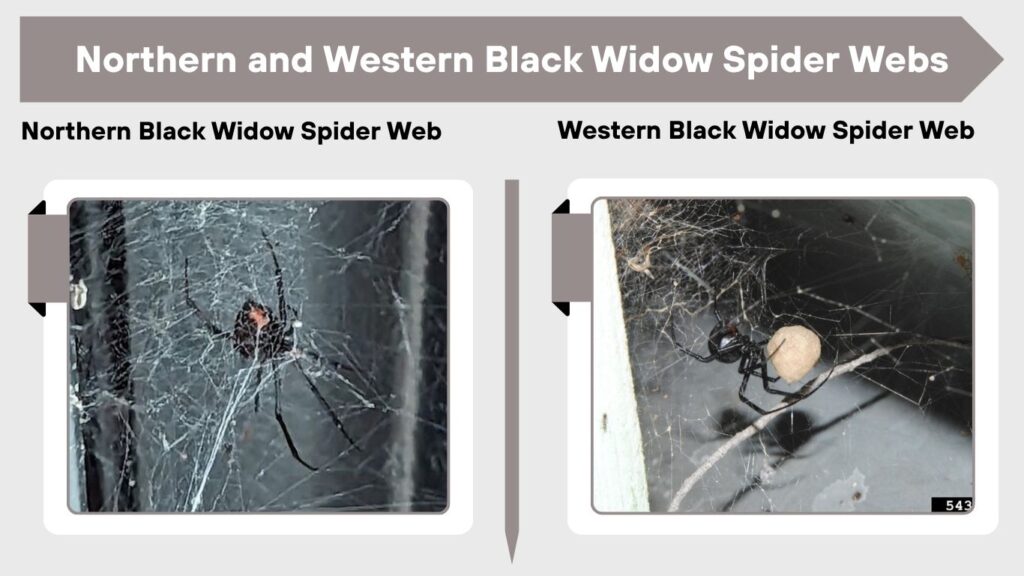
Northern black widow spider webs and western black widow spider webs are similar in general structure. Both are irregular cobwebs made in sheltered locations. The biggest differences are usually the spider’s range and markings, not the web pattern.
Northern black widows, western black widows, and southern black widows all belong to the same general group of widow spiders. They share many behaviors, including building tangled webs.
Northern Black Widow Spider Web
A northern black widow spider web may be found in protected outdoor locations, under logs, in stone walls, sheds, or quiet corners. The spider may have a broken or divided red marking instead of a perfect hourglass.
Because markings can vary, avoid relying only on one feature.
Western Black Widow Spider Web
A western black widow spider web is commonly found in dry, sheltered places across western regions. It may appear around garages, patio furniture, irrigation boxes, woodpiles, or outdoor storage.
In warm regions, black widow activity may continue for much of the year.
Black Widow Spider Web Pictures and Photos
Many people search for black widow spider web pictures because they want to compare a web they found. Photos can help, but they can also be misleading. Lighting, dust, angle, and age of the web can change how it looks.
A picture of a black widow spider web usually shows a tangled cobweb rather than a neat design. It may be difficult to distinguish from other cobwebs unless the spider or egg sacs are visible.
What to Look for in Photos
When comparing your web to photos, look for:
- Tangled structure
- Low, dark location
- Strong-looking silk
- Irregular lines
- Egg sacs nearby
- Shiny black spider nearby
- No circular pattern
If you find a web in a frequently used area, remove it carefully after checking for spiders.
Black Widow Spider Web Drawing
A black widow spider web drawing should not look like a perfect Halloween-style spiral. A more accurate drawing would show messy, crossing strands with an uneven cobweb structure. The web may be denser near the spider’s retreat and more open at the edges.
For educational art, include the spider hiding near a corner or dark crevice instead of sitting in the center of a round web.
Black Widow Spider Web Tattoo Meaning
A black widow spider web tattoo can have different meanings depending on the person. Some people choose it for themes of danger, survival, mystery, strength, independence, or transformation. Others like the dark visual style of the spider and web.
Tattoo meanings are personal. A black widow web tattoo does not have one fixed interpretation.
Common Tattoo Themes
A black widow spider web tattoo may symbolize:
- Feminine power
- Survival
- Mystery
- Protection
- Danger
- Independence
- Patience
- Transformation
- Dark beauty
- Strength after hardship
Some designs include the spider, red hourglass, web strands, skulls, roses, or geometric patterns.
Black Widow Spider Web Tattoo Design Ideas
Popular design ideas include a black widow hanging from a messy web, a red hourglass detail, a web behind a rose, or a small spider web near the wrist, shoulder, elbow, or ankle.
For a more realistic design, ask the artist to use an irregular cobweb pattern rather than a perfect circular web.
How to Remove a Black Widow Spider Web Safely
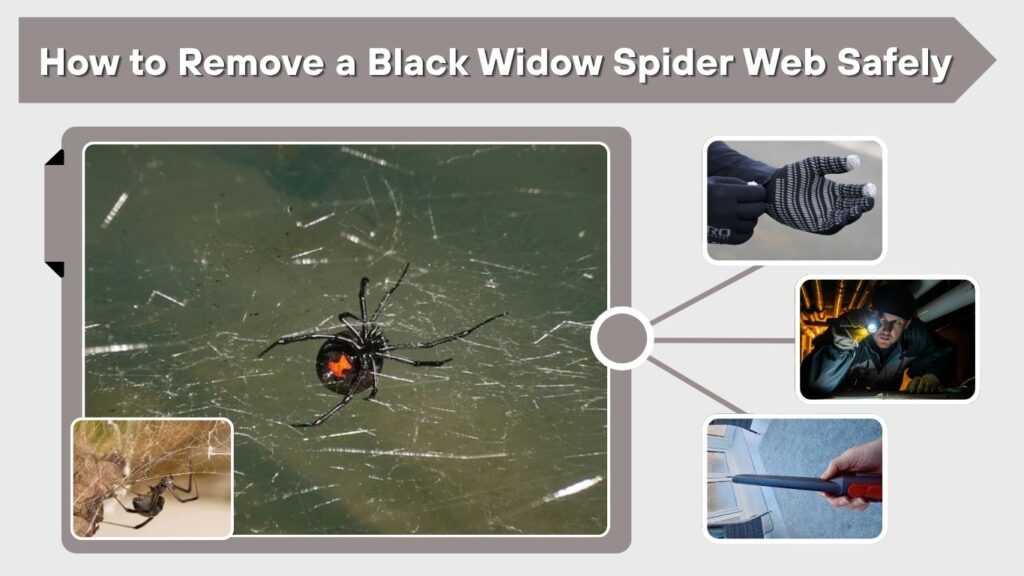
If you find a suspected black widow spider web, safety matters. Do not reach into the web with bare hands, especially in dark or cluttered areas.
Use gloves, long sleeves, and a long-handled broom or vacuum attachment. Move slowly and check the area before cleaning.
Safe Removal Steps
To remove a suspected black widow web:
- Wear thick gloves and closed shoes.
- Use a flashlight to inspect the area.
- Keep children and pets away.
- Use a long-handled tool or vacuum.
- Avoid touching the web or spider directly.
- Seal vacuum contents or dispose of debris carefully.
- Remove clutter that gives spiders hiding places.
- Monitor the area for new webs.
If you see multiple black widows, egg sacs, or webs in high-use areas, call a pest control professional.
What About Egg Sacs?
Black widow egg sacs may look like small pale or tan round sacs in or near the web. They can contain many young spiders. Do not crush or handle them with bare hands.
Vacuum or remove them carefully using protective measures. For heavy activity, professional treatment is safer.
How to Prevent Black Widow Webs
Prevention focuses on reducing hiding places and insect prey. Black widows stay where they have shelter and food. Cleaning and exclusion can make your home less attractive.
Prevention Tips
To reduce black widow webs:
- Clear clutter in garages and sheds.
- Wear gloves when moving stored items.
- Seal cracks around foundations.
- Repair door sweeps and screens.
- Store firewood away from the house.
- Keep outdoor furniture clean.
- Reduce insects around lights.
- Vacuum corners and storage areas.
- Shake out shoes, gloves, and outdoor clothing.
- Keep trash and debris away from walls.
Regular inspection is especially important in warm regions where black widows are common.
What to Do If You Find a Black Widow
If you find a black widow, do not panic. Avoid touching it. Keep children and pets away, and remove it safely if you are comfortable doing so. Otherwise, contact a pest professional.
If someone is bitten or may have been bitten, wash the area and contact Poison Control or a healthcare professional. Seek urgent care for severe pain, muscle cramps, trouble breathing, spreading symptoms, or if the bite involves a child, older adult, or vulnerable person.
FAQs
What does a black widow spider web look like?
A black widow spider web looks messy, tangled, and irregular. It is not a neat circular web. It is usually found in dark, quiet, protected areas such as garages, sheds, crawl spaces, woodpiles, outdoor furniture, and low corners near foundations.
How do you identify a black widow spider web?
Look for an irregular cobweb pattern, strong sticky silk, hidden low placement, trapped insects, and possible egg sacs. However, the web alone cannot confirm a black widow because false widows and house spiders also build tangled cobwebs.
Are black widow spider webs strong?
Yes, black widow spider webs can be surprisingly strong. Their silk is tough and sticky enough to hold struggling insects. However, strong silk alone does not prove the web belongs to a black widow, since other spiders can also make durable webs.
Can black widow webs be inside a house?
Yes, black widow webs can appear inside houses, especially in basements, garages, crawl spaces, closets, utility rooms, or cluttered storage areas. They are more common in quiet, undisturbed spots than in open living areas.
What should I do if I find a black widow web?
Do not touch it with bare hands. Wear gloves, use a flashlight, and remove it with a long-handled tool or vacuum. Keep children and pets away. If you find multiple webs, egg sacs, or spiders, consider calling a pest control professional.