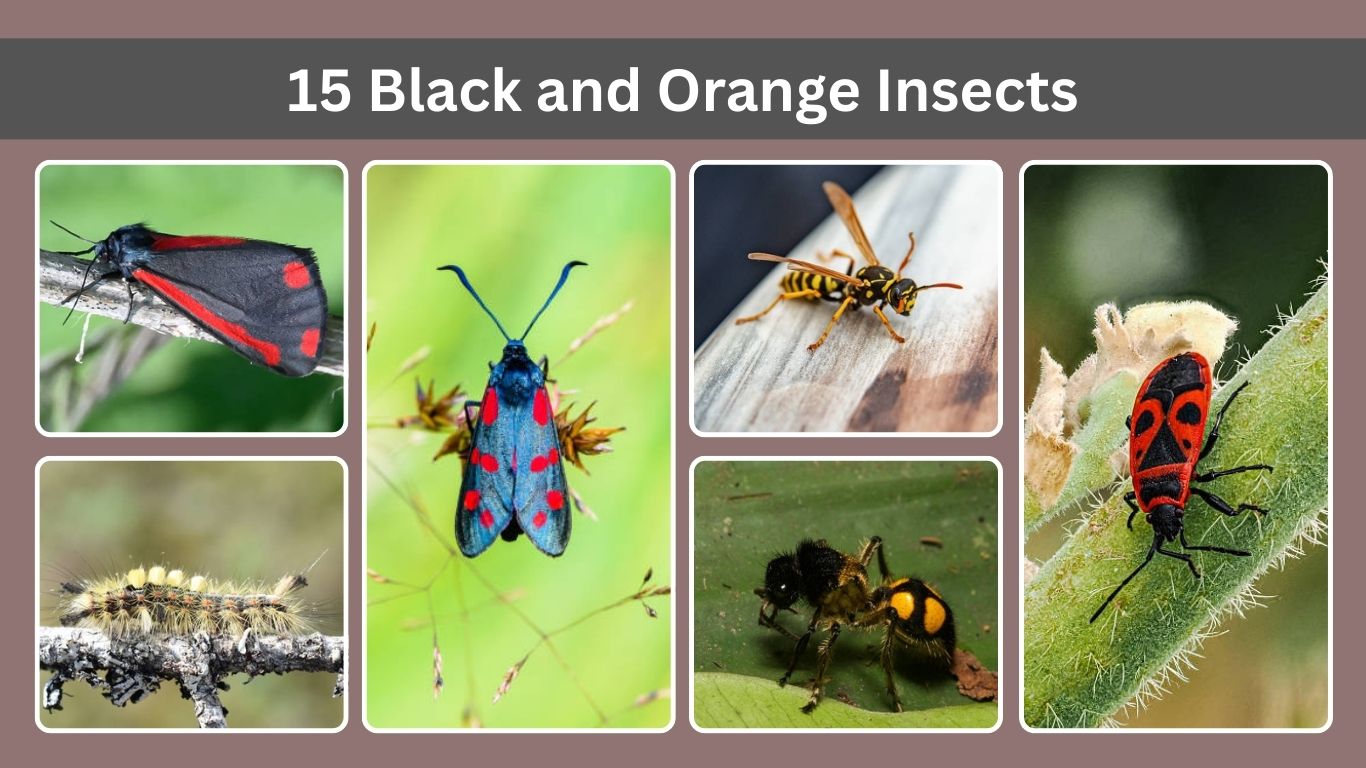
Black-and-orange insects are among the most visually distinctive species in nature, often showcasing bold stripes, spots, or wing patterns. These contrasting colors usually act as aposematic signals, warning predators of toxins, stings, or bad taste. Found in gardens, meadows, woodlands, and farmlands, they include beetles, bugs, caterpillars, moths, butterflies, and wasps.
Some, like ladybird larvae and velvet ants, are important predators, while others, such as boxelder bugs and cucumber beetles, can become pests. This guide highlights 15 striking examples with their identification, habitats, behaviors, and ecological importance.
1. Monarch Butterfly (Danaus plexippus)

The monarch butterfly is one of the most iconic orange-and-black flying insects, belonging to the family Nymphalidae. Its bold wing patterns serve as warning coloration, protecting it from predators. Monarchs are also famous for their extraordinary long-distance migration across North America.
Identification
- Wingspan: 90–100 mm
- Bright orange wings with thick black veins and borders
- White spots along black wing edges
- Black body with white dots on thorax
- Six black legs, with forelegs reduced in males
Habitat and Range
Monarch butterflies are widely distributed across North and South America, with introduced populations in Australia, New Zealand, and parts of Europe. They thrive in meadows, prairies, gardens, and open fields, where milkweed plants (Asclepias spp.) grow, as these are essential for breeding.
Behavior and Feeding Habits
Adult monarchs feed on nectar from a variety of flowers, while larvae (caterpillars) feed exclusively on milkweed, sequestering toxic cardiac glycosides that make them unpalatable to predators. Monarchs are also renowned for their mass migrations, traveling thousands of kilometers from Canada and the northern United States to overwintering sites in central Mexico.
Notable Facts
- One of the best-studied examples of aposematic coloration (orange and black).
- Caterpillars are striped black, yellow, and white.
- The migration is multigenerational, with butterflies reproducing en route.
- Populations are under threat due to habitat loss, climate change, and pesticide use.
Would you like me to continue with No. 2 Harlequin Ladybird in the exact same structured style?
2. Harlequin Ladybird (Harmonia axyridis)

The harlequin ladybird, also called the multicolored Asian lady beetle, is a highly variable orange-and-black insect belonging to the family Coccinellidae. Originally from Asia, it has spread worldwide and is now one of the most invasive ladybird species.
Identification
- Size: 5–8 mm long
- Elytra color ranges from orange to red, often with black spots
- Some morphs are black with orange or red spots
- Dome-shaped, rounded body typical of ladybirds
- Six short black legs and short antennae
Habitat and Range
This beetle is now widespread across Europe, North America, South America, and parts of Africa. It thrives in gardens, woodlands, orchards, and agricultural fields, especially where aphids are abundant.
Behavior and Feeding Habits
Harlequin ladybirds are voracious predators of aphids, scale insects, and mites, making them beneficial in pest control. However, they outcompete native ladybird species, sometimes harming local biodiversity. They overwinter in large numbers, often entering houses.
Notable Facts
- Known for variable coloration, hence “harlequin.”
- Can release a yellow defensive fluid with a strong odor.
- Considered both beneficial (pest control) and harmful (invasive).
- Their orange-and-black markings make them easily confused with native ladybirds.
3. Milkweed Bug (Oncopeltus fasciatus)

The milkweed bug is a striking black-and-orange insect with wings and stripes, belonging to the family Lygaeidae. Closely associated with milkweed plants, it is an important species in both natural ecosystems and scientific research.
Identification
- Size: 10–18 mm long
- Orange or reddish body with bold black bands
- Black legs, head, and antennae
- Elongated oval shape with piercing-sucking mouthparts
- Six legs and fully developed wings
Habitat and Range
Native to North America, milkweed bugs are found in meadows, fields, and gardens where milkweed plants (Asclepias spp.) grow. They are strongly dependent on this plant for both food and reproduction.
Behavior and Feeding Habits
These insects pierce milkweed seed pods and stems, sucking nutrient-rich fluids. They sequester toxic cardiac glycosides from the plant, making them unpalatable to predators. Their orange-and-black coloration serves as a strong aposematic warning, much like monarch butterflies.
Notable Facts
- Often seen in clusters basking on milkweed plants.
- Undergo gradual metamorphosis (egg → nymph → adult).
- Non-predatory, unlike ladybirds; strictly plant feeders.
- Frequently used in research due to ease of rearing in labs.
4. Cinnabar Moth (Tyria jacobaeae)

The cinnabar moth is a vivid black-and-orange flying insect, belonging to the family Erebidae. Its striking coloration makes it one of the most recognizable day-flying moths, commonly associated with ragwort plants.
Identification
- Wingspan: 32–42 mm
- Black forewings with bright orange-red markings
- Hindwings are mainly orange-red with black borders
- Black, slender, slightly hairy body
- Six black legs and feathery antennae
Habitat and Range
Native to Europe and western Asia, the cinnabar moth is also introduced to New Zealand and North America as a biological control for ragwort. It thrives in meadows, grasslands, heathlands, and coastal areas.
Behavior and Feeding Habits
Adults are day-flying nectar feeders, often seen on wildflowers. The caterpillars are striped black and orange and feed on ragwort leaves, absorbing toxic alkaloids that make both larvae and adults poisonous to predators.
Notable Facts
- Classic example of aposematic coloration.
- Larvae often feed in groups and can strip ragwort plants bare.
- Used in biocontrol programs against invasive ragwort.
- Adults live only a few weeks, flying in late spring to early summer.
5. Six-Spotted Burnet Moth (Zygaena filipendulae)

The six-spotted burnet moth is a striking orange-and-black insect with wings, belonging to the family Zygaenidae. This day-flying moth is easily spotted feeding on nectar in sunny wildflower meadows.
Identification
- Wingspan: 30–38 mm
- Metallic black-green forewings with six orange-red spots
- Hindwings bright orange-red with black borders
- Slender black body with clubbed antennae
- Six black legs adapted for clinging to flowers
Habitat and Range
Common across Europe and the UK, this moth inhabits flower-rich meadows, chalk downs, and coastal areas. It thrives in warm, sunny environments where wildflowers such as knapweed and thistles grow.
Behavior and Feeding Habits
Adults are nectar feeders, visiting thistles, knapweeds, and clovers. Caterpillars feed mainly on bird’s-foot trefoil (Lotus corniculatus). Both larvae and adults store cyanogenic glycosides, making them distasteful to predators.
Notable Facts
- Diurnal moth, often confused with butterflies.
- Bright coloration warns of toxicity.
- Sometimes confused with the five-spotted burnet moth.
- Active from June to August in sunny conditions.
6. Garden Tiger Moth Caterpillar (Arctia caja)

The garden tiger moth caterpillar, also called the woolly bear caterpillar, is a well-known black-and-orange spiky insect. It is the larval stage of the garden tiger moth, noted for its hairy body and bold defensive adaptations.
Identification
- Caterpillars grow up to 60 mm long
- Dense coat of black or dark brown hairs
- Striking orange-red bands visible between segments
- Covered with spiky setae (hairs) that deter predators
- Six true legs and several prolegs, typical of caterpillars
Habitat and Range
Found widely across Europe, North America, and parts of Asia, they inhabit gardens, hedgerows, grasslands, and woodland edges. Caterpillars feed on a wide range of herbaceous plants, including nettles, docks, and dandelions.
Behavior and Feeding Habits
These caterpillars are voracious plant feeders, often seen basking in the sun to regulate body temperature. When threatened, they curl into a ball, exposing their orange warning hairs. Adults emerge as brightly patterned moths with orange hindwings and black spots.
Notable Facts
- Their hairy spines can cause mild skin irritation.
- Overwinter as caterpillars before pupating in spring.
- Serve as a food source for birds resistant to their defenses.
- A classic example of warning coloration and mimicry.
7. Wasp Beetle (Clytus arietis)

The wasp beetle is a mimic species, resembling a black-and-orange striped flying insect, though it is harmless. Belonging to the longhorn beetle family Cerambycidae, it uses mimicry to avoid predators.
Identification
- Size: 9–18 mm long
- Elongated black body with yellow-orange stripes across elytra
- Long black antennae, half the body length
- Narrow thorax and six black legs
- Strong resemblance to a stinging wasp in flight
Habitat and Range
Native to Europe, especially the UK, the wasp beetle is found in woodlands, hedgerows, and gardens. Larvae develop inside rotting wood, while adults are seen on flowers during spring and early summer.
Behavior and Feeding Habits
Adults feed on pollen and nectar from umbellifers and other wildflowers. Larvae bore into decaying wood, aiding decomposition. Their black-and-orange striping acts as Batesian mimicry, helping them avoid predation.
Notable Facts
- Often mistaken for real wasps when flying.
- Active from May to July.
- Play a role in recycling nutrients in woodland ecosystems.
- Harmless despite their intimidating appearance.
8. Velvet Ant (Dasymutilla occidentalis)

The velvet ant, commonly called the “cow killer”, is actually a wasp rather than a true ant. It is a fuzzy black-and-orange insect known for its bright warning colors and extremely painful sting.
Identification
- Females are wingless, resembling hairy ants, up to 25 mm long
- Dense coat of orange-red and black hairs
- Males are winged but similar in coloration
- Six strong black legs and long antennae
- Thick, robust body adapted for ground movement
Habitat and Range
Velvet ants are found across the southern United States, inhabiting sandy soils, open fields, pastures, and meadows. They are solitary and often seen scurrying quickly across the ground.
Behavior and Feeding Habits
Females parasitize the nests of ground-nesting bees and wasps, laying eggs inside. The larvae develop as parasitoids, consuming the host larvae. Adults feed mainly on nectar. Their orange-and-black hairy appearance warns predators of their painful sting.
Notable Facts
- Nicknamed “cow killer” for its excruciating sting.
- Harmless unless provoked; not aggressive.
- Tough exoskeleton provides protection from predators.
- Important in regulating populations of ground-nesting bees and wasps.
9. Boxelder Bug (Boisea trivittata)

The boxelder bug is a black insect with orange stripes on its thorax and wings, belonging to the family Rhopalidae. Though harmless, it is considered a nuisance pest due to its habit of swarming in large numbers.
Identification
- Size: 12–14 mm long
- Elongated oval body, mostly black
- Three orange-red stripes on thorax and orange wing margins
- Black legs and long antennae
- Often mistaken for firebugs due to similar colors
Habitat and Range
Native to North America, boxelder bugs are found near boxelder, maple, and ash trees. They gather in sunny spots, tree trunks, and walls, and frequently invade houses in autumn to overwinter.
Behavior and Feeding Habits
They feed on seeds, flowers, and young leaves of host trees, using piercing-sucking mouthparts. While their feeding causes little damage, large infestations can be unsightly. Their orange-and-black markings serve as mild deterrence against predators.
Notable Facts
- Overwinter in buildings, becoming indoor pests.
- Do not bite, sting, or spread disease.
- Release a foul odor when crushed.
- Reproduce quickly in warm conditions, forming large seasonal groups.
10. Spotted Cucumber Beetle (Diabrotica undecimpunctata) – Orange Morph

The spotted cucumber beetle is usually greenish-yellow, but some regional morphs display orange bodies with black spots, making them resemble classic ladybirds. They are members of the family Chrysomelidae and are notorious agricultural pests.
Identification
- Size: 6–9 mm long
- Bright orange elytra with distinct black spots
- Black head, legs, and antennae
- Oval, dome-shaped body
- Six legs, typical beetle structure
Habitat and Range
These beetles are common across North America, particularly in gardens, fields, and farmlands. They thrive where cucurbits like cucumbers, melons, and squash are grown.
Behavior and Feeding Habits
Adults feed on leaves, stems, and flowers of cucurbits, while larvae (rootworms) feed on plant roots underground. Their feeding can severely damage crops and transmit plant diseases. Their orange-and-black coloration also helps camouflage them among flowers.
Notable Facts
- Major pest of cucumbers and related crops.
- Capable of spreading bacterial wilt disease.
- Adults are strong fliers and disperse widely.
- Sometimes confused with ladybugs due to their spots.
11. Oriental Hornet (Vespa orientalis)

The oriental hornet is a large orange-and-black stinging insect, belonging to the family Vespidae. Recognized by its reddish-orange body and dark contrasting bands, it is a powerful predator and social wasp.
Identification
- Size: 25–35 mm long
- Reddish-orange thorax and abdomen with black bands
- Large black eyes and strong mandibles
- Two pairs of transparent wings with orange veins
- Six strong legs and long segmented antennae
Habitat and Range
Native to North Africa, the Middle East, and southern Europe, oriental hornets build paper nests in soil banks, hollow trees, or sometimes buildings. Colonies thrive in hot, arid climates.
Behavior and Feeding Habits
Oriental hornets are predators, hunting other insects such as grasshoppers and bees to feed larvae. Adults also consume nectar and sugary substances. Their bright orange-and-black coloration warns predators of their potent sting. Interestingly, they can generate energy from sunlight using pigments in their cuticle.
Notable Facts
- Aggressive when defending nests.
- Sting is painful but not usually fatal.
- Unique among wasps for solar-powered metabolism.
- Considered both pest and beneficial predator depending on context.
12. Gulf Fritillary Butterfly (Agraulis vanillae)

The gulf fritillary is a graceful orange-and-black flying insect, belonging to the family Nymphalidae. Known for its bright wings and silver-spotted underside, it is commonly seen in gardens and open fields across warm regions of the Americas.
Identification
- Wingspan: 65–95 mm
- Brilliant orange wings with black spots and streaks
- Underside of hindwings silvery-white with dark markings
- Slender black body with white dots
- Six black legs, typical of butterflies
Habitat and Range
Widely distributed across the southern United States, Central America, and South America, it thrives in gardens, meadows, and tropical habitats where passionflower vines grow—the larval host plant.
Behavior and Feeding Habits
Adults feed on nectar from lantana, passionflowers, and other wildflowers. Caterpillars are black and orange spiny larvae that feed exclusively on passionflower leaves, acquiring toxins that deter predators. The orange-and-black coloration in adults and larvae both serve as warning signals.
Notable Facts
- Caterpillars have long black spines but are harmless to touch.
- Adults are active year-round in warm climates.
- Important pollinators in tropical and subtropical ecosystems.
- Sometimes confused with monarchs, but slimmer and with different wing patterns.
13. Rusty Tussock Moth Caterpillar (Orgyia antiqua)

The rusty tussock moth caterpillar is a fuzzy black-and-orange spiky insect, famous for its striking tufts of hairs. Belonging to the family Erebidae, it is the larval stage of the rusty tussock moth.
Identification
- Caterpillars grow up to 30–35 mm long
- Black body with bright orange-red markings
- Distinct tufts of white and brown hairs along the back
- Prominent black hair pencils at both ends
- Six true legs and additional prolegs
Habitat and Range
Found across Europe, Asia, and North America, they inhabit gardens, hedgerows, woodlands, and orchards. They feed on a wide variety of deciduous trees and shrubs, making them adaptable to many environments.
Behavior and Feeding Habits
Caterpillars are voracious leaf feeders, sometimes causing defoliation in outbreaks. Their hairy tufts act as protection against predators, while the orange-and-black coloration provides warning mimicry. Adults are sexually dimorphic: males are winged, while females are wingless.
Notable Facts
- Caterpillars can cause mild skin irritation if touched.
- Overwinter as eggs in frothy protective masses.
- Sometimes considered pests when populations boom.
- Their vivid patterns make them one of the most photographed garden caterpillars.
14. Firebug (Pyrrhocoris apterus)

The firebug is a small, eye-catching orange-and-black insect from the family Pyrrhocoridae. Its flat, oval body with bold markings makes it easily recognized, often seen clustering in sunny spots on the ground or near trees.
Identification
- Size: 7–12 mm long
- Flattened, oval-shaped body
- Orange-red wings with distinct black spots and patterns
- Black legs, head, and antennae
- Winged but usually poor fliers
Habitat and Range
Native to Europe, Asia, and North Africa, firebugs are commonly found near lime trees, hibiscus, and mallows. They prefer warm, sunny environments and are often seen in large aggregations at tree bases or walls.
Behavior and Feeding Habits
Unlike predatory ladybirds, firebugs are seed feeders, piercing seeds of lime and mallow plants to extract nutrients. They are harmless to humans and structures but are striking due to their orange-and-black coloration, which serves as a mild warning signal.
Notable Facts
- Non-biting and completely harmless.
- Often mistaken for boxelder bugs due to similar colors.
- Exhibit gregarious behavior, forming large groups.
- Active mainly during spring and summer in warm conditions.
15. Ladybird Larvae (Coccinellidae)

Ladybird larvae are the immature stage of ladybirds and often appear as black insects with orange spots or markings. Despite their spiky appearance, they are beneficial predators, playing a key role in controlling garden pests.
Identification
- Elongated, alligator-shaped body
- Black or dark gray coloration with bright orange markings on the back
- Spiky texture with small protrusions along the body
- Six black legs and short antennae
- Grow up to 10–15 mm before pupating
Habitat and Range
Ladybird larvae are found worldwide in gardens, forests, grasslands, and agricultural fields, wherever aphids are present. They are especially abundant in spring and summer, when aphid populations peak.
Behavior and Feeding Habits
These larvae are voracious predators, feeding primarily on aphids, mites, and small insect larvae. A single larva may consume hundreds of aphids during its development. Their black-and-orange warning colors discourage predation, much like adult ladybirds.
Notable Facts
- Pass through four larval stages before pupation.
- Frequently mistaken for pests due to their unusual appearance.
- Essential allies in natural pest control.
- After pupating, they emerge as the familiar spotted adult ladybirds.
FAQs
Why are so many insects black and orange?
Many insects display black-and-orange coloration as a form of aposematism, warning predators they are toxic, unpalatable, or capable of stinging. This color contrast is an effective survival strategy in nature.
Are all black-and-orange insects dangerous?
No. While some, like velvet ants and hornets, can sting, many others such as ladybird larvae, firebugs, and burnet moths are harmless to humans and even beneficial as pollinators or pest controllers.
Which black-and-orange insects are common in gardens?
Common garden species include ladybird larvae, harlequin ladybirds, boxelder bugs, milkweed bugs, and soldier beetles. Some protect plants by eating pests, while others may feed on seeds or leaves.
Can black-and-orange insects bite humans?
Most cannot. Predatory species such as assassin bugs and damsel bugs may bite defensively if handled, and stinging insects like hornets pose risks, but the majority are harmless nectar feeders or plant eaters.
How can I identify black-and-orange insects?
Look closely at body shape, wing patterns, spots, stripes, and habitat. For example, monarch butterflies have orange wings with black veins, while boxelder bugs are black with orange-red edges. Each insect has distinctive markings for recognition.