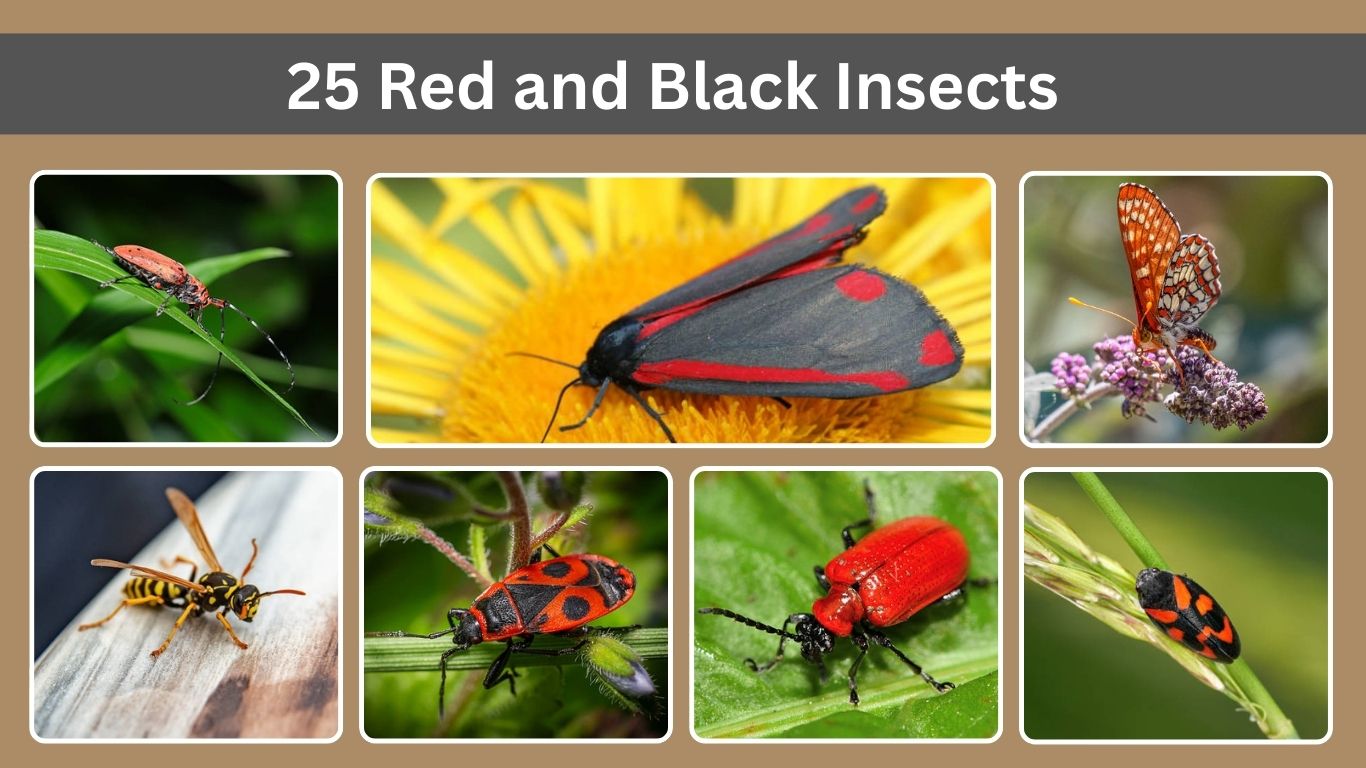
Red-and-black insects are among the most eye-catching in nature, often displaying vivid spots, stripes, or wing markings. These colors usually signal aposematism, warning predators of toxicity or bad taste. Found in gardens, meadows, forests, and farmland, they include beetles, bugs, moths, wasps, and ants. Some are beneficial pollinators or predators, while others are pests or invasive species. This guide presents 25 key examples, covering their identification, habitats, behaviors, and fascinating ecological roles.
1. Ladybug (Coccinellidae)

The ladybug (family Coccinellidae) is one of the most recognized red insects with black spots. Known as ladybird beetles in the UK, they are small, dome-shaped beetles with bright coloration that serves as a warning to predators. They are widely admired for their role in natural pest control and their distinct black-and-red body markings.
Identification
- Small beetle (4–8 mm long)
- Dome-shaped, rounded body
- Bright red or orange elytra (wing covers) with black spots
- Black head with white patches in some species
- Six black legs and short antennae
Natural Habitat
Ladybugs thrive in gardens, meadows, forests, and agricultural fields. They prefer areas with abundant vegetation where aphids and scale insects are present. These insects are adaptable and found on every continent except Antarctica. They are especially common in temperate zones but can survive in both warm and cold climates.
Behavior and Feeding Patterns
Ladybugs are predatory beetles and play a vital role in pest management. Their diet mainly consists of aphids, mites, mealybugs, and insect larvae. A single ladybug can consume up to 5,000 aphids in its lifetime. When threatened, they excrete a yellowish defensive fluid with a foul taste, deterring predators. Their bright red-and-black spots serve as aposematic coloration, warning predators of their unpalatability.
Facts and Ecological Importance
- Known as symbols of good luck in many cultures.
- Undergo complete metamorphosis: egg → larva → pupa → adult.
- Ladybug larvae are elongated and black with red or orange markings.
- They often overwinter in large groups, hiding in tree bark, leaf litter, or human dwellings.
- Extensively used in biological pest control programs due to their voracious appetite for crop-damaging insects.
Ladybugs are not only a beautiful example of a red insect with black dots but also a critical ally in maintaining ecological balance.
2. Firebug (Pyrrhocoris apterus)

The firebug is a striking red and black insect with wings, often confused with beetles but belonging to the family Pyrrhocoridae. Its bold coloration includes a red body with black spots and stripes, which functions as a warning signal to predators.
Identification
- Medium-sized insect, about 7–12 mm long
- Flattened, oval-shaped body
- Distinct red forewings with symmetrical black spots and markings
- Black legs and antennae
- Non-biting and harmless to humans
Habitat and Distribution
Firebugs are commonly found across Europe, parts of Asia, and North Africa. They prefer sunny, dry areas, often clustering near lime trees, mallows, and hibiscus plants. They gather in large groups around tree bases, walls, or garden edges where food sources are abundant.
Behavior and Ecology
Firebugs are gregarious insects, meaning they live and feed in groups. Unlike predatory beetles, they are seed-feeding insects, consuming fallen seeds of linden and mallow plants. They do not bite humans or damage structures. Their aggregation behavior makes them highly visible, especially in spring.
Interesting Facts
- Their aposematic red-and-black coloration warns predators of poor taste.
- They undergo simple metamorphosis (egg → nymph → adult).
- Firebugs are sometimes misidentified as boxelder bugs due to similar coloration.
- Despite their bold look, they are harmless and pose no risk to crops.
3. Milkweed Bug (Oncopeltus fasciatus)

The milkweed bug is a black insect with red-orange wings and stripes, belonging to the family Lygaeidae. It is closely associated with milkweed plants and is well known for its bold pattern and dependence on toxic plant compounds for defense.
Identification
- Size ranges from 10–18 mm long
- Elongated oval body
- Red-orange wings with distinct black bands
- Black head, legs, and antennae
- Piercing-sucking mouthparts for feeding on plant juices
Habitat and Range
Milkweed bugs inhabit North America, especially in fields, gardens, and open meadows where milkweed plants thrive. They are strongly tied to Asclepias species, which serve as both food and breeding sites.
Behavior and Feeding Habits
These bugs feed by piercing milkweed seed pods and sucking out the nutrient-rich juices. They sequester the toxic cardiac glycosides from the plant, making them unpalatable to predators. Their bright red-and-black coloration signals toxicity, similar to monarch butterflies.
Key Facts
- Often seen basking in groups on milkweed plants.
- Undergo gradual metamorphosis (egg → nymph → adult).
- Sometimes used in scientific research due to ease of rearing.
- Unlike ladybugs, they are not beneficial predators, as they feed exclusively on plants.
4. Red-Headed Cardinal Beetle (Pyrochroa serraticornis)

The red-headed cardinal beetle is a striking bright red insect with black legs and antennae, belonging to the family Pyrochroidae. This beetle is commonly spotted resting on flowers and vegetation during the summer months. Its bold coloration warns predators of toxicity, although it is harmless to humans.
Identification
- Medium-sized beetle, about 15–20 mm long
- Brilliant red elytra (wing covers) and head
- Black legs and long, serrated black antennae
- Elongated and flattened body shape
- Males and females are similar in appearance
Habitat and Range
This beetle is found across much of Europe, including the UK, in woodlands, hedgerows, and gardens. It prefers areas rich in decaying wood where larvae can develop. Adults are commonly seen resting on flowers such as umbellifers, often near forest edges or sunny glades.
Behavior and Feeding Habits
Adult red-headed cardinal beetles are predatory and feed on other insects visiting flowers. Their larvae live under the bark of decaying wood, feeding on other insect larvae. Their red-and-black coloration serves as aposematic signaling, discouraging predation by birds. They are strong fliers and are active in warm weather.
Facts and Significance
- Their vibrant color often leads to confusion with the scarlet lily beetle.
- Larvae play a role in breaking down decaying wood ecosystems.
- Adults emerge in late spring and are most visible from May to July.
- Despite their fierce look, they are entirely non-aggressive and pose no harm.
5. Boxelder Bug (Boisea trivittata)

The boxelder bug is a black insect with red stripes on its wings and thorax, belonging to the family Rhopalidae. Common in North America, it is known for its habit of forming large clusters on buildings during autumn.
Identification
- About 12–14 mm long, elongated oval body
- Predominantly black with three red-orange stripes on the thorax
- Red markings along wing edges and abdomen
- Long black legs and antennae
- Often confused with firebugs due to similar colors
Habitat and Range
Boxelder bugs are widespread in the United States and Canada, especially near boxelder trees (Acer negundo), maples, and ash trees. They thrive in urban, suburban, and rural areas, often sheltering in cracks of houses or tree bark during colder months.
Behavior and Ecology
These insects feed primarily on seeds, leaves, and flowers of boxelder and maple trees using their piercing-sucking mouthparts. They are not harmful to humans but are considered nuisance pests when they gather indoors for overwintering. Their red-and-black coloration helps deter some predators, though they rely more on clustering for protection.
Facts and Human Interaction
- Known to invade houses in large numbers in fall.
- They do not bite, sting, or spread disease.
- When crushed, they release a foul odor.
- Boxelder bugs undergo gradual metamorphosis and reproduce quickly in warm climates.
These insects, while harmless, are often mistaken for biting red-and-black bugs, but their nuisance factor comes mainly from their swarming habits rather than any danger.
6. Assassin Bug (Reduviidae)

The assassin bug is a black insect with red markings or stripes, belonging to the family Reduviidae. Known for its predatory lifestyle, this insect uses its piercing mouthparts to feed on other insects and occasionally on blood, depending on the species.
Identification
- Size ranges from 10–35 mm, depending on species
- Slender or robust body, usually black with red or orange patterns
- Long, narrow head with a distinct curved proboscis
- Six black legs, sometimes with reddish sections
- Some species have wings with red and black patches
Habitat and Range
Assassin bugs are distributed worldwide, thriving in forests, grasslands, gardens, and agricultural areas. They are most common in tropical and subtropical zones but can also be found in temperate regions.
Behavior and Feeding Habits
These insects are ambush predators, waiting patiently before attacking prey with a sharp, piercing beak. They inject digestive enzymes that liquefy the insides of their prey, which they then consume. Certain species, like the kissing bug (Triatoma), are infamous for biting humans and transmitting Chagas disease in the Americas.
Key Facts
- Their painful bite is defensive, not aggressive.
- Vital in controlling pest populations such as caterpillars and beetles.
- Exhibit diverse coloration, from black with red abdomens to patterned wings.
- Some species are used in biological control programs.
7. Red Velvet Ant (Dasymutilla occidentalis)

Despite its name, the red velvet ant is actually a species of wasp. This insect is known for its vivid red body with black legs and antennae, earning it the nickname “cow killer” due to the extreme pain of its sting.
Identification
- Females are wingless, resembling hairy ants, about 15–25 mm long
- Covered with dense bright red and black hairs
- Males are winged but similarly colored
- Six strong black legs, long antennae
- Thick, robust body structure
Habitat and Range
Red velvet ants are found primarily in the southern United States, particularly in sandy soils, open fields, and meadows. They are solitary insects, often spotted running rapidly across the ground in search of hosts.
Behavior and Life Cycle
Females lay eggs in the nests of ground-nesting bees or wasps. The larvae then develop as parasitoids, feeding on the host larvae. Adults feed on nectar but are not social insects. Their bright red-and-black coloration warns predators of their painful sting.
Notable Facts
- Their sting is one of the most painful among wasps, though not deadly.
- They are extremely tough and have strong exoskeletons.
- Often mistaken for ants, but belong to the Mutillidae family of wasps.
- Serve as natural regulators of ground-nesting bee and wasp populations.
8. Cinnabar Moth (Tyria jacobaeae)

The cinnabar moth is a striking black insect with red wings and spots, belonging to the family Erebidae. Its vivid coloration makes it one of the most recognizable day-flying moths in Europe and parts of Asia.
Identification
- Wingspan of 32–42 mm
- Black forewings with bright red streaks and spots
- Hindwings are red with black borders
- Slender black body with fine hairs
- Six black legs and feathery antennae
Habitat and Range
Cinnabar moths inhabit meadows, grasslands, heathlands, and coastal dunes, particularly where their host plant, ragwort (Senecio jacobaea), grows abundantly. They are distributed across Europe, western Asia, and introduced populations in New Zealand and North America.
Behavior and Feeding Habits
The larvae are well known for their black-and-yellow striped bodies. They feed voraciously on ragwort leaves, sequestering toxic alkaloids that render both caterpillars and adults unpalatable to predators. Adults are active in daytime, unlike many other moth species.
Interesting Facts
- Their aposematic coloration signals toxicity.
- Caterpillars often strip ragwort plants bare.
- Introduced in some countries as a biological control agent for ragwort.
- Adults are short-lived, typically surviving only a few weeks in summer.
9. Six-Spotted Burnet Moth (Zygaena filipendulae)

Overview
The six-spotted burnet moth is a black insect with red spots on its wings, a member of the family Zygaenidae. This day-flying moth is easily seen feeding on wildflowers in sunny grasslands.
Identification
- Wingspan of 30–38 mm
- Metallic black-green forewings with six vivid red spots
- Bright red hindwings edged in black
- Slender, furry black body with clubbed antennae
- Six black legs adapted for clinging to plants
Habitat and Range
This moth thrives in Europe, the UK, and parts of western Asia, favoring flower-rich meadows, downs, and coastal areas. Its presence indicates a healthy, biodiverse habitat.
Behavior and Feeding Habits
The six-spotted burnet moth is a nectar feeder, often seen on knapweed, thistles, and clovers. Larvae feed mainly on bird’s-foot trefoil (Lotus corniculatus). Both larvae and adults contain cyanogenic glycosides, making them distasteful to predators.
Notable Facts
- Known as one of the most common burnet moths in Europe.
- Diurnal, flying actively in sunshine.
- Sometimes confused with the five-spotted burnet moth.
- Their bright red-and-black wings function as a chemical warning signal.
10. Scarlet Lily Beetle (Lilioceris lilii)

The scarlet lily beetle is a vibrant red insect with black legs and head, belonging to the family Chrysomelidae. While visually attractive, it is considered a serious pest for gardeners due to its destructive feeding habits on lily plants.
Identification
- Small beetle, about 6–8 mm long
- Bright scarlet-red elytra (wing covers)
- Shiny black head, legs, and antennae
- Elongated body with smooth, hard wing cases
- Larvae are slug-like and often covered in their own excrement for protection
Habitat and Range
Native to Eurasia, the scarlet lily beetle has spread to North America, where it is a major pest. It thrives in gardens, parks, and cultivated landscapes where lilies and fritillaries grow. Adults and larvae remain on host plants throughout their life cycle.
Behavior and Feeding Habits
Both adults and larvae feed voraciously on lily leaves, flowers, and stems, often leaving plants skeletonized. They overwinter in the soil and re-emerge in spring to lay eggs. Their bright red body with black features functions as a warning to predators, although their primary defense is bitter-tasting compounds.
Key Facts
- Known for its destructive impact on ornamental lilies.
- Spreads quickly due to global plant trade.
- Adults are strong fliers and disperse easily.
- Control measures include hand-picking, neem oil, or targeted insecticides.
11. Red Fire Ant (Solenopsis invicta)

The red fire ant is a notorious red insect with a black abdomen, belonging to the family Formicidae. It is infamous for its aggressive behavior, painful stings, and invasive spread across many countries.
Identification
- Small ant, 2–6 mm long
- Reddish-brown head and thorax with a darker abdomen
- Six legs with blackish tarsal tips
- Elbowed antennae with a distinct club
- Colonies contain polymorphic workers (different sizes)
Habitat and Range
Originally from South America, red fire ants have invaded the southern United States, Australia, China, and other regions. They build large soil mounds in lawns, fields, pastures, and disturbed areas, thriving in warm, moist climates.
Behavior and Feeding Habits
Red fire ants are omnivorous, feeding on seeds, insects, and animal matter. They are highly territorial and swarm aggressively when disturbed. Their sting injects alkaloid venom, causing burning pain, pustules, and in rare cases, allergic reactions.
Notable Facts
- Considered one of the world’s most invasive insect pests.
- Colonies can contain hundreds of thousands of workers.
- Known for damaging crops, electrical equipment, and biodiversity.
- Their red-and-black coloration serves as a partial predator deterrent but their true defense lies in aggression.
12. Red-and-Black Froghopper (Cercopis vulnerata)

The red-and-black froghopper is a small but eye-catching black insect with red wing markings, belonging to the family Cercopidae. It is well known in Europe for its vivid coloration and strong jumping ability, which is used both for escaping predators and moving between plants.
Identification
- Size around 8–10 mm long
- Compact, oval-shaped body
- Shiny black wings with two bright red bands or patches
- Black head, legs, and antennae
- Powerful hind legs adapted for jumping
Habitat and Range
This species is found across Europe and parts of Asia, inhabiting meadows, hedgerows, grasslands, and woodland edges. Adults are commonly seen resting on grasses and low plants during warm months.
Behavior and Feeding Habits
Red-and-black froghoppers feed on plant sap, using their piercing-sucking mouthparts. They are solitary but abundant in suitable habitats. Nymphs are known as spittlebugs because they produce protective frothy masses (spittle) on plants to shield themselves from predators and dehydration.
Interesting Facts
- Their strong legs allow them to jump up to 70 cm, many times their body length.
- The red and black wing patterns act as a warning coloration.
- Adults are most active from May to July.
- They cause minimal plant damage compared to other sap-feeding insects.
13. Red Mason Bee (Osmia bicornis)

The red mason bee is a solitary red-bodied insect with black legs and head, belonging to the family Megachilidae. It is an important pollinator, especially for fruit trees, and is widely encouraged in gardens and orchards.
Identification
- Medium-sized bee, about 8–14 mm long
- Reddish-brown thorax and abdomen covered with fine hairs
- Black head, legs, and antennae
- Females larger and more robust than males
- Strong mandibles for nesting in cavities
Habitat and Range
Red mason bees are found across Europe and parts of Asia, thriving in gardens, orchards, hedgerows, and urban areas. They prefer nesting in hollow stems, cracks in walls, or man-made bee hotels.
Behavior and Feeding Habits
Unlike social honeybees, red mason bees are solitary nesters. Females collect pollen and nectar, forming provisions for each egg. They seal nest cells with mud, hence the name “mason bee.” Their red-and-black coloration blends well with flowers, and they are highly efficient pollinators, especially of apples and cherries.
Notable Facts
- Contribute significantly to crop pollination in agriculture.
- Harmless to humans and non-aggressive.
- Their active flight period is mainly in spring and early summer.
- Increasingly supported by conservationists using bee hotels.
14. Wasp Beetle (Clytus arietis)

The wasp beetle is a slender black insect with yellow to red stripes, belonging to the longhorn beetle family Cerambycidae. It mimics wasps in both color and movement, which protects it from predators despite being harmless.
Identification
- About 9–18 mm in length
- Elongated black body with yellowish to reddish stripes across the elytra
- Long black antennae, often half the body length
- Six black legs, sometimes with reddish joints
- Strong resemblance to a stinging wasp
Habitat and Range
The wasp beetle is found across Europe, especially the UK, in woodlands, hedgerows, and gardens. Larvae develop inside decaying wood, while adults are typically seen on flowers, particularly umbellifers, during spring and summer.
Behavior and Feeding Habits
Adults feed mainly on pollen and nectar, often visiting open flowers. Their wasp-like mimicry deters predators such as birds. Larvae bore into rotting wood, contributing to the decomposition process. Despite their fierce look, they are completely harmless to humans.
Notable Facts
- A classic example of Batesian mimicry in insects.
- Active mainly from May to July.
- Beneficial in wood recycling through larval activity.
- Often confused with real wasps when in flight.
15. Ichneumon Wasp (Ichneumonidae)

The ichneumon wasp is a diverse group of black flying insects with red abdomens or markings, belonging to the family Ichneumonidae. With over 25,000 described species, they play a vital role in natural pest control.
Identification
- Varies from 5 mm to over 40 mm long
- Slender black body with red or orange abdomen in many species
- Long, threadlike antennae
- Females often have a prominent ovipositor (sometimes mistaken for a stinger)
- Six black or reddish legs, depending on species
Habitat and Range
Ichneumon wasps are distributed worldwide, inhabiting forests, gardens, meadows, and agricultural areas. They are especially abundant in temperate regions, where they parasitize caterpillars, beetle larvae, and other insects.
Behavior and Feeding Habits
Females use their ovipositor to lay eggs inside or on host larvae. Developing wasp larvae feed internally, eventually killing the host. Adults feed on nectar, pollen, and honeydew. Their black-and-red body coloration acts as both camouflage and warning mimicry.
Notable Facts
- Completely harmless to humans, despite their intimidating look.
- Key biological control agents against crop pests.
- Their long ovipositors allow them to reach hosts inside wood or soil.
- Sometimes mistaken for stinging wasps due to coloration and size.
16. Velvet Beetle (Trichodes alvearius)

The velvet beetle is a brilliant red-and-black striped insect, belonging to the family Cleridae. Its bright coloration warns predators of its distastefulness, and it is commonly found in sunny flower-rich habitats during summer.
Identification
- Medium-sized beetle, about 8–12 mm long
- Elongated, slightly flattened body
- Red elytra with bold transverse black bands
- Black head, thorax, and legs with fine hairs
- Clubbed antennae suited for detecting prey and flowers
Habitat and Range
Velvet beetles occur widely across Europe, North Africa, and parts of Asia, frequenting meadows, woodland clearings, and gardens. Adults prefer sunny areas with abundant wildflowers, while larvae develop in bee and wasp nests.
Behavior and Feeding Habits
Adults are predatory and nectar-feeding, often found on daisies, knapweeds, and other open flowers. Larvae are parasitic, preying on the larvae of solitary bees and wasps. Their red-and-black striped pattern provides a clear warning to predators, reducing predation risk.
Notable Facts
- Considered beneficial in regulating bee and wasp populations.
- Active mainly from May to July in warm climates.
- Known for combining predation and pollination roles.
- Their bright markings make them one of the most photographed beetles in Europe.
17. Red and Black Net-Winged Beetle (Lycidae)

The net-winged beetle is a distinctive bright red insect with black body and wing tips, belonging to the family Lycidae. Its ridged wings resemble netting, giving the insect its common name.
Identification
- Medium-sized beetle, 10–15 mm long
- Bright red or orange elytra with black tips
- Pronotum (thorax plate) is black with ridged texture
- Soft, flexible wing covers with a net-like pattern
- Six black legs and long antennae
Habitat and Range
These beetles are widespread across Europe, Asia, and North America, inhabiting woodlands, hedgerows, and damp meadows. They are often found resting on vegetation or flowers during summer.
Behavior and Feeding Habits
Adults feed mainly on nectar, honeydew, and fungi, while larvae live in decaying wood, contributing to forest nutrient cycles. Their aposematic red-and-black coloration warns predators of their toxic and foul-tasting body fluids.
Notable Facts
- Known as classic warning-colored beetles.
- Often confused with cardinal beetles due to similar coloration.
- Larvae are important decomposers in woodland ecosystems.
- Adults are weak fliers and tend to stay close to flowers or foliage.
18. Blister Beetle (Red-Marked Species, Meloidae)

The blister beetle includes various species, some of which are black insects with red spots or stripes. These beetles are famous for secreting cantharidin, a chemical that causes blistering on skin, giving the group its name.
Identification
- Size varies from 10–25 mm depending on species
- Slender, elongated body with soft elytra
- Black or dark brown wings with bright red markings in some species
- Long neck-like thorax and flexible body
- Six long legs and distinct threadlike antennae
Habitat and Range
Blister beetles are distributed worldwide, particularly in warm, dry regions of North America, Europe, Africa, and Asia. They thrive in grasslands, agricultural fields, and open meadows, often feeding on flowering plants.
Behavior and Feeding Habits
Adults feed on flowers, nectar, and foliage, while larvae are parasitoids of grasshopper eggs or bee nests. Their chemical defense, cantharidin, deters predators but can cause skin irritation in humans. Their red-and-black body markings serve as visual warnings.
Notable Facts
- Historically, cantharidin was used in medicine (and infamously as “Spanish fly”).
- Highly toxic if ingested by humans or livestock.
- Larvae contribute to controlling grasshopper populations.
- Often confused with other red-and-black beetles but can be identified by soft, flexible bodies.
19. Crimson Beetle (Chrysomelidae family)

The crimson beetle is a vivid bright red insect with black legs and antennae, belonging to the leaf beetle family Chrysomelidae. Though less destructive than the scarlet lily beetle, some species feed on crops and ornamental plants.
Identification
- Small beetle, around 6–10 mm long
- Smooth, glossy deep red or crimson elytra
- Black head, legs, and underside
- Oval, dome-shaped body with short antennae
- Lacks spots, unlike ladybugs
Habitat and Range
Crimson beetles are found in Europe, Asia, and North America, inhabiting gardens, forests, and farmlands. They are commonly found on the leaves of shrubs and cultivated crops.
Behavior and Feeding Habits
These beetles feed mainly on leaves, flowers, and pollen, often causing cosmetic damage to plants but rarely devastating infestations. Their red coloration with black appendages acts as a subtle deterrent to predators.
Notable Facts
- Sometimes confused with the scarlet lily beetle, but usually less harmful.
- Adults are strong fliers and disperse quickly in warm weather.
- Some species contribute to pollination while feeding on flowers.
- Their vibrant red bodies make them a frequent subject of insect photography.
20. Red Firebug (Melanocoryphus albomaculatus)

The red firebug is a bold red-and-black insect with white spots, belonging to the family Lygaeidae. It is often confused with the common firebug (Pyrrhocoris apterus), but can be distinguished by its striking white markings in addition to the red-and-black pattern.
Identification
- Size ranges from 8–12 mm
- Oval-shaped body with red wings patterned in black and white
- Black legs, antennae, and head
- Distinctive pale or white spots on the forewings
- Six-legged true bug with piercing-sucking mouthparts
Habitat and Range
Found mainly in southern and central Europe, extending into the Mediterranean, this bug inhabits dry, warm grasslands, scrublands, and gardens. It prefers areas with mallow and related plants.
Behavior and Feeding Habits
The red firebug feeds primarily on seeds of herbaceous plants, piercing them with its rostrum to suck out nutrients. Unlike predatory insects, it is a plant feeder, though it causes minimal economic damage. Its black, red, and white coloration provides protection through warning mimicry.
Notable Facts
- Active mainly during sunny days.
- Often found in clusters, similar to boxelder and common firebugs.
- Their coloration makes them easily confused with assassin bugs.
- Harmless to humans, despite their intimidating appearance.
21. Red Soldier Beetle (Rhagonycha fulva)

The red soldier beetle is a common bright red insect with black legs, widely seen in gardens and meadows during summer. Belonging to the family Cantharidae, it is sometimes called the “bloodsucker beetle,” though it does not bite humans.
Identification
- About 7–10 mm in length
- Soft-bodied beetle with orange-red elytra
- Black tips on wing covers and legs
- Slender body with long black antennae
- Adults resemble wasps when flying
Habitat and Range
Widespread across Europe and Asia, and introduced in North America, red soldier beetles thrive in meadows, hedgerows, and gardens. They are most abundant in midsummer, often found resting on flowers like hogweed and tansy.
Behavior and Feeding Habits
Adults are active nectar and pollen feeders, contributing to pollination. They are also predatory, hunting small insects such as aphids. Their larvae live in soil and leaf litter, feeding on ground-dwelling invertebrates. The red-and-black coloration acts as protective mimicry.
Notable Facts
- Nicknamed the “bloodsucker beetle” due to color, not behavior.
- Mating pairs are frequently seen on flowers in July and August.
- Beneficial in gardens, both as pollinators and pest controllers.
- Non-aggressive and harmless to humans.
22. Checkerspot Butterfly (Larvae Stage, Euphydryas spp.)

The checkerspot butterfly caterpillar is a distinctive black insect with red or orange stripes, belonging to the family Nymphalidae. While the adult butterfly is patterned in orange, black, and cream, the larvae are far more recognizable for their bold contrasting markings.
Identification
- Caterpillars grow up to 25–30 mm in length
- Black, spiny body with red or orange dorsal stripes
- Covered in small branching spines for defense
- Six true legs plus several prolegs typical of caterpillars
- Adults emerge as checkered butterflies with orange, red, and black patterns
Habitat and Range
Checkerspot butterflies are found in North and Central America, especially in meadows, prairies, and open woodland edges. Larvae are commonly associated with host plants like plantains, turtlehead, and various herbs.
Behavior and Feeding Habits
The larvae are gregarious feeders, consuming leaves of host plants. Their black-and-red striping serves as a warning signal to predators, as many species sequester plant toxins. Adults feed on nectar from wildflowers and play a role in pollination.
Notable Facts
- Some species are threatened due to habitat loss.
- Larvae overwinter in silk shelters before pupating.
- Their warning coloration mirrors other toxic insects.
- Used as indicators of environmental health in conservation studies.
23. Red Damsel Bug (Nabis rugosus)

The red damsel bug is a slender red insect with black legs and antennae, belonging to the family Nabidae. Known as a beneficial predator, it is frequently found in gardens and farmlands where it helps regulate pest populations.
Identification
- Medium-sized bug, about 8–11 mm long
- Elongated, flattened body with a reddish-orange thorax and abdomen
- Narrow black legs and long segmented antennae
- Winged, with semi-transparent forewings
- Six legs adapted for grasping prey
Habitat and Range
Red damsel bugs are widespread across Europe, Asia, and North America, inhabiting fields, meadows, hedgerows, and agricultural crops. They are commonly seen on grasses and shrubs during summer.
Behavior and Feeding Habits
These insects are active predators, feeding on aphids, caterpillars, mites, and other small arthropods. They use their sharp rostrum to pierce prey and suck out body fluids. Unlike many red-and-black insects, they are entirely beneficial to humans.
Notable Facts
- Frequently used in biological control programs.
- Can bite humans if handled, though it is harmless.
- Important natural enemy of crop-damaging pests.
- Their red body with contrasting black appendages gives them a wasp-like look in flight.
24. Red Longhorn Beetle (Stictoleptura rubra)

The red longhorn beetle is a robust red insect with black legs and long antennae, belonging to the family Cerambycidae. It is well known for its striking appearance and its role in the decomposition of dead wood.
Identification
- Adults range from 12–20 mm long
- Reddish-brown to bright red wing covers (elytra)
- Black head, thorax, legs, and long segmented antennae
- Females are larger and broader, while males are slimmer with longer antennae
- Elongated cylindrical body typical of longhorn beetles
Habitat and Range
This species is distributed widely across Europe and Asia, often found in woodlands, forest clearings, and near dead logs. Larvae develop within decaying conifer wood, making them important contributors to forest nutrient cycles.
Behavior and Feeding Habits
Adults are usually found on flowers, especially umbellifers, where they feed on pollen and nectar. Larvae bore deep into dead wood, feeding on decaying plant material for several years before pupating. Their red-and-black coloration provides some predator deterrence, although they rely more on their tough exoskeleton.
Notable Facts
- Commonly active from June to August.
- Play a role in recycling nutrients in forest ecosystems.
- Non-aggressive and harmless to humans.
- Sometimes confused with the red-headed cardinal beetle, but distinguishable by antennae length.
25. Red-and-Black Net-Winged Beetle (Calopteron terminale)

The red-and-black net-winged beetle is a North American relative of the Lycidae family, easily identified as a red insect with black-tipped wings. Its ridged wing covers make it highly recognizable.
Identification
- About 10–15 mm long
- Bright red-orange elytra with black tips
- Wing covers deeply ridged in a net-like pattern
- Narrow black thorax with small head
- Six black legs and long antennae
Habitat and Range
Found mainly in eastern North America, this beetle inhabits woodlands, fields, and gardens. Adults are most active during summer, often resting on flowers or foliage.
Behavior and Feeding Habits
Adults feed on nectar, honeydew, and pollen, while larvae are found in decaying wood where they scavenge and recycle organic matter. Their red-and-black coloration functions as aposematic signaling, discouraging predators.
Notable Facts
- Weak fliers, usually staying close to vegetation.
- Sometimes mistaken for fireflies due to similar body shape.
- Larvae help decompose rotting wood, contributing to soil health.
- Their warning coloration signals mild toxicity, deterring birds and small mammals.