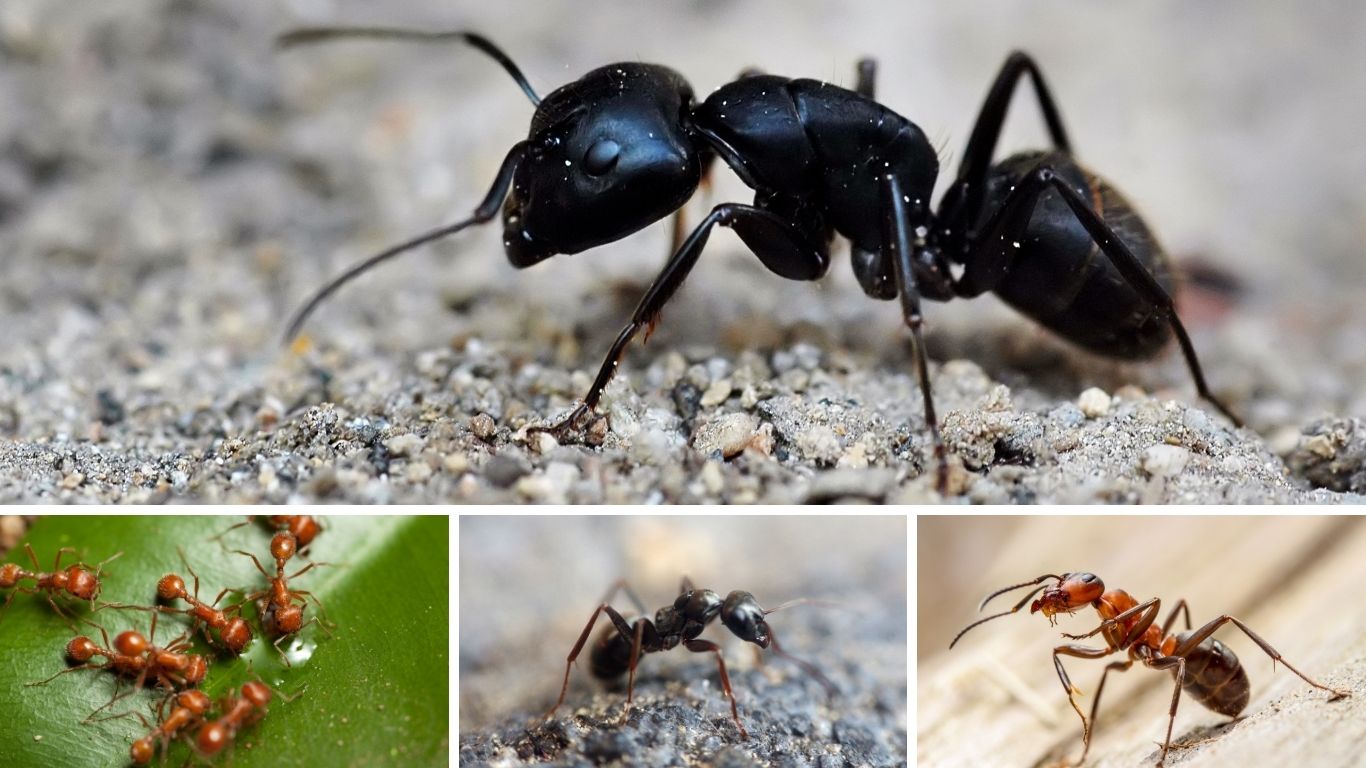
Ants are one of the most widespread insects found in homes, gardens, and natural spaces. With over 12,000 known species, only a handful are commonly encountered by people. This guide covers 25 of the most common ant types, including their identification traits, nesting habits, and behaviors. Whether you’re dealing with indoor pests or curious about backyard colonies, this breakdown will help you recognize them easily.
1. Carpenter Ant

Carpenter ants are among the largest and most recognizable ant species commonly found around homes and wooden structures. Unlike termites, they don’t eat wood but hollow it out to build their nests, which can lead to structural damage over time.
Identification
- Color: Usually black, but some species are red or a mix of red and black
- Size: 6 to 13 mm (queens up to 20 mm)
- Antennae: Elbowed, with 12 segments
- Waist: One node
- Thorax: Smooth and evenly rounded when viewed from the side
- Wings (if present): Front wings longer than hind wings in reproductive ants
Habitat
Carpenter ants prefer moist, decaying, or hollow wood for nesting, often found in tree stumps, wall voids, or under insulation. Indoors, they target areas with water damage like bathrooms or kitchens.
Behavior
These ants are mostly nocturnal and form satellite colonies. While they don’t sting, they can bite and spray formic acid into wounds, causing a mild burning sensation. They forage for sweets and proteins, often leaving visible trails.
Risk to Humans
Carpenter ants don’t spread disease, but their nesting habits can cause significant structural damage over time if left untreated.
2. Fire Ant

Fire ants are aggressive, reddish-brown ants known for their painful stings and mound-building behavior. They often infest lawns, gardens, and even electrical equipment, posing risks to humans and pets.
Identification
- Color: Reddish-brown with darker abdomen
- Size: 2 to 6 mm
- Antennae: 10 segments with two-segmented club
- Waist: Two nodes
- Stinger: Present, used to inject venom
- Mandibles: Strong, used for biting before stinging
Habitat
They build large mounds in open sunny areas like lawns, pastures, and roadsides. Nests are often deep and have no central opening on top.
Behavior
Fire ants are highly territorial and attack intruders with multiple painful stings. They swarm quickly and communicate through chemical signals. They feed on insects, sweet substances, and proteins.
Risk to Humans
Their sting can cause intense pain, itching, and sometimes allergic reactions. In sensitive individuals, stings may lead to serious medical emergencies.
3. Pharaoh Ant

Pharaoh ants are tiny, yellowish ants notorious for infesting hospitals, kitchens, and apartment buildings. They spread quickly and are difficult to control due to their colony-budding behavior.
Identification
- Color: Yellow to light brown with darker abdomen
- Size: 1.5 to 2 mm
- Antennae: 12 segments with three-segmented club
- Waist: Two nodes
- Eyes: Relatively small
- Thorax: Lacks spines
Habitat
They prefer warm, humid indoor environments such as wall voids, appliances, and cabinets. Often found near food sources and water pipes.
Behavior
Pharaoh ants form massive colonies with multiple queens, allowing them to bud and spread rapidly. They forage in wide trails and feed on sweets, proteins, and oils.
Risk to Humans
They can contaminate food and medical equipment, making them a serious concern in healthcare facilities. Their presence can lead to the spread of harmful pathogens.
4. Odorous House Ant

Odorous house ants are small, dark brown or black ants that release a foul, rotten coconut-like smell when crushed. They are commonly found indoors, especially during rainy weather.
Identification
- Color: Brown to black
- Size: 2.4 to 3.3 mm
- Antennae: 12 segments, no club
- Waist: One hidden node
- Body Shape: Uneven thorax when viewed from the side
- Odor: Strong, unpleasant smell when crushed
Habitat
They nest in wall voids, under floors, and around heaters or water pipes indoors. Outside, they build nests under rocks, mulch, or logs.
Behavior
These ants forage in long trails and feed on sweets, especially honeydew. Colonies may contain thousands of workers and multiple queens, making them persistent indoor pests.
Risk to Humans
They do not bite or sting but can contaminate food and become a nuisance when they invade homes in large numbers.
5. Argentine Ant

Argentine ants are light to dark brown ants known for forming massive colonies that can stretch across entire neighborhoods. They displace native species and are difficult to eliminate.
Identification
- Color: Light to dark brown
- Size: 2.2 to 2.8 mm
- Antennae: 12 segments, no club
- Waist: One node
- Body: Smooth, no spines
- Odor: Slight musty smell when crushed
Habitat
They build shallow nests under stones, wood, mulch, and inside walls. Prefer moist environments and often migrate indoors for food and water.
Behavior
Argentine ants follow well-defined trails and tend to avoid conflict with other members of their supercolonies. They feed on sugary substances, honeydew, and proteins.
Risk to Humans
They don’t sting or bite, but their massive colonies make them extremely invasive, and they can contaminate food and water sources.
6. Pavement Ant

Pavement ants are common in urban areas, often seen foraging in lines along sidewalks, driveways, and building foundations. They are small, dark ants that nest under concrete and cracks.
Identification
- Color: Dark brown to blackish
- Size: 2.5 to 4 mm
- Antennae: 12 segments with a three-segmented club
- Waist: Two nodes
- Thorax: Has pairs of small spines on the back
- Legs: Pale in contrast to body
Habitat
They nest under sidewalks, driveways, stones, and building slabs. Indoors, they may nest in walls or under floors, especially during winter months.
Behavior
Pavement ants forage mostly at night and form visible trails to food sources. They are attracted to sugary foods, grease, and pet food. Colonies are often involved in turf wars with rival colonies.
Risk to Humans
While not dangerous, they can become a nuisance indoors and contaminate food. They are also difficult to eradicate due to hidden nest locations.
7. Crazy Ant

Crazy ants get their name from their erratic, fast-moving behavior. They are invasive and can infest electrical equipment, homes, and yards. Unlike fire ants, they do not build visible mounds.
Identification
- Color: Reddish-brown to dark brown
- Size: 2.2 to 3 mm
- Antennae: 12 segments without a club
- Waist: One node
- Body Texture: Covered with long, coarse hairs
- Movement: Rapid, erratic, unpredictable
Habitat
They prefer warm, humid environments and often nest in wall voids, under flooring, in appliances, or outdoors under debris, logs, or mulch.
Behavior
Crazy ants do not follow clear foraging lines like other ants. They nest in both dry and moist environments, often forming supercolonies with multiple queens. They feed on insects, sweets, and household waste.
Risk to Humans
They don’t bite or sting but can damage electronics and overwhelm homes or commercial buildings. Their large numbers and nesting in electrical devices pose unique maintenance challenges.
8. Ghost Ant

Ghost ants are tiny, pale ants with a translucent lower body, making them appear almost invisible. They are frequent indoor invaders, especially in kitchens and bathrooms.
Identification
- Color: Head and thorax dark; abdomen and legs pale or translucent
- Size: 1.3 to 1.5 mm
- Antennae: 12 segments
- Waist: One node
- Body: Smooth and hairless with uneven thorax
- Visibility: Very hard to spot due to pale color
Habitat
They thrive in warm, humid environments. Indoors, they nest behind baseboards, wall voids, potted plants, and under sinks. Outdoors, they build nests under stones or in rotting wood.
Behavior
Ghost ants move in trails and are highly attracted to sugary substances. They have multiple queens and form large colonies that can split and relocate easily.
Risk to Humans
They do not bite or sting but are persistent indoor pests that contaminate food and are difficult to remove once established.
9. Sugar Ant

Sugar ants, a common name for several sweet-loving species, are particularly drawn to homes for sugary foods. They are often mistaken for odorous house ants or pavement ants.
Identification
- Color: Varies by region – often brownish-orange with darker heads
- Size: 2.5 to 18 mm depending on caste and species
- Antennae: 12 segments
- Waist: One or two nodes
- Mandibles: Prominent in larger workers
Habitat
They prefer moist and warm environments. Outdoors, they nest in soil, under rocks, or logs. Indoors, they enter through small cracks to seek food in pantries or sinks.
Behavior
Highly attracted to sugary foods like syrup, honey, or crumbs. Workers are mostly nocturnal and leave visible trails from the nest to the food source.
Risk to Humans
They are non-aggressive and don’t pose medical risks but become a significant nuisance in kitchens and food storage areas.
10. Little Black Ant

Little black ants are tiny, shiny black ants commonly found foraging in homes, especially around kitchens and food areas. They nest in a wide variety of indoor and outdoor spaces.
Identification
- Color: Jet black
- Size: 1.5 to 2 mm
- Antennae: 12 segments with a two-segmented club
- Waist: Two nodes
- Body: Shiny, smooth surface
- Wings: Swarmers have pale wings
Habitat
They nest in soil, under logs, stones, and piles of bricks outdoors. Indoors, they nest in wall voids, behind baseboards, and under carpets or appliances.
Behavior
They forage in long, visible trails and prefer greasy or sugary food sources. Colonies have multiple queens and reproduce rapidly, leading to persistent infestations.
Risk to Humans
They do not bite or sting but are considered a nuisance due to their tendency to infest food and be hard to control.
11. Red Imported Fire Ant

Red imported fire ants are invasive and highly aggressive ants with a painful sting. They are notorious for forming large mounds and swarming attackers quickly.
Identification
- Color: Reddish-brown with darker abdomen
- Size: 2.4 to 6 mm (workers of varying sizes)
- Antennae: 10 segments with two-segmented club
- Waist: Two nodes
- Stinger: Present and functional
- Mandibles: Strong, used to hold while stinging
Habitat
They nest in soil and build dome-shaped mounds in open areas like lawns, fields, and roadsides. Indoors, they may invade electrical boxes and foundations.
Behavior
They attack in large numbers, each delivering multiple stings. Colonies are massive and can relocate quickly when disturbed. They feed on plants, animals, and sweet or oily foods.
Risk to Humans
Their stings cause burning pain, pustules, and allergic reactions. In some cases, multiple stings can lead to serious health risks or anaphylaxis.
12. Thief Ant

Thief ants are extremely small ants known for nesting near other ant colonies to steal food and larvae. Their tiny size allows them to infiltrate packaging and enter sealed containers.
Identification
- Color: Yellow to light brown
- Size: 1.5 to 2.2 mm
- Antennae: 10 segments with two-segmented club
- Waist: Two nodes
- Eyes: Very small and set far apart
- Mandibles: Narrow, with few teeth
Habitat
They nest in wall voids, baseboards, behind cabinets, and under flooring indoors. Outdoors, they build shallow nests in soil, under rocks, or in decaying wood.
Behavior
They trail in narrow, hidden lines and prefer high-protein foods like grease, meat, and dead insects. Colonies are small, but their proximity to other nests allows them to exploit nearby species.
Risk to Humans
They do not bite or sting but can contaminate food due to their attraction to greasy or protein-rich sources. Their small size makes them hard to detect and eliminate.
13. Acrobat Ant

Acrobat ants are known for raising their heart-shaped abdomens over their heads when disturbed. They are often mistaken for carpenter ants but are generally smaller and less destructive.
Identification
- Color: Varies—light brown, red, or black
- Size: 2.5 to 4 mm
- Antennae: 11 segments with a three-segmented club
- Waist: Two nodes
- Abdomen: Heart-shaped and flexible
- Legs: Long and spindly
Habitat
They nest in decaying wood, tree stumps, under rocks, and occasionally inside structures like insulation and wall voids. Indoors, they’re attracted to moisture-damaged wood.
Behavior
They emit a foul odor when disturbed and forage in trails for sweets and proteins. Colonies are moderate in size and tend to remain hidden until disturbed.
Risk to Humans
While not dangerous, they may bite defensively and can become a nuisance when nesting indoors. Their presence may also indicate wood decay or moisture issues.
14. Big-Headed Ant

Big-headed ants are named for their major workers, which have disproportionately large heads. These ants often displace native species and are a growing concern in tropical and subtropical regions.
Identification
- Color: Yellowish to reddish-brown
- Size: 1.5 to 4 mm (major workers much larger than minor workers)
- Antennae: 12 segments with a three-segmented club
- Waist: Two nodes
- Head: Major workers have extremely large heads
- Mandibles: Strong and prominent in major workers
Habitat
They prefer to nest in disturbed soil, under rocks, pavement cracks, or inside wall voids and foundation gaps. Indoors, they may be found in potted plants or behind baseboards.
Behavior
These ants are highly competitive and often take over territory from other ant species. They forage in trails and are attracted to sugars, proteins, and greasy substances.
Risk to Humans
Not harmful directly, but they can become a nuisance by invading homes and outcompeting native ants. Their aggressive spread can disrupt ecological balances.
15. White-Footed Ant

White-footed ants are easily recognized by their pale-colored legs. They form massive colonies and can infest buildings in large numbers, particularly in warm climates.
Identification
- Color: Black or dark brown body with pale yellow or whitish feet
- Size: 2.5 to 3 mm
- Antennae: 12 segments
- Waist: One node
- Legs: Distinctly pale, contrasting with dark body
- Body Shape: Compact and rounded
Habitat
They commonly nest in wall voids, attics, electrical boxes, and under roof shingles. Outdoors, they build nests in tree trunks, leaf litter, and soil.
Behavior
White-footed ants form massive colonies with thousands of workers. Unlike many ants, they do not share food mouth-to-mouth but pass liquids externally. They prefer sugary foods and rarely consume proteins.
Risk to Humans
They don’t bite or sting but invade homes in large numbers and are difficult to control due to their nesting and feeding behavior.
16. Yellow Crazy Ant

Yellow crazy ants are invasive pests known for their rapid, erratic movements and ability to form supercolonies. They are a major ecological threat in tropical environments.
Identification
- Color: Yellow to yellowish-brown
- Size: 4 to 5 mm
- Antennae: 12 segments without a club
- Waist: One node
- Legs: Long and slender
- Movement: Very fast and erratic, especially when disturbed
Habitat
They nest in a wide range of environments including soil, under logs, leaf litter, walls, and electrical devices. They prefer moist, shaded areas near human activity.
Behavior
They form extremely large colonies with multiple queens. Workers move rapidly and do not follow straight trails. They feed on insects, sugary substances, and honeydew.
Risk to Humans
They do not bite or sting but can cause skin irritation when crushed. Their large populations and tendency to infest electronics can create serious nuisance and property damage.
17. Field Ant

Field ants are a diverse group often mistaken for carpenter ants due to their size and color. They are mostly outdoor dwellers that build visible mounds in grassy areas.
Identification
- Color: Ranges from black, brown, red, or a mix
- Size: 4 to 8 mm
- Antennae: 12 segments
- Waist: One node
- Body: Lacks spines; thorax uneven in profile
- Odor: Can release a formic acid smell when crushed
Habitat
They build mounds in lawns, fields, and open woodland areas. Nests are usually not found indoors but may appear near foundations or patios.
Behavior
They are active during the day and feed on nectar, honeydew, and dead insects. Colonies are relatively large and can become aggressive if disturbed.
Risk to Humans
They don’t sting but can bite and spray formic acid into the bite, causing mild discomfort. Outdoors, their mounds may damage lawns and become unsightly.
18. Garden Ant (Black Garden Ant)

Garden ants, also known as black garden ants, are common in Europe and parts of Asia. They are harmless but frequently invade homes in search of sweet foods.
Identification
- Color: Shiny black
- Size: 3 to 5 mm
- Antennae: 12 segments
- Waist: One node
- Body: Smooth, with no spines
- Wings: Reproductives have transparent wings during swarming
Habitat
They nest in soil, between paving stones, under rocks, or in garden beds. Indoors, they enter through cracks and gaps around windows or doors.
Behavior
Garden ants form long trails and are active foragers, especially during summer. They are attracted to sugary substances like syrup, fruit juice, and honeydew from aphids.
Risk to Humans
They do not bite or sting. However, their foraging trails and food contamination can be an annoyance, particularly in kitchens and pantries.
19. Cornfield Ant

Cornfield ants are small, soil-dwelling ants often found in lawns, gardens, and crop fields. They are not aggressive and rarely enter homes.
Identification
- Color: Light to dark brown
- Size: 2.5 to 4 mm
- Antennae: 12 segments
- Waist: Two nodes
- Thorax: Uneven shape with small spines
- Legs: Lighter than the body
Habitat
They build small mounds in grassy fields, lawns, and along sidewalks. Nests are shallow and usually found in undisturbed soil.
Behavior
Cornfield ants are active in warm weather and often found tending aphids for honeydew. They feed on small insects and sugary plant secretions.
Risk to Humans
They are harmless and do not sting or bite. They are primarily considered beneficial outdoors due to their role in soil aeration and insect control.
20. Meadow Ant

Meadow ants are soil-nesting ants commonly found in grassy areas and pastures. They rarely invade homes and are more active outdoors, especially in open meadows.
Identification
- Color: Yellowish to light brown, sometimes reddish
- Size: 3 to 4 mm
- Antennae: 12 segments
- Waist: Two nodes
- Body: Fine hairs on head and thorax
- Mandibles: Small but visible
Habitat
They build dome-shaped mounds in grasslands, meadows, and gardens. Nests may be found near sidewalks or under stones in lawns and open areas.
Behavior
Meadow ants feed on insects and tend to aphids for honeydew. They are active during warm months and show limited interest in entering buildings.
Risk to Humans
They do not bite or sting and are not considered pests indoors. Outdoors, their nesting can slightly disturb turfgrass but is generally harmless.
21. Rover Ant

Rover ants are tiny ants known for their rapid movement and sudden infestations indoors, especially in humid or water-damaged areas.
Identification
- Color: Pale brown to dark brown
- Size: 1.5 to 2 mm
- Antennae: 9 segments with no distinct club
- Waist: One node
- Body: Glossy appearance, compact
- Eyes: Prominent and forward-facing
Habitat
They prefer moist environments and are often found near bathrooms, sinks, potted plants, and wall voids. Outdoors, they nest under mulch or moist soil.
Behavior
Rover ants do not follow well-defined trails and move erratically. They are attracted to sweets and often enter homes through foundation cracks and plumbing gaps.
Risk to Humans
They are non-aggressive and do not bite or sting. However, they can quickly become a nuisance indoors and are resistant to some common ant treatments.
22. European Fire Ant

European fire ants are aggressive, reddish ants with a painful sting. They are invasive in some regions and often nest in moist soil near human dwellings.
Identification
- Color: Reddish-brown
- Size: 3.5 to 5 mm
- Antennae: 12 segments with a three-segmented club
- Waist: Two nodes
- Stinger: Present and functional
- Body: Covered with fine hairs
Habitat
They nest in lawns, gardens, under logs, rocks, or leaf litter, especially in shaded, damp areas. They often establish colonies near buildings and patios.
Behavior
They swarm aggressively when disturbed and sting repeatedly. Colonies may have multiple queens and are known to relocate quickly. They feed on sweets, proteins, and small insects.
Risk to Humans
Their sting causes pain, swelling, and possible allergic reactions. They are a public health concern in infested parks, yards, and residential areas.
23. Indian Crazy Ant

Indian crazy ants are fast-moving, invasive ants often found in tropical climates. They are known for their erratic movements and ability to infest buildings.
Identification
- Color: Dark brown to black
- Size: 2.5 to 3 mm
- Antennae: 12 segments
- Waist: One node
- Body: Slender with long legs
- Movement: Rapid, non-linear, “crazy” motion
Habitat
They nest in wall voids, under floorboards, in potted plants, and around damp, cluttered outdoor areas. Often seen around bathrooms, kitchens, and basements.
Behavior
These ants form large colonies with multiple queens. They are omnivorous and attracted to sweets, grease, and insects. Their unpredictable movement makes tracking trails difficult.
Risk to Humans
They do not sting but may bite. Large infestations can overwhelm homes and damage electronics. Control is difficult due to their colony structure and foraging habits.
24. Silky Ant

Silky ants are ground-dwelling ants with a silky or velvety appearance. They are generally non-aggressive and found in outdoor environments, especially in dry, sandy soils.
Identification
- Color: Reddish to dark brown with a silky sheen
- Size: 3 to 6 mm
- Antennae: 12 segments
- Waist: Two nodes
- Body Texture: Covered with fine, silky hairs
- Head: Slightly elongated
Habitat
They nest in open, sandy areas, under stones, logs, or in loose soil. Commonly found in dry fields, forest edges, and gardens.
Behavior
Silky ants forage individually or in loose trails. They are scavengers, feeding on dead insects and plant material. Colonies are relatively small and slow-growing.
Risk to Humans
They do not bite or sting and are not indoor pests. They contribute to natural decomposition and are generally beneficial in garden ecosystems.
25. Jet Ant

Jet ants are named for their smooth, jet-black appearance. They resemble carpenter ants in size and color but differ in nesting behavior and structure.
Identification
- Color: Shiny black (jet-black)
- Size: 5 to 7 mm
- Antennae: 12 segments
- Waist: Two nodes
- Body: Glossy and smooth, without spines
- Legs: Also black and moderately long
Habitat
They nest in soil, under stones, logs, and in decaying wood. Less commonly found indoors, but may enter structures in search of food or moisture.
Behavior
Jet ants are slow-moving and form moderately sized colonies. They feed on insects, nectar, and plant secretions. Foraging occurs primarily on the ground.
Risk to Humans
They are non-aggressive and rarely bite. Jet ants are not considered structural pests but may become a minor nuisance if they enter buildings.