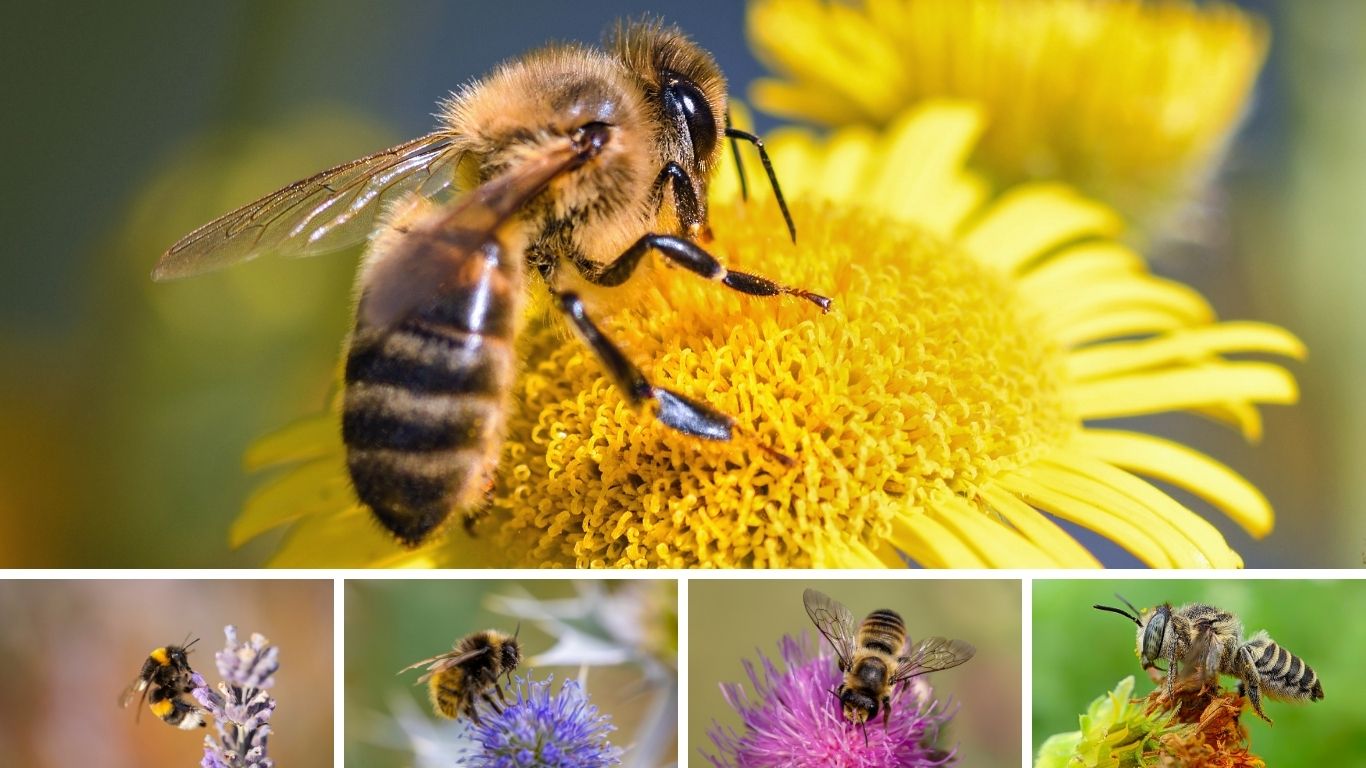
Bees are more than just honey makers—they’re vital pollinators that come in many shapes, sizes, and colors. Each species has unique traits and behaviors, from the well-known honey bee to the fuzzy bumblebee and the tiny sweat bee. This guide covers 25 of the most common types of bees, helping you recognize them, understand their roles, and appreciate their importance in nature and our gardens.
1. Honey Bee

Honey bees are social insects best known for producing honey and beeswax. They play a vital role in pollination and are commonly found in gardens, farms, and natural landscapes.
Identification
- Color: Golden-yellow with brown or black bands
- Size: 12 to 15 mm
- Antennae: Elbowed, medium-length
- Wings: Two pairs, transparent
- Body: Hairy, with narrow waist and pollen baskets on hind legs
- Stinger: Present in females, barbed
Habitat
Honey bees live in large colonies housed in tree cavities, man-made hives, or hollow structures. They prefer environments rich in flowers and water sources.
Behavior
Highly social, honey bees work together in organized colonies. Worker bees forage for nectar and pollen, while the queen lays eggs. They perform a “waggle dance” to communicate food locations.
Risk to Humans
They sting only when threatened. While the sting can be painful, it is usually not dangerous unless the person is allergic. Honey bees are crucial pollinators and generally non-aggressive.
2. Bumblebee

Bumblebees are large, fuzzy bees known for their loud buzzing and excellent pollination abilities. They are less aggressive than honey bees and often seen hovering around flowers.
Identification
- Color: Black with yellow or orange bands
- Size: 13 to 25 mm
- Antennae: Short and bent
- Wings: Two pairs, relatively small
- Body: Hairy and robust
- Stinger: Present in females, smooth and reusable
Habitat
They nest in abandoned rodent burrows, compost piles, or under sheds. Unlike honey bees, bumblebee colonies are smaller and seasonal.
Behavior
Bumblebees are social and work in colonies but don’t store large amounts of honey. They are strong pollinators, even in colder weather, using a method called “buzz pollination.”
Risk to Humans
They are generally docile but will sting if provoked or defending their nest. Their stings can be painful but are rarely serious unless allergic.
3. Carpenter Bee

Carpenter bees resemble bumblebees but have shiny, hairless abdomens. They are solitary and known for boring holes into wood to lay their eggs.
Identification
- Color: Black or metallic blue, sometimes with yellow on thorax
- Size: 12 to 25 mm
- Antennae: Medium-length
- Wings: Dark-tinted, large
- Body: Robust, shiny abdomen
- Stinger: Only females can sting
Habitat
They bore into untreated wood, often in decks, fences, or eaves of buildings. They prefer dry, softwoods for nesting tunnels.
Behavior
Solitary but often nest near each other. Males hover near nests and act territorial, though they can’t sting. Females excavate tunnels to lay eggs and provide pollen for larvae.
Risk to Humans
Generally non-aggressive. Females sting only if handled. They can cause structural damage over time if infestations grow.
4. Mason Bee

Mason bees are solitary, gentle bees named for their habit of using mud or other materials to build nest partitions inside holes or crevices.
Identification
- Color: Metallic blue, black, or green
- Size: 6 to 12 mm
- Antennae: Medium-length, straight
- Wings: Clear or slightly tinted
- Body: Hairy, stout, often metallic
- Stinger: Present but rarely used
Habitat
They nest in natural holes in wood, hollow stems, or man-made bee houses. Mason bees prefer sunny spots near flowering plants and moist soil.
Behavior
Solitary, with each female building and stocking her own nest. They are excellent early-spring pollinators and are far more efficient than honey bees in small-scale pollination.
Risk to Humans
Very docile and rarely sting. They are highly beneficial to gardens and safe around people, including children and pets.
5. Leafcutter Bee

Leafcutter bees are solitary bees known for cutting neat, circular pieces from leaves to build their nests. They are important native pollinators.
Identification
- Color: Dark brown to black with pale hairs
- Size: 7 to 18 mm
- Antennae: Straight, medium-length
- Wings: Clear with visible veins
- Body: Robust with hairs on the underside of the abdomen for pollen
- Stinger: Present in females, not aggressive
Habitat
They nest in holes in wood, hollow stems, or in soil. Leafcutter bees often use the same nesting sites year after year if undisturbed.
Behavior
Females cut leaves or petals to construct nest cells, often in garden plants. They prefer soft-leaved plants like roses. Their pollination style is very efficient for many crops.
Risk to Humans
They do not defend their nests and rarely sting. Leafcutter bees are beneficial pollinators and not considered pests, despite minor cosmetic damage to plants.
6. Sweat Bee

Sweat bees are small, often metallic-colored bees that are attracted to human sweat for its salt content. Despite their name, they are important native pollinators.
Identification
- Color: Metallic green, blue, or black; some are dull-colored
- Size: 4 to 10 mm
- Antennae: Short to medium
- Wings: Transparent
- Body: Slender with short hairs
- Stinger: Present but rarely used
Habitat
They nest in soil, rotting wood, or within plant stems. Most prefer sunny, undisturbed ground, including garden beds and pathways.
Behavior
Some species are solitary, while others live in small communal groups. They forage on a wide variety of wildflowers and crops and are highly active pollinators.
Risk to Humans
They may land on people to lick sweat but rarely sting. Stings are mild and only occur when the bee feels trapped or threatened.
7. Mining Bee

Mining bees are ground-nesting solitary bees that dig tunnels in loose soil. They are among the first bees to emerge in spring.
Identification
- Color: Black or brown with pale or reddish hairs
- Size: 8 to 15 mm
- Antennae: Medium-length
- Wings: Clear, sometimes iridescent
- Body: Hairy, especially on thorax
- Stinger: Present in females, rarely used
Habitat
They nest in dry, sandy, or well-drained soil. You may spot small mounds or holes in lawns or garden edges during early spring.
Behavior
Each female builds her own nest underground, laying eggs in individual chambers stocked with pollen and nectar. They are important pollinators for spring-blooming plants.
Risk to Humans
Mining bees are non-aggressive and solitary. They pose no threat to humans, pets, or lawns, as they do not damage turf or bite.
8. Long-Horned Bee

Long-horned bees are named for the males’ unusually long antennae. These solitary bees are active in mid-to-late summer and are especially important pollinators of sunflowers and wildflowers.
Identification
- Color: Black or brown with yellow or orange markings
- Size: 7 to 14 mm
- Antennae: Very long in males, standard length in females
- Wings: Transparent with clear venation
- Body: Hairy, robust, especially on the thorax
- Stinger: Present in females, rarely used
Habitat
They nest in sandy or loose soil, often in sunny areas such as garden borders or natural meadows. Females dig small burrows to lay eggs and provision nests.
Behavior
Long-horned bees are solitary but may nest in large aggregations. They are active in late summer and are highly attracted to composite flowers like daisies and sunflowers.
Risk to Humans
These bees are docile and very unlikely to sting. They are excellent pollinators and cause no damage to plants or property.
9. Cuckoo Bee

Cuckoo bees are parasitic bees that lay their eggs in the nests of other solitary bees, especially mining and leafcutter bees. They do not build nests or gather pollen.
Identification
- Color: Usually black with red, yellow, or white markings
- Size: 6 to 14 mm
- Antennae: Medium-length, slightly curved
- Wings: Clear or smoky
- Body: Sleek, less hairy than pollen-gathering bees
- Stinger: Present and sometimes used aggressively
Habitat
They are found wherever their host species nest—typically in fields, gardens, or forest edges. They do not dig their own nests.
Behavior
Cuckoo bees sneak into the nests of host bees and lay their eggs. The larva hatches and consumes the host bee’s food stores—or even the host larva. Adults feed on nectar.
Risk to Humans
Cuckoo bees are not aggressive toward humans. They may sting if handled but are not considered dangerous or a nuisance. Their presence is part of a healthy bee ecosystem.
10. Long-Horned Bee

Long-horned bees are named for the males’ unusually long antennae. These solitary bees are active in mid-to-late summer and are especially important pollinators of sunflowers and wildflowers.
Identification
- Color: Black or brown with yellow or orange markings
- Size: 7 to 14 mm
- Antennae: Very long in males, standard length in females
- Wings: Transparent with clear venation
- Body: Hairy, robust, especially on the thorax
- Stinger: Present in females, rarely used
Habitat
They nest in sandy or loose soil, often in sunny areas such as garden borders or natural meadows. Females dig small burrows to lay eggs and provision nests.
Behavior
Long-horned bees are solitary but may nest in large aggregations. They are active in late summer and are highly attracted to composite flowers like daisies and sunflowers.
Risk to Humans
These bees are docile and very unlikely to sting. They are excellent pollinators and cause no damage to plants or property.
11. Cuckoo Bee

Cuckoo bees are parasitic bees that lay their eggs in the nests of other solitary bees, especially mining and leafcutter bees. They do not build nests or gather pollen.
Identification
- Color: Usually black with red, yellow, or white markings
- Size: 6 to 14 mm
- Antennae: Medium-length, slightly curved
- Wings: Clear or smoky
- Body: Sleek, less hairy than pollen-gathering bees
- Stinger: Present and sometimes used aggressively
Habitat
They are found wherever their host species nest—typically in fields, gardens, or forest edges. They do not dig their own nests.
Behavior
Cuckoo bees sneak into the nests of host bees and lay their eggs. The larva hatches and consumes the host bee’s food stores—or even the host larva. Adults feed on nectar.
Risk to Humans
Cuckoo bees are not aggressive toward humans. They may sting if handled but are not considered dangerous or a nuisance. Their presence is part of a healthy bee ecosystem.
12. Squash Bee

Squash bees are specialist pollinators that primarily visit squash, pumpkin, and gourd flowers. They are solitary and often mistaken for honey bees due to their size and coloring.
Identification
- Color: Yellow-orange with black bands
- Size: 10 to 14 mm
- Antennae: Medium-length
- Wings: Transparent with visible veins
- Body: Hairy, especially on legs for collecting pollen
- Stinger: Present in females, rarely used
Habitat
They nest in loose, sandy soil near cucurbit plants (like squash and pumpkins). Females dig shallow burrows close to the flowering crops they pollinate.
Behavior
Most active at dawn when squash flowers open. Females gather pollen exclusively from squash family plants. Unlike honey bees, they do not form colonies and have short lifespans.
Risk to Humans
Very gentle and non-aggressive. Their pollination is critical to squash crops, and they pose no threat to humans or pets.
13. Digger Bee

Digger bees are solitary, ground-nesting bees that create small burrows in sandy or loose soil. They emerge in large numbers during spring and are vital native pollinators.
Identification
- Color: Black, brown, or gray with pale hairs
- Size: 10 to 16 mm
- Antennae: Medium to long
- Wings: Clear, often held flat
- Body: Robust and fuzzy
- Stinger: Present in females, rarely used
Habitat
They nest in dry, open, and well-drained soil such as lawns, gardens, or paths. Nests appear as small holes with loose soil around the entrance.
Behavior
Each female builds her own nest tunnel and lays eggs in pollen-provisioned chambers. Though solitary, they often nest in aggregations, giving the appearance of a swarm.
Risk to Humans
They do not sting unless handled or trapped. Digger bees are important pollinators and should not be disturbed; they pose no damage to lawns or danger to humans.
14. Carder Bee

Carder bees are wool-collecting bees that scrape plant hairs to build their nests. They are part of the leafcutter bee family and are often seen around fuzzy-leafed plants.
Identification
- Color: Black with yellow or golden markings
- Size: 10 to 15 mm
- Antennae: Medium-length
- Wings: Clear with fine veins
- Body: Fuzzy with a stout build
- Stinger: Present in females, rarely used
Habitat
They nest in cavities, hollow stems, or crevices, lining their nests with plant fibers. Often found near lamb’s ear, mullein, and other soft-leafed plants.
Behavior
Carder bees collect plant hairs by scraping them off leaves, giving the name “carder.” They are solitary and often very territorial, with males defending flower patches aggressively.
Risk to Humans
Generally non-aggressive, though males may hover near humans. Stings are rare and mild. They’re excellent pollinators and cause no harm to plants or property.
15. Tawny Mining Bee

The tawny mining bee is a spring-flying, solitary bee known for its dense orange-red fur. It’s a common garden visitor in Europe and easily spotted due to its bright coloration.
Identification
- Color: Rusty-orange with black legs and face
- Size: 10 to 12 mm
- Antennae: Short to medium
- Wings: Slightly smoky, clear edges
- Body: Very hairy, especially the thorax
- Stinger: Present in females, rarely used
Habitat
They dig nests in sunny, grassy areas like lawns, flower beds, and garden borders. The entrances appear as small volcano-like mounds of soil.
Behavior
Females emerge in early spring and are active for a few weeks, building individual burrows for their eggs. They are important pollinators for fruit trees and spring flowers.
Risk to Humans
Completely harmless. They don’t swarm or sting unless severely provoked. Their presence is short-lived and beneficial to garden ecosystems.
16. Ivy Bee

Ivy bees are late-season solitary bees that specialize in pollinating ivy flowers. They are one of the last bees to emerge each year and are commonly found in gardens and hedgerows.
Identification
- Color: Orange-yellow with black bands and a pale face
- Size: 8 to 13 mm
- Antennae: Medium-length
- Wings: Clear with dark veins
- Body: Hairy, especially on the thorax and legs
- Stinger: Present in females, very rarely used
Habitat
They nest in sandy, well-drained soils in sunny areas—lawns, roadside banks, and field edges. Nesting sites often contain hundreds of individual burrows clustered together.
Behavior
Females emerge in late summer or early fall, coinciding with ivy bloom. Each female digs her own nest and provisions it with pollen and nectar from ivy flowers.
Risk to Humans
Ivy bees are solitary and very gentle. They pose no threat to people or pets, even when nesting in large groups. Their presence helps support autumn pollination.
17. Hairy-Footed Flower Bee

Hairy-footed flower bees are fast-flying spring bees often mistaken for bumblebees due to their fuzzy bodies. Males have long hairs on their middle legs—hence the name.
Identification
- Color: Males are gingery with pale faces; females are black with orange hairs on hind legs
- Size: 10 to 14 mm
- Antennae: Medium-length
- Wings: Clear, rapid-beating in flight
- Body: Very hairy and stout
- Stinger: Present in females, rarely used
Habitat
They nest in soft mortar, crumbling brickwork, or exposed soil banks. Common in urban gardens and parks, especially where lungwort, comfrey, or dead-nettle grows.
Behavior
Solitary, though many may nest in the same area. They fly rapidly and hover while feeding. Males patrol flower patches in search of mates, often chasing off rivals.
Risk to Humans
They are non-aggressive and unlikely to sting. Hairy-footed flower bees are highly beneficial pollinators for early spring plants.
18. Red Mason Bee

Red mason bees are solitary spring bees known for nesting in small cavities and using mud to seal their nest cells. They are highly valued for their pollination of fruit trees.
Identification
- Color: Rusty-red to orange with a black face
- Size: 8 to 10 mm
- Antennae: Medium-length
- Wings: Transparent with clear venation
- Body: Fuzzy with a robust build
- Stinger: Present in females, very mild and rarely used
Habitat
They nest in natural holes, hollow plant stems, or bee hotels. Often found in gardens, orchards, and woodland edges where fruit blossoms are plentiful.
Behavior
Each female creates a series of chambers in a tunnel, fills each with pollen and nectar, and seals them with mud. They are active for just a few weeks in spring.
Risk to Humans
They are extremely gentle and very unlikely to sting. Their presence is beneficial for home gardens and they are easy to encourage with bee houses.
19. Green Metallic Sweat Bee

Green metallic sweat bees are small, iridescent bees that shimmer in shades of green or blue. They are a type of sweat bee and are frequently seen on flowers throughout summer.
Identification
- Color: Bright metallic green or blue
- Size: 5 to 8 mm
- Antennae: Short to medium
- Wings: Clear with light venation
- Body: Smooth, compact, with a metallic sheen
- Stinger: Present in females, rarely used
Habitat
They nest in bare patches of soil, especially in sunny and undisturbed areas like garden beds or woodland edges. Some nest in rotting wood or plant stems.
Behavior
Some species are solitary, others form loose social groups. They are active from spring through fall and are excellent pollinators of wildflowers and crops.
Risk to Humans
They may land on people to lick sweat but rarely sting. Their sting is mild, and they pose no threat. Their small size and beautiful coloring make them easy to miss.
20. Western Honey Bee

The Western honey bee is the most widely domesticated bee species and the primary producer of commercial honey. It plays a major role in agriculture and global pollination.
Identification
- Color: Golden-brown with black bands
- Size: 12 to 15 mm
- Antennae: Medium-length, elbowed
- Wings: Transparent, slightly veined
- Body: Hairy, with visible pollen baskets on hind legs
- Stinger: Barbed, used once by females
Habitat
They live in man-made hives or natural cavities like tree hollows. Colonies are managed by beekeepers but also exist in the wild, especially near abundant flowering sources.
Behavior
Highly social, forming large colonies with a queen, drones, and thousands of workers. They forage in large areas and communicate food sources using the “waggle dance.”
Risk to Humans
They sting only in defense. The sting is painful but usually not dangerous unless allergic. They are essential pollinators and widely respected in ecosystems and farming.
21. Eastern Carpenter Bee

Eastern carpenter bees are large, solitary bees that tunnel into wood to lay their eggs. They resemble bumblebees but have shiny, hairless abdomens.
Identification
- Color: Black with yellow hairs on the thorax
- Size: 12 to 25 mm
- Antennae: Medium-length
- Wings: Large and slightly darkened
- Body: Glossy, robust, with smooth black abdomen
- Stinger: Present in females, smooth and reusable
Habitat
They bore into untreated or weathered wood, such as decks, fences, and eaves. Tunnels are reused and expanded each year if not sealed.
Behavior
Solitary but may nest near each other. Males are territorial and may hover near people, though they can’t sting. Females dig long tunnels where they lay eggs in separate cells.
Risk to Humans
Females rarely sting unless handled. While not harmful to people, their wood-boring activity can cause structural damage over time if not addressed.
22. European Wool Carder Bee

European wool carder bees are solitary bees named for their habit of collecting plant hairs (“wool”) to line their nests. Males are known for aggressively guarding flower patches.
Identification
- Color: Black with yellow spots and markings
- Size: 10 to 14 mm
- Antennae: Short to medium
- Wings: Clear with dark veins
- Body: Compact and robust with sparse hairs
- Stinger: Females sting; males cannot sting but have spines
Habitat
They nest in crevices, hollow stems, and bee hotels, lining their nests with fibers scraped from fuzzy plants like lamb’s ear or mullein.
Behavior
Males fiercely guard flowering plants, chasing away other insects. Females build nests alone and collect pollen and plant hairs to provision and insulate brood cells.
Risk to Humans
Females are non-aggressive and rarely sting. Males cannot sting but may buzz near people. They are useful garden pollinators and harmless to humans.
23. Black-Tailed Bumblebee

Black-tailed bumblebees are one of the most common and recognizable bumblebee species in Europe, easily identified by their white tail and yellow bands.
Identification
- Color: Black with yellow thorax band and white tail
- Size: 11 to 22 mm
- Antennae: Short and slightly bent
- Wings: Transparent with strong veins
- Body: Fuzzy and rounded
- Stinger: Present in females, smooth and reusable
Habitat
They nest underground in abandoned rodent burrows, compost piles, or thick grass. Colonies are seasonal and consist of a queen and worker bees.
Behavior
Social and active from early spring to late summer. Workers collect pollen and nectar, while the queen lays eggs. Their buzz is deep and distinct.
Risk to Humans
Generally docile, they only sting if provoked or their nest is threatened. They are essential pollinators and highly beneficial in gardens and wild habitats.
24. Southern Plains Bumblebee

The Southern Plains bumblebee is a native North American bee known for its large size and deep black body with striking yellow markings. It is a strong pollinator but has declined in recent years.
Identification
- Color: Black with yellow stripes on thorax and abdomen
- Size: 13 to 25 mm
- Antennae: Short, elbowed
- Wings: Clear with dark veins
- Body: Fuzzy and robust
- Stinger: Present in females, smooth and reusable
Habitat
They nest in grasslands, prairies, and open woodlands, often using abandoned animal burrows or thick grass clumps. They prefer wildflower-rich areas with minimal disturbance.
Behavior
Colonies are annual, starting in spring and dying off by fall. Workers forage for nectar and pollen, especially from native prairie plants like milkweed and goldenrod.
Risk to Humans
Not aggressive and sting only when handled or disturbed. They are vital pollinators of native plants and crops in central and southern U.S. regions.
25. Common Furrow Bee

The common furrow bee is a small, slender solitary bee often found in gardens and grasslands. It’s named for the shallow furrows or grooves on its abdomen.
Identification
- Color: Black with pale abdominal stripes
- Size: 6 to 10 mm
- Antennae: Medium-length
- Wings: Clear with fine veins
- Body: Slender with faint furrows on abdomen
- Stinger: Present in females, rarely used
Habitat
They nest in the ground, often along dry paths, lawns, or sandy banks. They prefer sunny spots with bare or lightly vegetated soil.
Behavior
Solitary but often nest in loose aggregations. Active from spring to fall, females build individual burrows and provision them with pollen for their young.
Risk to Humans
Very gentle and non-aggressive. They are harmless pollinators and pose no threat to people, pets, or plants.
FAQs
1. What is the difference between honey bees and bumblebees?
Honey bees are smaller, less hairy, and live in large, perennial colonies that produce honey. Bumblebees are larger, fuzzier, and form smaller seasonal colonies. Bumblebees are also better adapted to cooler climates and perform buzz pollination.
2. Are all bees social insects?
No. While honey bees and bumblebees are social and live in colonies, most bee species—like mason bees, leafcutter bees, and mining bees—are solitary and build individual nests.
3. Do all bees sting?
Only female bees can sting, and many solitary bees rarely do. Social bees like honey bees and bumblebees will sting in defense of their colony. Solitary bees are typically non-aggressive and sting only if provoked.
4. Why are bees important to the environment?
Bees are crucial pollinators for flowering plants, fruits, and vegetables. Around 70% of crop species humans rely on for food are pollinated by bees, making them essential for biodiversity and food security.
5. Can I attract bees to my garden safely?
Yes. Planting a variety of native flowering plants, avoiding pesticides, and providing nesting spots (like bee houses or bare soil) can safely attract beneficial bees without increasing sting risk. Most solitary bees are non-aggressive.