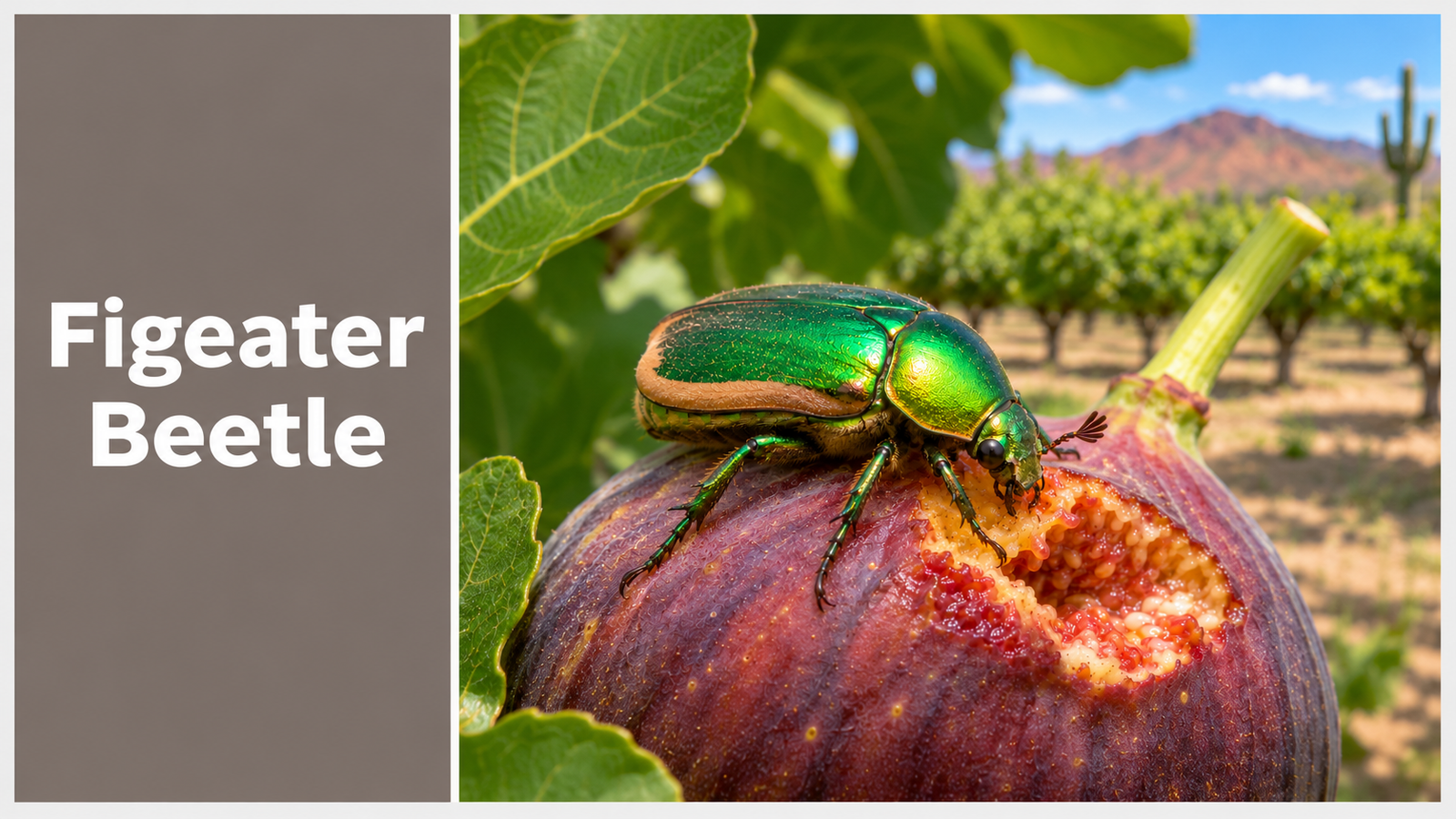
The figeater beetle is a large, metallic green scarab often noticed buzzing around fruit trees in summer. Also called the green fruit beetle, green fig beetle, or western green June beetle, it is known scientifically as Cotinis mutabilis. Adult beetles feed on ripe, soft fruit, while their pale grubs live in compost and other decomposing organic matter. This guide explains how to identify a figeater beetle, distinguish it from similar insects, understand its life cycle, and reduce fruit damage.
What Is a Figeater Beetle?
The figeater beetle (Cotinis mutabilis) is a scarab beetle in the family Scarabaeidae and subfamily Cetoniinae, a group that includes flower chafers. It is native to the southwestern United States and Mexico, though records show the beetle has also been observed farther north in recent decades.
Its common names can be confusing. “Green fruit beetle,” “green fig beetle,” and “western green June beetle” may all refer to C. mutabilis. It is not the same species as the eastern green June beetle (Cotinis nitida), though the two can look very similar. Identification often depends on location and close examination of physical features.
Figeater Beetle Identification

Adult figeater beetles are oval, sturdy, and usually about three-quarters of an inch to a little over an inch long. Their upper surface is typically metallic green, sometimes with tan or brown coloring along the outer edges of the wing covers. The underside may shine a brighter green. A short, hornlike projection on the face and clubbed antennae are useful identification features.
The beetle’s wings are protected by hardened forewings called elytra. Adults can fly strongly, and their flight often produces a loud buzz. They may fly close to the ground or around fruit trees, where their size and noisy movement can startle people. Despite their appearance, figeater beetles do not bite and pose no direct threat to people.
Figeater beetle larvae look very different from adults. They are pale or dirty-white grubs with short brown legs and a brownish head. When disturbed, a grub may curl into a C shape. If exposed, it can turn onto its back and move with rippling motions, using stiff hairs along its body. Mature grubs can grow to around two inches long.
| Feature | Figeater beetle |
|---|---|
| Scientific name | Cotinis mutabilis |
| Family | Scarabaeidae |
| Adult color | Metallic green, often with tan or brown wing-cover edges |
| Adult size | About ¾–1⅓ inches |
| Larval form | Pale grub, often C-shaped when disturbed |
| Common names | Green fruit beetle, green fig beetle, western green June beetle |
Figeater Beetle vs. Green June Beetle
The figeater beetle is often confused with the eastern green June beetle, Cotinis nitida. Both are large, green scarabs, and their appearance can overlap. Their ranges are a helpful clue: C. mutabilis is associated with the western United States and Mexico, while C. nitida is primarily an eastern species.
Figeater beetles are also sometimes mistaken for Japanese beetles. Japanese beetles are smaller and have distinctive white tufts of hair along the sides of the abdomen. Figeater beetles lack those tufts and have a short hornlike projection on the front of the head. If a beetle is found in an area where Japanese beetles are a regulated pest, check local identification guidance before assuming the species.
Figeater Beetle Habitat and Distribution

Figeater beetles are associated with the southwestern United States and Mexico. They are common in some California communities during summer and early fall, and they may be found in gardens, orchards, and areas with compost or other decomposing plant material.
The adult beetles are attracted to the smell of ripe fruit, fermenting fruit, and manure. They can fly relatively long distances while searching for food or a place to lay eggs. Larvae develop in moist organic matter, including compost, lawn clippings, leaf litter, manure, and mulch. An environment that offers both food for adults and decomposing material for larvae can support local populations.
What Do Figeater Beetles Eat?
Adult figeater beetles feed on ripe or overripe fruit. They may gather on figs, peaches, plums, apricots, grapes, berries, and other soft-skinned fruit. Their attraction to fruit odors can bring them into home gardens and orchards, especially when fruit is ripening or has fallen and begun to ferment.
Adults chew into the fruit and feed on the soft flesh. A beetle may leave shallow holes or damaged patches, and several beetles gathering to mate can increase damage. Figeater beetles are usually considered occasional fruit pests rather than a serious threat to every harvest. Their impact depends on how many adults are present and how much ripe fruit is available.
The larvae have a different diet. They mainly consume decomposing organic matter in compost, mulch, manure, and lawn debris. Although grubs may be found in soil, figeater beetle larvae generally do not damage fruit and are not the root-feeding pest that some people fear. Removing every grub from a compost pile is usually unnecessary; the larvae help break down organic material.
Figeater Beetle Life Cycle

Figeater beetles develop through four stages: egg, larva, pupa, and adult. In many areas, the species produces one generation per year and spends most of its life as a grub in the soil or organic matter.
- Egg: In late summer or fall, females lay small, pale eggs just beneath the surface of compost, mulch, manure, or other organic material.
- Larva: Eggs hatch in about a week. The grubs feed on decomposing material and grow through three larval stages, called instars.
- Pupa: As larvae mature, they form a cell in the soil and transform into pupae, often in spring.
- Adult: Adult beetles emerge in late spring or summer, feed on ripe fruit, mate, and begin the next generation.
Adults are most noticeable from late spring through early fall, depending on local climate. The larvae overwinter, so a beetle population seen in summer may have developed for months in nearby compost or soil.
Are Figeater Beetle Grubs Harmful?
Figeater beetle grubs are generally beneficial decomposers, not a major lawn or garden pest. They feed mostly on decaying organic matter and are commonly found in compost heaps, mulch, manure, or piles of grass clippings. Finding them in compost can be a sign that insects are helping break down the material.
Their appearance can cause confusion because many scarab beetle larvae are called white grubs. Some species feed on plant roots, but figeater beetle grubs are not generally known for causing the kind of root damage associated with damaging lawn grubs. Before treating a lawn or removing larvae, identify them correctly. Unnecessary treatments can harm beneficial insects and other wildlife.
How to Keep Figeater Beetles Off Fruit

Since adult beetles are attracted to ripe fruit and larvae develop in organic debris, prevention focuses on managing both food sources. You can:
- Harvest ripe fruit promptly instead of leaving it on the tree.
- Pick up fallen or damaged fruit to reduce fermenting odors.
- Cover or screen compost bins where practical.
- Avoid leaving thick piles of lawn clippings, leaves, or manure beside fruit trees.
- Turn compost regularly to speed decomposition and expose grubs to birds and other predators.
- Consider fruit varieties that ripen earlier if beetles repeatedly damage late-season crops.
Traps baited with fruit juice may capture some adults, but a bait trap can also attract beetles to the area. Use traps thoughtfully and place them away from valuable fruit when possible. University of California guidance does not recommend insecticide applications for green fruit beetles, in part because adults feed on fruit that is already ripe or nearly ripe.
Are Figeater Beetles Dangerous?
Figeater beetles do not bite people and are not dangerous to pets or household structures. Their loud buzzing and large size can be startling, but they are not aggressive. If one lands nearby, it is usually searching for food, a mate, or a place to rest.
Avoid crushing beetles unnecessarily, and use care when moving compost or organic debris where larvae may be developing. If the beetles are damaging fruit, focus on harvesting ripe produce and reducing the nearby sources of decaying organic material.
Why Are Figeater Beetles Important?
Figeater beetles have different roles at different life stages. Adults feed on ripe fruit and may occasionally damage crops, while larvae help break down decomposing organic matter. Their grubs are part of the food web, providing food for birds and other animals that search through compost and soil.
Understanding this life cycle helps explain why adult beetles may appear suddenly in summer. They are the visible stage of an insect that spent much of the year hidden in the soil or compost as a grub. Managing ripe fruit and organic debris can reduce nuisance without treating every larva as a pest.
FAQs About Figeater Beetles
What is the scientific name of the figeater beetle?
The scientific name is Cotinis mutabilis. It is also known as the green fruit beetle, green fig beetle, and western green June beetle.
Do figeater beetles bite?
No. Figeater beetles do not bite people and pose no direct threat. Their loud, low-flying buzz can be startling, but they are not aggressive.
What do figeater beetle larvae eat?
The larvae mostly feed on decomposing organic material in compost, mulch, manure, leaf litter, and lawn clippings. They are generally not considered damaging root-feeding grubs.
What fruit do figeater beetles eat?
Adults feed on ripe or overripe soft fruit, including figs, peaches, plums, apricots, grapes, and berries. Cleaning up fallen fruit can help reduce the odors that attract them.
How can I keep figeater beetles away from my fruit trees?
Harvest ripe fruit promptly, remove fallen fruit, and cover or turn compost piles near the trees. Avoid insecticide use unless a local expert recommends it, because beetles often feed on fruit that is nearly ready to harvest.