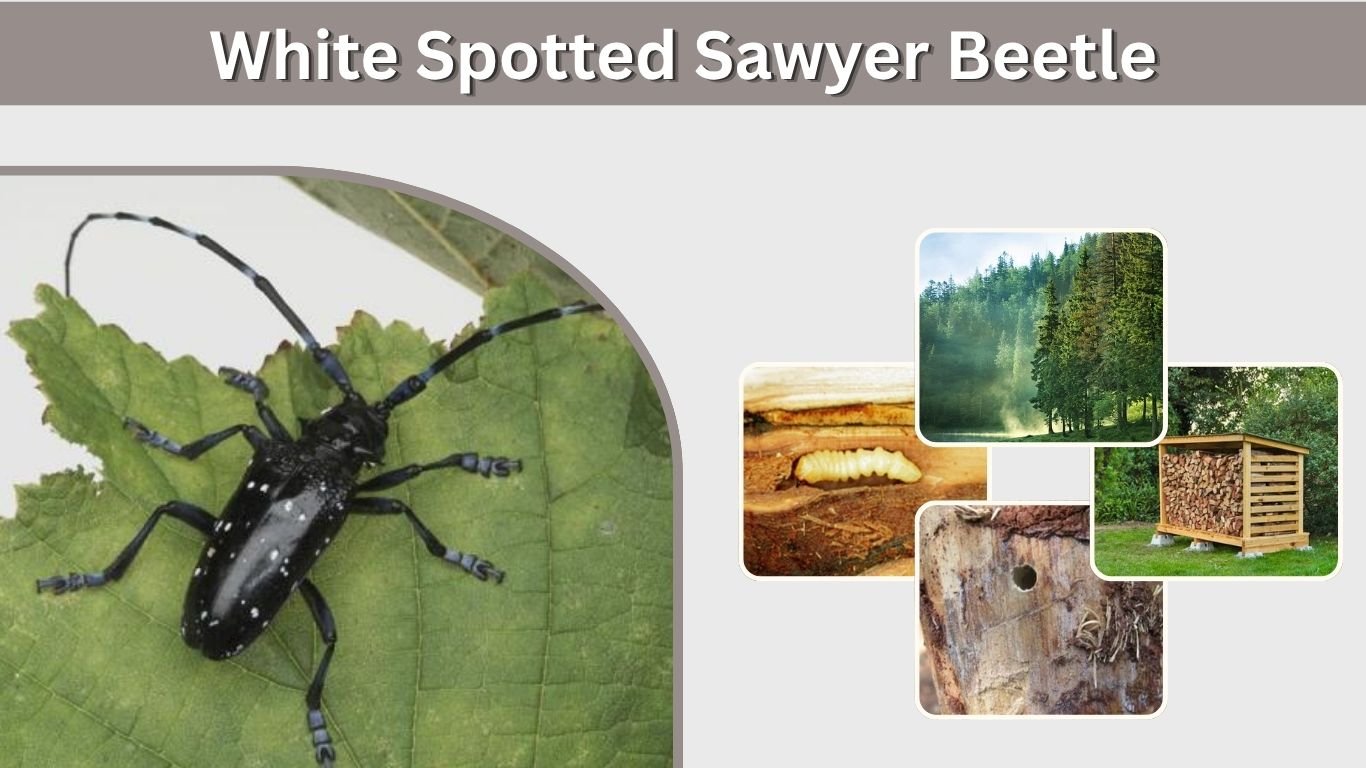
The white spotted sawyer beetle (Monochamus scutellatus) is a large, dark-colored longhorn beetle commonly found in coniferous forests across North America. Recognized by its exceptionally long antennae and distinctive white spot near the base of its wings, this beetle often inhabits weakened, dying, or recently dead trees. Although its appearance can seem intimidating, the white spotted sawyer is generally harmless to humans. However, its larvae can damage harvested timber, and adults may transmit organisms associated with pine wilt disease. This guide explains its identification, habitat, diet, life cycle, bite risks, and control methods.
What Is a White Spotted Sawyer Beetle?
The white spotted sawyer beetle is a native North American wood-boring insect belonging to the family Cerambycidae. It is also known as the whitespotted pine sawyer or spruce sawyer. These beetles play an important ecological role by helping break down weakened and dead conifer trees.
White Spotted Sawyer Beetle Identification
Adult white spotted sawyer beetles have several recognizable characteristics.
- Scientific name: Monochamus scutellatus
- Body color: Black, bronzy black, or dark gray with occasional pale markings.
- Body length: Approximately 13–27 millimeters.
- Antennae: Extremely long, particularly in males.
- White marking: A distinctive pale spot between the bases of the wing covers.
- Body shape: Elongated and cylindrical.
- Thorax: A noticeable spine on each side.
- Wings: Hard, textured wing covers protecting functional flying wings.
The single white marking near the front of the wing covers is one of the most useful identification features.
Male vs. Female White Spotted Sawyer Beetles
Male white spotted sawyer beetles usually have longer antennae than females. Their antennae may extend more than twice their body length.
Males often appear uniformly black except for the distinctive white spot.
Females generally have shorter antennae and may display scattered white or grayish markings across their wing covers.
Where Do White Spotted Sawyer Beetles Live?
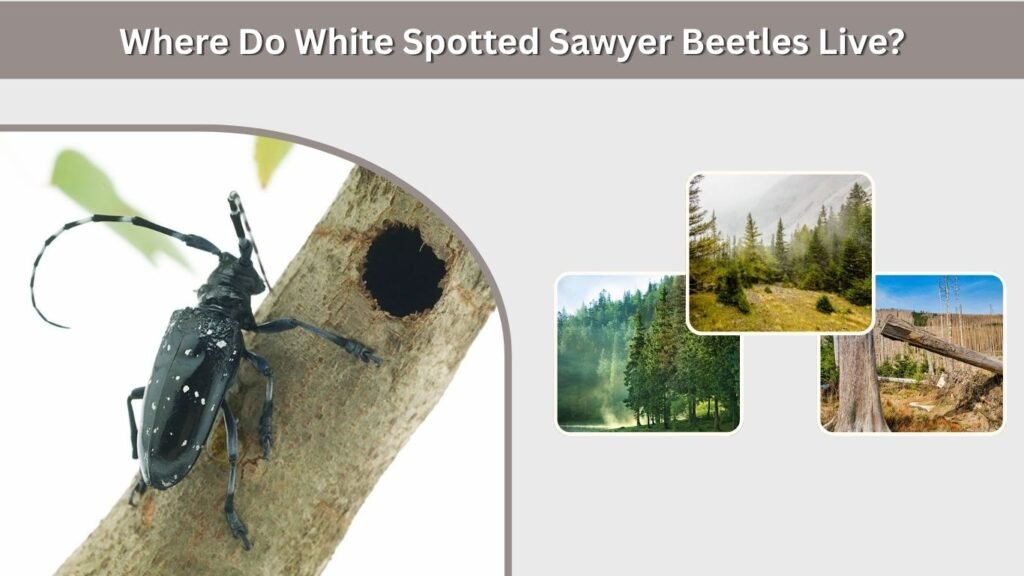
White spotted sawyer beetles inhabit coniferous forests, particularly areas containing pine, spruce, and fir trees. Adults are often found on recently fallen logs, weakened trees, and freshly cut timber. Their distribution covers substantial portions of North America, although local populations vary with climate and forest conditions.
White Spotted Sawyer Beetle Habitat
Common habitats include:
- Pine forests and woodlands
- Spruce and fir forests
- Recently burned forest areas
- Fallen trees and decaying logs
- Lumber yards and timber storage sites
- Forests affected by storms or disease
Eastern white pine is an important host in northeastern North America, but several other conifer species can also support development.
White Spotted Sawyer Beetle Distribution
White spotted sawyer beetles occur across large regions of Canada and the United States.
They are found in places such as Maine, Massachusetts, Michigan, Ohio, Wisconsin, Colorado, and Alaska.
Their seasonal activity varies by region, with adults commonly appearing from late spring through summer.
What Do White Spotted Sawyer Beetles Eat?
White spotted sawyer beetles have different feeding habits during adulthood and larval development. Adults consume tender plant tissues, while larvae feed inside weakened or dead conifer wood. Their feeding activities contribute to wood decomposition but can also reduce the commercial quality of harvested timber.
Adult White Spotted Sawyer Beetle Diet
Adult beetles primarily feed on tender bark, twigs, and needles of conifer trees.
They may consume the bark of young branches while preparing for reproduction.
This feeding can occasionally cause small areas of branch damage, but healthy trees usually tolerate limited adult feeding.
White Spotted Sawyer Beetle Larvae Diet
The larvae feed beneath the bark and within the wood of weakened, dying, or recently dead conifers.
Young larvae initially consume inner bark and cambial tissues. As they mature, they tunnel deeper into the sapwood.
Their feeding creates extensive galleries that can reduce the commercial value of timber.
White Spotted Sawyer Beetle Larvae and Life Cycle

White spotted sawyer beetles undergo complete metamorphosis, developing through egg, larva, pupa, and adult stages. Their development generally takes one or two years, depending on climate and environmental conditions. Most of this time is spent concealed inside wood.
White Spotted Sawyer Beetle Larvae Identification
White spotted sawyer larvae are elongated, creamy-white grubs with soft bodies and dark, powerful mandibles.
Mature larvae may reach approximately 35–50 millimeters long.
Unlike June beetle grubs, they lack well-developed legs and do not have strongly curved bodies.
Their cylindrical shape helps them move through the narrow tunnels they excavate inside wood.
White Spotted Sawyer Beetle Life Cycle Stages
The life cycle includes four main stages:
- Egg: Females deposit eggs inside small openings chewed into the bark of suitable trees.
- Larva: Newly hatched larvae feed beneath the bark before tunneling deeper into the wood.
- Pupa: Mature larvae form chambers inside the wood and transform into pupae.
- Adult: Fully developed beetles emerge through circular exit holes and begin feeding and reproducing.
In northern climates, development commonly takes two years. Warmer conditions may allow some populations to complete development in one year.
Are White Spotted Sawyer Beetles Harmful to Humans?
Despite their large antennae and intimidating appearance, white spotted sawyer beetles are not considered dangerous to humans. They do not sting, and they are not venomous. However, their strong mandibles can produce a defensive bite if the beetle is restrained or handled carelessly.
Do White Spotted Sawyer Beetles Bite?
Yes, white spotted sawyer beetles can bite when threatened.
Their mandibles are designed for chewing plant tissues rather than attacking people.
A defensive bite may cause temporary pain, redness, or a minor skin injury. However, these beetles do not seek out humans to bite.
White Spotted Sawyer Beetle Bite Treatment
If bitten by a white spotted sawyer beetle, basic first aid is usually sufficient.
- Wash the affected area with clean water and mild soap.
- Apply a cold compress to reduce discomfort.
- Avoid scratching or irritating the skin.
- Keep any broken skin clean.
- Monitor for increasing redness, swelling, or signs of infection.
Seek medical attention if significant swelling, persistent pain, or infection develops.
White Spotted Sawyer Beetle vs. Asian Longhorned Beetle
The white spotted sawyer is frequently confused with the Asian longhorned beetle (Anoplophora glabripennis). Both species have dark bodies and extremely long antennae. However, their markings, host trees, and ecological impacts differ considerably.
Key Differences Between the Two Beetles
| Feature | White Spotted Sawyer | Asian Longhorned Beetle |
| Scientific name | Monochamus scutellatus | Anoplophora glabripennis |
| Body color | Bronzy black or mottled | Glossy black |
| White markings | Distinct white spot at wing base | Multiple bold white spots |
| Antennae | Very long | Long, distinctly banded |
| Host trees | Primarily conifers | Primarily hardwoods |
| Tree preference | Weakened or dead trees | Can attack healthy trees |
| Invasive in North America | No, native | Yes, invasive |
How to Tell Them Apart
The most useful difference is the white patch located between the wing covers near the white spotted sawyer’s thorax.
Asian longhorned beetles lack this distinctive patch and generally have more clearly defined white spots across their wings.
Suspected Asian longhorned beetles should be reported to local forestry or agricultural authorities.
White Spotted Sawyer Beetle Damage to Trees
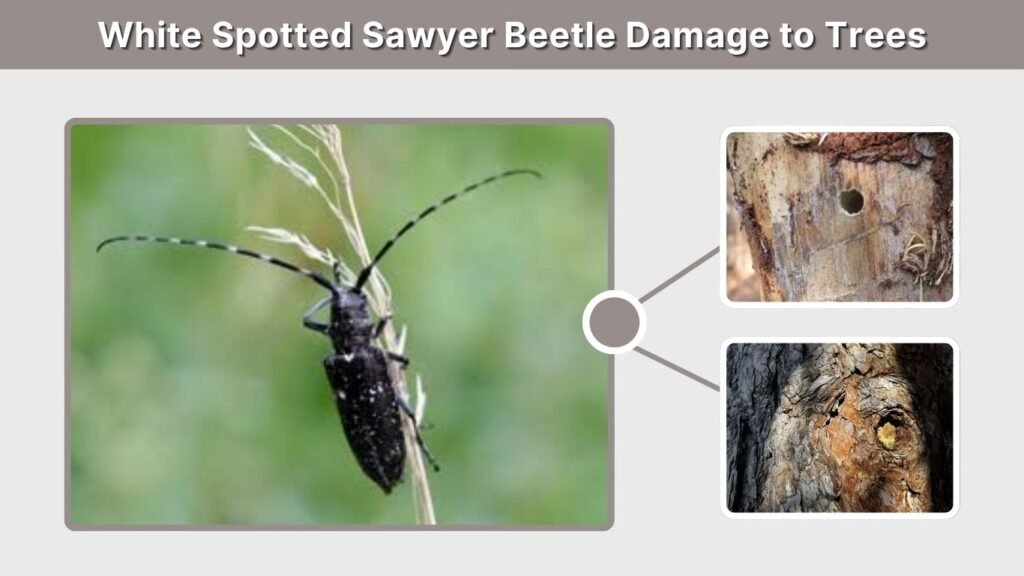
White spotted sawyer beetles primarily attack trees already weakened by disease, fire, storms, or other environmental stress. Their larvae create tunnels beneath the bark and inside the wood, contributing to decomposition. Although they rarely kill healthy trees directly, they can damage timber and spread certain tree pathogens.
Signs of White Spotted Sawyer Beetle Damage
Common warning signs include:
- Circular exit holes: Openings where adult beetles emerge.
- Wood tunnels: Large galleries created by feeding larvae.
- Coarse sawdust: Wood fibers and frass around infested material.
- Bark damage: Egg-laying scars or feeding marks.
- Damaged branches: Young twigs may weaken after adult feeding.
- Timber deterioration: Internal tunneling reduces wood quality.
These signs are especially common in recently dead trees and stored conifer logs.
Can White Spotted Sawyer Beetles Kill Trees?
White spotted sawyer beetles generally do not kill healthy trees through their own feeding activity.
However, they can transmit the pinewood nematode (Bursaphelenchus xylophilus), which causes pine wilt disease in susceptible trees.
The severity of pine wilt depends on the tree species, local environment, and presence of the nematode.
Why Is a White Spotted Sawyer Beetle in My House?
White spotted sawyer beetles occasionally enter houses through open doors and windows or emerge from infested firewood brought indoors. Their appearance inside a home does not normally indicate an established household infestation.
Can White Spotted Sawyer Beetles Damage Furniture?
White spotted sawyer beetles generally do not infest dry household furniture or properly seasoned structural lumber.
Their larvae require suitable conifer wood, typically from weakened, dying, or recently dead trees.
If one appears indoors, inspect stored firewood and nearby entry points rather than assuming the house contains a breeding population.
How to Get Rid of White Spotted Sawyer Beetles

Controlling white spotted sawyer beetles usually involves managing infested wood and preventing accidental indoor entry. Because these insects mainly develop in dead or weakened conifers, routine pesticide spraying is rarely necessary in residential areas.
Effective White Spotted Sawyer Beetle Control Methods
Several management practices can reduce problems:
- Remove infested wood: Dispose of heavily damaged logs according to local recommendations.
- Store firewood outdoors: Avoid keeping freshly cut conifer wood inside the home.
- Inspect stored timber: Look for large exit holes and larval galleries.
- Seal entry points: Repair window screens and close gaps around doors.
- Maintain tree health: Reduce drought stress and unnecessary tree injuries.
- Monitor weakened trees: Inspect declining conifers for wood-boring activity.
Consult a forestry professional if valuable trees show significant decline or suspected pine wilt symptoms.
FAQs
1. Are White Spotted Sawyer Beetles Poisonous?
No. White spotted sawyer beetles are not poisonous or venomous. They do not possess stingers or inject toxins. However, their strong mandibles can cause a painful defensive pinch if handled roughly. Avoid handling unfamiliar beetles with bare hands.
2. Can White Spotted Sawyer Beetles Fly?
Yes. White spotted sawyer beetles have functional wings and are capable of flying between trees and forested areas. Their long antennae can make their appearance unusual during flight. Adults often travel to find suitable feeding, mating, and egg-laying locations.
3. Why Do White Spotted Sawyer Beetles Make Sounds?
White spotted sawyer beetles may produce squeaking sounds through friction between body structures, a behavior called stridulation. Their larvae can also produce audible chewing sounds while feeding inside wood. These noises do not indicate aggression toward humans.
4. Are White Spotted Sawyer Beetles Invasive?
White spotted sawyer beetles are native to North America and are not considered invasive within their natural range. However, transporting infested wood into regions outside their native distribution may create biosecurity concerns, especially because some sawyer beetles transmit pinewood nematodes.
5. Are White Spotted Sawyer Beetles Common in Michigan?
Yes. White spotted sawyer beetles occur in Michigan and other regions containing suitable conifer forests. Adults are most noticeable during warmer months, particularly around weakened pine and spruce trees. Their presence is generally part of normal forest decomposition processes.