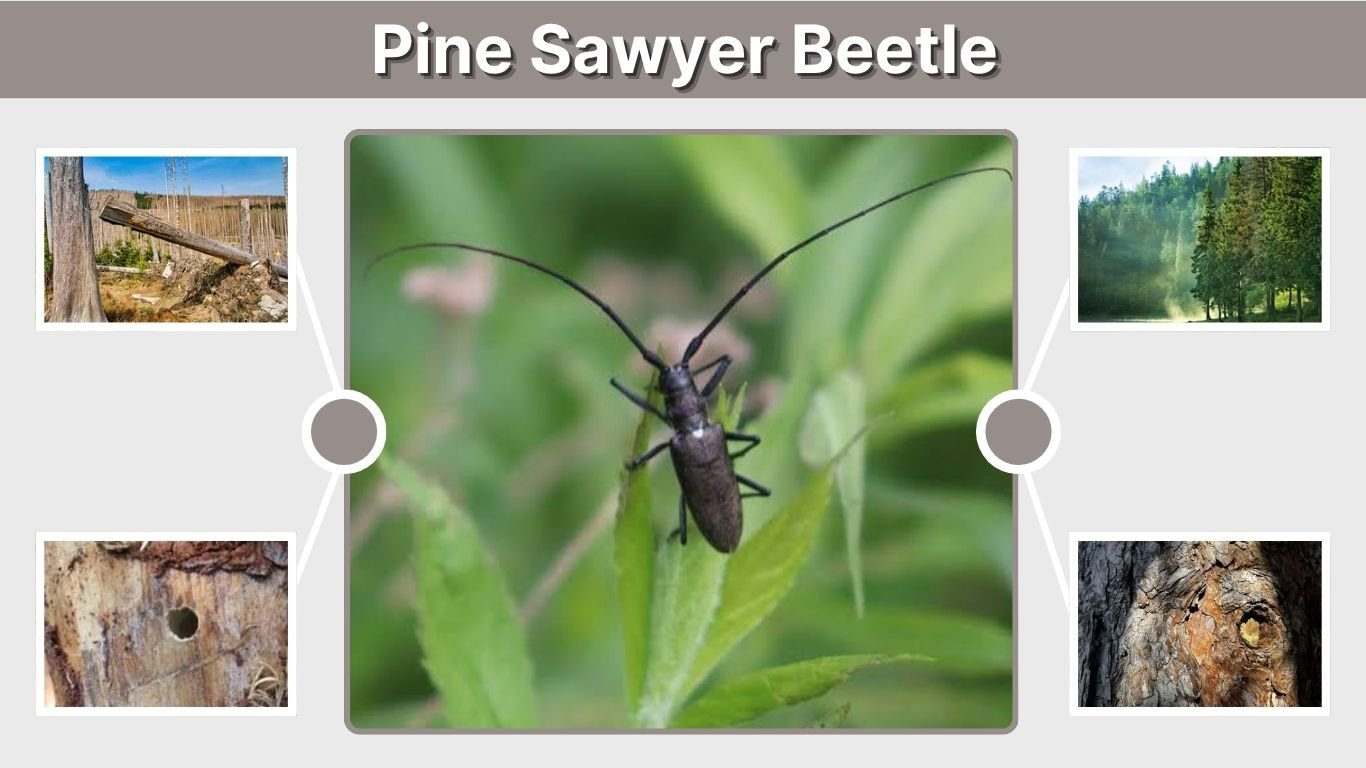
The pine sawyer beetle is a large wood-boring insect recognized by its long antennae, dark body, and strong mandibles. These beetles commonly inhabit pine forests, where their larvae tunnel through weakened, dying, or recently dead trees. Although their appearance can seem intimidating, pine sawyer beetles are generally harmless to humans and play a natural role in wood decomposition. However, some species can damage timber or transmit pinewood nematodes that threaten susceptible pine trees. This guide explains pine sawyer beetle identification, common species, habitat, life cycle, bite risks, tree damage, and effective control methods.
What Is a Pine Sawyer Beetle?
Pine sawyer beetles are longhorned beetles belonging primarily to the genus Monochamus in the family Cerambycidae. They are commonly found in coniferous forests across North America, Europe, and Asia. Their name comes from their wood-boring larvae, which create extensive tunnels through the wood of pine and other conifer trees.
Pine Sawyer Beetle Identification
Adult pine sawyer beetles have several distinctive physical characteristics.
- Body shape: Long, cylindrical, and relatively robust.
- Body color: Black, gray, brown, or mottled with lighter patches.
- Antennae: Extremely long, sometimes reaching two or three times the body length.
- Body size: Commonly 15–40 millimeters, depending on species.
- Legs: Six strong legs adapted for climbing tree bark.
- Thorax: A prominent spine on each side.
- Wings: Hard outer wing covers protecting functional flying wings.
Males often have noticeably longer antennae than females.
Pine Sawyer Beetle Size and Appearance
Pine sawyer beetles vary considerably in size. Smaller species may measure around 15–25 millimeters, while some northeastern species approach 50 millimeters.
Their long antennae make them appear much larger than their actual body length.
Some species have dark, nearly black bodies, while others display grayish or brown mottled patterns that blend with tree bark.
Common Types of Pine Sawyer Beetles
Several pine sawyer species occur across North America. Although they share similar body structures and feeding habits, their coloration, size, and geographical distribution differ. Recognizing these differences helps distinguish native species from potentially invasive beetles.
1. Carolina Pine Sawyer Beetle
The Carolina pine sawyer (Monochamus carolinensis) occurs throughout much of eastern North America.
Adults typically have reddish-brown or dark mottled bodies with long antennae. Pale markings may appear along the thorax.
Their larvae develop inside weakened, dying, or recently dead pine trees. This species can also transmit the pinewood nematode.
2. Northeastern Pine Sawyer Beetle
The northeastern pine sawyer (Monochamus notatus) is one of the largest longhorned beetles found in northeastern North America.
Adults can approach two inches in body length and generally have grayish-brown coloration.
They are commonly associated with pine forests and weakened or recently dead conifer trees.
3. Whitespotted Pine Sawyer Beetle
The whitespotted pine sawyer (Monochamus scutellatus) has a dark, somewhat bronzy body with pale markings.
One important identification feature is a distinct white patch between the bases of its wing covers.
This species commonly develops in weakened or recently dead pine, spruce, and fir trees.
4. Southern and Western Pine Sawyer Beetles
The southern pine sawyer (Monochamus titillator) occurs in the southeastern United States. It has a gray-brown, mottled body and particularly long antennae.
Western North America supports additional species, including the western pine sawyer (Monochamus clamator).
These beetles generally develop in stressed or recently dead conifer wood.
Where Do Pine Sawyer Beetles Live?
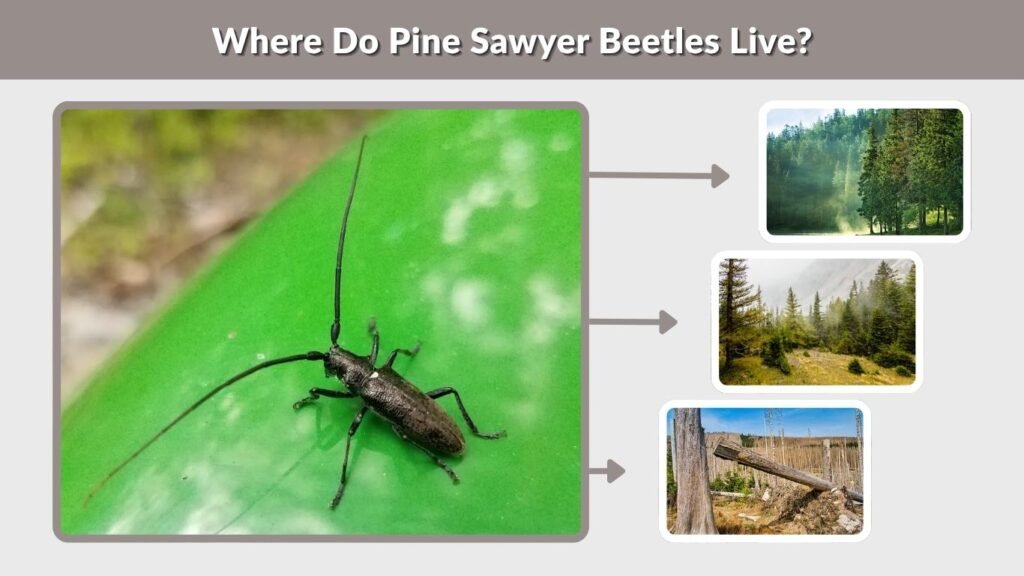
Pine sawyer beetles inhabit forests containing suitable conifer trees. Adults are frequently found on tree trunks, logs, and fallen timber, while larvae spend most of their development concealed inside wood. Their distribution varies according to climate and host-tree availability.
Pine Sawyer Beetle Habitat
Common habitats include:
- Pine forests and woodlands
- Spruce and fir forests
- Recently logged areas
- Fallen trees and stumps
- Fire-damaged forests
- Lumber storage areas
- Piles of freshly cut conifer firewood
Pine sawyers occur in places such as Maine, Massachusetts, Michigan, Wisconsin, Colorado, Oregon, and Washington, although the species present differ geographically.
What Do Pine Sawyer Beetles Eat?
Adult pine sawyer beetles feed on tender bark and foliage of conifer trees.
Their larvae have different feeding habits. They bore beneath the bark of weakened or recently dead trees, consuming inner bark tissues before entering the wood.
Larval tunneling contributes to decomposition but can reduce the commercial value of harvested timber.
Pine Sawyer Beetle Larvae and Life Cycle
Pine sawyer beetles undergo complete metamorphosis, passing through egg, larva, pupa, and adult stages. Their development usually occurs in weakened or recently dead conifers. Depending on the species and climate, completing the life cycle may take approximately one or two years.
Pine Sawyer Beetle Larvae Identification
Pine sawyer larvae are creamy-white, soft-bodied grubs with brownish heads and powerful chewing mouthparts.
Unlike June beetle grubs, they do not have well-developed legs or strongly C-shaped bodies.
Mature larvae may reach several centimeters long. They create tunnels beneath the bark and eventually bore deeper into the sapwood.
Pine Sawyer Beetle Reproduction
Female beetles chew small depressions into the bark of suitable trees and deposit their eggs.
After hatching, larvae begin feeding beneath the bark. As they grow, they construct deeper galleries inside the wood.
Mature larvae eventually pupate inside chambers before emerging as adults through round or oval exit holes.
Pine Sawyer Beetle Damage to Pine Trees

Pine sawyer beetles are generally considered secondary wood-boring insects because most species prefer weakened, dying, or recently dead trees. Their larvae can damage timber by tunneling through valuable wood. Some species also transmit organisms responsible for serious pine diseases.
Signs of Pine Sawyer Beetle Damage
Common signs include:
- Round exit holes: Openings where adult beetles emerge.
- Wood tunnels: Extensive larval galleries beneath bark and inside wood.
- Coarse sawdust: Wood fibers and frass accumulating around infested material.
- Bark damage: Small depressions where females lay eggs.
- Wood deterioration: Reduced strength and commercial quality of timber.
- Declining trees: Beetles may be associated with already stressed or dying conifers.
These symptoms should be examined carefully because several other wood-boring insects produce similar damage.
Do Pine Sawyer Beetles Kill Trees?
Most native pine sawyers primarily colonize trees already weakened or killed by other factors.
However, certain species can transmit the pinewood nematode (Bursaphelenchus xylophilus), which causes pine wilt disease in susceptible trees.
Pine wilt can cause rapid needle discoloration and tree decline. The risk varies considerably among pine species and regions.
Are Pine Sawyer Beetles Harmful to Humans?
Despite their large size and intimidating antennae, pine sawyer beetles are generally harmless to people. They do not sting, and they are not venomous. However, adults have strong mandibles and may bite defensively when restrained.
Do Pine Sawyer Beetles Bite?
Yes, pine sawyer beetles can pinch or bite if handled carelessly.
Their mandibles are designed for chewing plant tissues rather than attacking humans.
A defensive bite may cause temporary pain or minor skin injury but is not normally medically serious.
If bitten, wash the affected area with soap and water. Seek medical advice if significant swelling, worsening pain, or signs of infection develop.
Why Do Pine Sawyer Beetles Make Sounds?
Some pine sawyer beetles produce squeaking or scraping sounds when disturbed.
These sounds result from rubbing specialized body structures together, a behavior called stridulation.
The noise may serve as a defensive response and does not indicate that the beetle is actively attacking.
Why Is a Pine Sawyer Beetle in My House?
Pine sawyer beetles occasionally enter houses accidentally, particularly in wooded areas. Adults may fly through open doors or windows, while developing beetles may emerge from infested firewood brought indoors. Their presence does not normally indicate a structural wood infestation.
Can Pine Sawyer Beetles Damage Your Home?
Pine sawyer beetles generally do not establish infestations in dry structural lumber or household furniture.
They prefer recently dead or weakened conifer wood, which provides suitable conditions for larval development.
If a pine sawyer appears indoors, inspect stored firewood and nearby entry points. Remove the beetle carefully and relocate it outdoors when appropriate.
Pine Sawyer Beetle vs. Asian Longhorned Beetle
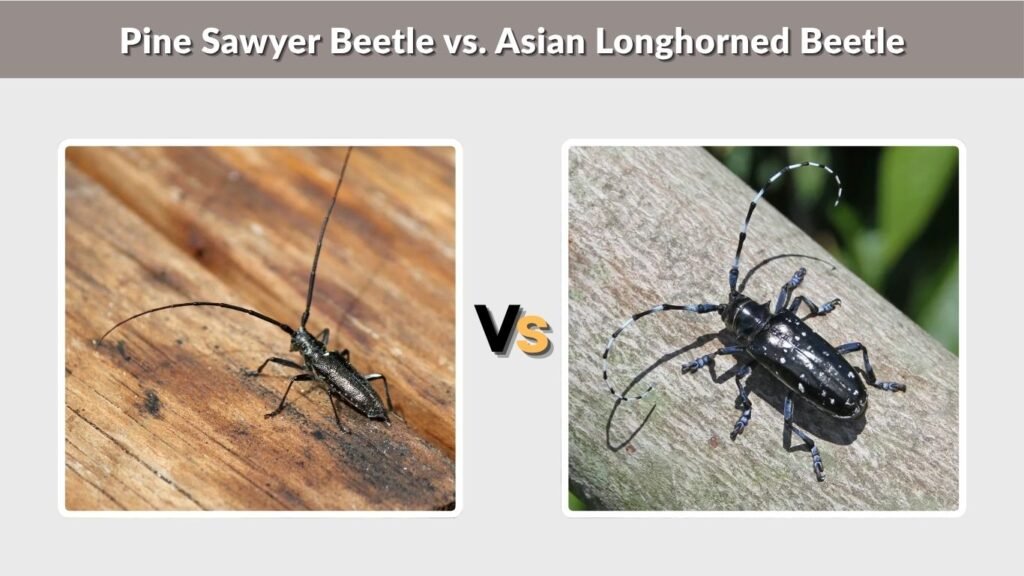
Pine sawyer beetles are frequently confused with the invasive Asian longhorned beetle (Anoplophora glabripennis). Both have long antennae and dark bodies, but important physical and ecological differences can help identify them.
| Feature | Pine Sawyer Beetle | Asian Longhorned Beetle |
| Scientific group | Monochamus spp. | Anoplophora glabripennis |
| Body color | Dark, gray, or mottled | Glossy black |
| White markings | Often faint or irregular | Distinct white spots |
| Antennae | Very long, sometimes subtly banded | Strongly black-and-white banded |
| Host trees | Primarily conifers | Primarily hardwoods |
| Tree condition | Usually weakened or dead | Can infest healthy trees |
| Pest importance | Mainly timber damage and disease transmission | Serious invasive hardwood pest |
How to Tell Them Apart
The whitespotted pine sawyer has a distinctive white patch between its wing covers that is absent from the Asian longhorned beetle.
Asian longhorned beetles generally have more clearly defined white spots on a glossy black body.
Suspected Asian longhorned beetles should be reported to local agricultural or forestry authorities for identification.
How to Get Rid of Pine Sawyer Beetles
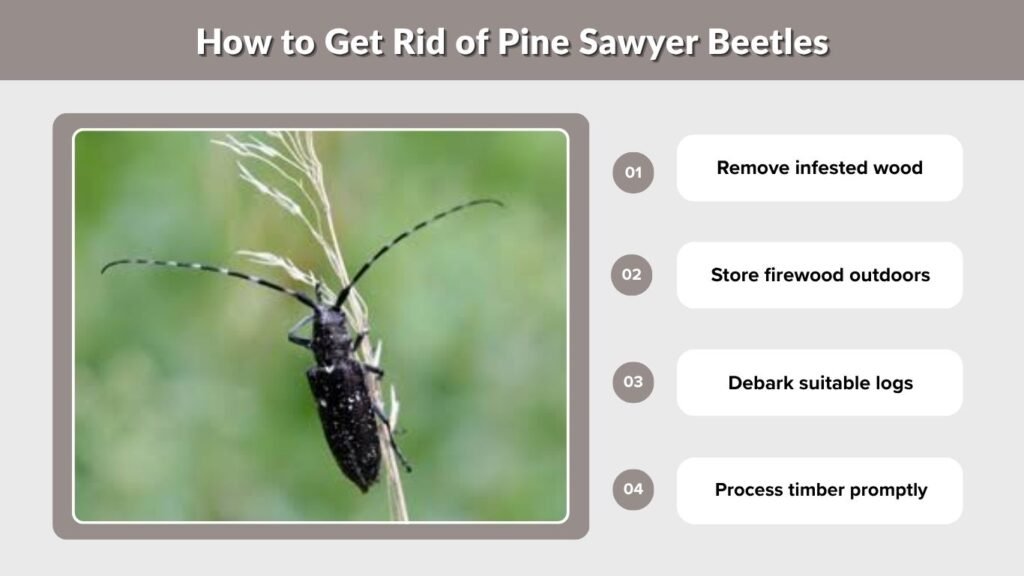
Pine sawyer beetle control focuses on managing infested wood rather than routinely spraying healthy trees. Since most native species prefer dead or weakened conifers, sanitation and proper timber storage are usually the most effective preventive measures.
Effective Pine Sawyer Beetle Control Methods
- Remove infested wood: Dispose of heavily infested logs according to local recommendations.
- Store firewood outdoors: Keep freshly cut wood away from indoor living spaces.
- Debark suitable logs: Removing bark can reduce opportunities for beetle egg laying.
- Process timber promptly: Avoid leaving freshly cut conifers exposed for extended periods.
- Maintain tree health: Reduce drought stress and prevent unnecessary trunk injuries.
- Monitor pine wilt symptoms: Seek professional assessment when pine trees decline unexpectedly.
Insecticide applications are usually unnecessary for native pine sawyers in residential settings.
When Is Professional Treatment Necessary?
Professional assistance may be appropriate when extensive timber damage occurs or when pine wilt disease is suspected.
A forestry specialist can identify the beetle species, evaluate affected trees, and recommend management practices.
Avoid moving potentially infested firewood across regions because doing so can spread wood-boring insects and associated pathogens.
FAQs
1. Are Pine Sawyer Beetles Dangerous?
Pine sawyer beetles are not considered dangerous to humans. They do not sting or produce venom, although they can bite defensively when handled. Their main importance involves wood damage and, in certain species, transmission of pinewood nematodes.
2. Can Pine Sawyer Beetles Fly?
Yes. Adult pine sawyer beetles have functional wings and can fly between trees and forested areas. Their flight may appear slow or awkward because of their large bodies and long antennae. Flying allows them to locate suitable feeding and breeding sites.
3. Are Pine Sawyer Beetles Invasive?
Many pine sawyer species are native to North America and are not considered invasive in their natural ranges. However, species introduced outside their native regions may pose ecological risks, particularly when they carry pinewood nematodes capable of damaging susceptible pine forests.
4. How Long Do Pine Sawyer Beetles Live?
Pine sawyer beetles commonly complete their life cycle in one to two years, depending on species and climate. Most development occurs inside wood during the larval stage. Adult lifespan varies but is generally considerably shorter than the entire developmental period.
5. How Can You Identify Pine Sawyer Beetle Larvae?
Pine sawyer larvae are creamy-white, elongated, and legless, with strong brownish mouthparts. They develop inside weakened or recently dead conifer wood, creating tunnels filled with wood fibers. Species-level identification often requires specialist examination of larvae or adults.