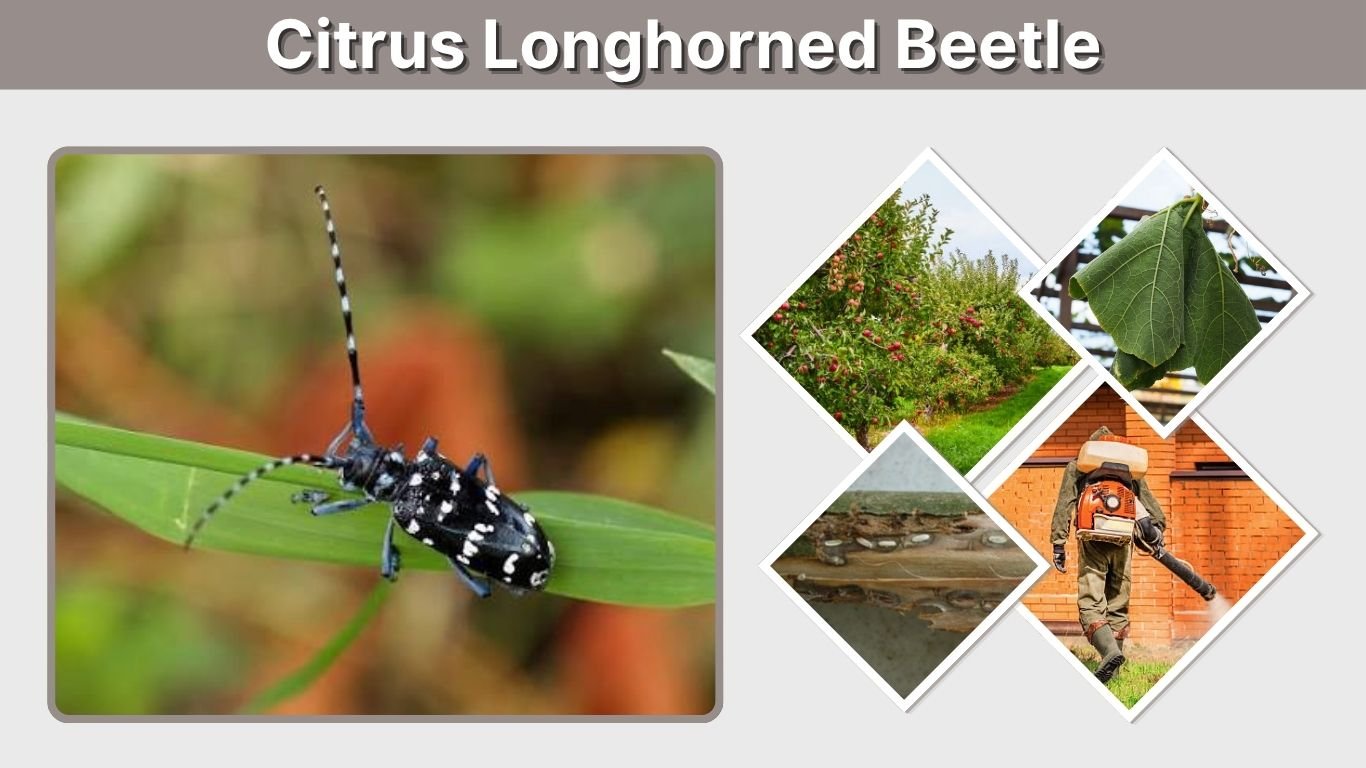
The citrus longhorned beetle (Anoplophora chinensis) is a destructive wood-boring insect that attacks citrus trees, maples, and many other hardwood species. Recognized by its glossy black body, distinctive white spots, and extremely long antennae, this beetle is considered a serious invasive pest in several regions. Its larvae tunnel through tree trunks and roots, weakening healthy trees and sometimes causing their death. Understanding citrus longhorned beetle identification, habitat, life cycle, and control methods is essential for protecting vulnerable trees. This guide also explains how the beetle appears in Animal Crossing: New Horizons.
What Is the Citrus Longhorned Beetle?
The citrus longhorned beetle is a species of longhorn beetle belonging to the family Cerambycidae. It is native to parts of eastern Asia and feeds on a wide range of woody plants. Unlike many wood-boring beetles that attack weakened trees, this species can infest healthy, living trees.
Citrus Longhorned Beetle Scientific Classification
The scientific classification of the citrus longhorned beetle includes:
- Scientific name: Anoplophora chinensis
- Family: Cerambycidae
- Order: Coleoptera
- Class: Insecta
- Common names: Citrus longhorned beetle, citrus longhorn beetle, black-and-white longhorn beetle
- Primary hosts: Citrus, maple, birch, willow, and other woody plants
The beetle is particularly concerning because it can damage ornamental trees, orchards, and urban forests.
Citrus Longhorned Beetle Identification
Adult citrus longhorned beetles have several distinctive features:
- Body length: Approximately 19–37 millimeters.
- Body color: Glossy black with irregular white spots.
- Antennae: Long, black-and-white banded, sometimes nearly twice the body length.
- Legs: Six strong legs, sometimes with a bluish appearance.
- Wings: Hard black wing covers with white markings.
- Body texture: Small raised bumps near the base of the wing covers.
These raised bumps are particularly useful for distinguishing citrus longhorned beetles from similar species.
Citrus Longhorned Beetle Habitat and Distribution
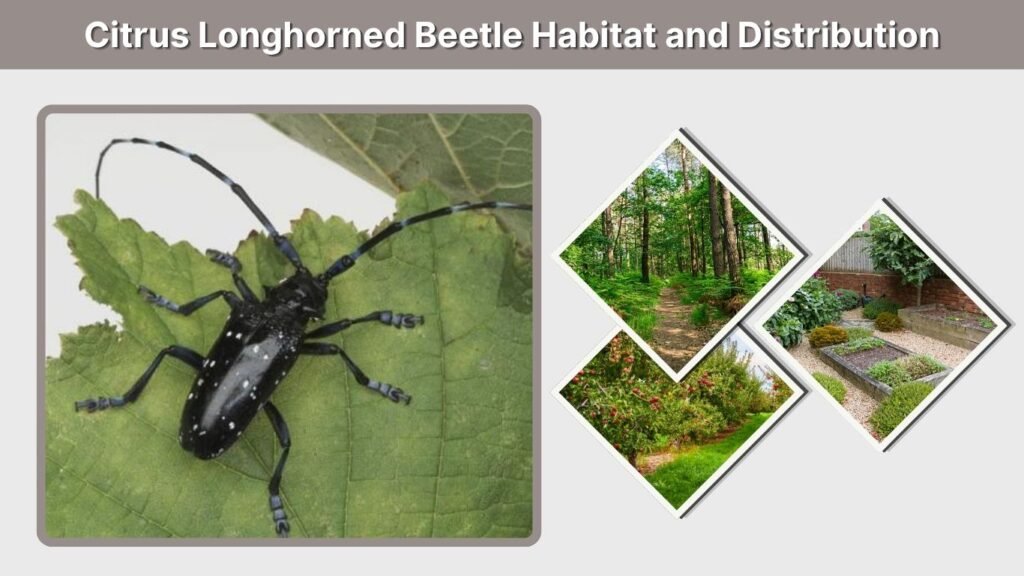
Citrus longhorned beetles naturally inhabit forests, orchards, gardens, and other environments containing suitable host trees. Their larvae spend most of their development inside living wood, while adults move among trees for feeding and reproduction. International trade in ornamental plants has contributed to their introduction outside their native range.
Where Do Citrus Longhorned Beetles Come From?
The citrus longhorned beetle is native to China, Japan, Korea, and other parts of Asia.
It has been introduced into parts of Europe through imported ornamental plants, particularly bonsai and Japanese maple trees.
As of 2026, established or restricted populations have been recorded in certain European countries, including Italy. The beetle is not considered established in the United Kingdom or United States.
What Trees Do Citrus Longhorned Beetles Attack?
Citrus longhorned beetles feed on numerous broadleaf trees and shrubs.
Common host plants include:
- Citrus trees, including oranges and lemons
- Maple trees
- Birch trees
- Willow trees
- Poplar trees
- Apple trees
- Elm trees
- Hazel trees
Although citrus trees are important hosts, the beetle is not restricted to citrus plants. This broad host range makes it a significant threat to forests and urban landscapes.
Citrus Longhorned Beetle Life Cycle
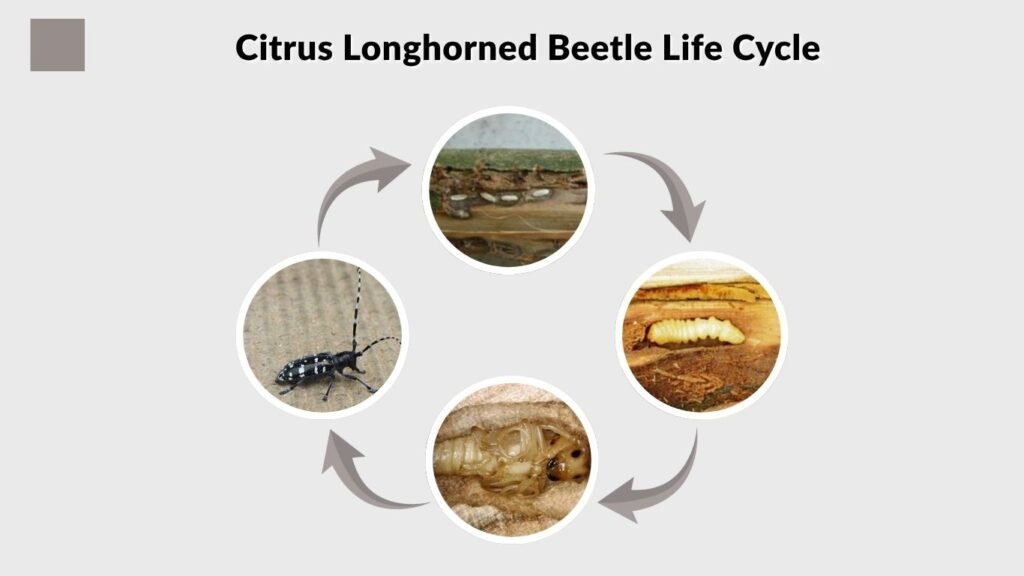
The citrus longhorned beetle undergoes complete metamorphosis, developing through egg, larva, pupa, and adult stages. Its life cycle generally takes one to two years in favorable climates but may last longer in cooler regions. Most of its development occurs inside tree roots and lower trunks.
Egg and Larval Stages
Female beetles chew small openings into tree bark, usually close to the base of the trunk or on exposed roots.
They deposit individual eggs beneath the bark. Under favorable conditions, eggs hatch within approximately one to three weeks.
The newly hatched larvae begin feeding beneath the bark before tunneling deeper into the wood.
Citrus Longhorned Beetle Larvae
Citrus longhorned beetle larvae are creamy-white, elongated grubs with brownish heads.
Unlike scarab beetle grubs, they do not have well-developed legs and are not typically C-shaped.
Mature larvae can reach approximately 50–56 millimeters long. They feed inside the lower trunk and roots, gradually creating extensive tunnels.
Pupal and Adult Stages
After completing development, mature larvae construct chambers inside the wood and transform into pupae.
The pupal stage generally lasts several weeks. Adults then emerge through circular holes in the bark.
Adult emergence usually occurs during warmer months, although seasonal activity varies by location and climate.
What Damage Do Citrus Longhorned Beetles Cause?
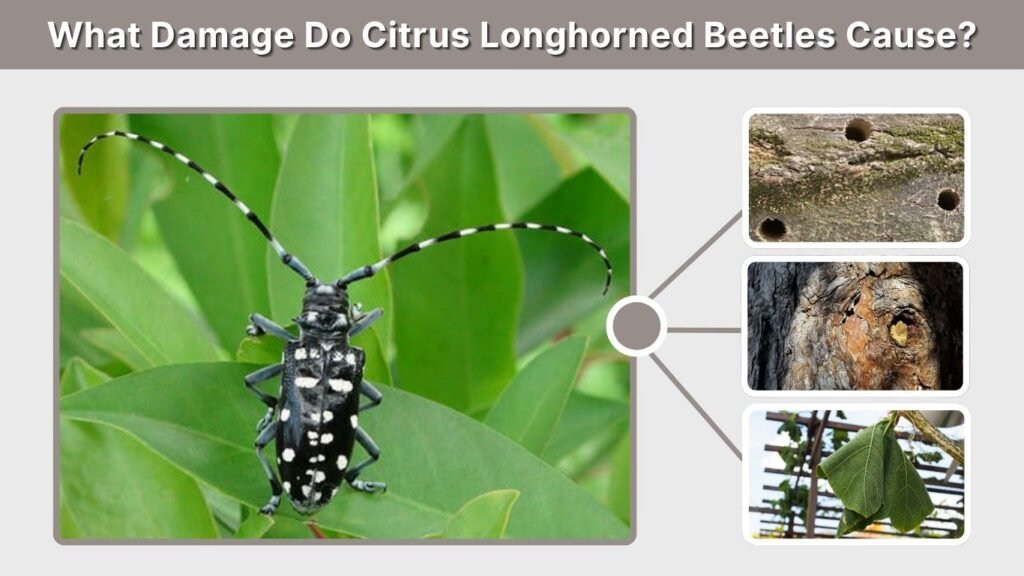
Citrus longhorned beetle damage primarily results from larval feeding inside living trees. The larvae create tunnels that disrupt water and nutrient transport and weaken the tree’s structural integrity. Severe infestations can cause branch decline, root damage, and eventual tree death.
Common Signs of Citrus Longhorned Beetle Damage
Important warning signs include:
- Circular exit holes: Round openings approximately 6–11 millimeters wide.
- Sawdust-like material: Frass accumulates around the trunk base and exposed roots.
- Bark damage: Small cuts or scars appear where females deposit eggs.
- Sap leakage: Sap may emerge from damaged bark.
- Wilting leaves: Affected trees may show declining foliage.
- Weak roots: Extensive tunneling reduces structural stability.
- Tree decline: Severe infestations can eventually kill affected trees.
Exit holes near the base of the trunk are particularly characteristic of citrus longhorned beetle activity.
Why Is This Beetle So Destructive?
Citrus longhorned beetle larvae can remain concealed inside healthy trees for extended periods.
As they feed, their tunnels damage important internal tissues and reduce the tree’s ability to transport water and nutrients.
The resulting structural weakness may also make trees more vulnerable to wind damage and additional infections.
Citrus Longhorned Beetle vs. Asian Longhorned Beetle
The citrus longhorned beetle and Asian longhorned beetle look remarkably similar. Both have shiny black bodies, white markings, and long banded antennae. However, their preferred egg-laying locations and typical larval feeding sites differ.
| Feature | Citrus Longhorned Beetle | Asian Longhorned Beetle |
| Scientific name | Anoplophora chinensis | Anoplophora glabripennis |
| Body color | Black with white spots | Black with white spots |
| Antennae | Long and banded | Long and banded |
| Wing-cover base | Noticeable small bumps | Relatively smooth |
| Larval feeding | Roots and lower trunk | Trunk and branches |
| Typical exit holes | Near trunk base and roots | Often higher on trunk and branches |
How to Identify the Differences
One distinguishing feature is the texture near the base of the wing covers.
Citrus longhorned beetles have small raised bumps in this area, while Asian longhorned beetles generally have smoother wing covers.
However, these beetles can be difficult to separate visually, so suspected invasive specimens should be examined by qualified specialists.
Citrus Longhorned Beetle vs. Alder Borer Beetle
The banded alder borer (Rosalia funebris) also has black-and-white markings and long antennae.
However, its body displays broad pale bands rather than scattered white spots.
The banded alder borer primarily develops in dead or dying wood, making its ecological role different from that of citrus longhorned beetles.
How to Control Citrus Longhorned Beetles

Citrus longhorned beetle control focuses on preventing introductions, detecting infestations early, and stopping the spread of infested plant materials. Because larvae develop deep inside living wood, ordinary household insecticide sprays are not reliable treatments. Official pest management programs are particularly important in regions where the species is regulated.
Effective Citrus Longhorned Beetle Control Methods
Recommended management practices include:
- Inspect vulnerable trees: Examine trunks, roots, and nearby soil for exit holes and frass.
- Report suspicious beetles: Notify local plant health or agricultural authorities.
- Avoid moving infested plants: Do not transport potentially infected nursery stock or woody materials.
- Follow official removal guidance: Confirmed infestations may require removal and destruction of affected trees.
- Monitor surrounding trees: Inspect nearby host plants for additional activity.
- Use approved professional treatments: Chemical or biological control should follow local regulations and expert guidance.
In areas where this species is a quarantine pest, contact authorities before pruning, removing, or transporting potentially infested material.
How to Prevent Citrus Longhorned Beetle Infestations
Preventive measures are especially important for nurseries, orchards, and landscaping businesses.
Purchase plants from reputable suppliers, inspect imported trees carefully, and follow plant import regulations.
Avoid transporting woody planting material from known infestation areas. Early reporting helps prevent the beetle from establishing in new environments.
Citrus Longhorned Beetle in Animal Crossing: New Horizons
The citrus longhorned beetle also appears in Animal Crossing: New Horizons (ACNH), where players can catch it as part of the game’s insect collection. Unlike the real-world invasive pest, the game version is simply a collectible bug found on tree stumps.
How to Catch Citrus Longhorned Beetles in ACNH
Players can catch this beetle by approaching tree stumps while carrying a bug-catching net.
The beetle appears throughout the year in both hemispheres and can be caught at any time of day.
To increase catching opportunities, leave several tree stumps on your island. Approach slowly to avoid startling the beetle before using your net.
Citrus Longhorned Beetle ACNH Price
The citrus longhorned beetle has the following selling values in Animal Crossing: New Horizons:
| Selling Location | Price |
| Nook’s Cranny | 350 Bells |
| Flick | 525 Bells |
| Drop-off Box | 280 Bells |
The beetle is available year-round and generally appears on tree stumps when it is not raining.
FAQs
1. Are Citrus Longhorned Beetles Dangerous to Humans?
Citrus longhorned beetles are not venomous and do not normally attack humans. However, adults have strong mandibles and may deliver a painful pinch if handled carelessly. Their main threat involves damage to living trees rather than human health.
2. Is the Citrus Longhorned Beetle an Invasive Species?
Yes. The citrus longhorned beetle is considered an invasive pest outside its native Asian range. It has caused concern in parts of Europe because its larvae can damage healthy trees. Several countries regulate the movement of susceptible plants to prevent introductions.
3. What Do Citrus Longhorned Beetles Eat?
Adult citrus longhorned beetles feed on young bark, twigs, and foliage of suitable host trees. Their larvae feed internally on living wood, especially in roots and lower trunks. This underground feeding behavior causes most of the serious damage.
4. What Are the Natural Predators of Citrus Longhorned Beetles?
Natural enemies include certain parasitoid wasps, insect-pathogenic fungi, and nematodes. Some birds and other insect-eating animals may also consume exposed beetles. However, natural predators alone may not provide reliable control of established populations, particularly where the species is invasive.
5. How Much Is the Citrus Longhorned Beetle Worth in Animal Crossing?
In Animal Crossing: New Horizons, the citrus longhorned beetle sells for 350 Bells at Nook’s Cranny or 525 Bells when sold to Flick. Players can catch it on tree stumps throughout the year, making it a relatively accessible collectible insect.