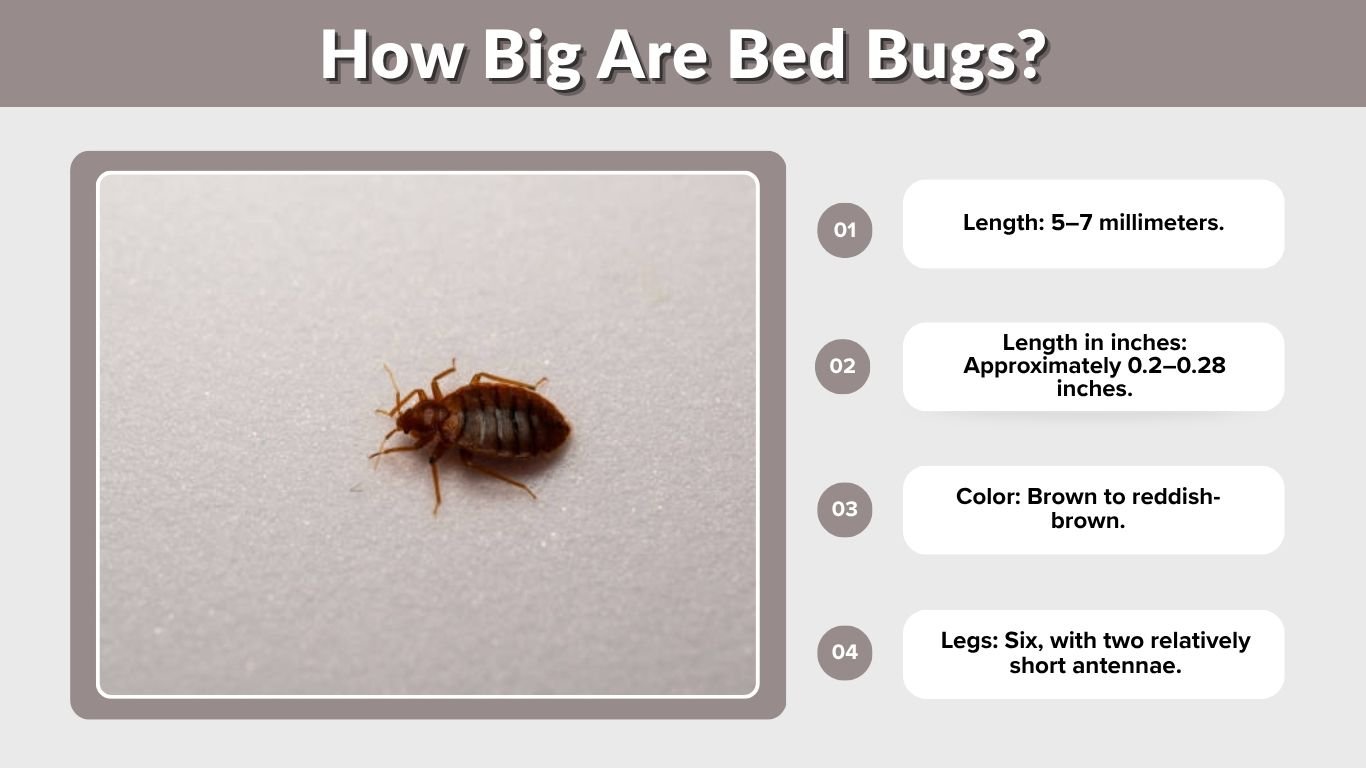
How big are bed bugs? Adult bed bugs typically measure 5–7 millimeters long, approximately the size of an apple seed. However, baby bed bugs are much smaller, starting at just 1.5 millimeters, while their eggs measure around 1 millimeter. Although these insects are visible to the human eye, their flattened bodies and hiding habits make them difficult to detect. Their appearance also changes after feeding. This guide explains actual bed bug sizes, growth stages, eggs, bites, stains, and how to identify them around your home.
How Big Are Adult Bed Bugs?
Adult bed bugs are relatively small insects with flat, oval-shaped bodies. Their average length ranges from 5 to 7 millimeters, making them comparable to an apple seed. Despite their small size, adults are generally visible without magnification. However, their body shape and appearance can change considerably depending on whether they have recently consumed a blood meal.
Adult Bed Bug Size in Inches and Millimeters
Adult bed bugs generally measure:
- Length: 5–7 millimeters.
- Length in inches: Approximately 0.2–0.28 inches.
- Common comparison: Similar to a small apple seed.
- Body shape: Broadly oval and flattened before feeding.
- Color: Brown to reddish-brown.
- Legs: Six, with two relatively short antennae.
Adult females may be somewhat larger and broader than males, although individual sizes overlap.
Their flattened bodies allow them to squeeze into narrow openings along mattresses, furniture, and bed frames.
How Big Are Bed Bugs After Feeding?
A recently fed bed bug looks noticeably different from an unfed insect.
After consuming blood, its abdomen expands, becoming fuller, longer, and more rounded. The body may also appear darker red.
Although the insect becomes larger after feeding, the exact increase depends on its age and the amount of blood consumed.
Consequently, photographs of fed and unfed bed bugs may appear to show different insects.
How Big Are Baby Bed Bugs?
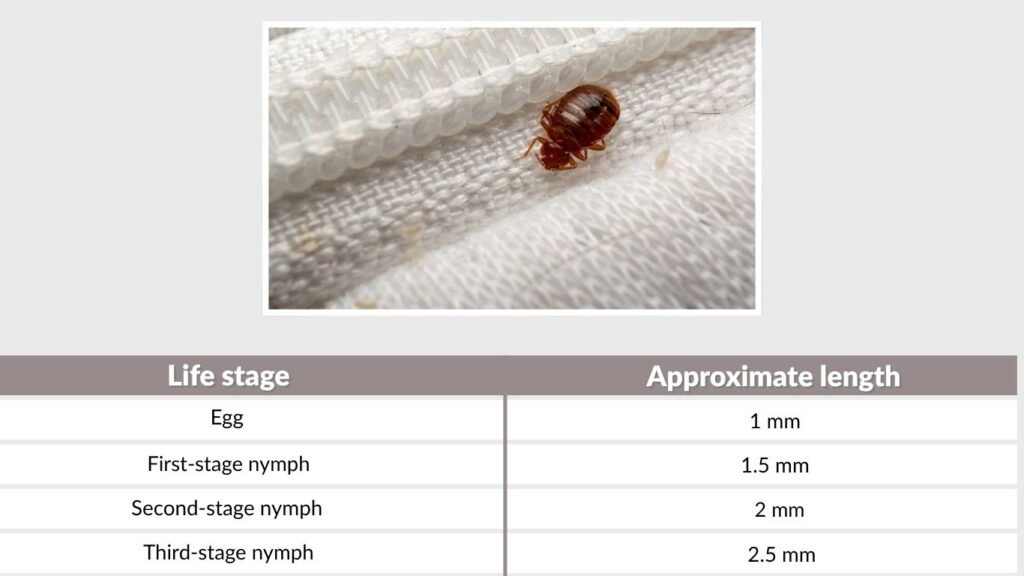
Baby bed bugs are called nymphs. They resemble miniature adult bed bugs but are much smaller and generally lighter in color. Newly hatched nymphs appear pale yellow or nearly transparent before feeding. They must obtain blood meals to progress through five developmental stages, gradually increasing in size until they become reproductive adults.
Bed Bug Size Chart by Life Stage
| Life stage | Approximate length |
| Egg | 1 mm |
| First-stage nymph | 1.5 mm |
| Second-stage nymph | 2 mm |
| Third-stage nymph | 2.5 mm |
| Fourth-stage nymph | 3 mm |
| Fifth-stage nymph | 4.5 mm |
| Adult bed bug | 5–7 mm |
These measurements represent typical reference sizes. Recently fed insects may appear larger than unfed individuals.
Can You See Baby Bed Bugs With the Human Eye?
Yes, baby bed bugs are visible without a microscope, although newly hatched nymphs can be extremely difficult to notice.
Their pale, translucent bodies blend into light-colored mattresses and bedding.
After feeding, the blood visible through their abdomen makes them appear reddish and easier to recognize.
A flashlight and magnifying glass are particularly useful when examining early-stage nymphs.
How Big Are Bed Bug Eggs and Casings?
Bed bug eggs are considerably smaller than adult insects and are easily overlooked during routine cleaning. Their pale coloration allows them to blend into mattress seams and other protected surfaces. Shed skins, sometimes called casings, are also important identification clues. Their sizes depend on the developmental stage of the nymph that produced them.
Bed Bug Egg Size and Appearance
Bed bug eggs measure approximately 1 millimeter in length.
They are oval, pearly white, and sometimes compared to tiny grains of rice, although actual rice grains are substantially larger.
Females commonly attach their eggs to protected surfaces, including furniture joints, mattress seams, and narrow cracks.
Because eggs are so small, they may be difficult to recognize without magnification.
How Big Are Bed Bug Shells?
Bed bugs shed their external skeletons as they grow through five nymphal stages.
These discarded skins resemble pale, empty versions of the insects.
Their sizes generally reflect the nymph stages that produced them, ranging from approximately 1.5 millimeters to several millimeters.
Finding multiple shed skins near a bed may indicate developing bed bug activity.
How Big Are Bed Bug Bites on Humans?

Bed bug bite reactions differ significantly among individuals. Some people develop small, itchy bumps, while others experience larger welts or no visible marks. The size of a skin reaction does not reliably indicate the size of the bed bug responsible. Furthermore, several other insects and skin conditions can produce similar-looking marks.
Typical Bed Bug Bite Appearance
Bed bug bite reactions may include:
- Small bumps: Raised or slightly swollen areas.
- Redness: Pink, red, or darker discoloration depending on skin tone.
- Itching: Mild to intense irritation.
- Clusters: Several marks appearing close together.
- Lines: Occasionally, bites develop in a linear arrangement.
- Larger welts: Some people experience more pronounced inflammatory reactions.
There is no fixed diameter that identifies a bed bug bite.
Are Baby Bed Bug Bites Smaller?
Not necessarily. Young bed bugs use similar feeding mechanisms to adults.
The resulting skin reaction depends primarily on the person’s immune response rather than the insect’s physical size.
A small nymph may produce a noticeable reaction, while an adult bed bug may leave no visible mark.
Bite appearance alone cannot confirm an infestation.
How Big Are Bed Bug Stains and Droppings?
Bed bug stains are among the most frequently noticed signs of infestation. They may appear as tiny black dots, reddish spots, or irregular marks on mattresses and bedding. However, unlike the insects themselves, stains have no consistent size. Their appearance depends on the material, the amount deposited, and whether the mark has spread.
Bed Bug Droppings Size
Bed bug droppings often appear as tiny dark spots resembling ink marks.
On absorbent materials, liquid waste may soak into fibers and spread beyond the original deposit.
Look for clusters of dark spots around mattress seams, bed frames, and protected hiding locations.
Individual spots can be difficult to distinguish from ordinary dirt without additional evidence.
How Big Are Bed Bug Blood Stains?
Blood stains can range from tiny reddish dots to larger smears on sheets or pillowcases.
They may occur when a recently fed bed bug is accidentally crushed.
However, blood stains are not unique to bed bugs. Scratches, other insects, and unrelated causes may leave similar marks.
Live insects, shed skins, and characteristic fecal spotting provide stronger supporting evidence.
How Big Are Bed Bugs Compared to Fleas and Ticks?
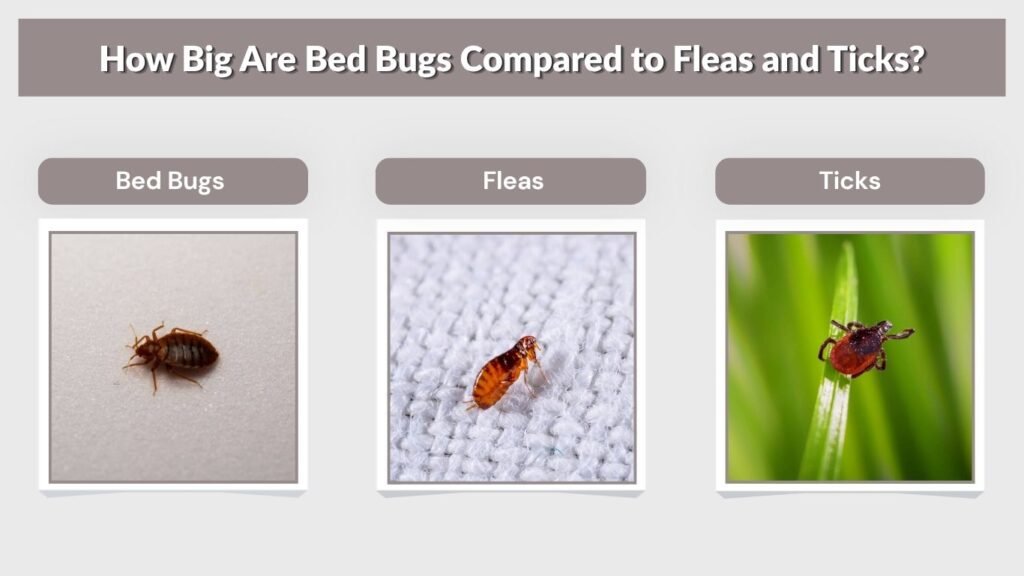
Bed bugs are sometimes confused with fleas and ticks because all three are small, blood-feeding arthropods. However, their body structures and movement patterns differ. Comparing their sizes is helpful, but identification should also consider leg count, shape, antennae, and feeding behavior. A recently fed specimen may look very different from an unfed individual.
Bed Bugs vs. Fleas: Size Comparison
Adult fleas are often smaller than adult bed bugs, although their size ranges can overlap with bed bug nymphs.
Fleas have narrow bodies flattened from side to side and enlarged hind legs adapted for jumping.
Bed bugs have broader, flattened bodies and crawl rather than jump.
Bed Bugs vs. Ticks: Size Comparison
Tick size varies greatly by species, developmental stage, and feeding condition.
Unlike bed bugs, which are insects with six legs, tick nymphs and adults have eight legs.
Tick larvae have six legs but lack insect antennae.
Ticks may remain attached while feeding, whereas bed bugs generally feed briefly and return to nearby hiding places.
How to Find Bed Bugs at Their Actual Size
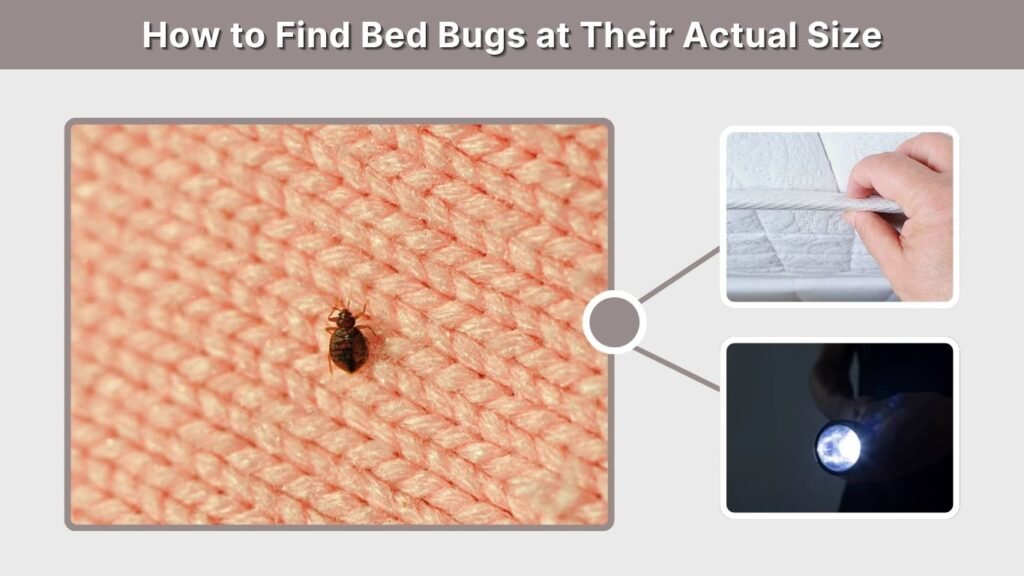
Because bed bugs are small and skilled at hiding, identifying them requires more than casually examining the mattress surface. Both adults and nymphs can occupy narrow seams, cracks, and furniture joints. Early infestations may contain relatively few insects, so systematic inspection improves the chances of finding reliable physical evidence.
Where to Look for Bed Bugs
Follow these inspection steps:
- Check mattress seams: Examine piping, stitching, labels, and fabric folds.
- Inspect the box spring: Look along edges, staples, and wooden supports.
- Examine the bed frame: Inspect joints, screw holes, and headboard cracks.
- Look for tiny stains: Identify dark fecal spots and reddish smears.
- Search for eggs: Look for small pearly-white objects attached to protected surfaces.
- Use a flashlight: Illuminate narrow spaces where insects may hide.
- Collect suspicious insects: Preserve specimens for identification.
A magnifying glass can help reveal small nymphs and eggs.
What Should You Do If You Find Bed Bugs?
If you discover a suspected bed bug, collect a specimen and confirm its identification before starting treatment.
Inspect nearby sleeping areas and avoid moving potentially infested belongings between rooms.
For confirmed infestations, consider contacting a qualified pest control professional. Bed bugs can be difficult to eliminate because eggs and insects may remain hidden.
FAQs
These common questions address bed bug visibility, size changes, and other concerns homeowners frequently encounter during inspections.
1. Are bed bugs big enough to see without a microscope?
Yes. Adult bed bugs are easily visible when exposed, measuring approximately 5–7 millimeters. Newly hatched nymphs are smaller and harder to notice.
2. How big are bed bugs when they first hatch?
Newly hatched bed bugs are approximately 1.5 millimeters long. Their pale coloring makes them difficult to detect on light-colored surfaces.
3. Are bed bugs the size of an apple seed?
Adult bed bugs are commonly compared to apple seeds because both have a similar length and oval shape. Baby bed bugs are much smaller.
4. Do bed bugs get bigger after biting?
Yes. Bed bugs expand after consuming blood, becoming longer and more swollen. Their abdomen gradually returns toward a flatter appearance as the blood meal is digested.
5. Can bed bugs be smaller than a pinhead?
Bed bug eggs are approximately 1 millimeter long, while newly hatched nymphs measure around 1.5 millimeters. Both can appear extremely small, depending on the comparison object.