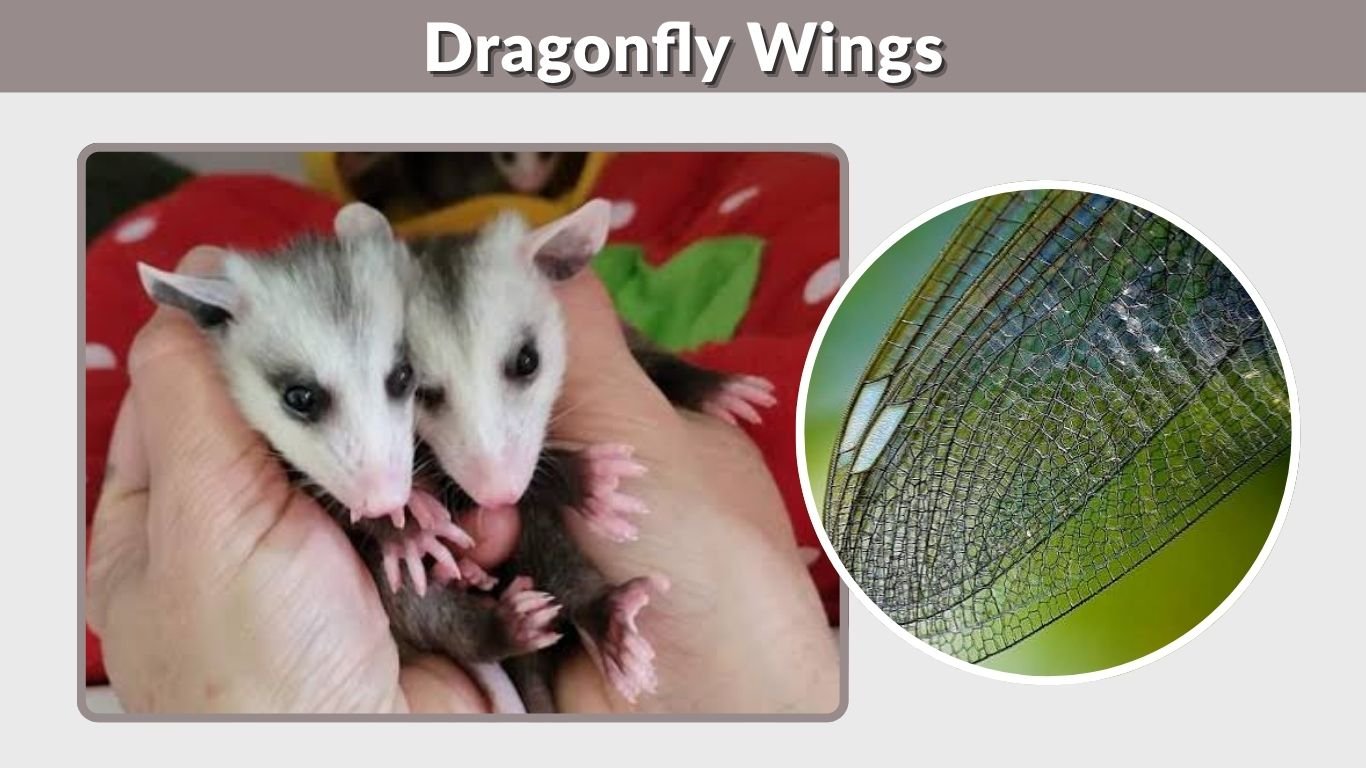
Dragonfly wings are remarkable structures that combine strength, flexibility, and extremely low weight. Every adult dragonfly has four wings arranged as a forewing and hindwing on each side of the thorax. Their transparent membranes are reinforced by an intricate network of veins that creates the familiar stained-glass appearance seen in close-up photographs. Dragonflies use these wings for hovering, sharp turns, acceleration, gliding, and even backward movement. Wing shape, color, venation, and markings also provide useful clues for identifying different dragonfly species.
What Do Dragonfly Wings Look Like?
A dragonfly has two pairs of large membranous wings attached to its thorax. Unlike many insects, the wings cannot be folded neatly over the abdomen. They are normally held outward when the insect rests. Their complex network of veins strengthens the thin membrane while allowing enough flexibility to deform under aerodynamic forces during flight.
Dragonfly Wing Identification
Important features include:
- Four wings in total
- Two forewings and two hindwings
- Transparent or partly colored membranes
- Dense networks of longitudinal and cross veins
- A darker pterostigma near the outer leading edge
- A distinct nodus around the middle of the leading edge
- Hindwings usually broader near the base than forewings
- Numerous polygon-shaped cells formed by intersecting veins
The precise arrangement of veins differs among groups and can help specialists identify species.
Are Dragonfly Wings Symmetrical?
The wings appear highly symmetrical when viewed from above, with the left and right forewings corresponding closely and the two hindwings doing the same.
However, the forewings and hindwings are not identical in shape. Hindwings are generally broader at their bases, while forewings are often narrower. This difference contributes to their aerodynamic performance.
How Do Dragonfly Wings Work?
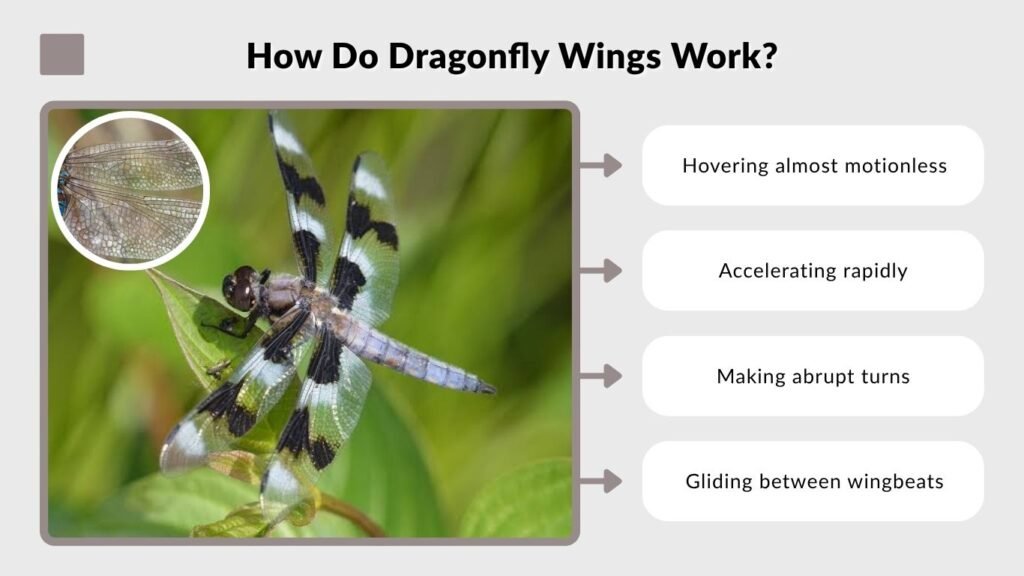
Dragonflies are among the most maneuverable flying insects. Their four-wing arrangement allows the front and rear pairs to interact in different ways depending on whether the insect is cruising, accelerating, turning, or hovering. Research on dragonfly flight shows that they change wing timing, angle of attack, and airflow patterns to generate the forces needed for remarkably agile movement.
What Can Dragonflies Do With Their Wings?
Their flight abilities include:
- Hovering almost motionless
- Accelerating rapidly
- Making abrupt turns
- Gliding between wingbeats
- Moving sideways
- Changing altitude quickly
- Flying backward for short distances
- Pursuing and intercepting airborne prey
Dragonflies can coordinate the front and rear wings differently during different maneuvers rather than relying on one fixed wingbeat pattern. During some forms of flight, forewings and hindwings beat out of phase; during acceleration they may shift toward more synchronized movements.
How Fast Do Dragonfly Wings Beat?
There is no single wingbeat speed for every dragonfly. Frequency changes with species, body size, temperature, and flight behavior.
Studies of dragonfly flight have reported wingbeat frequencies around a few dozen beats per second. One commonly cited physiological estimate is approximately 29 Hz, meaning about 29 wingbeat cycles per second, but this should not be treated as a universal value for all species.
What Are Dragonfly Wings Made Of?
Dragonfly wings may look like fragile sheets of glass, but they are sophisticated biological composite structures. Their membranes and veins are formed from insect cuticle, with chitin and proteins providing strength and flexibility. The veins are not simply decorative lines; their arrangement creates a lightweight structural framework capable of handling repeated loads throughout thousands of wingbeats.
Wing Membrane and Veins
The thin wing membrane is supported by longitudinal veins and smaller cross veins. Research shows that dragonfly wing veins contain layered chitin-protein structures, while flexible materials such as resilin occur in important regions and joints.
Resilin behaves somewhat like an elastic protein, helping portions of the wing flex rather than remain completely rigid. This combination gives dragonfly wings both stiffness and controlled deformation during flight.
The Nodus and Pterostigma
The nodus is a noticeable joint-like structure along the leading edge of the wing. It contributes to the mechanical behavior of the wing as it bends and twists.
The pterostigma is a thickened, often dark or colored patch close to the wingtip. Research suggests that its added mass may contribute to wing stability and influence the aerodynamic behavior of the wing during flight.
Dragonfly Wing Colors and Iridescence
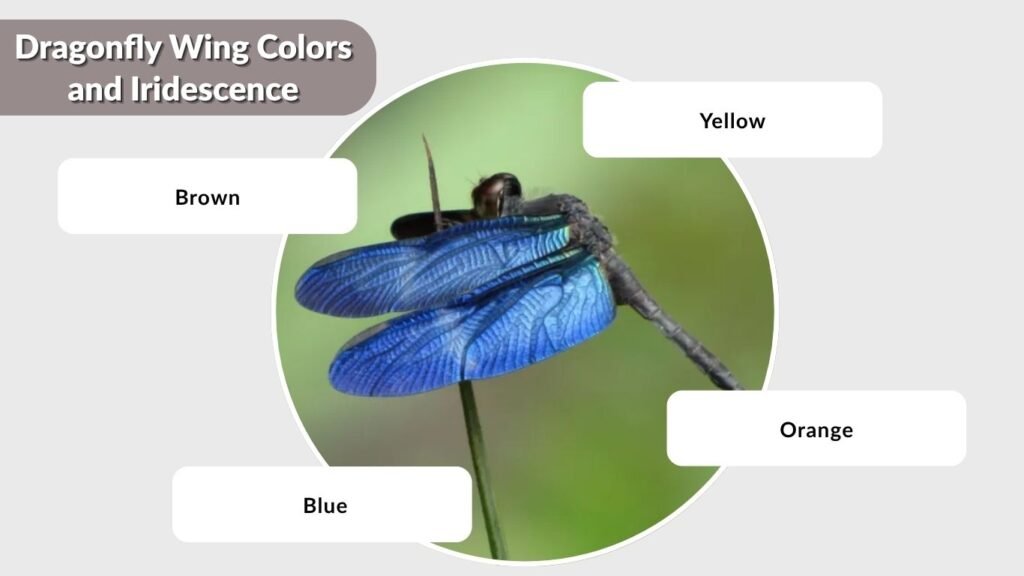
Although many dragonfly wings are mostly transparent, they are not always completely colorless. Different species may have yellow, orange, amber, brown, black, blue, or reddish patches. Some wings also appear iridescent because microscopic structures interact with light. Wing color can differ between males and females and may change as an adult matures.
Why Do Some Wings Look Iridescent?
Iridescent wings can appear to change color when viewed from different angles because the effect may be produced partly by microscopic structures rather than ordinary pigments alone.
The appearance also depends strongly on lighting. A clear wing photographed against blue sky can look blue, while the same wing against vegetation may appear greenish or nearly transparent.
Dragonfly Wings Under a Microscope
Magnification reveals that the apparently smooth membrane is much more complex. Veins divide the wing into hundreds or thousands of small cells, while the surface itself contains microscopic and nanoscale structures.
Studies have found nanoscale protrusions on the wings of some dragonfly species. These surface structures have even attracted scientific interest because experiments found that certain dragonfly wing surfaces can physically damage bacterial cells.
Broken Dragonfly Wings: Can They Heal?
Dragonfly wings experience collisions, attacks by predators, vegetation strikes, and normal wear during adult life. Small tears do not necessarily prevent a dragonfly from flying because the vein network helps limit the spread of damage. Research into wing structure indicates that the arrangement of veins and membrane contributes to resistance against crack propagation and repeated mechanical stress.
Can Dragonfly Wings Grow Back?
No. A damaged adult dragonfly cannot grow a completely new wing.
Dragonflies develop their functional wings during the final molt from aquatic nymph to winged adult. The newly emerged adult expands the wings, which then harden. Adult dragonflies do not continue molting, so lost portions of mature wings cannot simply regenerate through another molt.
What Happens When a Wing Is Damaged?
Depending on severity:
- Tiny tears may have little noticeable effect.
- Worn wing edges may still permit normal flight.
- Larger tears can reduce flight efficiency.
- Damage to important veins may be more serious.
- A badly broken wing may prevent effective hunting.
- Severe asymmetric damage can make controlled flight difficult.
If you encounter a dragonfly with minor natural wing damage, handling it is usually unnecessary.
Can You Touch Dragonfly Wings?
It is better not to handle a dragonfly by its wings. The membranes and veins are lightweight structures and can be damaged by squeezing, bending, or rough handling.
If handling becomes unavoidable for rescue purposes, minimizing contact with the wings is preferable.
Dragonfly Wings vs Damselfly Wings
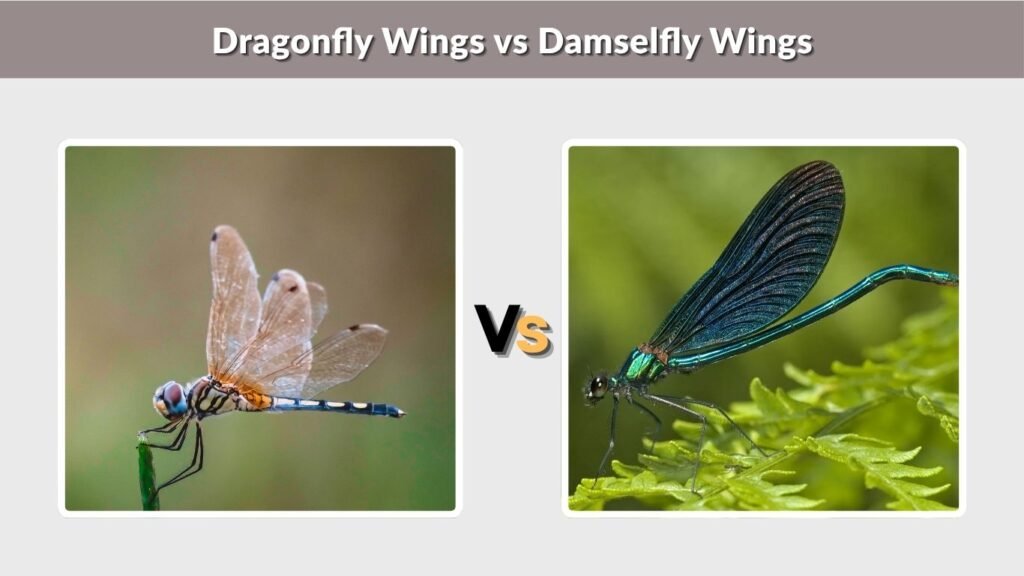
Dragonflies and damselflies both belong to the order Odonata and each has four wings, but their wing shape and resting posture provide useful identification clues. Dragonflies generally have broader hindwings and rest with their wings extended, while most damselflies have wings that are more similar in shape and usually bring them together above or along the abdomen while resting.
Key Wing Differences
Dragonfly wings:
- Four strong membranous wings
- Hindwings broader near the base
- Usually held outward when resting
- Built for powerful, agile flight
- Generally associated with a robust body
Damselfly wings:
- Also four wings
- Forewings and hindwings more similar in shape
- Usually held together or backward at rest
- Often narrower toward the base
- Associated with a more slender body
There are exceptions to resting posture, so several characteristics should be considered instead of relying on one feature alone.
Why Dragonfly Wings Inspire Science and Design
The unusual combination of lightness, flexibility, strength, and aerodynamic performance has made dragonfly wings an important subject in biomimetic research. Engineers study their veins, corrugated surfaces, flexible joints, and four-wing flight system when developing ideas for small aircraft, flexible materials, and engineered surfaces. Dragonfly wing research therefore extends well beyond entomology into engineering and materials science.
Wings and Micro-Aircraft
Researchers have investigated dragonfly-inspired wing designs for small flying robots and micro-air vehicles. The natural wing’s vein arrangement, ability to deform, and aerodynamic behavior provide useful models for building lightweight structures that must remain stable while repeatedly flapping.
Antibacterial Wing Surfaces
Dragonfly wings have also inspired antimicrobial material research.
Experiments on species such as Diplacodes bipunctata found nanoscale surface structures capable of damaging microbes through physical interactions. Scientists have investigated artificial nanopillar surfaces modeled partly on these structures for possible biomedical and industrial applications.
FAQs
Dragonfly wings may appear simple from a distance, but their four-wing arrangement and microscopic structure make them among the most specialized flight organs in insects. Questions often focus on how many wings they have, whether damage can heal, why they remain open at rest, and what creates their transparent or colorful appearance.
1. How many wings does a dragonfly have?
A dragonfly has four wings: two forewings and two hindwings. The hindwings are generally broader near the base than the forewings.
2. Can dragonfly wings grow back?
No. Once a dragonfly has completed its final molt and become an adult, damaged or missing wing tissue cannot be replaced through another molt.
3. Why don’t dragonflies fold their wings?
Adult dragonflies have a wing arrangement that does not allow them to fold their wings neatly over the abdomen like many other insects. They normally rest with the wings extended outward.
4. Are dragonfly wings made of chitin?
Yes. Their cuticular structures contain chitin combined with proteins. Wing veins have a complex layered construction, and flexible proteins such as resilin occur in certain regions.
5. Are dragonfly and damselfly wings the same?
No. Both insects have four wings, but dragonfly hindwings are generally broader at the base and are typically held outward at rest. Most damselflies have similarly shaped pairs that are held together or swept backward when resting.