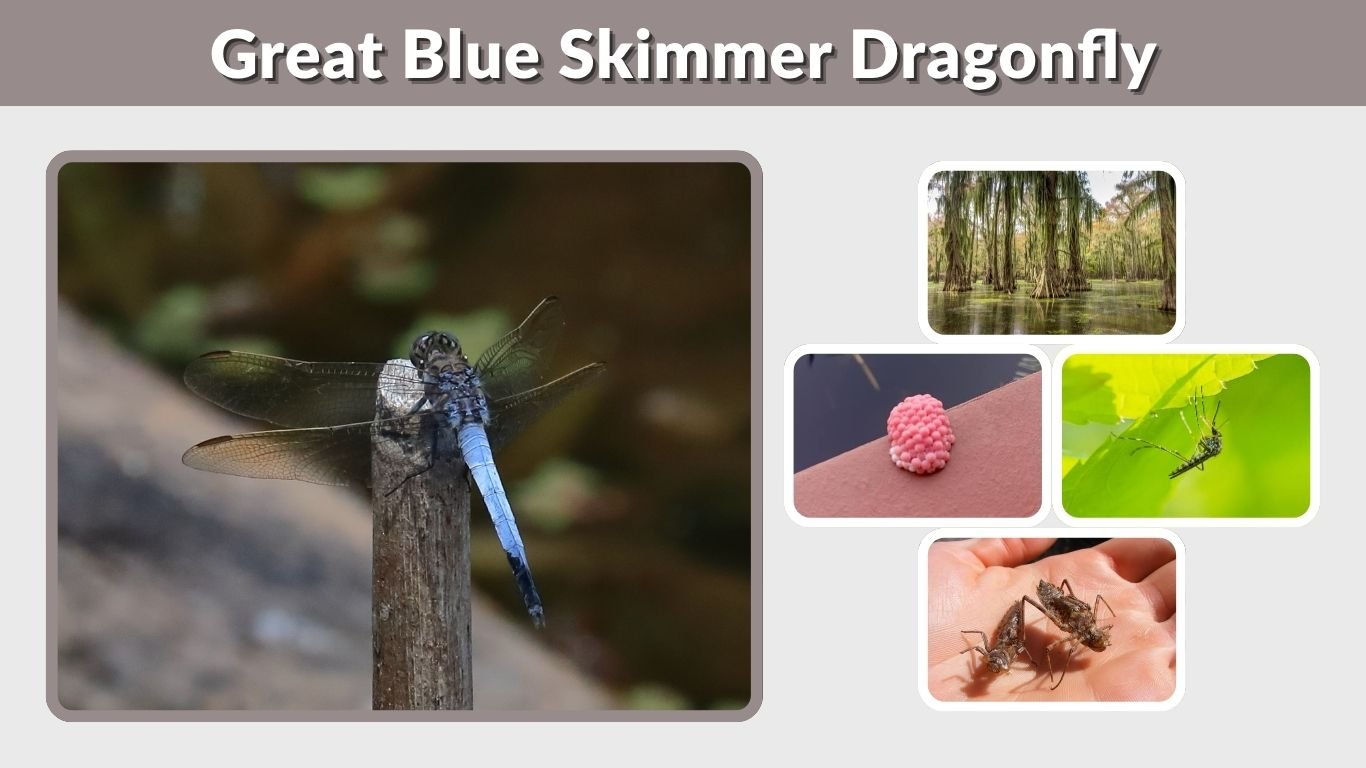
The Great Blue Skimmer dragonfly (Libellula vibrans) is one of the largest and most striking skimmers found in eastern North America. Mature males develop a powdery blue body and bright blue eyes, while females are generally brown with darker markings. This species favors wooded ponds, swamps, and slow-moving streams, where adults hunt flying insects and aquatic nymphs develop beneath the water. Often confused with Blue Dashers, Slaty Skimmers, and other blue dragonflies, the Great Blue Skimmer has several distinctive features that make identification easier.
What Is a Great Blue Skimmer Dragonfly?
The Great Blue Skimmer belongs to the skimmer family Libellulidae, one of the largest dragonfly families. Its combination of large size, pale face, blue eyes, and blue-gray coloration in mature males makes it particularly impressive. The species is primarily associated with the eastern and southeastern United States and is strongly linked to wooded freshwater habitats.
Scientific Classification
- Common name: Great Blue Skimmer
- Scientific name: Libellula vibrans
- Family: Libellulidae
- Order: Odonata
- Suborder: Anisoptera
- Genus: Libellula
- Adult length: About 50–63 mm
- Lifestyle: Predatory freshwater dragonfly
Why Is It Called the Great Blue Skimmer?
“Great” refers partly to its impressive size because it is among the largest species in the genus Libellula. “Blue” describes the powdery blue coloration acquired by mature males, while “skimmer” is the common name applied to members of its dragonfly family.
Females and immature individuals are not actually bright blue, which sometimes creates confusion during identification.
Great Blue Skimmer Identification
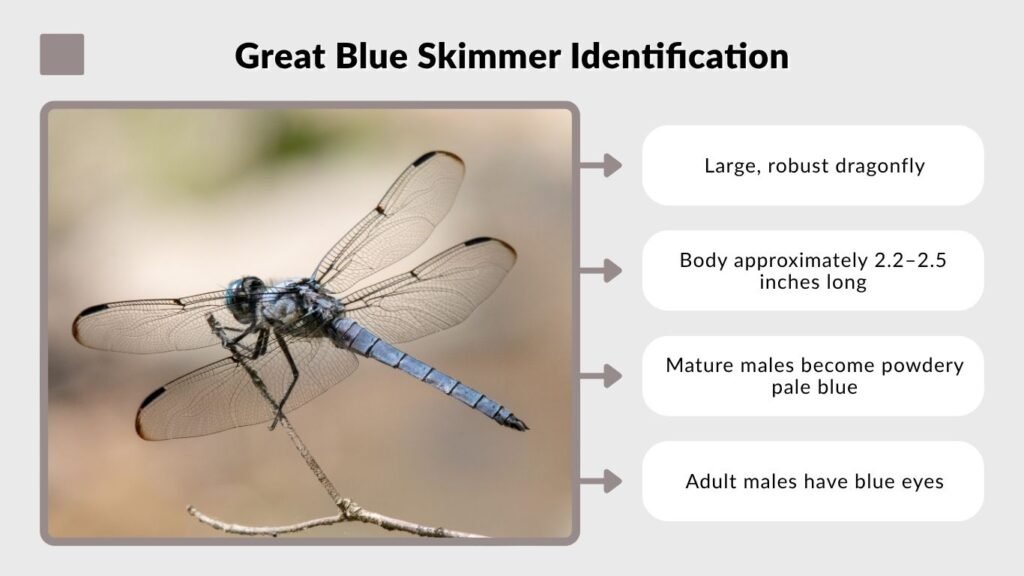
Color changes significantly as these dragonflies mature. A newly emerged male can resemble a female, while an older male becomes extensively blue. Therefore, identification should consider the face, eyes, wings, body pattern, and sex rather than relying on blue coloration alone.
Key Identification Features
- Large, robust dragonfly
- Body approximately 2.2–2.5 inches long
- Mature males become powdery pale blue
- Adult males have blue eyes
- Face is pale or whitish
- Legs are dark or black
- Wings have dark markings near the base
- Dark marks may occur around the nodus and wing tips
- Females become brown with a dark stripe along the abdomen
Male Great Blue Skimmer
Mature males are the source of the species’ name. Their thorax and abdomen develop a pale, powdery blue coating called pruinescence. Their eyes also become blue, while the face remains unusually pale.
Males frequently perch on low branches or vegetation overlooking water before leaving the perch to chase insects or rival dragonflies.
Female Great Blue Skimmer
Female Great Blue Skimmers look remarkably different. Mature females are predominantly brown rather than blue and usually show a dark stripe running down the abdomen.
Their eyes become blue with maturity, providing an important clue. Female wing tips also tend to show stronger dark coloration than those of males.
Immature Great Blue Skimmer
Young individuals may have reddish-brown eyes, a whitish face, a grayish thorax, and a yellowish abdomen marked by a dark central stripe.
Young males gradually acquire blue pruinescence, starting around the thorax before much of the abdomen becomes blue.
Great Blue Skimmer Size
The Great Blue Skimmer is a relatively large dragonfly and is noticeably bigger than familiar species such as the Blue Dasher. Its strong body and broad wings give it a powerful appearance both when perched and in flight.
How Big Is a Great Blue Skimmer?
Adults generally reach about 56–63 mm, or approximately 2.2–2.5 inches, in body length. Some references give a broader range beginning near 50 mm.
Its wings extend well beyond the body when held horizontally at rest, making an adult appear even larger.
Great Blue Skimmer Habitat and Range
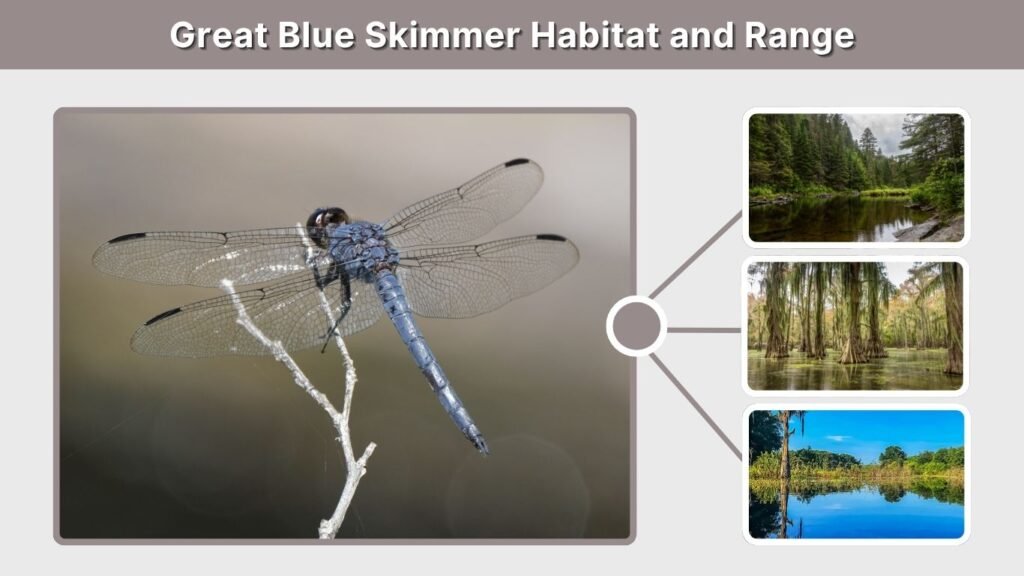
Great Blue Skimmers are strongly associated with wooded freshwater habitats. Unlike some skimmers that prefer exposed, sunny ponds, this species regularly occurs around shaded or partly shaded water surrounded by trees and shrubs.
Preferred Habitat
- Forest ponds
- Wooded swamps
- Shallow pools
- Slow forest streams
- Swampy creeks
- Backwaters
- Ditches with slow or standing water
- Bottomland forests
- Shaded lake margins
The nymphs live underwater, so suitable breeding sites must provide aquatic habitat long enough for them to complete development.
Where Do Great Blue Skimmers Live?
The species occurs primarily across the eastern United States, with its strongest distribution in the Southeast. Individuals can occasionally occur farther north, and records extend into parts of New England and rarely southern Canada.
Great Blue Skimmer in Florida
Florida provides abundant suitable habitat, including forested wetlands, swamps, ponds, and slow streams. Great Blue Skimmers can therefore be encountered throughout suitable parts of the state.
A large pale-blue male flying around a wooded Florida pond is a good candidate for this species, although several other blue dragonflies should always be considered before identification.
What Do Great Blue Skimmers Eat?

Great Blue Skimmers are predators throughout their lives. Adults hunt in the air, whereas nymphs hunt underwater. Their predatory behavior helps transfer energy between freshwater and terrestrial ecosystems and contributes to natural regulation of small insect populations.
Adult Diet
- Mosquitoes
- Midges
- Flies
- Small moths
- Flying ants
- Other small flying insects
Adult dragonflies use their legs like a basket to intercept prey in flight and may consume small insects without landing. This general hunting strategy is characteristic of dragonflies.
Great Blue Skimmer Nymph Diet
The aquatic nymphs are also predators. Like other dragonfly larvae, they capture aquatic insect larvae and other small animals living within freshwater habitats.
Potential prey includes mosquito larvae, other aquatic insects, small crustaceans, and similarly sized organisms. Larger dragonfly nymphs can sometimes take tadpoles or tiny fish, although the exact diet depends heavily on prey availability.
Great Blue Skimmer Life Cycle
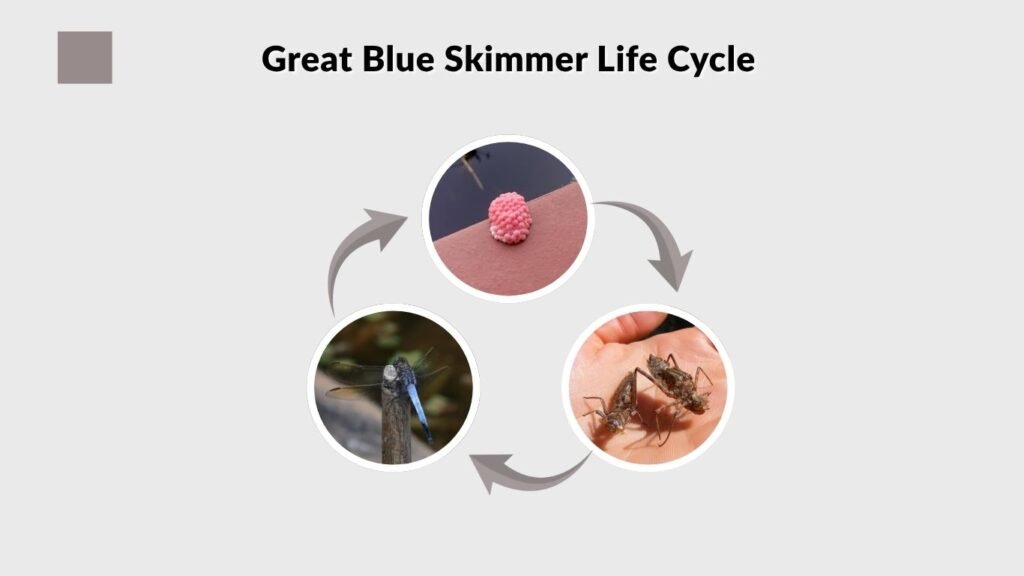
Like all dragonflies, the Great Blue Skimmer undergoes incomplete metamorphosis. There is no caterpillar-like larva followed by a pupa. Instead, development progresses from egg to aquatic nymph and then directly to a winged adult.
Eggs and Reproduction
Males patrol breeding territories around suitable water and may repeatedly challenge other males.
After mating, females deposit eggs around water. Observations describe females releasing eggs into shallow water while males may remain nearby and guard against competing males.
Aquatic Nymph Stage
Eggs hatch into aquatic nymphs, also called naiads. These young dragonflies remain submerged, hunting other small aquatic animals and molting repeatedly as they increase in size.
The aquatic stage accounts for a substantial portion of the dragonfly’s life.
Emerging as an Adult
Once fully developed, a nymph leaves the water and climbs onto vegetation, wood, or another exposed surface. The adult emerges through a split in the nymphal exoskeleton.
Its wings gradually expand and harden. The abandoned skin, called an exuvia, remains attached to the emergence surface.
Great Blue Skimmer Behavior
Great Blue Skimmers often fly low around shaded woodland pools. Males establish territories and make regular patrol flights, returning repeatedly to favored perches. Their relatively large size allows them to dominate many smaller dragonflies around suitable breeding habitat.
Perching and Territorial Behavior
A male may remain on a branch, twig, or low plant while watching the surrounding area. When another dragonfly or flying insect approaches, it quickly launches into the air.
Males also patrol breeding water and chase rival males before returning to vegetation.
Great Blue Skimmer vs Other Blue Dragonflies
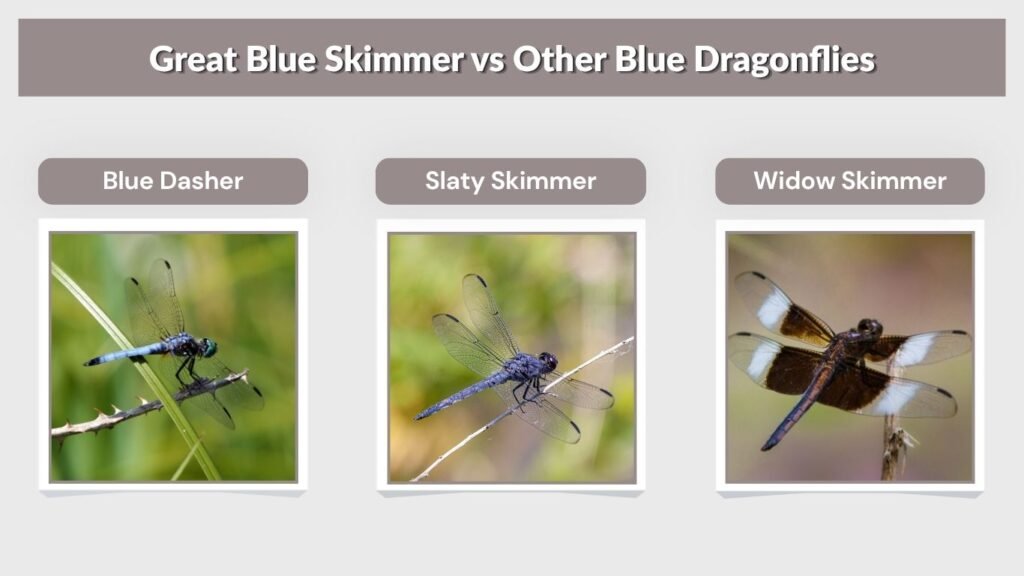
Several North American dragonflies develop blue coloration, so a blue body alone does not confirm a Great Blue Skimmer. Size, face color, wing markings, habitat, and body proportions provide better identification clues.
Great Blue Skimmer vs Blue Dasher
The Blue Dasher (Pachydiplax longipennis) is much smaller and more slender. Mature males are blue, but they commonly have a darker tip toward the end of the abdomen and a different overall body shape.
Great Blue Skimmers are substantially larger and more robust.
Great Blue Skimmer vs Slaty Skimmer
Slaty Skimmers can be similar in size and coloration. Mature male Slaty Skimmers are typically darker and have a dark face, whereas Great Blue Skimmers have a conspicuously pale or whitish face.
Great Blue Skimmer vs Widow Skimmer
Widow Skimmers are easily distinguished by prominent dark bands across their wings. Mature males also develop large white patches outside the dark bands.
The Great Blue Skimmer lacks these broad black-and-white wing bands.
Are Great Blue Skimmers Dangerous?
Great Blue Skimmers are harmless to people. They do not possess a stinger and do not seek humans as prey. Their jaws are designed for capturing small insects.
A large dragonfly might attempt to bite defensively if someone holds it tightly, but normal encounters around ponds, gardens, or woodland trails present no meaningful danger.
Interesting Great Blue Skimmer Facts
The Great Blue Skimmer stands out even among colorful North American dragonflies. Its changing coloration, preference for wooded wetlands, and impressive adult size make it a favorite among dragonfly watchers.
Quick Facts
- It is one of the largest Libellula skimmers.
- Its scientific name is Libellula vibrans.
- Males become powdery blue as they mature.
- Mature females are mainly brown.
- Both sexes eventually develop blue eyes.
- Its pale face helps distinguish it from similar species.
- It prefers wooded ponds, swamps, and slow streams.
- Adults capture flying insects.
- Nymphs are aquatic predators.
- It occurs primarily in eastern North America.
FAQs
1. Is the Great Blue Skimmer rare?
It is not generally rare throughout its core southeastern range and can be fairly common in appropriate wooded wetland habitat. However, it becomes much less common toward the northern edge of its distribution.
2. How big is a Great Blue Skimmer dragonfly?
Adults are generally about 56–63 mm, or roughly 2.2–2.5 inches, long, making the species one of the larger North American skimmers.
3. Are female Great Blue Skimmers blue?
Usually not. Mature females are predominantly brown with a dark dorsal abdominal stripe, although their eyes become blue. Mature males develop the much more obvious powdery-blue body.
4. Where can I find Great Blue Skimmers?
Look around shaded forest ponds, wooded swamps, slow streams, backwaters, and other relatively still freshwater habitats across the eastern United States.
5. Is a Blue Skimmer the same as a Great Blue Skimmer?
Not necessarily. “Blue skimmer” can be used informally for several blue dragonflies. The Great Blue Skimmer specifically refers to Libellula vibrans, a large North American species. Other blue-colored skimmers found elsewhere, including Africa, should not automatically be identified as L. vibrans.