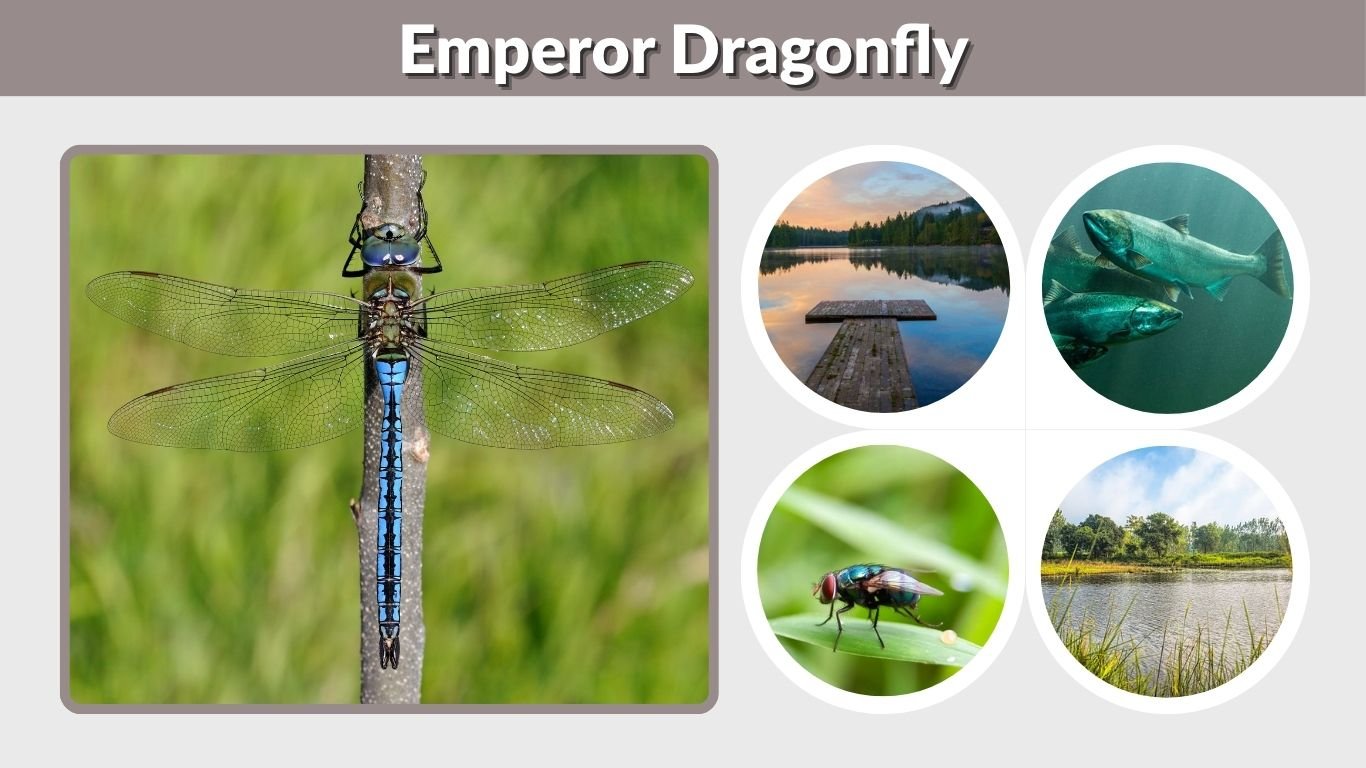
The emperor dragonfly (Anax imperator), also called the blue emperor, is one of Europe’s largest and most impressive dragonflies. Males are easily recognized by their bright blue abdomen, apple-green thorax, and powerful territorial flight, while females are generally greener. These aerial predators spend much of their adult lives hunting insects around ponds and lakes. Their aquatic larvae are equally formidable hunters. This guide covers emperor dragonfly identification, size, habitat, diet, life cycle, lifespan, behavior, larvae, predators, and similar species.
What Is an Emperor Dragonfly?
The emperor dragonfly is a large hawker belonging to the family Aeshnidae. Its scientific name, Anax imperator, reflects its imposing appearance: Anax means ruler or lord, while imperator means emperor. It is particularly well known in Britain, where it is among the bulkiest and most conspicuous dragonflies around large ponds and lakes.
Scientific Classification
- Common name: Emperor dragonfly or blue emperor
- Scientific name: Anax imperator
- Family: Aeshnidae
- Order: Odonata
- Suborder: Anisoptera
- Type: Hawker dragonfly
- Adult length: Around 78 mm
- Larval length: About 45–56 mm
Emperor Dragonfly Identification
Adults have an apple-green thorax, very large eyes, a yellow leading edge to the wings, and a dark line running down the abdomen. Their powerful flight is also distinctive. Emperor dragonflies spend long periods patrolling without landing and often hold the rear of the abdomen slightly downward while flying.
Male vs Female Emperor Dragonfly
Male and female emperor dragonflies are similar in overall size and build but differ noticeably in abdominal color. Mature males are the spectacular blue individuals most people associate with this species. Females are predominantly green, although some develop blue coloration that can make identification more challenging.
Male Emperor Dragonfly
- Bright sky-blue abdomen
- Dark central abdominal stripe
- Apple-green thorax
- Blue or blue-green eyes
- Highly territorial around breeding water
- Frequently patrols without settling
Males aggressively defend sections of ponds and lakes. Rival males may chase one another at high speed, while a territorial male also investigates passing females.
Female Emperor Dragonfly
Females typically have an apple-green thorax and a green abdomen marked by a dark longitudinal stripe. Some females can appear partly or substantially blue.
Unlike the constantly patrolling males, females are commonly noticed while laying eggs in aquatic vegetation. They can oviposit alone by inserting eggs into floating or submerged plant material.
Emperor Dragonfly Size and Wingspan
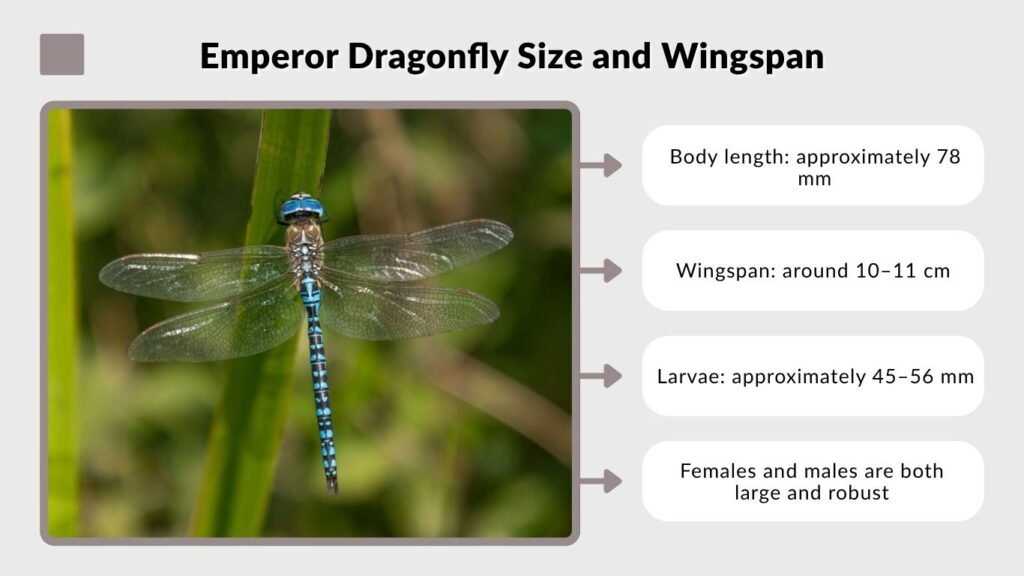
The emperor is an exceptionally large European dragonfly. Its combination of a long abdomen, broad thorax, large eyes, and substantial wings gives it an unmistakably powerful appearance in flight.
How Big Is an Emperor Dragonfly?
- Body length: approximately 78 mm
- Wingspan: around 10–11 cm
- Larvae: approximately 45–56 mm
- Females and males are both large and robust
- It is among the largest dragonflies regularly encountered in Britain
The golden-ringed dragonfly can exceed it in overall length, particularly because of the female’s long ovipositor, but the emperor is generally regarded as Britain’s bulkiest dragonfly.
Emperor Dragonfly Habitat and Distribution
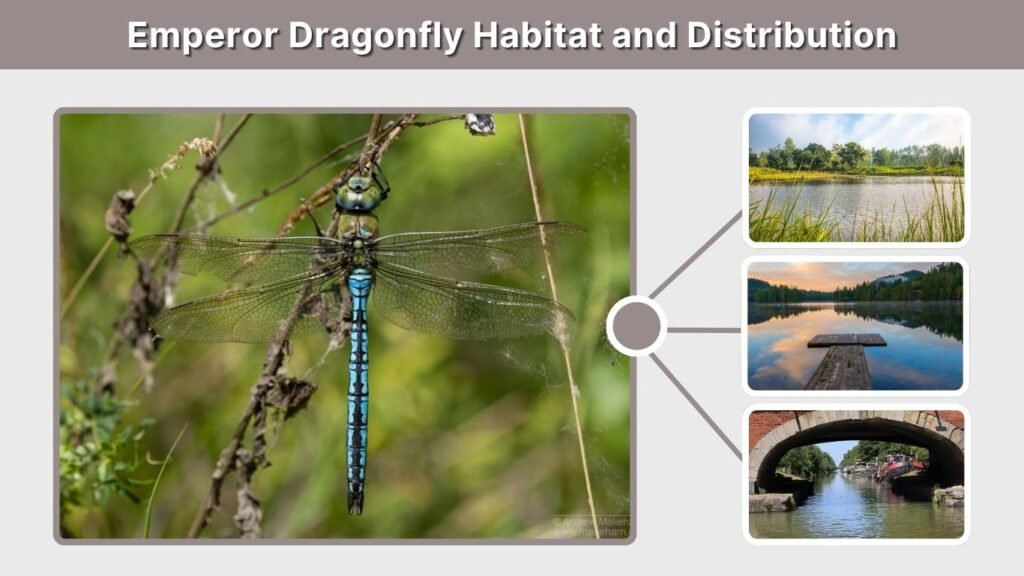
Emperor dragonflies are strongly associated with freshwater but can use several different types of wetland habitat. Warm, well-vegetated ponds and lakes are especially suitable because they provide hunting territory for adults, submerged vegetation for larvae, and suitable plants in which females can deposit eggs.
Where Do Emperor Dragonflies Live?
- Large ponds
- Lakes
- Reservoirs
- Canals
- Slow-flowing rivers
- Vegetated wetlands
- Occasionally smaller suitable ponds
The species has a broad Afro-Eurasian distribution, occurring through much of Europe, Africa, and parts of western and central Asia.
Emperor Dragonfly in the UK and Ireland
The emperor occurs across most of England and Wales and has expanded considerably northward since the 1990s. It has been recorded in Scotland since the early 2000s. It also expanded rapidly through Ireland after first being recorded there around 2000.
What Do Emperor Dragonflies Eat?
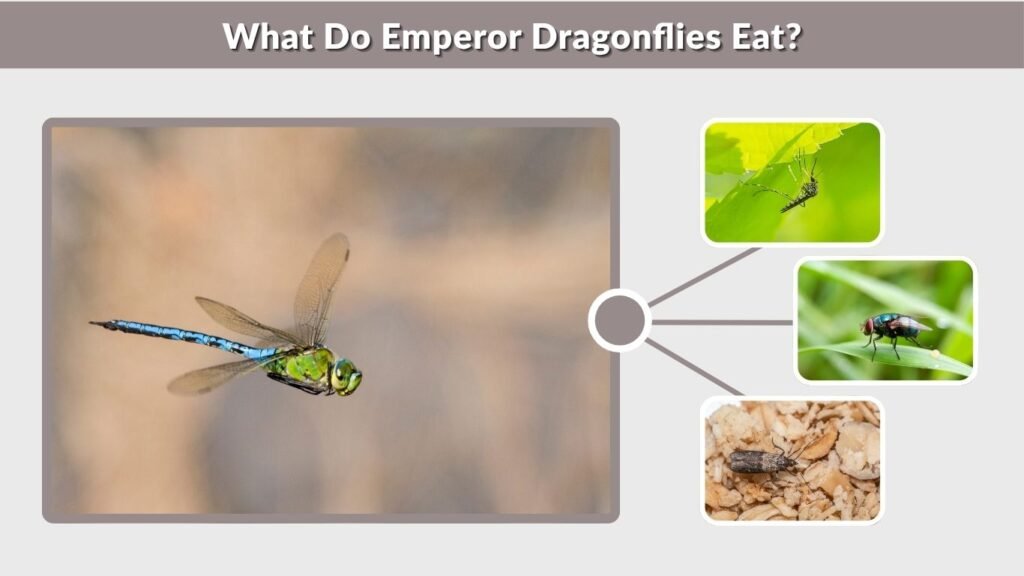
Both adult and larval emperor dragonflies are predators, but they hunt in completely different environments. Adults pursue insects in the air, while nymphs ambush animals underwater. This predatory lifestyle makes emperors important members of both aquatic and terrestrial food webs.
Emperor Dragonfly Diet
- Midges
- Mosquitoes
- Flies
- Moths
- Wasps
- Other dragonflies
- Other small flying insects
Emperors are exceptionally accomplished aerial hunters and may consume prey while remaining in flight rather than landing first.
What Do Emperor Dragonfly Larvae Eat?
Emperor nymphs are large aquatic predators. Like other dragonfly larvae, they use an extendable lower jaw, or labium, to seize prey.
Their food can include aquatic insect larvae, small crustaceans, worms, tadpoles, and occasionally small fish.
Emperor Dragonfly Life Cycle
Dragonflies undergo incomplete metamorphosis, which means they have no pupal stage. An emperor develops through three basic phases: egg, aquatic larva or nymph, and winged adult. Most of its life is spent underwater rather than flying over a pond.
Egg and Nymph Stage
Females insert their eggs into aquatic plant material, including floating pondweed. After hatching, young nymphs begin hunting underwater and molt repeatedly as they grow.
Emperor larvae are long and streamlined with particularly large, rounded eyes. Development commonly takes about two years in Britain, although warmer conditions can allow development within a year.
Emergence and Adult Life
When fully developed, the nymph climbs from the water onto vegetation. Its outer skin splits, and the winged adult slowly pulls itself free. The empty larval skin left behind is called an exuvia.
The newly emerged dragonfly is initially pale and vulnerable. Its wings and body harden before it makes its first flight. Dragonflies generally spend far less time as adults than they do as aquatic larvae.
Are Emperor Dragonflies Dangerous?
Their size, rapid flight, and large jaws can make emperor dragonflies seem intimidating, but they are not considered dangerous to humans. They are predators of insects and have no interest in attacking people.
Do Emperor Dragonflies Bite or Sting?
Dragonflies cannot sting because they do not possess a stinger.
A large dragonfly may use its jaws defensively if it is caught and held, potentially producing a small pinch. Under normal circumstances, however, emperor dragonflies simply fly away from people and do not pose a meaningful threat.
Emperor Dragonfly Predators
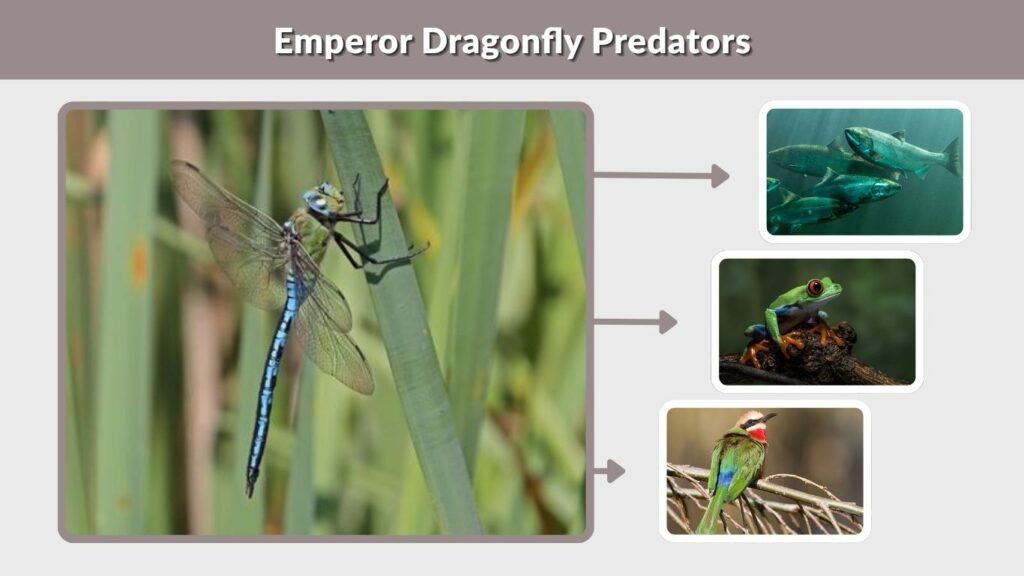
Despite being impressive hunters themselves, emperors become prey to other animals at every life stage. Aquatic nymphs are vulnerable to animals living in ponds, while adults can be caught by fast-flying insect-eating birds.
Common Predators
- Fish
- Waterfowl
- Larger dragonfly larvae
- Frogs and other aquatic predators
- Insect-eating birds
- Hobbies and other agile birds
Hobbies are particularly capable of capturing large dragonflies in flight, and emperor dragonflies have been recorded among their prey.
Emperor vs Lesser and Vagrant Emperor Dragonflies
Several dragonflies carry “emperor” in their common names, but they are separate species. Color, size, and geographic range can help distinguish them.
Emperor vs Lesser Emperor
The lesser emperor (Anax parthenope) is smaller at around 71 mm and generally duller. It has a brownish abdomen with blue concentrated near its base, whereas male A. imperator has a conspicuous bright-blue abdomen.
Emperor vs Vagrant Emperor
The vagrant emperor (Anax ephippiger) is about 63 mm long and primarily brown or yellow-brown. Males have a noticeable blue patch near the base of the abdomen rather than the extensive blue coloration of a male emperor.
What About the Australian Emperor?
The Australian emperor is not the Anax emperor. It is a different species, Anax papuensis, found throughout Australia and parts of the South Pacific. It is generally brownish-yellow with darker markings rather than the characteristic blue-and-green pattern of a male A. imperator.
FAQs
1. What is the scientific name of the emperor dragonfly?
The scientific name is Anax imperator. It belongs to the hawker family Aeshnidae.
2. How big is an emperor dragonfly?
Adults reach approximately 78 mm in body length, with a wingspan of roughly 10–11 cm. This makes the emperor one of Britain’s largest dragonflies.
3. How long do emperor dragonflies live?
Much of their life is spent underwater as larvae, commonly for around one to two years depending on environmental conditions. The free-flying adult stage is much shorter, generally lasting weeks rather than years.
4. Do emperor dragonflies bite humans?
They do not normally bite people. A captured or roughly handled individual might use its jaws defensively, but emperor dragonflies are not aggressive toward humans and cannot sting.
5. What is the difference between male and female emperor dragonflies?
Mature males usually have a vivid sky-blue abdomen with a dark central stripe. Females typically have a green abdomen with a similar dark stripe, although some females can develop blue coloration.