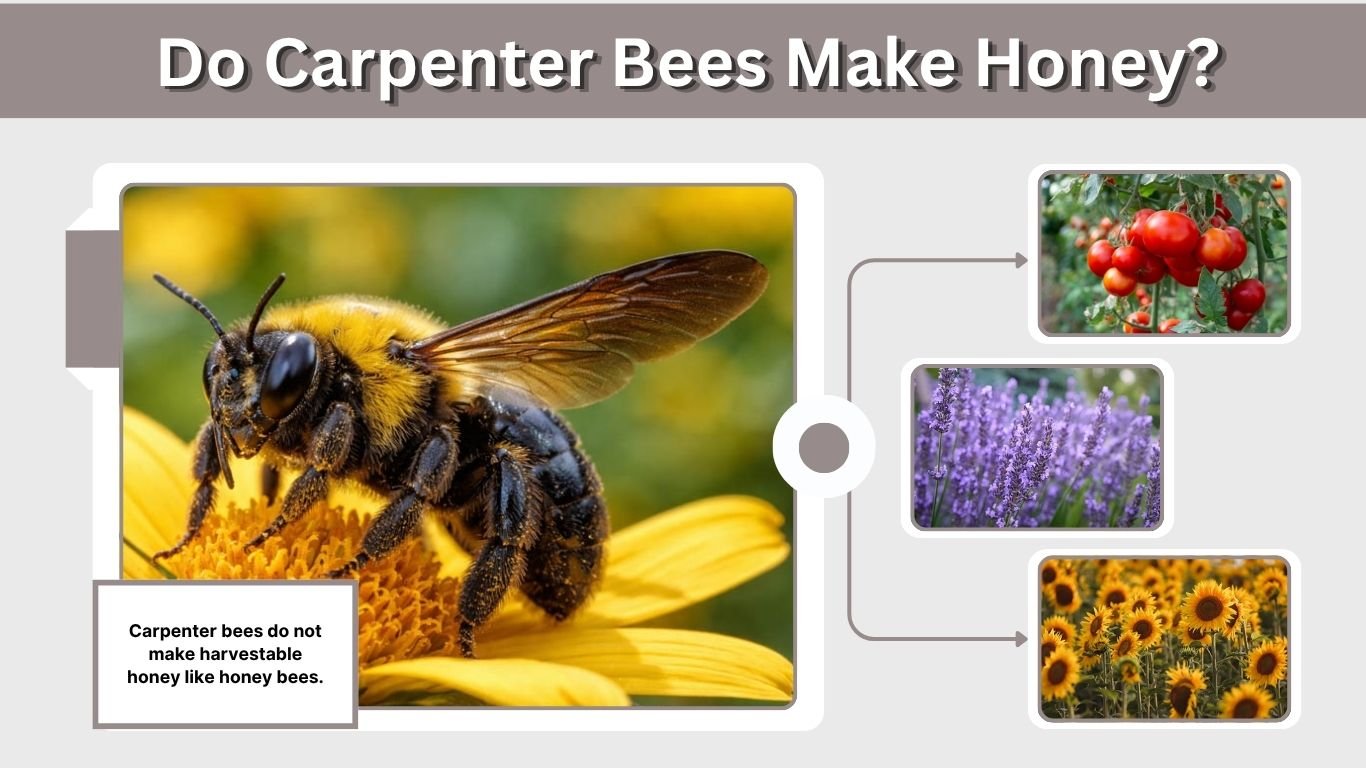
Carpenter bees do not make harvestable honey like honey bees. Although they collect nectar and pollen from flowers, female carpenter bees use these resources to prepare small food provisions for their developing larvae. They do not live in large, permanent colonies or build wax honeycombs filled with stored honey. Most carpenter bees live independently and excavate nesting tunnels in wood or plant stems. Blue, black, and Australian carpenter bees follow the same general pattern: they are valuable pollinators, but they are not true honey-producing bees.
Do Carpenter Bees Make Honey?
Carpenter bees gather nectar, but they do not transform and store it as large quantities of mature honey. Instead, a female mixes nectar with pollen to create a soft food mass inside each brood chamber. Her larva consumes this provision after hatching.
The Short Answer
- Carpenter bees collect flower nectar.
- They also collect pollen for their larvae.
- They do not build wax honeycombs.
- They do not maintain large honey reserves.
- Their nests contain small larval food provisions.
- They cannot produce harvestable honey.
- They are important pollinators despite not making honey.
The small amount of nectar inside a carpenter bee’s nest should not be considered a usable honey supply. It is mixed with pollen and reserved for a developing offspring.
Why Carpenter Bees Do Not Produce Honey
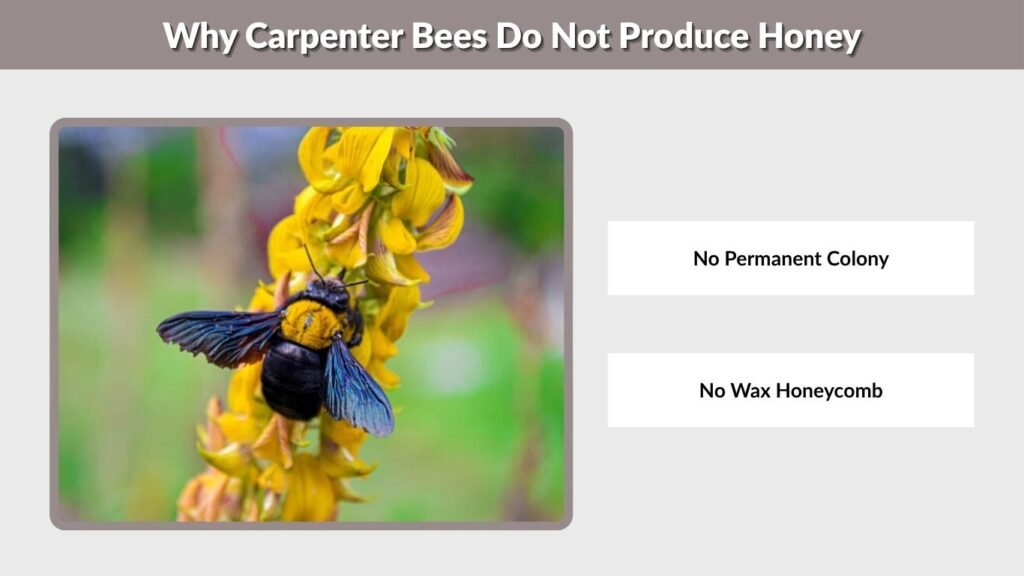
Honey production is closely connected to the social lifestyle of honey bees. A honey bee colony contains thousands of workers that remain active throughout the year. These workers must preserve enough food to support the queen, brood, drones, and winter cluster.
Most carpenter bees live alone, so they do not have a large colony requiring long-term food reserves. Some species may share nests or display limited social behavior, but they still do not create honey stores comparable to those of honey bees.
No Permanent Colony
A female carpenter bee usually builds and provisions her own nest. She does not have thousands of worker daughters collecting nectar for her. After creating several brood cells, she may guard the entrance while her offspring develop.
Because the next generation receives food directly inside its individual cells, there is no need to fill a large communal structure with honey.
No Wax Honeycomb
Honey bees produce wax and arrange it into thousands of hexagonal cells. They place nectar inside these cells, evaporate its excess water, and seal the mature honey with wax.
Carpenter bees follow a different nesting system. Females chew tunnels into wood and divide them into separate chambers using partitions made from wood pulp and other materials. Each chamber contains one egg and enough food for one larva.
What Do Carpenter Bees Produce Instead?
A female carpenter bee prepares a mixture often called a pollen loaf or provision mass. It consists primarily of pollen moistened with nectar. This compact food package supplies the protein, carbohydrates, fats, vitamins, and minerals required by a growing larva.
Preparing Larval Food
The nesting process generally follows these stages:
- The female excavates or reuses a wooden tunnel.
- She collects pollen and nectar from flowers.
- She forms the food into a provision mass.
- She lays one egg beside the food.
- She seals the chamber with a partition.
- She repeats the process for additional offspring.
- The larvae consume their individual food supplies.
Unlike honey bee larvae, carpenter bee larvae are not repeatedly visited and fed by nurse workers. Each chamber must contain sufficient food before the female seals it.
Do Blue Carpenter Bees Make Honey?
Blue carpenter bees are large Xylocopa species with vivid metallic blue hairs. The name commonly refers to the blue carpenter bee, Xylocopa caerulea, found in parts of Asia. Despite its unusual appearance, it does not produce harvestable honey.
Blue Carpenter Bee Behavior
Female blue carpenter bees collect nectar and pollen, excavate nesting tunnels, and create provisioned brood cells. Their nectar is used for personal energy or mixed with pollen for their larvae.
The blue coloration does not indicate a connection with honey production. It is simply a physical characteristic that distinguishes these carpenter bees from common black, brown, or yellow species.
Do Black Carpenter Bees Make Honey?
Many carpenter bee species appear primarily black, sometimes with yellow, white, or orange markings. Large black females are frequently mistaken for bumblebee queens or unusually large honey bees.
Black Carpenter Bee Nests
Black carpenter bees use nectar and pollen in the same way as other members of their group. They do not store jars, pockets, or combs of pure honey inside their wooden tunnels.
A person opening an active nest might find moist pollen provisions, but these belong to the developing larvae and are not suitable for harvesting. Damaging the nest can kill the immature bees and remove beneficial pollinators from the area.
Do Australian Carpenter Bees Make Honey?
Australia is home to several carpenter bee species, including large and small carpenter bees. These insects collect nectar and pollen but do not produce commercial or harvestable honey.
Australian carpenter bees should not be confused with native stingless bees. Some Australian stingless bees live in social colonies and store small quantities of honey in resin-and-wax pots. Carpenter bees remain biologically and behaviorally different.
Carpenter Bees vs Stingless Bees
| Feature | Carpenter bees | Australian stingless bees |
| Social structure | Usually solitary | Highly social |
| Nest location | Wood or plant stems | Tree cavities or managed hives |
| Honey storage | No harvestable supply | Small honey pots |
| Comb structure | Individual brood chambers | Organized colony nest |
| Colony size | Usually one nesting female | Thousands of workers |
| Honey harvesting | Not possible | Possible in managed colonies |
Carpenter Bees vs Honey Bees
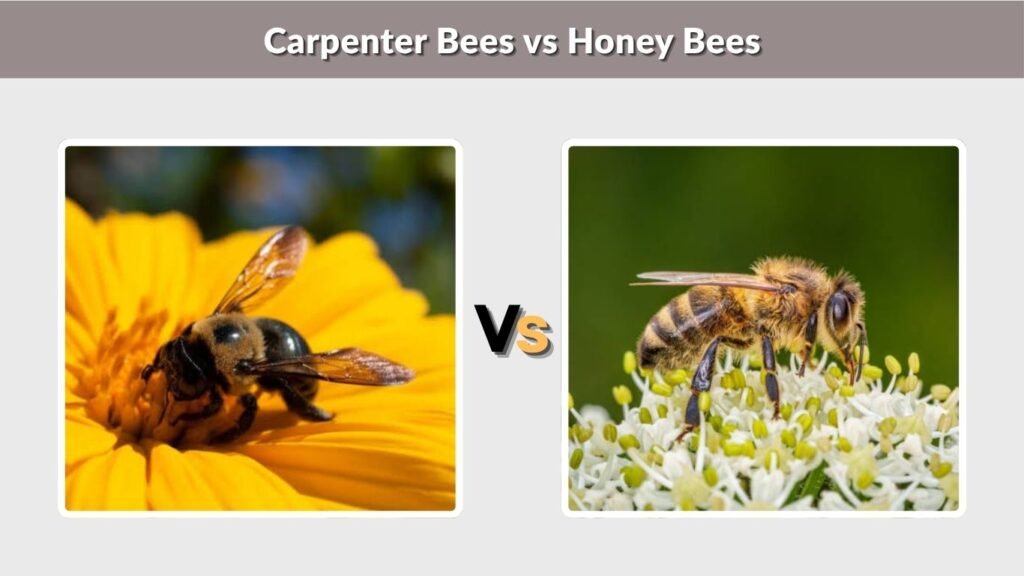
Both types visit flowers, carry pollen, and consume nectar. However, their nesting systems, colony structures, and methods of feeding offspring are fundamentally different.
Important Differences
| Characteristic | Carpenter bee | Honey bee |
| Lifestyle | Mostly solitary | Highly social |
| Nest | Tunnels in wood or stems | Cavity containing wax comb |
| Workers | No large worker force | Thousands of workers |
| Honey production | No harvestable honey | Produces and stores honey |
| Larval food | Nectar-pollen provision | Food supplied by nurse bees |
| Winter food storage | Minimal | Large honey reserves |
| Pollination | Important wild pollinator | Agricultural and wild pollinator |
Honey bees convert watery nectar into stable honey by adding enzymes and removing moisture. Carpenter bees generally use nectar quickly or place it in larval food rather than processing it for long-term colony storage.
What Do Carpenter Bees Eat?
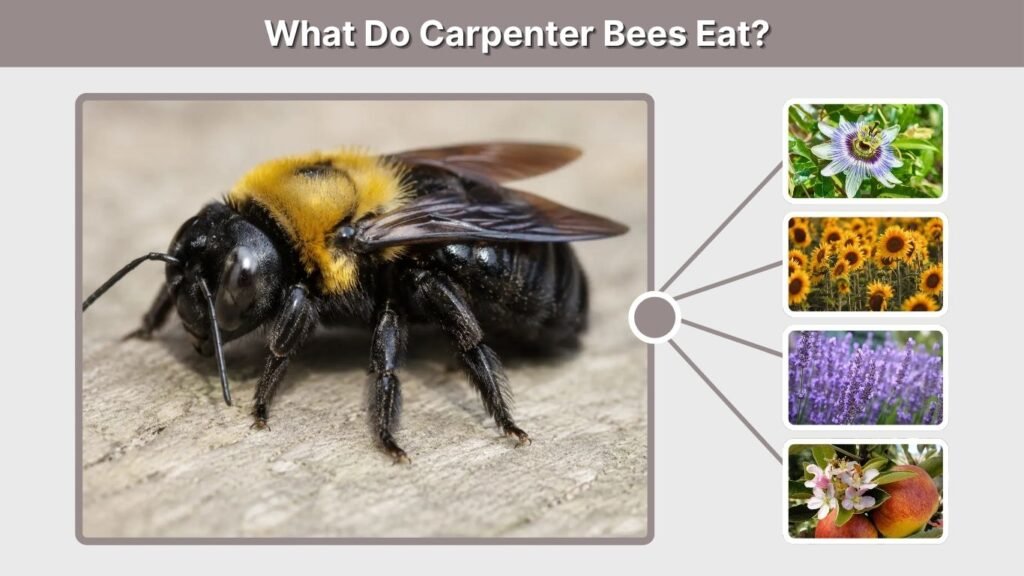
Adult carpenter bees consume nectar for carbohydrates and energy. Females collect pollen because it provides the protein and fats needed by larvae.
Common Food Sources
Carpenter bees visit many flowers, including:
- Passionflowers
- Salvia
- Wisteria
- Sunflowers
- Lavender
- Fruit blossoms
- Legume flowers
- Native wildflowers
- Garden herbs
- Flowering shrubs
Their exact preferences depend on the carpenter bee species and the plants growing in its region.
Some carpenter bees practice nectar robbing. A bee may cut a small opening near the base of a deep flower to reach nectar without touching the flower’s reproductive structures. However, carpenter bees also pollinate many plants normally and are especially effective at buzz pollination.
Why Do Carpenter Bees Drill Into Wood?
Carpenter bees do not eat wood or convert it into honey. Females excavate wood solely to create protected nesting chambers. They prefer weathered, unfinished, or soft wood because it is easier to chew.
Common Nesting Sites
- Roof eaves
- Fascia boards
- Wooden fences
- Deck railings
- Porch furniture
- Barn timbers
- Dead tree branches
- Bamboo
- Hollow or pithy stems
A female uses her strong mandibles to create a round entrance and tunnel. She pushes the wood particles outside or uses some of them to construct partitions between brood cells.
Are Carpenter Bees Useful Without Making Honey?
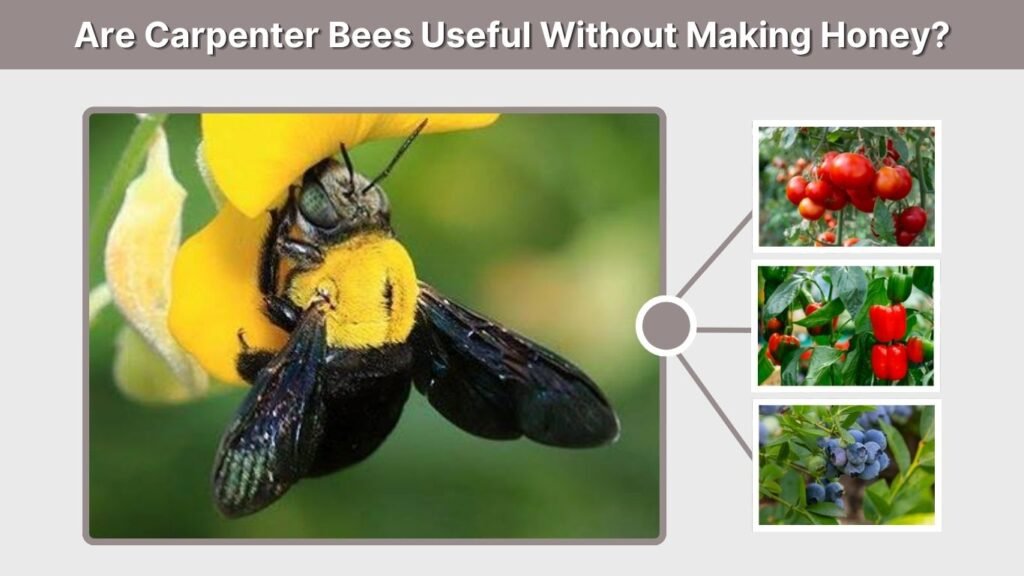
Carpenter bees are valuable because pollination does not depend on honey production. Their large bodies and strong flight muscles allow them to transfer considerable amounts of pollen between flowers.
Pollination Benefits
Carpenter bees help pollinate:
- Tomatoes
- Eggplants
- Peppers
- Passion fruit
- Blueberries
- Beans
- Squash
- Native flowers
- Ornamental garden plants
Their ability to vibrate flowers releases pollen that may otherwise remain trapped inside the anthers. Honey bees cannot perform this specialized buzz-pollination behavior.
Should You Remove a Carpenter Bee Nest?
A nest inside a dead branch, bamboo stem, or unused wooden structure can often be left alone. Carpenter bees are generally not aggressive away from their nests. Males may hover around people but cannot sting, while females can sting but rarely do unless handled or trapped.
If nesting threatens an important structure, wait until the bees have emerged and then repair and protect the wood. Painting or sealing exposed surfaces can make them less attractive for future nesting. Avoid closing an active tunnel while bees or larvae remain inside.
FAQs
Do carpenter bees store any honey?
They do not store true honey in harvestable quantities. Females place small amounts of nectar and pollen inside brood chambers as larval food.
Can you eat honey from a carpenter bee nest?
Carpenter bee nests do not contain collectible honey. Their food provisions belong to developing larvae and should not be removed or eaten.
Do blue carpenter bees produce blue honey?
No. Blue carpenter bees do not make honey, and their body color has no effect on the nectar they collect.
Are carpenter bees related to honey bees?
Both belong to the bee family Apidae, but carpenter bees are in the genus Xylocopa, while familiar western honey bees belong to the genus Apis.
Are carpenter bees good pollinators?
Yes. They pollinate many wildflowers, garden plants, and crops. Their ability to perform buzz pollination makes them especially valuable for certain flowers.