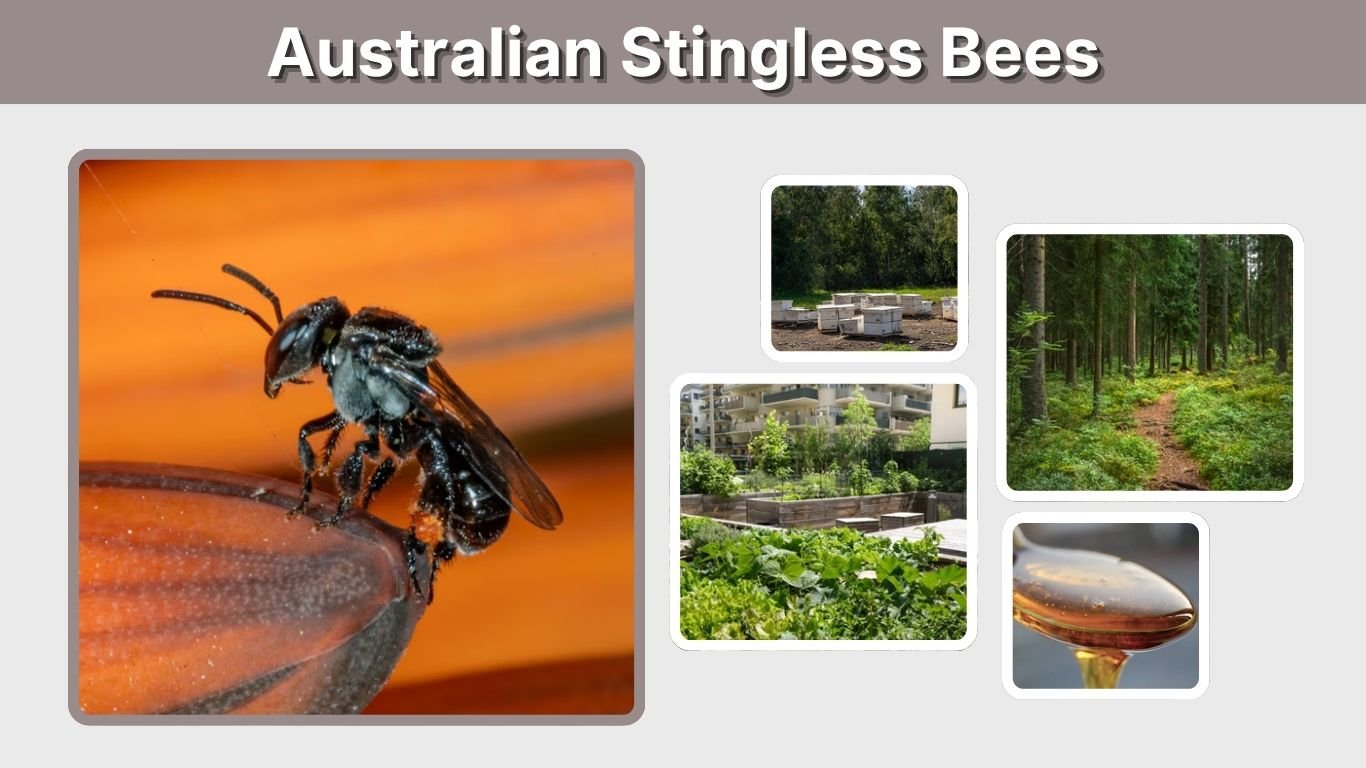
Australian stingless bees are tiny native pollinators that live in highly organized colonies and produce a distinctive honey known as sugarbag. Unlike European honey bees, these bees cannot deliver a functional sting, making them popular among native-bee enthusiasts and gardeners. Australia has several social stingless bee species, particularly within the genera Tetragonula and Austroplebeia. They naturally inhabit warm parts of northern and eastern Australia, where colonies occupy hollow trees and other protected cavities. Their fascinating spiral brood structures, queens, honey pots, and pollination abilities make them some of Australia’s most interesting native bees.
What Are Australian Stingless Bees?
Australian stingless bees are native social bees belonging mainly to the genera Tetragonula and Austroplebeia. Unlike most Australian native bees, which live solitary lives, stingless bees create permanent colonies containing a queen, workers, and males. Australia has about 1,700 known native bee species, but only 11 species are social stingless bees.
Australian Stingless Bee Identification
Typical characteristics include:
- Size: Usually around 3–5 mm long
- Color: Mostly black or very dark brown
- Body: Small and compact
- Stinger: Reduced and unable to deliver a normal sting
- Colonies: Hundreds or thousands of individuals
- Food: Nectar and pollen
- Nest: Usually inside hollow trees or cavities
- Honey: Stored in small resin-and-wax pots
- Behavior: Highly social
- Flight: Quick and sometimes difficult to follow because of their tiny size
Tetragonula carbonaria, one of the best-known Australian species, is approximately 4–5 mm long and occurs along coastal areas from Queensland into southern New South Wales.
Are All Australian Native Bees Stingless?
No. Only a very small proportion of Australia’s native bees are stingless.
Australia has around 1,700 native bee species, while only 11 social species belonging to Tetragonula and Austroplebeia are stingless. Most other Australian native bees are solitary species capable of stinging, although many are small and generally non-aggressive.
This means “Australian native bee” and “Australian stingless bee” should not be treated as interchangeable names.
Australian Stingless Bee Species
Australia’s stingless bees belong mainly to two groups: Tetragonula and Austroplebeia. Individual species differ in geographic range, nest architecture, behavior, and preferred climate. Correct identification is particularly important when keeping colonies because moving tropical bees into climates that are too cold can result in colony failure.
Common Australian Stingless Bees
Some commonly encountered species include:
- Tetragonula carbonaria
- Tetragonula hockingsi
- Tetragonula davenporti
- Tetragonula mellipes
- Tetragonula sapiens
- Austroplebeia australis
- Austroplebeia cassiae
Tetragonula carbonaria and Tetragonula hockingsi are two of the species most commonly discussed by Australian native-bee keepers.
Tetragonula Carbonaria
Tetragonula carbonaria is particularly famous for its beautiful brood structure.
The developing brood may be arranged in an impressive spiral pattern inside the nest. Around this central brood area, workers build storage pots containing honey and pollen.
Colonies may contain thousands of individual bees. The species occurs naturally along Australia’s eastern coastal region, especially Queensland and New South Wales.
Tetragonula Hockingsi
Tetragonula hockingsi is another popular hive species, particularly in Queensland.
It generally prefers warmer conditions than T. carbonaria and is especially common in coastal Queensland north of Bundaberg. Moving colonies too far outside their natural climatic range is discouraged because cold conditions can severely damage or kill the colony.
Where Do Australian Stingless Bees Live?
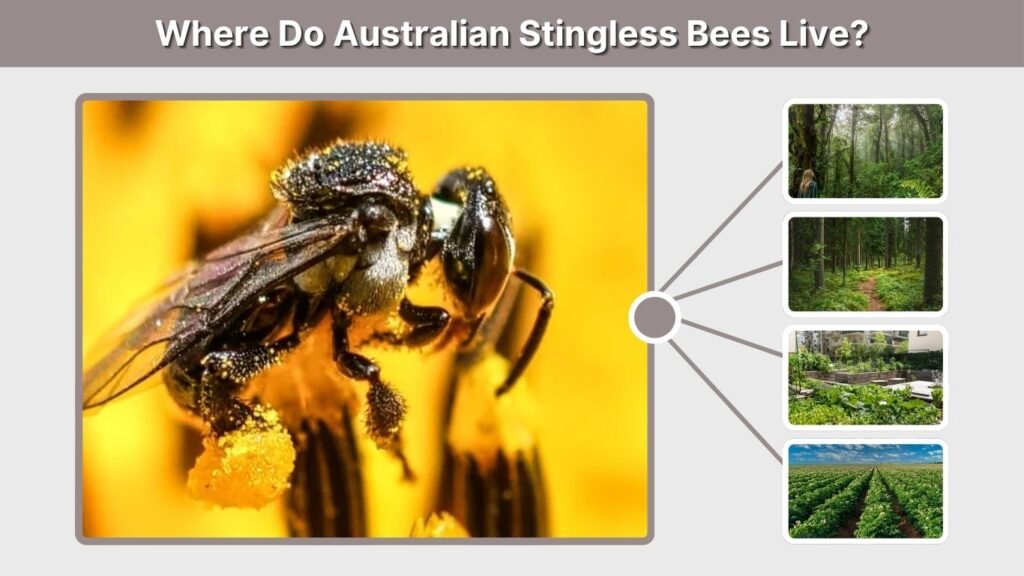
Australian stingless bees are primarily tropical and subtropical insects. Their natural distribution reflects their need for relatively warm temperatures throughout the year. They generally occur across northern Australia and along warmer sections of the eastern coastline, becoming less common as climates become colder farther south.
Australian Stingless Bee Habitat
Natural habitats include:
- Tropical forests
- Subtropical forests
- Woodlands
- Heathland
- Urban gardens
- Rural landscapes
- Hollow trees
- Hollow logs
- Protected wall cavities
- Other enclosed spaces
Tetragonula carbonaria can live in urban and rural environments as well as forests, woodland, and heath. Natural colonies frequently occupy large hollow trees.
Where Are They Found in Australia?
Social stingless bees are naturally associated with:
- Queensland
- Northern New South Wales
- Coastal New South Wales
- Northern Territory
- Northern Western Australia
Queensland and the Northern Territory provide particularly suitable climates. Northern NSW and the NSW Mid North Coast also support thriving populations of some species.
Cold climates can be challenging. Moving colonies well outside their natural distribution may expose them to temperatures they cannot tolerate.
Australian Stingless Bee Hive
A native stingless bee hive looks dramatically different inside from a conventional European honey-bee hive. Rather than building large vertical sheets of honeycomb, Australian stingless bees construct complex structures from wax and plant resin. Brood occupies the central region, while honey and pollen are stored separately in small pot-like chambers.
Inside an Australian Stingless Bee Nest
A colony generally contains:
- A queen
- Worker bees
- Male bees
- Brood cells
- Developing larvae and pupae
- Honey storage pots
- Pollen storage pots
- Wax
- Plant resin
- Propolis-like construction material
In Tetragonula carbonaria, brood cells can form an especially striking spiral structure. Workers stock individual brood cells with food before the queen lays an egg, after which the cell is sealed.
Do Australian Stingless Bees Have Queens?
Yes. Every healthy social stingless bee colony normally has a reproductive queen.
The queen lays the eggs that produce the next generation of workers, males, and potential reproductive females. Workers perform most other tasks, including gathering nectar and pollen, maintaining the nest, caring for brood, and defending the colony.
This social structure is similar in principle to a honey-bee colony, although stingless bees differ considerably in nest construction and reproduction.
Australian Stingless Bee Hive Boxes
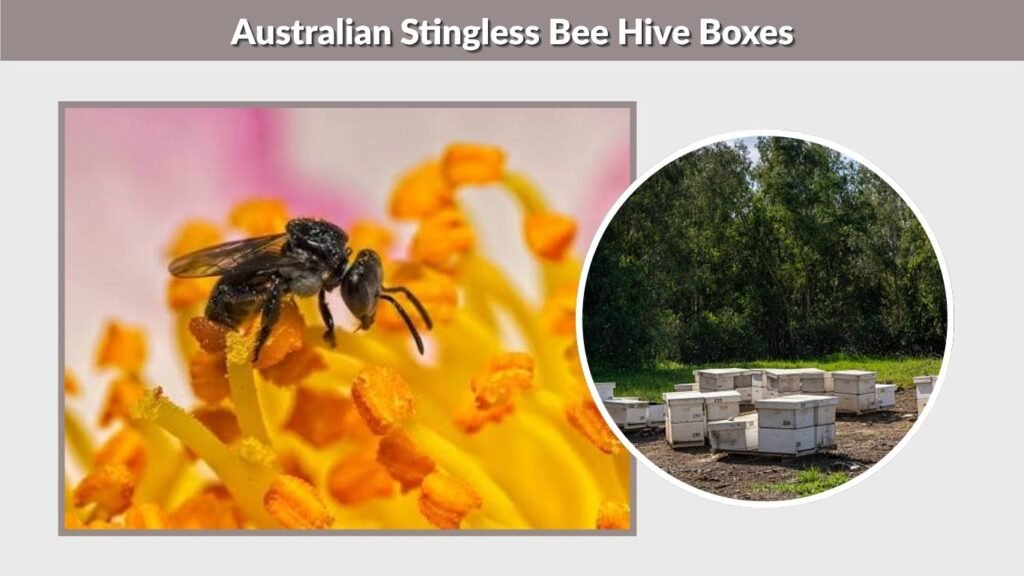
Stingless bee colonies can be maintained in specially designed wooden boxes. Native-bee keeping has become popular in warmer Australian regions for conservation, garden pollination, education, colony propagation, and small-scale honey production.
One widely used design is the OATH, or Original Australian Tetragonula Hive.
Basic Stingless Bee Hive Requirements
A managed hive should provide:
- Strong insulation
- Protection from intense afternoon sun
- Protection from cold winds
- Shelter from heavy rain
- Adequate ventilation
- A secure entrance
- Suitable internal volume
- Access to flowering plants
- Protection from pesticides
- Placement within the species’ suitable climate
Hive design varies according to species and local conditions.
The OATH design commonly consists of two main sections, which can make it easier for experienced keepers to propagate colonies by splitting them.
Can You Keep Australian Stingless Bees?
Yes, stingless bee colonies are commonly kept in suitable regions of Australia.
However, obtaining colonies responsibly is important. Native bee nests should not be removed from national parks or protected reserves. Boxed colonies propagated by experienced keepers are a much better option than destroying trees or taking wild nests.
Prospective keepers should also choose a species naturally suited to their local climate.
Australian Stingless Bee Honey
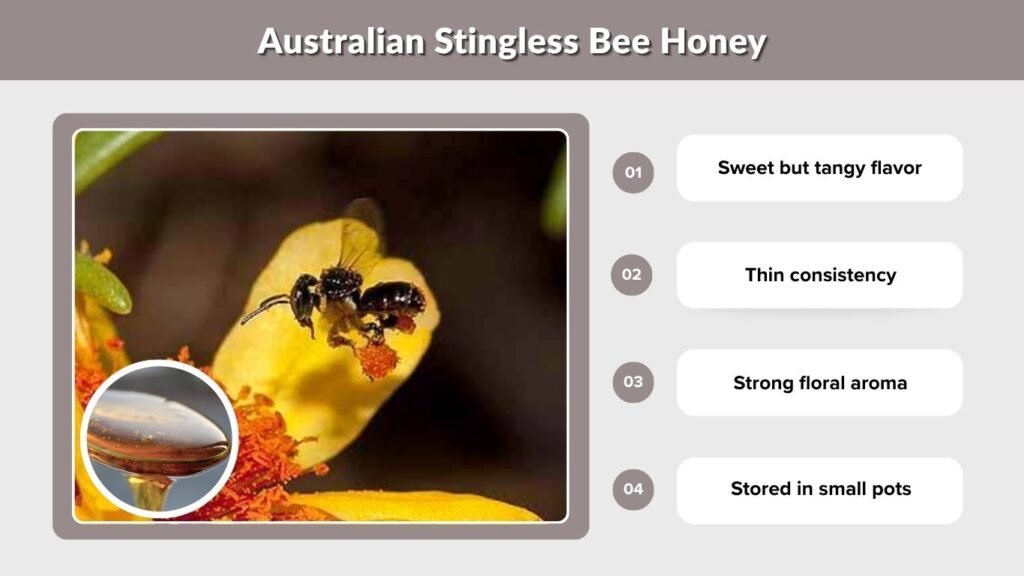
Australian stingless bee honey is traditionally known as sugarbag honey. Rather than filling conventional honeycomb, the bees store their honey in clusters of small pots surrounding the brood area.
Sugarbag has a distinctive flavor and usually tastes more tangy than ordinary commercial honey.
What Is Sugarbag Honey Like?
Typical characteristics include:
- Sweet but tangy flavor
- Thin consistency
- Strong floral aroma
- Stored in small pots
- Produced in relatively small quantities
- Flavor varying with flowers and region
Australian stingless bees make much less harvestable honey than European honey bees. In cooler environments, colonies may require most of their stored honey to survive periods when flowers are scarce.
Should Every Hive Be Harvested?
No.
Honey production should not automatically be the main goal of keeping Australian stingless bees. Harvesting too aggressively can remove food required by the colony.
In cooler parts of their range, leaving honey inside the hive can be particularly important for survival during winter or prolonged periods of poor weather.
Why Australian Stingless Bees Are Important
Native stingless bees are valuable pollinators. Workers move between flowers collecting nectar and pollen and transfer pollen in the process.
Their small size and different foraging behavior mean they can complement introduced European honey bees in Australian landscapes.
Benefits of Australian Stingless Bees
They can:
- Pollinate native plants
- Pollinate garden flowers
- Support biodiversity
- Contribute to fruit and seed production
- Pollinate some agricultural crops
- Produce small quantities of sugarbag honey
- Provide opportunities for environmental education
- Support native-bee conservation
Stingless bees are considered effective pollinators of crops such as macadamias and are also being studied and used for managed crop pollination.
FAQs
1. Do Australian stingless bees really have no sting?
They possess greatly reduced stingers that cannot function like those of European honey bees. They are generally harmless to people, although colonies can still defend themselves in other ways.
2. Do Australian stingless bees produce honey?
Yes. Australia’s social stingless bees produce a tangy honey commonly known as sugarbag, which is stored inside small wax-and-resin pots.
3. How big are Australian stingless bees?
Most Australian social stingless bees are tiny, commonly around 3–5 mm long. Tetragonula carbonaria, for example, reaches approximately 4–5 mm.
4. Can I keep Australian stingless bees in my garden?
Yes, particularly if you live within their natural warm range. A suitable species, insulated hive, shade, flowering plants, and protection from temperature extremes are important.
5. Are Australian stingless bees native to Western Australia?
Some social stingless bees occur naturally in the warmer northern parts of Western Australia. They are tropical bees and are not naturally suited to the much cooler climate of southern Western Australia.