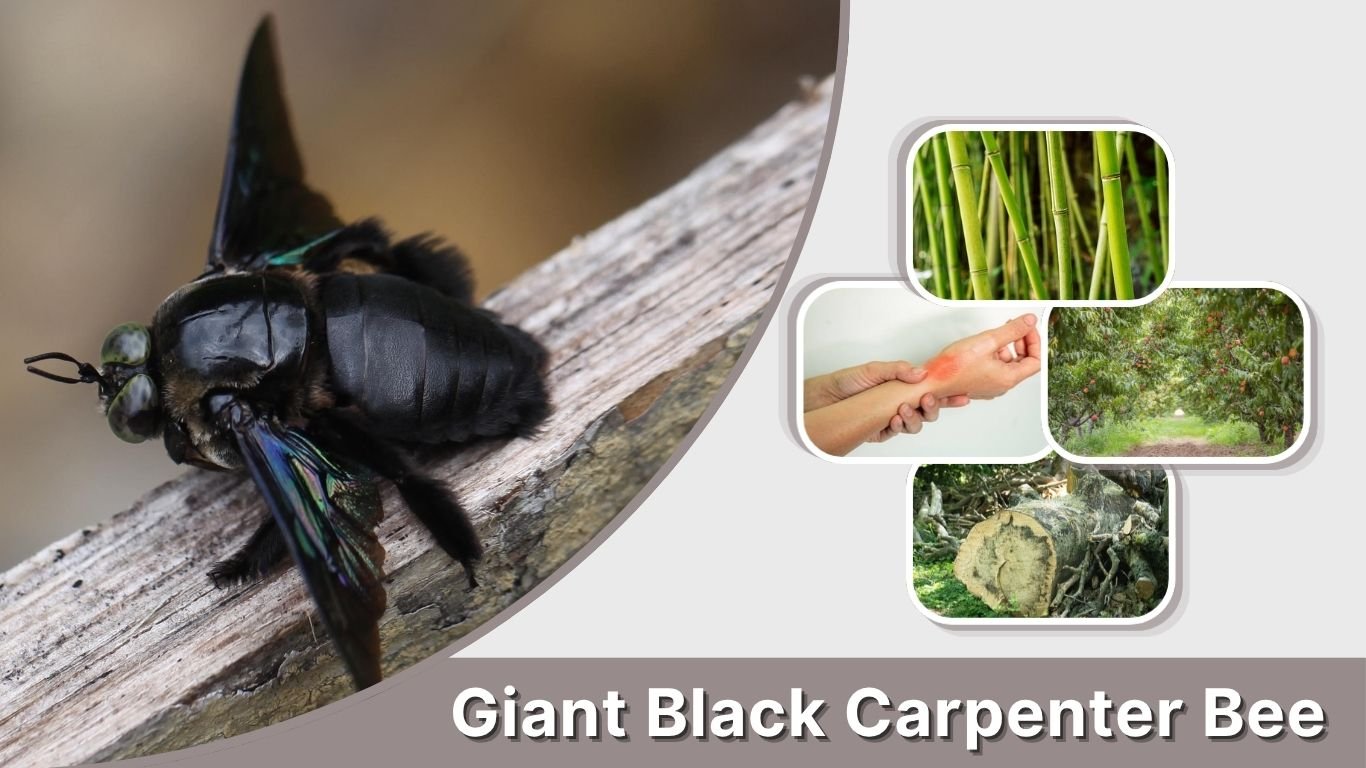
The giant black carpenter bee is an enormous, glossy bee known for its deep buzzing flight and iridescent blue, green, or purple wings. The name is commonly applied to the broad-handed carpenter bee, Xylocopa latipes, one of the largest carpenter bees in Asia. Despite its intimidating appearance, it is primarily a flower-visiting pollinator rather than an aggressive insect. These bees build nests by excavating dead wood, bamboo, and timber and are especially noticeable throughout tropical parts of South and Southeast Asia.
Giant Black Carpenter Bee Identification
The term “giant black carpenter bee” can sometimes describe several large black Xylocopa species, so identification by common name alone can be confusing. One species strongly associated with the name is Xylocopa latipes, also called the broad-handed, tropical, or Giant Bornean carpenter bee. It is among the largest and heaviest carpenter bees in its region.
What Does a Giant Black Carpenter Bee Look Like?
- Scientific name: Xylocopa latipes
- Family: Apidae
- Body length: Often around 30 mm, with some specimens approaching 35 mm
- Body: Large, broad, robust, and glossy black
- Wings: Dark with metallic blue, green, or purple iridescence
- Abdomen: Smooth and shiny rather than densely furry
- Flight: Strong with a loud, low-pitched buzz
- Legs: Powerful and adapted for gripping flowers and wood
- Female: Usually entirely dark and robust
- Male: Black but with distinctive modifications to the front legs
Singapore’s National Parks describes X. latipes as about 30 mm long and the country’s largest bee. Other taxonomic records report individuals reaching roughly 32–35 mm.
Giant Black Carpenter Bee Male vs Female
Male Xylocopa latipes can be distinguished by their unusual front legs. Their front tarsi are broad, flattened, and lined with conspicuous pale hairs. Males also have larger eyes that approach each other more closely at the top of the head.
Females lack these specialized pale front-leg structures. They are responsible for excavating nests and provisioning brood cells with pollen and nectar.
Giant Black Carpenter Bee Habitat and Distribution
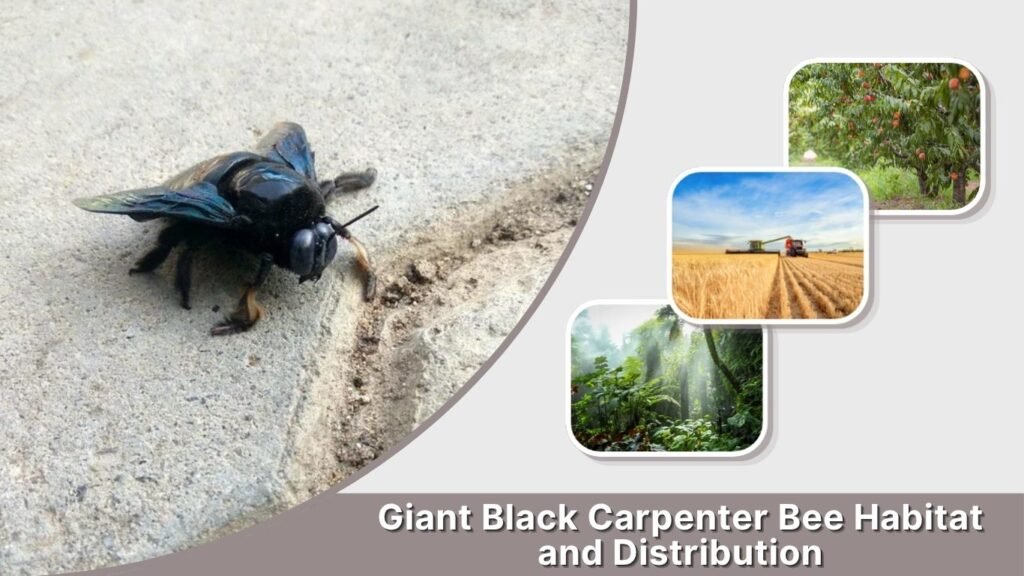
Giant black carpenter bees favor tropical and subtropical environments containing abundant flowers and suitable nesting wood. Xylocopa latipes occurs widely across Southeast Asia and also reaches portions of South Asia. It can survive in both natural forest and human-modified landscapes when nesting sites and flowers remain available.
Where Are Giant Carpenter Bees Found?
They may occur in:
- Tropical forests
- Forest edges
- Gardens
- Agricultural areas
- Orchards
- Parks
- Urban flowering landscapes
- Areas containing bamboo
- Places with dead trees and branches
- Wooden structures near suitable flowers
The Giant Bornean carpenter bee name is specifically associated with Xylocopa latipes, although its distribution is broader than the island of Borneo.
Giant Black Carpenter Bee Behavior and Diet
Although a giant carpenter bee may seem threatening when it flies past at close range, these bees are mainly occupied with feeding, mating, and nesting. They are generally solitary rather than forming huge colonies like honey bees. Several females can nevertheless nest in the same general piece of wood when the location is particularly suitable.
What Do Giant Black Carpenter Bees Eat?
- Flower nectar
- Pollen
- Nectar from tropical flowering plants
- Pollen collected for developing larvae
- Nectar from deep tubular flowers
Adults drink nectar primarily for energy, while females gather pollen to provision their offspring.
Large carpenter bees can also perform buzz pollination. They vibrate flowers using their flight muscles, helping release pollen that can then be carried between blossoms. X. latipes is recognized as a buzz-pollinating bee and is frequently seen visiting large tubular flowers.
Because of their large bodies, they sometimes cannot enter narrow flowers normally. In such cases, carpenter bees may access nectar through the base of the flower, a behavior known as nectar robbing. Research has documented this behavior in X. latipes on narrow-flowered plants such as sesame.
Giant Black Carpenter Bee Nest
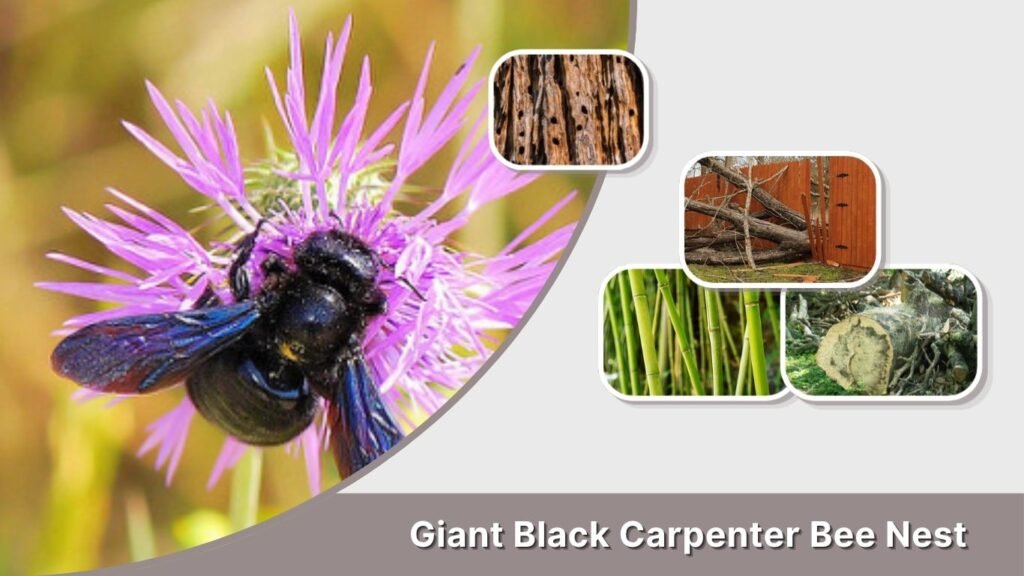
Carpenter bees receive their name from their ability to excavate wood. They do not eat the wood for nutrition. Instead, females use strong mandibles to remove fibers and construct protected galleries for their offspring.
Common Nesting Locations
- Dead tree trunks
- Dead branches
- Bamboo
- Fallen logs
- Weathered lumber
- Wooden rafters
- Timber posts
- Other untreated wooden structures
Studies of X. latipes have documented nests in dead wood, bamboo, and dead branches of living trees. The tunnel contains a series of individual brood cells.
How Is the Nest Built?
A female chews an entrance into suitable wood and excavates a gallery. Within the tunnel, she constructs separate chambers.
She places pollen mixed with nectar inside each chamber and lays one egg with the food supply. The chamber is then separated from the next using a partition produced from chewed wood particles held together with saliva.
The larva therefore has a private chamber containing enough food to support its early development.
Do Giant Black Carpenter Bees Sting?
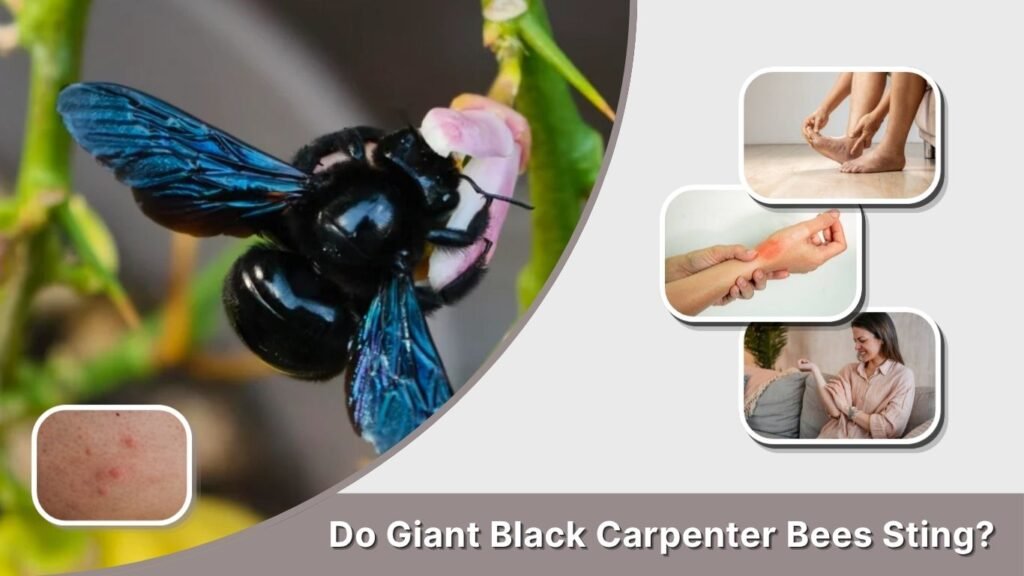
Their enormous size naturally causes people to wonder whether giant carpenter bees are dangerous. They can defend themselves, but they are not normally aggressive toward people. Sources describing X. latipes specifically characterize it as relatively unaggressive and unlikely to sting without significant provocation.
Giant Black Carpenter Bee Sting
Female giant carpenter bees can sting. They are most likely to do so when caught, squeezed, stepped on, or handled.
Male carpenter bees cannot sting because they lack a functional stinger.
A sting can cause localized:
- Pain
- Redness
- Swelling
- Itching
- Tenderness
Anyone developing difficulty breathing, widespread hives, dizziness, or swelling around the throat following any bee sting should seek urgent medical attention.
The best approach is simply to observe these impressive bees without trying to catch or handle them.
Giant Carpenter Bee Life Cycle
Like other bees, giant carpenter bees undergo complete metamorphosis. They pass through four distinct developmental stages. Most of this early development occurs safely inside the wooden gallery constructed by the female.
Four Life Cycle Stages
- Egg: The female places one egg in a provisioned brood chamber.
- Larva: The egg hatches, and the larva consumes the stored pollen and nectar.
- Pupa: The mature larva transforms into a pupa within its chamber.
- Adult: The fully developed carpenter bee eventually emerges from the wooden nest.
Unlike honey bees, carpenter bee larvae are not continuously fed by workers. The mother places the necessary food inside the brood chamber before sealing it.
Giant Indian Carpenter Bee
The Giant Indian carpenter bee usually refers to another species, Xylocopa tranquebarica. It should not automatically be treated as the same bee as Xylocopa latipes.
One particularly unusual feature of X. Tranquebarica is its nighttime activity. Research describes it as an obligately nocturnal carpenter bee capable of navigating and foraging even on extremely dark nights.
Therefore, photographs labeled simply “giant carpenter bee” may actually show several different Xylocopa species depending on location.
Giant Resin Bee vs Giant Carpenter Bee
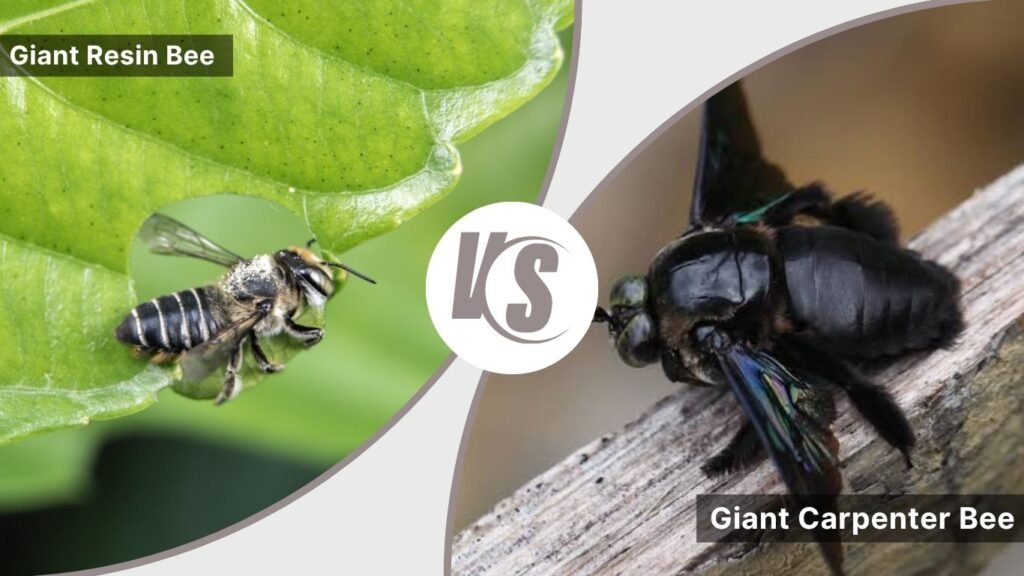
Giant resin bees and giant carpenter bees are both large bees, but they belong to different groups and use very different nesting strategies.
Key Differences
- Carpenter bees: Belong to the genus Xylocopa.
- Resin bees: Usually belong to the family Megachilidae.
- Carpenter bee nests: Females actively excavate tunnels into wood.
- Resin bee nests: Females generally use existing cavities and construct cells using resin or other materials.
- Carpenter bee body: Often broad, glossy, and powerfully built.
- Nesting evidence: Carpenter bees may leave visible wood shavings around nest entrances.
This distinction also helps clarify another commonly confused insect: Wallace’s giant bee.
Is Wallace’s Giant Bee a Carpenter Bee?
No. Wallace’s giant bee (Megachile pluto) is not a carpenter bee. It belongs to the leafcutter and resin-bee family Megachilidae.
Wallace’s giant bee is considered the world’s largest known living bee, with females reaching around 39 mm in body length. Xylocopa latipes is enormous, but it does not hold the overall world record for bee size.
FAQs
1. Are giant black carpenter bees dangerous?
Usually not. They are generally solitary and relatively nonaggressive. Females can sting when strongly provoked, but males cannot sting.
2. How big is a giant black carpenter bee?
Xylocopa latipes are commonly around 30 mm long, while especially large individuals may reach approximately 32–35 mm.
3. What is the Giant Bornean carpenter bee?
The name Giant Bornean carpenter bee is commonly used for Xylocopa latipes, also called the broad-handed or tropical carpenter bee.
4. Why are giant carpenter bees black with blue wings?
Their bodies are glossy black, while microscopic structures and pigmentation in the wings produce metallic blue, green, or purple reflections when viewed in sunlight.
5. Are giant carpenter bees beneficial?
Yes. They visit numerous flowers for pollen and nectar and can be highly effective pollinators. They become problematic mainly when repeated nesting occurs inside important structural timber.