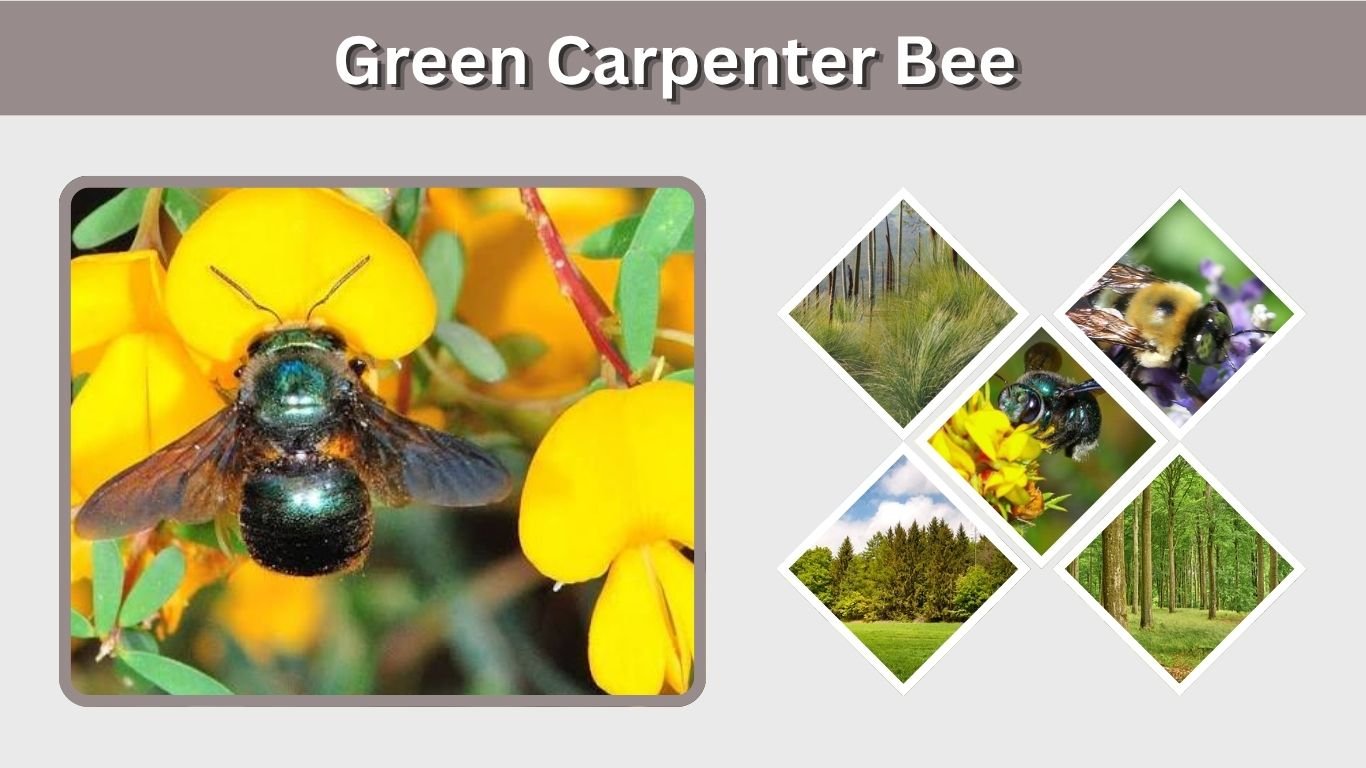
The green carpenter bee is one of Australia’s most striking native bees, famous for its shimmering metallic green body and deep buzzing flight. Often called the golden-green or metallic green carpenter bee, Xylocopa (Lestis) aerata is a large wood-nesting species found mainly in parts of New South Wales and on Kangaroo Island. Despite its impressive size, it is not considered an aggressive bee. Green carpenter bees are valuable native pollinators, but habitat loss and intense bushfires have caused serious declines in parts of their former range.
What Is a Green Carpenter Bee?
The green carpenter bee is a large Australian native bee in the family Apidae. Its common name comes from two obvious characteristics: the metallic green appearance of its body and the female’s habit of excavating nesting tunnels in soft dead wood.
It is also commonly known as the golden-green carpenter bee or metallic green carpenter bee.
Green Carpenter Bee Identification
Look for these characteristics:
- Scientific name: Xylocopa (Lestis) aerata
- Color: Metallic green, blue-green, bronze-green, or sometimes purplish
- Size: Close to 2 cm long
- Body: Large, broad, and robust
- Wings: Dark or smoky
- Flight: Fast with a noticeable low buzzing sound
- Male: May show yellow facial markings
- Female: Typically darker with a strong blue-green metallic sheen
- Nest: Tunnels excavated into suitable dead wood or dry grass-tree flower stalks
The reflective body can appear to change color depending on lighting and viewing angle, making an individual look greener, bluer, or more purple at different moments.
Is the Green Carpenter Bee the Same as the Peacock Carpenter Bee?
No. Australia has another striking carpenter bee known as the peacock carpenter bee, Xylocopa bombylans.
The two can appear similar because both have metallic coloration. The Australian Museum describes the peacock carpenter bee as occurring in eastern Australia north of Sydney, while the golden-green carpenter bee has populations in parts of New South Wales and Kangaroo Island.
Because common names can overlap, photographs alone may not always be enough for reliable identification.
Where Do Green Carpenter Bees Live?
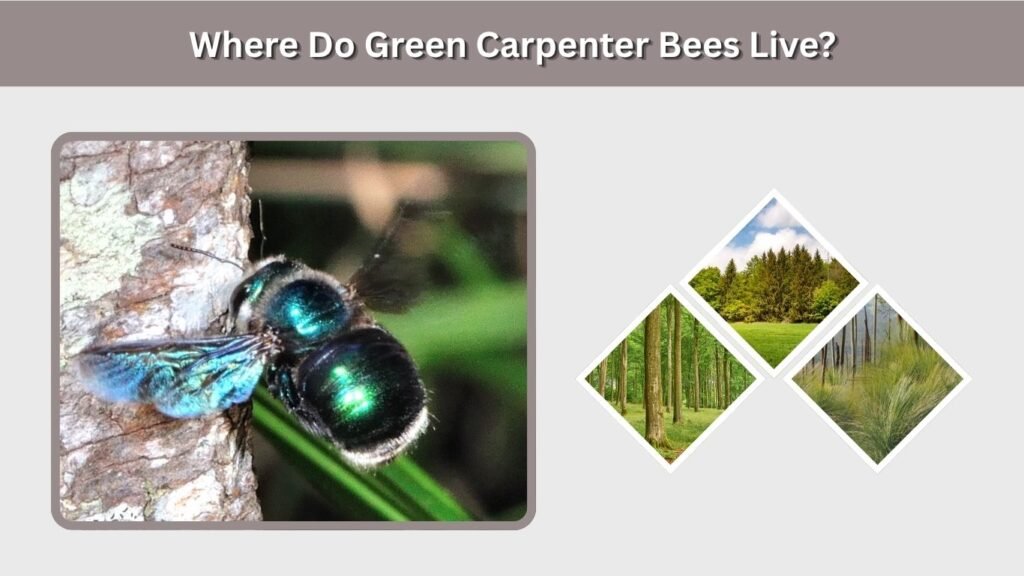
Green carpenter bees need two major resources: flowering plants for nectar and pollen and suitable dead plant material in which females can excavate nests. Their dependence on old nesting material is one reason habitat disturbance and repeated severe fires can have such a major effect on populations.
Green Carpenter Bee Habitat
Suitable habitat may include:
- Native woodland
- Heathland
- Forest edges
- Areas containing mature Banksia
- Grass-tree habitats
- Flower-rich native vegetation
- Conservation areas
- Landscapes containing old, soft dead wood
Females particularly use dry grass-tree flower stalks and soft dead Banksia wood for nesting. Banksia may require decades of growth before suitable large dead trunks become available, making these nesting sites difficult to replace quickly after fire.
Where Are Green Carpenter Bees Found in Australia?
Historically, the species occupied a much broader part of southeastern Australia.
Today, important surviving populations occur around Sydney and parts of the Great Dividing Range in New South Wales, as well as Kangaroo Island in South Australia. CSIRO reported in 2025 that Kangaroo Island supports South Australia’s only remaining population.
The species has disappeared from Victoria and mainland South Australia.
Why Are They Called Carpenter Bees?
Carpenter bees do not eat wood like termites. Instead, females use their powerful jaws to chew into soft dead plant material and construct tunnels where their offspring develop.
The ability to excavate wood gives the entire carpenter bee group its common name.
How Green Carpenter Bees Build Nests
The nesting process generally involves:
- A female finds suitable soft dead wood or a dry grass-tree stalk.
- She chews into the material with her jaws.
- A long tunnel is gradually being excavated.
- The tunnel is divided into individual brood cells.
- Nectar and pollen are placed inside each cell.
- An egg is laid with the food supply.
- The chamber is sealed.
- The developing larva feeds on the stored pollen and nectar.
- Young bees eventually emerge from the nest.
Nest tunnels can become quite long, and several bees may sometimes share or cooperate around a nesting site even though green carpenter bees are not organized into honeybee-style colonies.
Do Green Carpenter Bees Damage Houses?
The Australian green carpenter bee primarily depends on natural dead plant material such as Banksia wood and grass-tree stalks.
This is different from some carpenter bee species elsewhere in the world that commonly attract attention by nesting in structural timber.
If a native green carpenter bee is found around natural wood, removing or destroying the nest unnecessarily should be avoided, particularly because some populations are under significant conservation pressure.
What Do Green Carpenter Bees Eat?
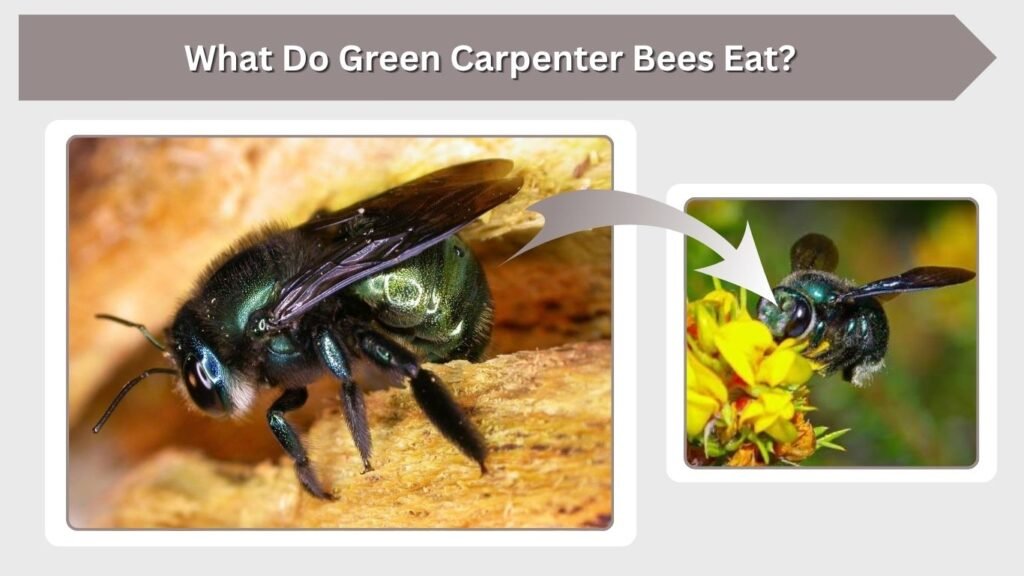
Adult green carpenter bees feed on nectar for energy and collect pollen as a protein-rich food for developing offspring. They visit various native flowers and can travel between plants while foraging.
Their feeding behavior makes them valuable pollinators rather than wood-eating pests.
Green Carpenter Bee Diet
Their food primarily consists of:
- Flower nectar
- Pollen
- Nectar stored for larvae
- Pollen collected for brood cells
Female bees combine pollen and nectar into provisions that are placed inside nesting chambers before an egg is laid.
Green carpenter bees are also capable of buzz pollination, during which vibrations help release pollen from certain flowers. This makes them particularly valuable to plants whose pollen is difficult to release through ordinary flower visits.
Why Are Green Carpenter Bees Important?
Their importance extends beyond their unusual appearance.
As they travel between flowers, green carpenter bees transfer pollen and support reproduction in native plants. Their ability to buzz-pollinate means they can be particularly effective visitors to certain flowering species.
Losing populations of these bees can therefore affect more than the insects themselves; it can also reduce an important ecological pollination service.
Do Green Carpenter Bees Sting?
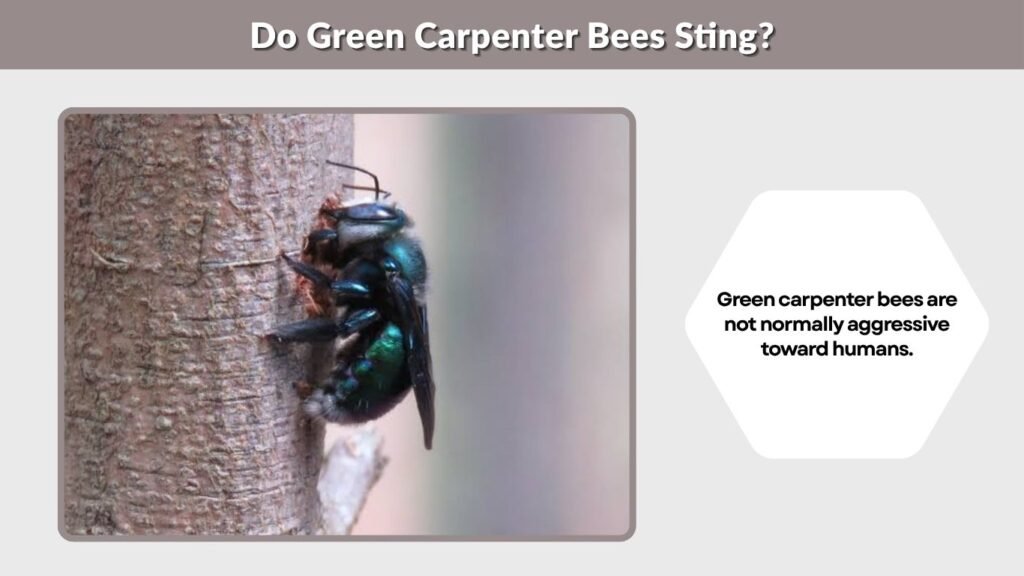
Green carpenter bees are not normally aggressive toward humans. Like other carpenter bees, females have the ability to sting, but they generally prefer escaping rather than attacking.
A sting is most likely if a female is trapped, squeezed, or deliberately handled.
Are Green Carpenter Bees Dangerous?
For most people, these bees present very little threat when left alone.
Remember:
- Females can sting if strongly provoked.
- Males cannot sting.
- They do not form large defensive honeybee-style hives.
- They normally concentrate on flowers and nesting.
- They should not be handled unnecessarily.
- People with serious bee-sting allergies should still avoid close contact with any bee.
There is usually no reason to remove a green carpenter bee simply because it is visiting garden flowers.
Are Green Carpenter Bees Extinct?
The green carpenter bee is not completely extinct, but it has disappeared from important parts of its former distribution.
This distinction is important because searches for “green carpenter bee extinct” can give the impression that the entire species has vanished.
Green Carpenter Bee Conservation Status
The situation can be summarized as follows:
- It is extinct from Victoria.
- It has disappeared from mainland South Australia.
- It still occurs in parts of New South Wales.
- A vulnerable population survives on Kangaroo Island.
- Habitat loss has reduced available nesting locations.
- Severe bushfires have destroyed both bees and nesting material.
South Australian conservation assessments have identified the Kangaroo Island population as particularly vulnerable, while CSIRO confirmed in 2025 that the island retains South Australia’s only remaining population.
How Did Bushfires Affect Green Carpenter Bees?
Fire creates a complicated problem for these bees.
Some grass trees produce useful nesting stalks following fire, but intense or frequent fires can destroy existing bees, dead Banksia nesting wood, and flowering resources. Banksia suitable for nesting may require more than 30 years to develop, meaning repeated fires can prevent habitat from recovering sufficiently.
The 2019–20 fires severely affected the remaining habitat on Kangaroo Island. Conservation workers have used artificial nesting material, including specially prepared balsa wood, to help provide replacement nest sites.
Green-Eyed Carpenter Bees
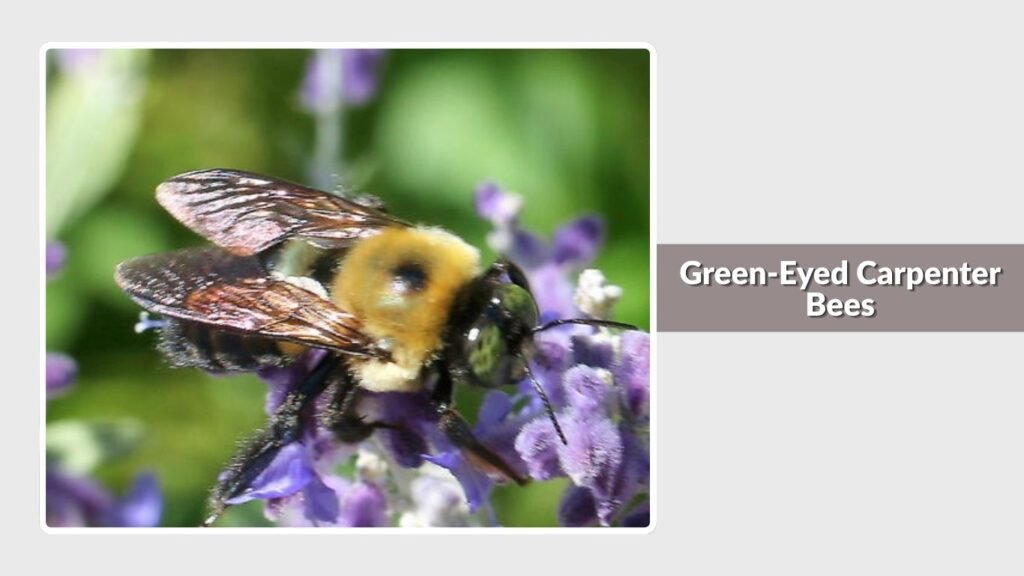
A carpenter bee with green-looking eyes is not automatically the Australian green carpenter bee.
“Green carpenter bee” refers primarily to metallic body coloration in species such as Xylocopa aerata. Eye color varies among carpenter bee species, and some males belonging to other Xylocopa groups can have conspicuous light or greenish eyes.
Identification should therefore consider body color, sex, geographic location, size, and other physical features rather than eye color alone.
Metallic Green vs Golden-Green Carpenter Bee
The names metallic green carpenter bee, golden-green carpenter bee, and green carpenter bee are commonly used for Xylocopa aerata.
These names describe the same remarkable reflective coloration. Under strong sunlight, the bee may appear brilliant green or golden-green, while another viewing angle can produce blue, bronze, or purple tones.
FAQs
1. Are green carpenter bees rare?
They can be uncommon and geographically restricted. Xylocopa aerata has disappeared from Victoria and mainland South Australia, with surviving populations in New South Wales and on Kangaroo Island.
2. Do green carpenter bees sting?
Female green carpenter bees are capable of stinging but are generally non-aggressive and unlikely to sting unless handled or threatened. Males cannot sting.
3. Where do green carpenter bees nest?
Females commonly excavate nests in soft dead Banksia wood and dry flower stalks of grass trees. They create tunnels divided into individual brood chambers.
4. What do green carpenter bees eat?
Adults consume nectar and collect pollen. Females provide a mixture of nectar and pollen for their developing larvae.
5. Are green carpenter bees harmful?
No. They are beneficial native pollinators rather than dangerous pests. Their populations face habitat and fire-related pressures, so naturally occurring nests should generally be left undisturbed whenever possible.