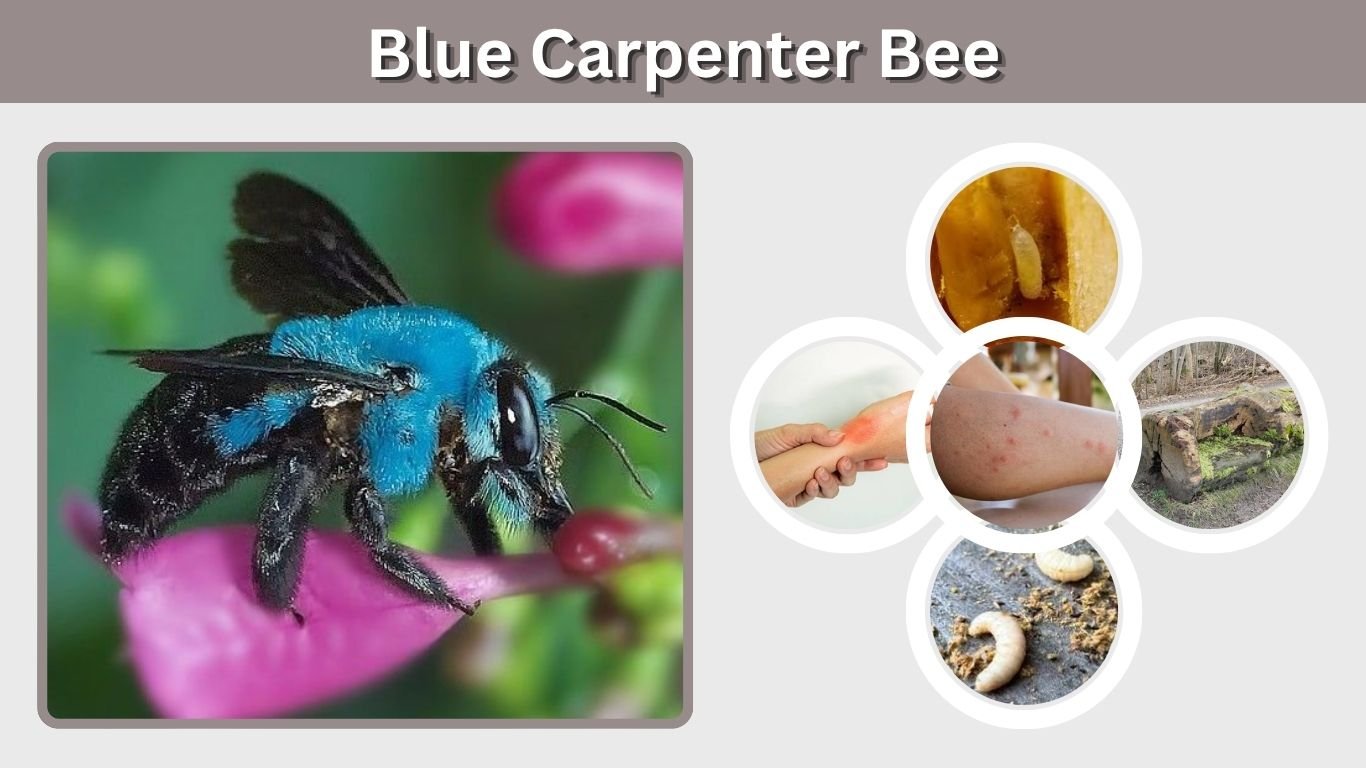
The blue carpenter bee is one of the most striking large bees in the world, known for its metallic blue body and powerful buzzing flight. The name commonly refers to Xylocopa caerulea, a large carpenter bee found in parts of South and Southeast Asia. Despite its intimidating size, this bee is generally calm and spends most of its time visiting flowers or preparing nests in wood. In this guide, you’ll learn about blue carpenter bee identification, habitat, sting risk, diet, nesting habits, lifespan, and life cycle.
Blue Carpenter Bee Identification
Blue carpenter bees are immediately recognizable because of their unusual blue or bluish-gray appearance. Unlike many carpenter bees that are mostly glossy black, Xylocopa caerulea has dense bluish hairs that can give the entire insect a soft metallic or powder-blue look. Its large body and strong wings also make it much more noticeable than smaller native bees.
What Does a Blue Carpenter Bee Look Like?
- Scientific name: Xylocopa caerulea
- Family: Apidae
- Body size: Commonly around 20–25 mm long
- Color: Metallic blue, gray-blue, or bluish-black
- Body shape: Large, broad, and robust
- Thorax: Covered with dense blue-gray hairs
- Abdomen: Dark with bluish hairs or metallic reflections
- Wings: Dark, smoky, or slightly iridescent
- Flight: Strong and accompanied by a deep buzzing sound
Why Are Blue Carpenter Bees Blue?
The blue appearance comes largely from the coloration and light-reflecting properties of the hairs covering the body. Depending on lighting conditions, an individual may look pale blue, teal, bluish-gray, or almost black.
This can also explain why photographs of the same species sometimes show noticeably different shades.
Blue Carpenter Bee Habitat and Range
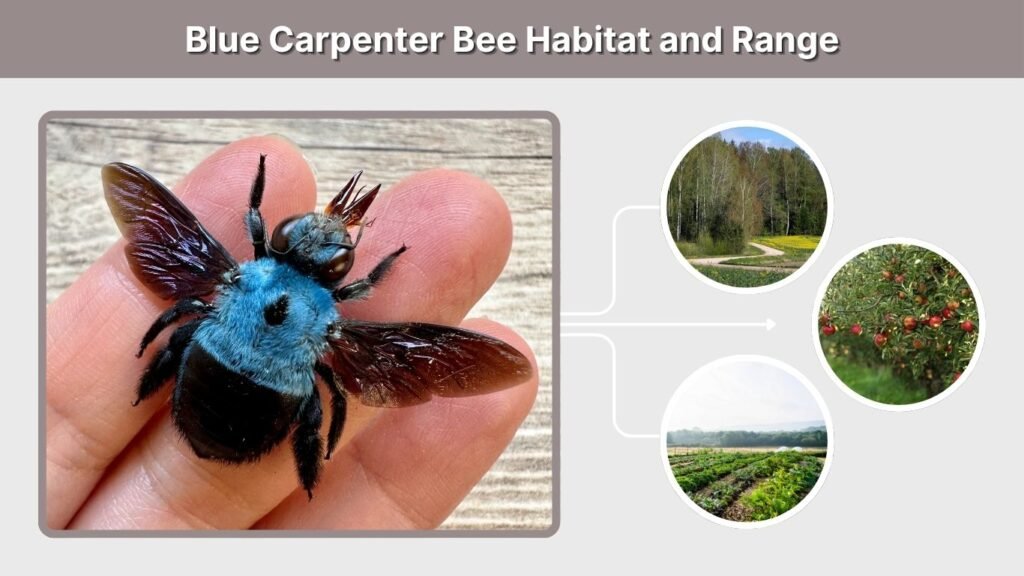
Blue carpenter bees prefer warm climates with abundant flowering plants and suitable wood for nesting. They are mainly associated with tropical and subtropical regions of Asia. Gardens, forest edges, orchards, and agricultural landscapes can all provide good habitat as long as flowers and nesting material are available.
Where Do Blue Carpenter Bees Live?
- India
- Southern China
- Thailand
- Malaysia
- Indonesia
- Singapore
- Other parts of South and Southeast Asia
- Tropical gardens
- Forest edges
- Orchards
- Agricultural areas
- Places containing dead or weathered wood
Are Blue Carpenter Bees Found in Australia or the UK?
The true blue carpenter bee, Xylocopa caerulea, is primarily an Asian species. Large carpenter bees occur in Australia, but they belong to other species and may sometimes be described casually as blue because of metallic coloration.
Likewise, a large dark bee with blue or violet wings in the UK is more likely to be the violet carpenter bee, Xylocopa violacea, rather than Xylocopa caerulea.
Blue Carpenter Bee Behavior and Diet
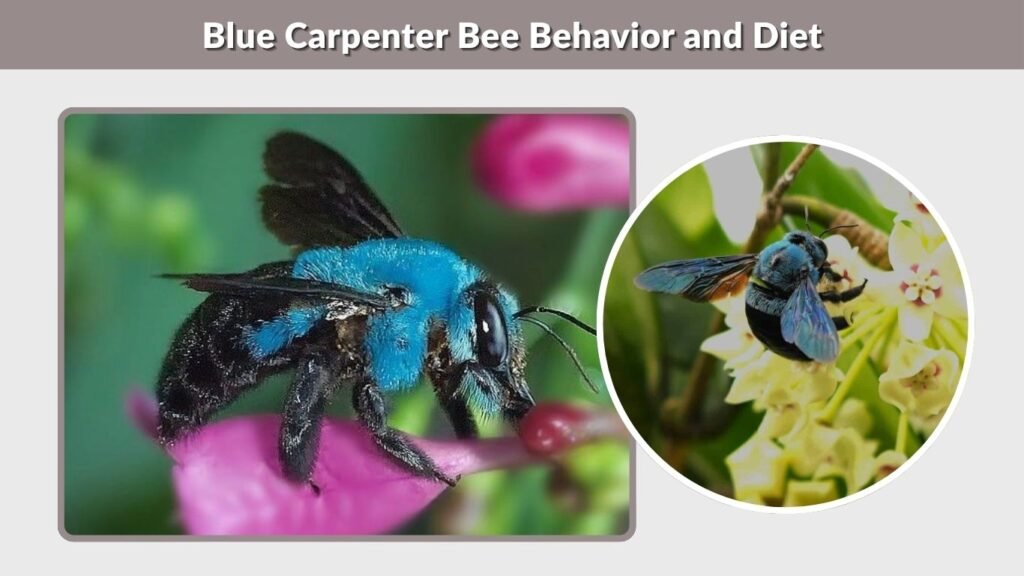
Blue carpenter bees are primarily solitary insects. Females build and provision their own nests instead of living in large colonies like honey bees. Several females may sometimes nest close together when suitable wood is available, but each female generally manages her own brood chambers.
What Do Blue Carpenter Bees Eat?
Adult blue carpenter bees feed mainly on:
- Flower nectar
- Pollen
- Nectar from deep flowers
- Pollen from tropical flowering plants
- Nectar from garden flowers
- Blossoms of fruiting plants
Nectar provides energy for flight, while pollen supplies protein and nutrients. Females collect both pollen and nectar to prepare food for their developing larvae.
Blue Carpenter Bee Pollination
Their large bodies make blue carpenter bees effective pollinators. As they move from flower to flower, pollen sticks to their hairy bodies and is transferred to other blossoms.
Carpenter bees can also use buzz pollination on certain plants. Vibrations produced by their flight muscles help shake pollen loose from flowers, making them particularly valuable for some crops and wild plants.
Blue Carpenter Bee Nest
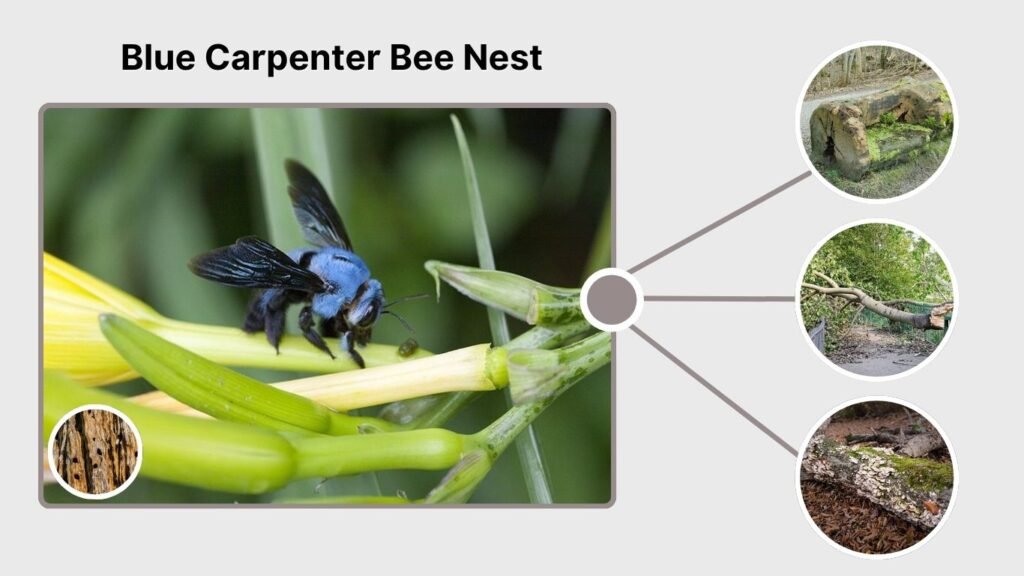
The name “carpenter bee” comes from the female’s ability to excavate nests inside wood. She uses powerful jaws to chew tunnels rather than eating the wood itself. These tunnels serve as protected chambers where eggs can develop safely.
Where Do Blue Carpenter Bees Nest?
- Dead branches
- Fallen logs
- Weathered timber
- Bamboo-like plant material
- Dead tree trunks
- Wooden posts
- Untreated outdoor wood
- Soft or partially decayed wood
Inside the tunnel, the female creates several separate brood cells. Each cell receives a ball of pollen mixed with nectar before she lays an egg.
The chamber is then sealed with material created from chewed wood.
Do Blue Carpenter Bees Damage Wood?
Natural nesting in dead trees or logs is normally harmless. Problems may occur if carpenter bees repeatedly use wooden structures around homes.
A single nesting tunnel usually causes limited damage. However, repeated nesting and expansion over several years may weaken exposed wood. Painting or sealing outdoor timber can reduce its attractiveness to nesting carpenter bees.
Are Blue Carpenter Bees Dangerous?
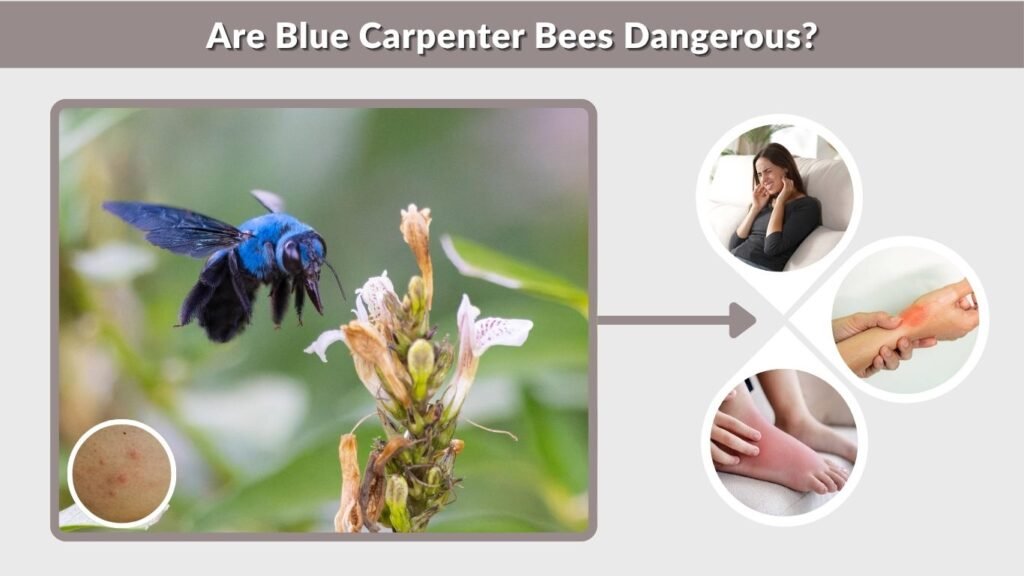
The impressive size and loud buzzing of a blue carpenter bee can make it appear threatening. However, these bees are generally not aggressive toward humans. Their primary concerns are feeding, mating, and finding appropriate nesting locations.
Do Blue Carpenter Bees Sting?
Female blue carpenter bees can sting, but they rarely sting unless they are grabbed, trapped, stepped on, or strongly threatened.
Male carpenter bees cannot sting.
A male may fly close to people or hover around a nesting territory, which can look aggressive, but this behavior is mostly intended to investigate intruders or defend mating areas.
Blue Carpenter Bee Sting Symptoms
A sting from a female may cause:
- Immediate pain
- Redness
- Local swelling
- Itching
- Tenderness around the sting site
Serious allergic reactions are possible with any bee sting. Difficulty breathing, severe swelling, dizziness, or widespread hives requires urgent medical attention.
Blue carpenter bees do not normally bite people. Their jaws are primarily used for excavating wood and handling nesting material.
Do Blue Carpenter Bees Make Honey?
Blue carpenter bees collect nectar, but they do not produce honey in large stores like honey bees. Their solitary lifestyle does not require a communal honey reserve.
How They Use Nectar and Pollen
Females mix nectar with pollen to form a nutritious food mass inside each brood chamber. An egg is placed with this food supply.
After hatching, the larva consumes the stored pollen and nectar while developing. It does not need workers to continuously feed it because the mother prepares enough food beforehand.
This is very different from the social feeding system used inside honey bee colonies.
Blue Carpenter Bee Life Cycle
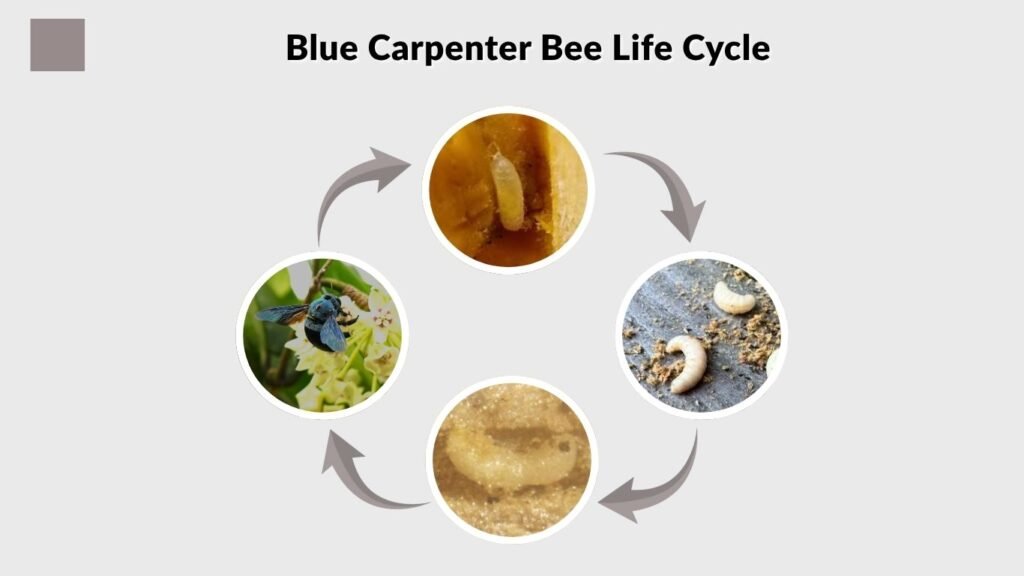
The blue carpenter bee undergoes complete metamorphosis. Its development includes egg, larva, pupa, and adult stages. Nearly all nesting work is performed by the female, who excavates the gallery and provisions each chamber before laying her eggs.
Four Life Cycle Stages
- Egg: The female lays one egg inside a prepared brood cell.
- Larva: The larva hatches and consumes stored pollen and nectar.
- Pupa: After completing larval growth, it enters the pupal stage.
- Adult: The fully developed bee emerges from the nest.
The amount of time needed for development depends on temperature, food availability, climate, and local seasonal conditions.
Blue Carpenter Bee Lifespan
The exact lifespan of Xylocopa caerulea can vary, but carpenter bees generally live considerably longer than many short-lived adult insects. Their lives are closely connected to seasonal flowering and nesting conditions.
How Long Do Blue Carpenter Bees Live?
Adults may survive for several months under favorable conditions. Their complete life cycle can extend much longer when development inside the nest is included.
Females invest substantial time in nest construction, egg laying, and collecting pollen. Adults may also use wooden galleries as shelter when weather becomes unfavorable.
Are Blue Carpenter Bees Rare?
Blue carpenter bees can appear rare because their geographic range is limited compared with more widespread honey bees and bumblebees. Their striking coloration also makes sightings feel especially unusual.
However, they may be locally common in suitable tropical habitats where flowering plants and appropriate nesting wood are abundant.
Habitat loss, removal of dead wood, pesticide exposure, and reduced flower diversity can all negatively affect solitary bee populations.
FAQs
1. Are blue carpenter bees real?
Yes. Xylocopa caerulea is a real carpenter bee species known for its striking bluish coloration and large body.
2. Are blue carpenter bees dangerous?
No. Blue carpenter bees are generally peaceful. Females can sting when strongly threatened, while males cannot sting.
3. Where are blue carpenter bees found?
They are primarily found in parts of South and Southeast Asia, including India, Thailand, Malaysia, Indonesia, and neighboring regions.
4. Do blue carpenter bees make honey?
No. They collect nectar but do not produce large honey stores. Females mix nectar with pollen to provide food for their larvae.
5. How big is a blue carpenter bee?
Blue carpenter bees are large and commonly measure around 20–25 mm in body length, although individual size can vary.