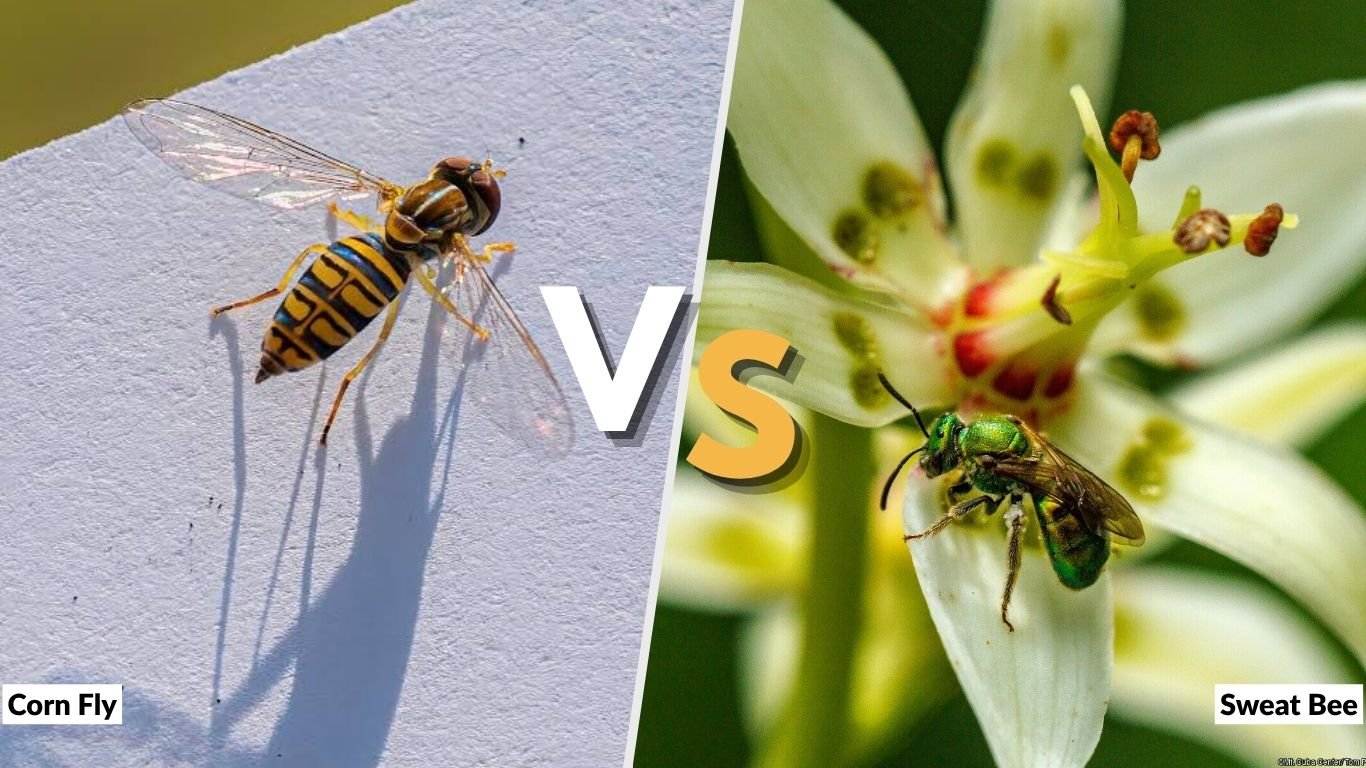
Corn flies and sweat bees are small insects that can look surprisingly similar, especially when they are hovering around flowers or landing on people during summer. However, a corn fly is actually a type of hover fly, while a sweat bee is a true bee belonging to the family Halictidae. The easiest differences involve their wings, eyes, antennae, body shape, flight behavior, and ability to sting. This corn fly vs sweat bee comparison explains how to identify each insect and determine whether the visitor around you is harmless.
Corn Fly vs Sweat Bee: Quick Comparison
Corn flies imitate bees with yellow-and-black markings, which helps explain why people frequently confuse them with sweat bees. Despite their similar size and appearance, they belong to completely different insect groups. Corn flies are syrphid flies, whereas sweat bees are genuine bees and important pollinators.
| Feature | Corn Fly | Sweat Bee |
| Insect type | Hover fly/syrphid fly | Bee |
| Common group | Often Toxomerus | Halictidae |
| Wings | One functional pair | Two pairs |
| Eyes | Very large, fly-like | Smaller bee-like eyes |
| Antennae | Short | Longer, obvious antennae |
| Body | Smooth and fly-like | Often hairy |
| Common colors | Yellow/orange and black | Green, blue, black, brown or striped |
| Flight | Frequently hovers | More typical bee flight |
| Sting | Cannot sting | Females can sting |
| Bite humans | No | Not normally |
| Attraction | Flowers, vegetation | Flowers, pollen, human sweat |
| Pollinator | Yes | Yes |
Corn flies and other syrphid flies neither bite nor sting humans, while female sweat bees have a functional stinger but are generally docile.
What Is a Corn Fly?
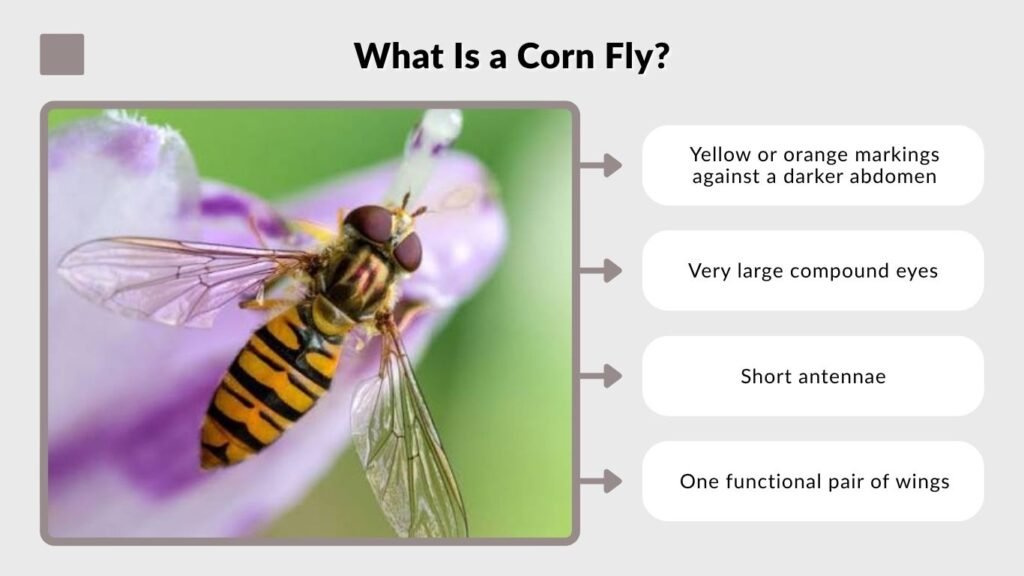
The name “corn fly” is commonly applied to certain syrphid or hover flies. One particularly relevant species is the maize calligrapher, Toxomerus politus, which occurs around cornfields and resembles a tiny yellow-and-black bee or wasp. Purdue Extension describes cornfield hover flies in the genus Toxomerus, often likely T. politus, as harmless bee mimics.
Corn Fly Identification
Look for these characteristics:
- Yellow or orange markings against a darker abdomen
- Very large compound eyes
- Short antennae
- One functional pair of wings
- Relatively smooth body
- Narrow fly-like legs
- Ability to hover almost motionless
- Sudden changes in flight direction
Their black-and-yellow pattern is a form of bee or wasp mimicry, but corn flies lack a stinger. Syrphid flies are also called hover flies or flower flies because adults frequently visit flowers.
Why Are Corn Flies Around People?
Corn flies may hover close to people or land on clothing and exposed skin, which can make them seem threatening.
They are not attempting to sting. Hover flies have no stinger and cannot bite humans. Their close approach is therefore annoying at most rather than dangerous.
What Is a Sweat Bee?
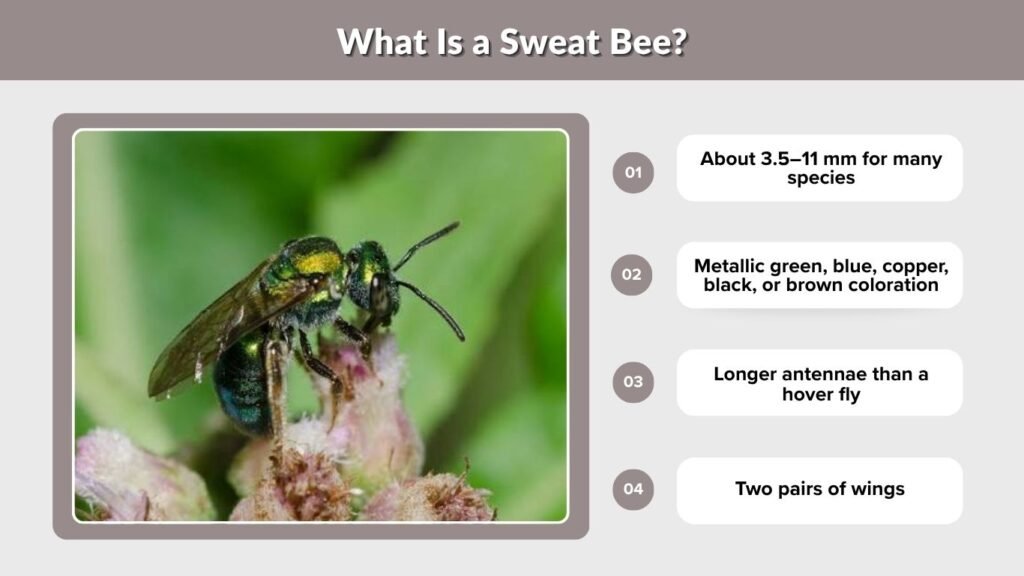
Sweat bees belong to the family Halictidae. They include many small species with dramatically different appearances. Some are brilliant metallic green or blue-green, while others are black, brown, or striped. They are called sweat bees because some species are attracted to salts in human perspiration.
Sweat Bee Identification
Typical characteristics include:
- About 3.5–11 mm for many species
- Metallic green, blue, copper, black, or brown coloration
- Longer antennae than a hover fly
- Two pairs of wings
- Hair on the body and legs
- Pollen-carrying hairs on the hind legs of many species
- Slender bee-like body
- Attraction to flowers and sometimes perspiration
Not every sweat bee is green. Some species have light-colored bands across a dark abdomen and can therefore resemble tiny honey bees.
Why Do Sweat Bees Land on Humans?
Some sweat bees seek salts from perspiration. This is particularly noticeable during hot weather when exposed skin becomes sweaty.
A sweat bee landing on your arm is usually looking for moisture and minerals rather than preparing to attack. Sweat bees are generally docile and unlikely to sting unless they are trapped, squeezed, or otherwise threatened.
Corn Fly vs Sweat Bee Appearance
Appearance is where most confusion begins. Both insects may be tiny, fast-moving, and associated with flowers. Some corn flies have yellow-and-black patterns that resemble bees, while some sweat bees are similarly small and striped.
Examining the eyes, antennae, wings, and body texture provides a much more reliable identification.
1. Eyes
Corn flies have the noticeably large compound eyes characteristic of flies. Their eyes may occupy much of the head.
Sweat bee eyes are proportionally smaller, leaving more visible space for their prominent antennae.
2. Antennae
Corn fly antennae look short and relatively inconspicuous.
Sweat bees have longer, segmented antennae that are easy to notice when viewing the insect from the front or side.
3. Wings
Wing number is one of the most reliable distinctions.
Corn flies are true flies and possess one functional pair of wings. Sweat bees, like other bees, possess two pairs, although the front and rear wings can overlap and appear like a single pair when folded.
4. Body Texture
Corn flies generally look smoother and less hairy.
Sweat bees often have noticeable hairs, especially on their legs and bodies. Female non-parasitic sweat bees commonly have pollen-carrying hairs on their hind legs.
Corn Fly vs Sweat Bee Flight Behavior
You can sometimes identify the insect without getting close enough to examine its body. Hover flies earned their name because they can remain almost stationary in the air before suddenly darting sideways or forward.
How Corn Flies Move
A corn fly may:
- Hover directly in front of you
- Remain suspended in one place
- Move suddenly sideways
- Return repeatedly to the same location
- Visit flowers
- Land briefly and fly away
This highly controlled hovering behavior is characteristic of syrphid flies.
How Sweat Bees Move
Sweat bees generally move more like conventional bees. They fly between flowers, vegetation, nesting areas, and sometimes people.
If a tiny bee repeatedly lands directly on sweaty skin and appears to lick the surface, a sweat bee becomes a stronger possibility.
Do Corn Flies or Sweat Bees Sting?
This is the most important practical difference.
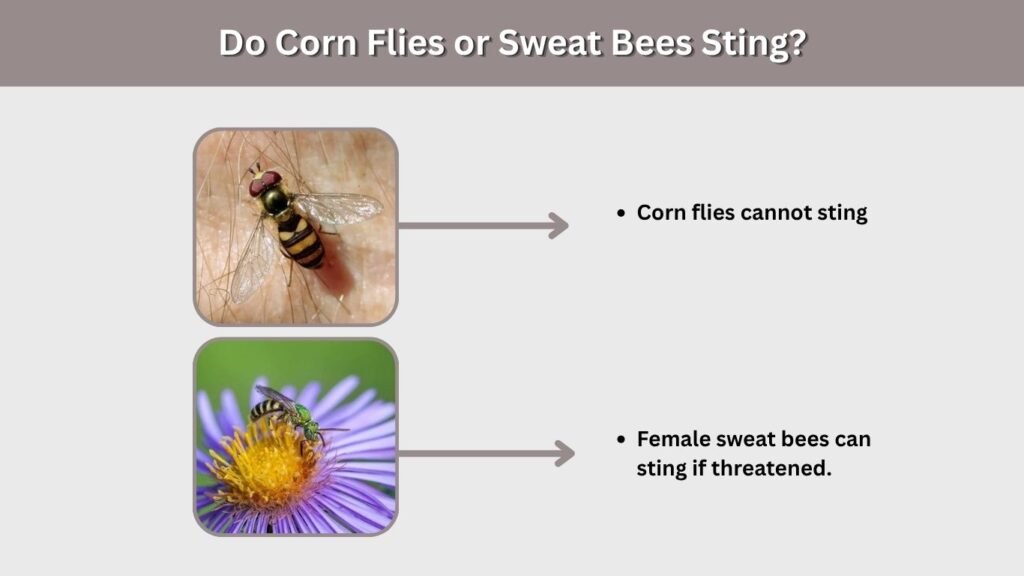
Corn flies cannot sting. Sweat bees can sting, although only females possess a functional stinger and they are generally not considered aggressive toward people.
Can a Corn Fly Sting?
No.
Corn flies and other hover flies:
- Have no stinger
- Cannot sting humans
- Do not bite humans
- Are harmless to people
Their bee-like colors are deceptive. University of Minnesota Extension specifically describes syrphid flies as insects that do not bite or sting.
Can a Sweat Bee Sting?
Female sweat bees can sting if threatened.
A sting may cause temporary:
- Sharp pain
- Burning
- Redness
- Itching
- Local swelling
- Tenderness
However, sweat bees are normally docile. Simply having one land on you does not mean it intends to sting.
Corn Fly vs Sweat Bee Diet
Both insects can be valuable around gardens because adults visit flowers. However, their immature stages and feeding behaviors differ considerably.
What Do Corn Flies Eat?
Adult syrphid flies typically visit flowers for pollen and nectar.
Many syrphid larvae are valuable predators. University of Minnesota Extension notes that larvae of many species consume aphids and can eat dozens per day, making hover flies useful natural pest-control insects.
What Do Sweat Bees Eat?
Adult sweat bees obtain nectar for energy and gather pollen to provision their offspring.
Many females have specialized hairs on their hind legs for transporting pollen. Some species also visit sweaty human skin for salt.
Are Corn Flies and Sweat Bees Beneficial?
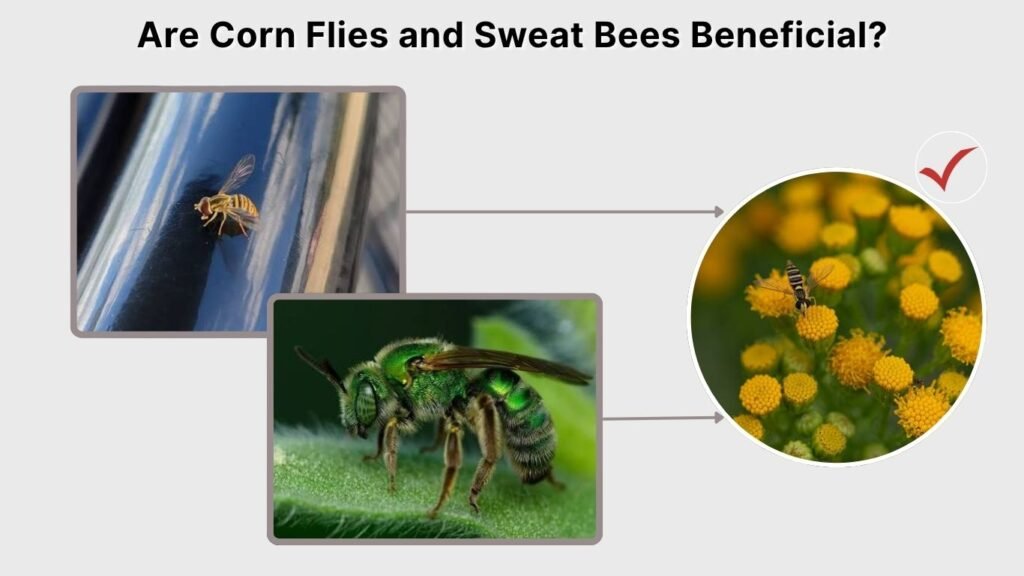
Both insects are generally worth leaving alone.
Corn flies contribute to pollination, while larvae of many hover fly species help control aphids. Sweat bees are native pollinators that regularly visit flowers and contribute to pollination in gardens and natural habitats.
Why You Should Avoid Killing Them
These insects can help by:
- Pollinating flowers
- Supporting plant reproduction
- Increasing insect diversity
- Providing food for wildlife
- Helping maintain garden ecosystems
Hover fly larvae can additionally reduce populations of aphids and other soft-bodied plant pests.
If the insects are simply visiting flowers or hovering nearby, control is usually unnecessary.
How to Tell a Corn Fly From a Sweat Bee Quickly
You do not need a microscope to make a reasonable identification. Watch the insect for several seconds before looking at its key physical features.
Quick Identification Checklist
It is probably a corn fly if it:
- Has extremely large eyes
- Has very short antennae
- Has only one visible functional pair of wings
- Hovers almost motionless
- Looks smooth rather than hairy
- Has yellow-and-black fly-like markings
It is probably a sweat bee if it:
- Has longer antennae
- Has a noticeably hairy body
- Carries pollen on its hind legs
- Looks metallic green or blue-green
- Has a bee-shaped head and body
- Shows interest in sweaty skin
The most reassuring distinction is that a corn fly is incapable of stinging, whereas a female sweat bee can sting but usually does so only defensively.
FAQs
1. Is a corn fly the same as a sweat bee?
No. A corn fly is a syrphid or hover fly, while a sweet bee is a true bee belonging to the family Halictidae.
2. Can corn flies sting you?
No. Corn flies do not have stingers and cannot sting or bite humans.
3. Can sweat bees sting humans?
Yes. Female sweat bees are capable of stinging, although they are usually docile and unlikely to sting unless threatened.
4. Why do corn flies look like bees?
Their yellow-and-black appearance resembles bees or wasps, which can make predators—and people—mistake them for stinging insects.
5. What is the easiest way to tell them apart?
Look at the eyes and antennae. Corn flies generally have very large fly-like eyes and short antennae, while sweat bees have more obvious antennae and typically hairier bodies. Flight is another clue: corn flies frequently hover almost motionless in the air.