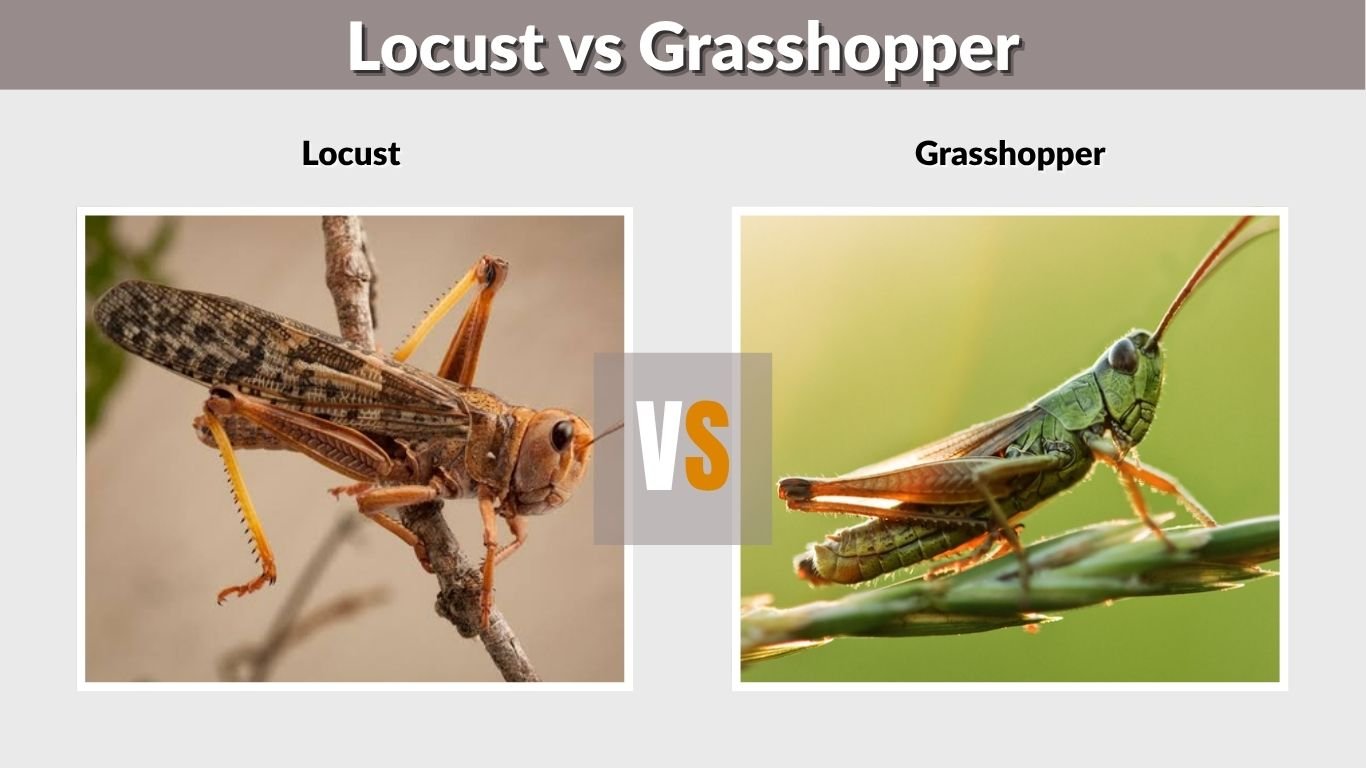
Locusts and grasshoppers look so similar that identifying them by appearance alone can be difficult. There is a good reason: locusts are actually certain species of grasshoppers. The major difference appears in their behavior. Under particular environmental and population conditions, locusts can change from a solitary lifestyle to a highly social phase, forming enormous moving groups and swarms. This locust vs grasshopper comparison explains their differences in appearance, size, color, sound, diet, flight, and swarming behavior.
Locust vs Grasshopper: Quick Comparison
The most important distinction between locusts and ordinary grasshoppers is not simply body shape or size. Locusts have an unusual ability known as phase polyphenism. Their behavior and sometimes physical appearance can change when population density increases. Ordinary grasshoppers do not undergo the same dramatic transformation or form massive coordinated swarms.
| Feature | Locust | Grasshopper |
| Classification | A type of grasshopper | Broad group of insects |
| Antennae | Usually short | Usually short |
| Lifestyle | Solitary or gregarious | Usually solitary |
| Swarming | Can form huge swarms | Normally does not |
| Diet | Primarily vegetation | Primarily vegetation |
| Color | May change with phase | Depends on species |
| Flight | Often strong, long-distance | Varies by species |
| Crop damage | Can be devastating in swarms | Usually localized |
| Body shape | Grasshopper-like | Varies among species |
| Social behavior | Can become highly social | Usually independent |
Are Locusts and Grasshoppers the Same?
Locusts are grasshoppers, but most grasshoppers are not locusts. Both belong to the order Orthoptera and share features such as powerful hind legs, chewing mouthparts, relatively short antennae, and usually two pairs of wings as adults.
What Is a Locust?
A locust is a grasshopper species capable of switching between solitary and gregarious phases.
When locust populations are relatively low, individuals behave much like ordinary grasshoppers. Under suitable conditions, increasing population density can cause changes in behavior and physiology. The insects become attracted to one another and may eventually form large groups.
What Is a Grasshopper?
Grasshopper is a much broader term covering thousands of short-horned Orthopteran species.
Most grasshoppers remain relatively independent throughout their lives. Although large numbers can sometimes occur in the same area and damage vegetation, they do not necessarily undergo the organized swarming transformation characteristic of true locust species.
Locust vs Grasshopper Appearance
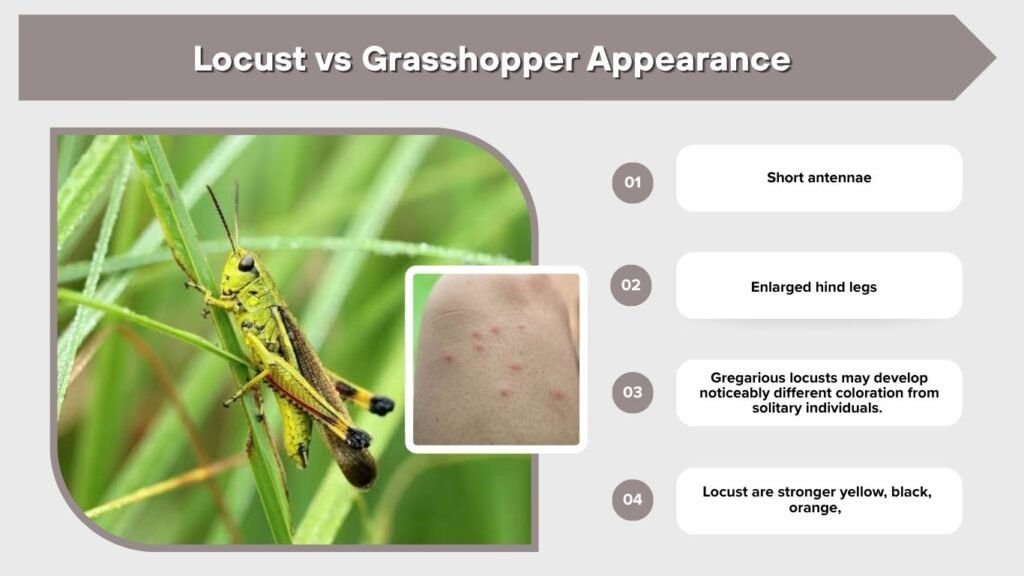
A solitary locust can look extremely similar to an ordinary grasshopper, which makes visual identification difficult without knowing the species. Changes become more noticeable when locusts enter their gregarious phase. Their coloration, body proportions, behavior, and movement may change depending on the locust species.
Grasshopper Appearance
Typical grasshopper characteristics include:
- Short antennae
- Enlarged hind legs
- Strong chewing mouthparts
- Large compound eyes
- Two pairs of wings in many adults
- Green, brown, gray, yellow, or patterned coloration
- A body adapted for jumping
These features also occur in locusts because locusts are grasshoppers.
Locust Appearance
Gregarious locusts may develop noticeably different coloration from solitary individuals. The exact colors depend on the species, age, and reproductive condition.
For example, some may show stronger yellow, black, orange, or contrasting markings during particular stages. Therefore, there is no single color that reliably separates every locust from every grasshopper.
Locust vs Grasshopper Size
Size is another commonly searched difference, but it is not a dependable identification method. Grasshoppers occur in a wide variety of sizes, and locust species fall within the same general range.
Are Locusts Bigger Than Grasshoppers?
Not necessarily. Some ordinary grasshoppers can be larger than certain locust species.
Grasshopper size depends on species rather than whether the insect is capable of swarming. Giant and lubber grasshoppers, for example, may appear considerably heavier than many familiar locusts.
Does a Locust Change Size?
Locust phase changes can affect body proportions and overall appearance, but becoming gregarious does not simply turn a small grasshopper into a giant insect.
The spectacular impression created by locusts comes from their enormous numbers rather than unusually large individual body size.
Locust vs Grasshopper Behavior
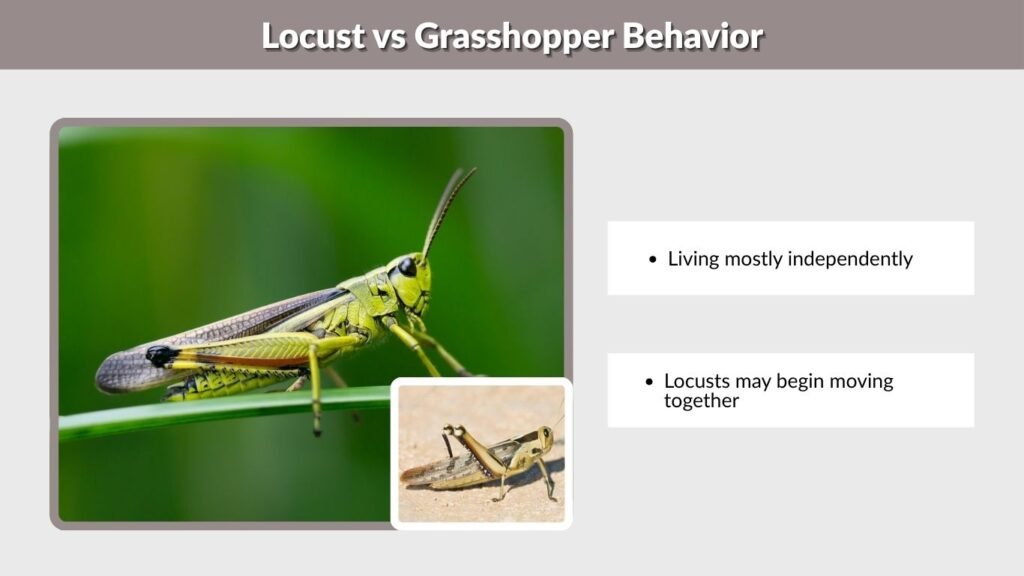
Behavior provides the clearest distinction between true locusts and ordinary grasshoppers. Most grasshoppers spend their lives feeding and moving individually. Locusts can behave similarly during their solitary phase but become dramatically more social when conditions trigger gregarious behavior.
Solitary Grasshopper Behavior
Typical grasshopper behavior includes:
- Living mostly independently
- Feeding on nearby vegetation
- Jumping or flying away from threats
- Searching individually for mates
- Remaining within suitable feeding habitats
Large numbers may inhabit the same field without forming a coordinated migratory swarm.
Locust Swarming Behavior
As locust density increases, repeated contact with other individuals can contribute to a transition toward gregarious behavior.
Locusts may begin moving together, initially forming dense groups of wingless nymphs known as hopper bands. Winged adults can later gather into swarms capable of traveling considerable distances.
Grasshopper vs Locust Swarm
Swarming is the characteristic most strongly associated with locusts. A true locust swarm consists of enormous numbers of coordinated insects traveling and feeding through an area.
Why Do Locusts Swarm?
Locust outbreaks often develop when environmental conditions encourage vegetation growth and successful reproduction, allowing populations to increase rapidly.
As suitable habitat becomes crowded and conditions change, locusts may become increasingly gregarious. Large groups can then move in search of additional food and favorable habitats.
Do Grasshoppers Swarm?
Ordinary grasshoppers can occasionally become extremely abundant and move between areas, but they do not exhibit the same classic phase transformation seen in locusts.
This ability to shift between solitary and gregarious forms is what separates true locust species from other grasshoppers.
Locust vs Grasshopper Diet
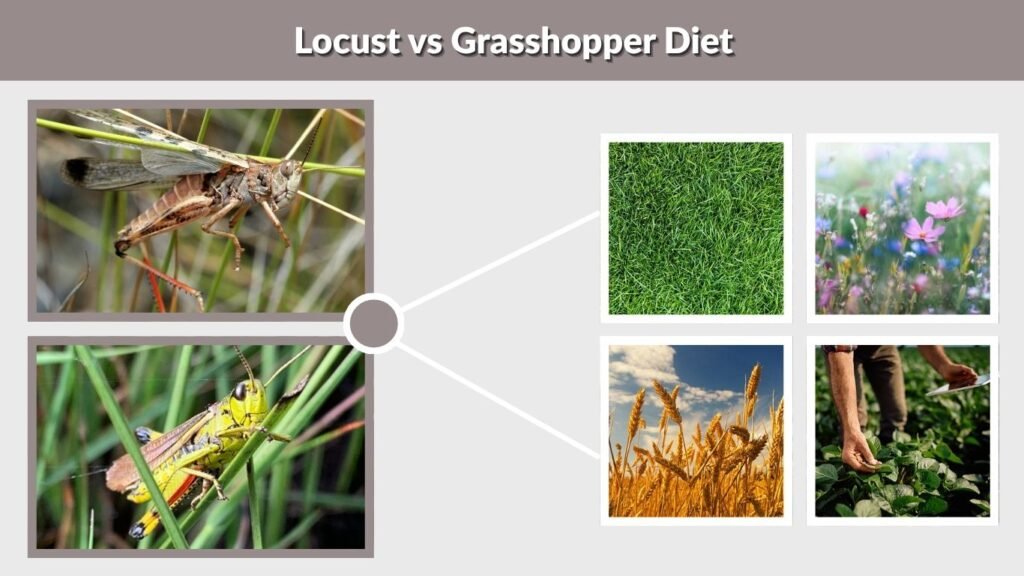
Both locusts and grasshoppers primarily feed on plants. They possess powerful chewing mouthparts capable of cutting through grasses, leaves, stems, flowers, and agricultural crops.
What Do Grasshoppers Eat?
Grasshoppers commonly eat:
- Grass
- Leaves
- Weeds
- Flowers
- Seeds
- Grains
- Cereal crops
- Garden plants
Diet varies considerably between species, with some grasshoppers specializing in particular plants.
What Do Locusts Eat?
Locusts also consume vegetation, including grasses and agricultural crops. Their individual feeding behavior is not necessarily extraordinary.
The problem occurs when millions of locusts feed within the same region. Collectively, a swarm can remove large amounts of vegetation and threaten crops and livestock forage.
Locust vs Grasshopper Flight and Sound
Both grasshoppers and adult locusts may possess functional wings. Many ordinary grasshoppers fly short or moderate distances, while swarming locusts are particularly well adapted for coordinated movement across large areas.
Flying Grasshopper vs Locust
Seeing an insect fly does not mean it is a locust. Many grasshopper species are capable flyers.
Locusts become distinctive when large numbers fly together as a swarm rather than because an individual has special wings.
Locust vs Grasshopper Sound
Both locusts and grasshoppers can produce sounds through mechanisms such as rubbing body structures together.
Their sounds vary considerably by species, so sound alone usually cannot reliably determine whether an insect is a locust or an ordinary grasshopper.
Locust vs Cricket vs Grasshopper
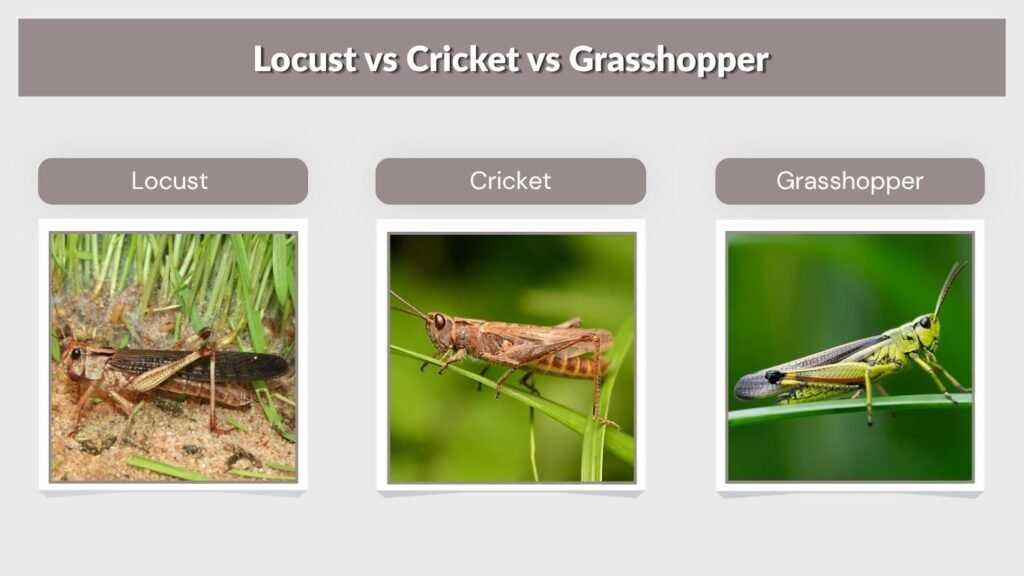
Crickets are related to grasshoppers and locusts but can usually be separated easily by their antennae. Crickets normally have very long, threadlike antennae, whereas grasshoppers and locusts usually have short antennae.
How to Tell Them Apart
- Grasshopper: Short antennae and usually solitary behavior.
- Locust: A grasshopper capable of entering a gregarious, swarming phase.
- Cricket: Long antennae and commonly active at night.
- Katydid: Very long antennae and often a green, leaflike body.
- Cicada: Belongs to a completely different insect order and has broad transparent wings.
The word “locust” is sometimes casually applied to cicadas in parts of North America, but cicadas are not true locusts.
Frequently Asked Questions
1. What is the main difference between a locust and grasshopper?
Locusts are particular grasshopper species capable of changing into a gregarious phase and forming large swarms. Most grasshopper species cannot do this.
2. Is a locust just a grasshopper?
Yes. A true locust is a type of short-horned grasshopper with the ability to undergo dramatic behavioral changes associated with crowding.
3. Are locusts bigger than grasshoppers?
Not necessarily. Some grasshopper species are larger than locusts, so body size is not a reliable way to distinguish them.
4. Do grasshoppers turn into locusts?
Only grasshopper species classified as locusts can undergo the behavioral and physical phase changes associated with locust swarming. An ordinary grasshopper species cannot suddenly become a locust.
5. Which is more harmful, locust or grasshopper?
Both can damage plants, but locusts can be much more destructive when they form huge swarms because millions of insects may feed across agricultural areas simultaneously.