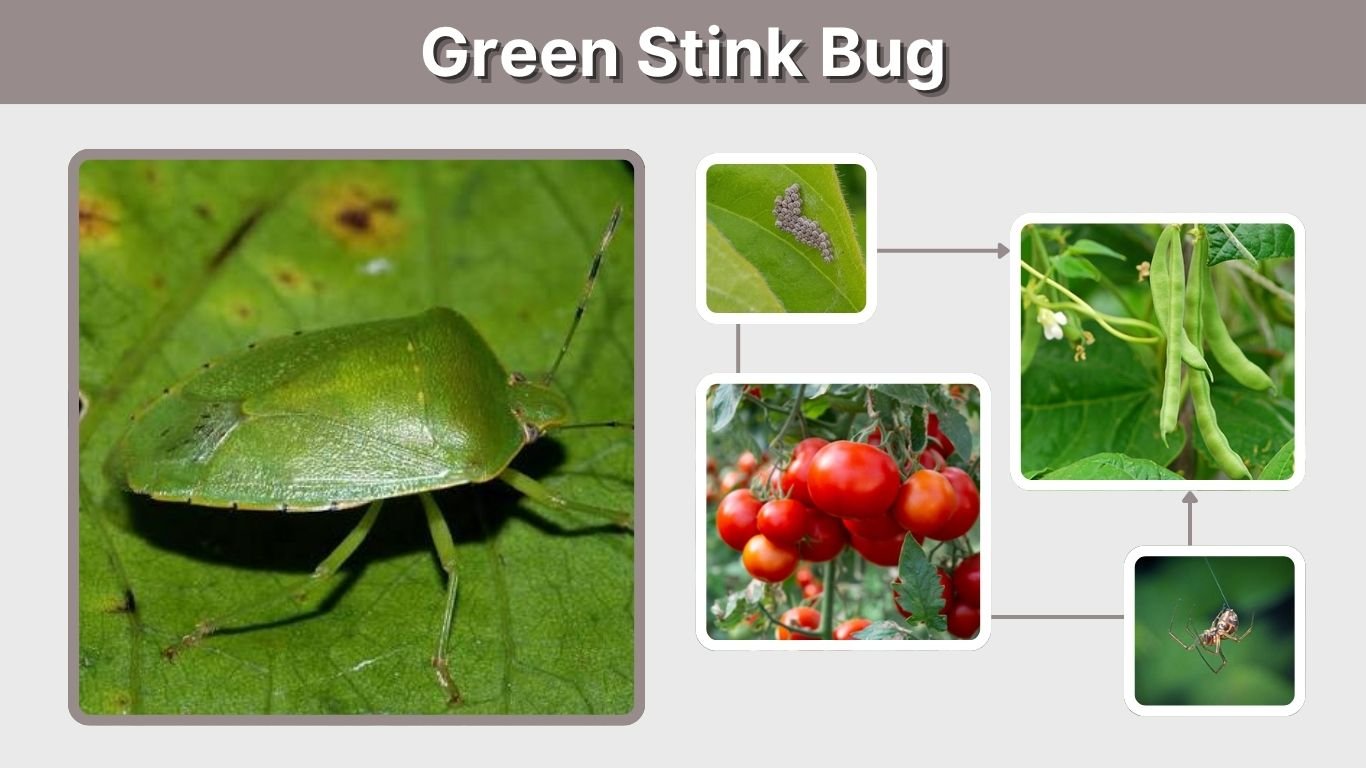
The green stink bug is a shield-shaped insect commonly found in gardens, farms, orchards, and around homes. Its bright green body makes it easy to notice, but several different stink bug species can look surprisingly similar. Most feed on plants using piercing-sucking mouthparts and can damage fruits, vegetables, seeds, and field crops.
Although their unpleasant defensive odor makes them seem threatening, green stink bugs are generally not dangerous to people. Understanding their appearance, eggs, nymph stages, host plants, and behavior can help you identify them correctly and decide whether control is necessary.
What Is a Green Stink Bug?
The common green stink bug belongs to the stink bug family Pentatomidae, a large group of insects known for their broad, shield-shaped bodies and defensive odor.
In North America, the species commonly called the green stink bug is Chinavia hilaris, formerly classified as Acrosternum hilare. Another frequently encountered species is the southern green stink bug, Nezara viridula.
Green Stink Bug Scientific Classification
| Classification | Green Stink Bug |
|---|---|
| Common name | Green stink bug |
| Scientific name | Chinavia hilaris |
| Order | Hemiptera |
| Family | Pentatomidae |
| Body type | Shield-shaped |
| Diet | Plant juices, fruits, seeds, vegetables |
| Development | Egg → nymph → adult |
Both adults and nymphs possess piercing-sucking mouthparts that allow them to puncture plant tissues and consume fluids.
Green Stink Bug Identification
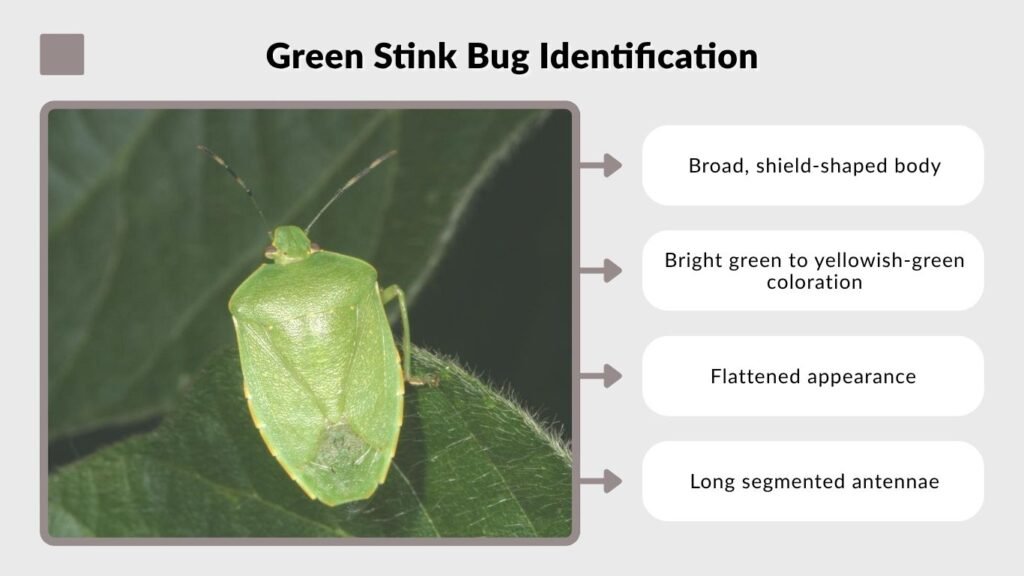
Adult green stink bugs are relatively easy to recognize once you know their main features. However, color alone should not be used for identification because several shield bugs are green.
What Does a Green Stink Bug Look Like?
Look for these characteristics:
- Broad, shield-shaped body
- Bright green to yellowish-green coloration
- Flattened appearance
- Long segmented antennae
- Piercing-sucking mouthparts beneath the body
- Fully developed wings in adults
- Small markings around the edges of the abdomen
- Approximately ½ to ¾ inch long in many adults
Some individuals may appear lime green, bright green, yellow-green, or green mixed with brown depending on species, age, season, and environmental conditions.
Black and Green Stink Bugs
A black-and-green stink bug is often a nymph rather than an adult. Young stink bugs can look dramatically different from mature insects.
Green stink bug nymphs may have combinations of:
- Black
- Green
- White
- Yellow
- Orange
- Red
As they mature through successive stages, their coloration gradually becomes more similar to the green adult.
Green Stink Bug vs. Southern Green Stink Bug
The common green stink bug and southern green stink bug are closely related but are different species.
The southern green stink bug (Nezara viridula) is particularly common in warmer climates and can become an important agricultural pest.
| Feature | Green Stink Bug | Southern Green Stink Bug |
| Scientific name | Chinavia hilaris | Nezara viridula |
| Adult color | Bright green | Green |
| General shape | Broad shield shape | Shield shape |
| Common habitat | Gardens, fields, orchards | Crops, gardens, warm regions |
| Feeding | Plant tissues and seeds | Plant tissues and seeds |
| Pest status | Agricultural pest | Major crop pest in some regions |
Southern green stink bugs are particularly associated with warm areas, although their distribution extends well beyond the southern United States.
Green Stink Bug Eggs
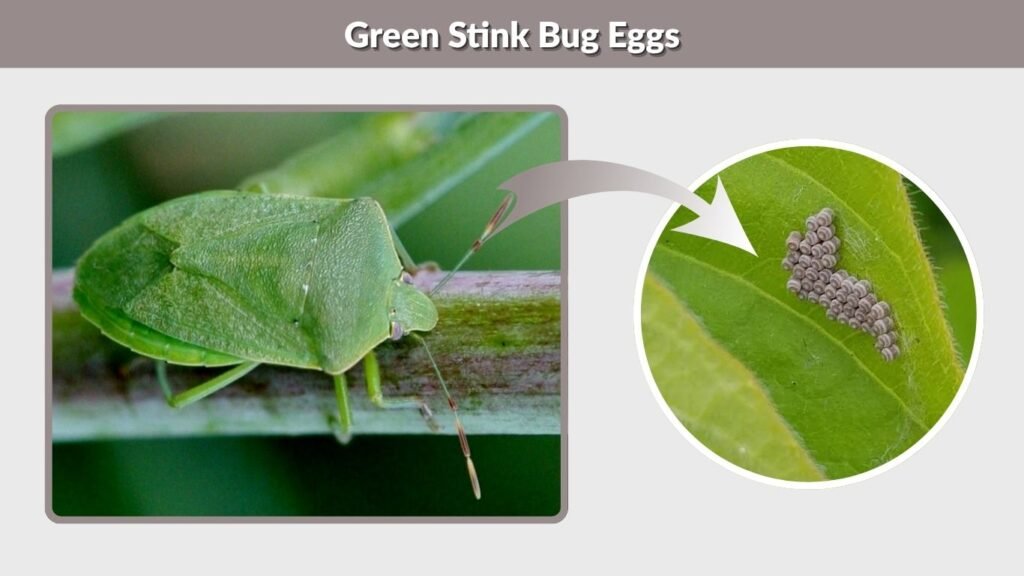
Finding eggs is often the earliest indication that stink bugs are reproducing on garden or crop plants.
Female stink bugs typically deposit their eggs together in neat clusters on plant surfaces.
What Do Green Stink Bug Eggs Look Like?
Green stink bug eggs generally have these characteristics:
- Small and barrel-shaped
- Pale green, yellowish, or whitish
- Arranged closely together
- Usually deposited on leaves
- Often found on the underside of foliage
The eggs darken or change appearance as the developing nymphs approach hatching.
Checking the undersides of leaves regularly can help detect a population before large numbers of nymphs begin feeding.
Green Stink Bug Nymph
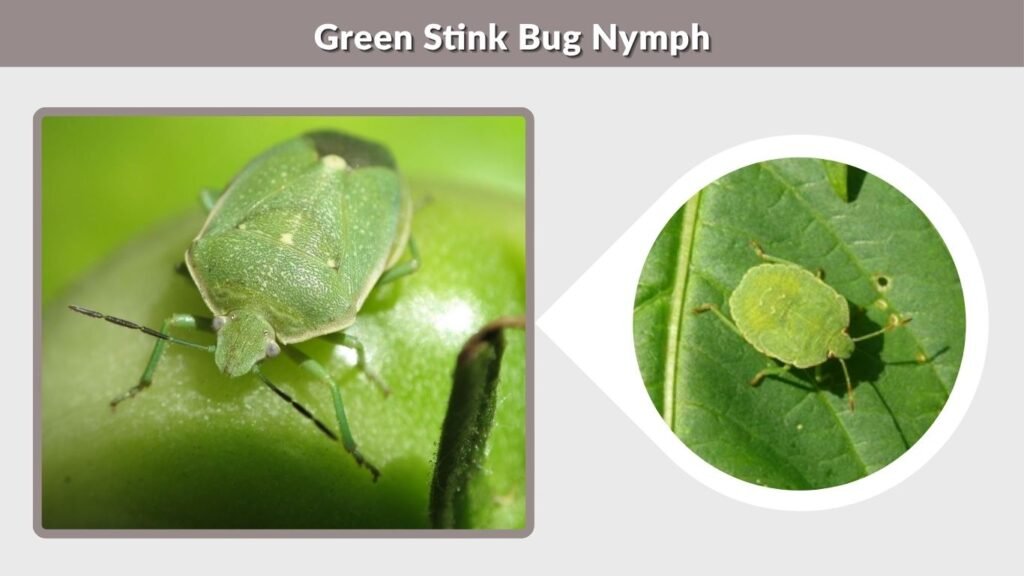
Green stink bugs undergo incomplete metamorphosis, meaning there is no caterpillar-like larval or pupal stage.
Young stink bugs are called nymphs.
Green Stink Bug Nymph Identification
Newly emerged nymphs are small, rounded insects that do not yet have functional wings. Depending on their developmental stage, they can appear black, reddish, orange, green, or patterned.
The life cycle generally follows:
- Egg
- First-stage nymph
- Second-stage nymph
- Third-stage nymph
- Fourth-stage nymph
- Fifth-stage nymph
- Adult
Each nymph stage ends with molting. The insect becomes larger and progressively develops adult features.
There is technically no true green stink bug larva because insects with incomplete metamorphosis develop as nymphs rather than larvae.
Green Stink Bug Life Cycle
The complete green stink bug life cycle begins when females place egg clusters on suitable host plants.
After hatching, the young nymphs initially remain close together. Later stages spread across the plant and begin feeding more actively.
Green Stink Bug Stages
During warmer months, development can progress relatively quickly when food and suitable temperatures are available.
Adult stink bugs eventually mate and produce another generation. In cooler climates, adults commonly seek protected places to survive unfavorable winter conditions.
The number of generations produced each year varies according to location and climate.
What Do Green Stink Bugs Eat?
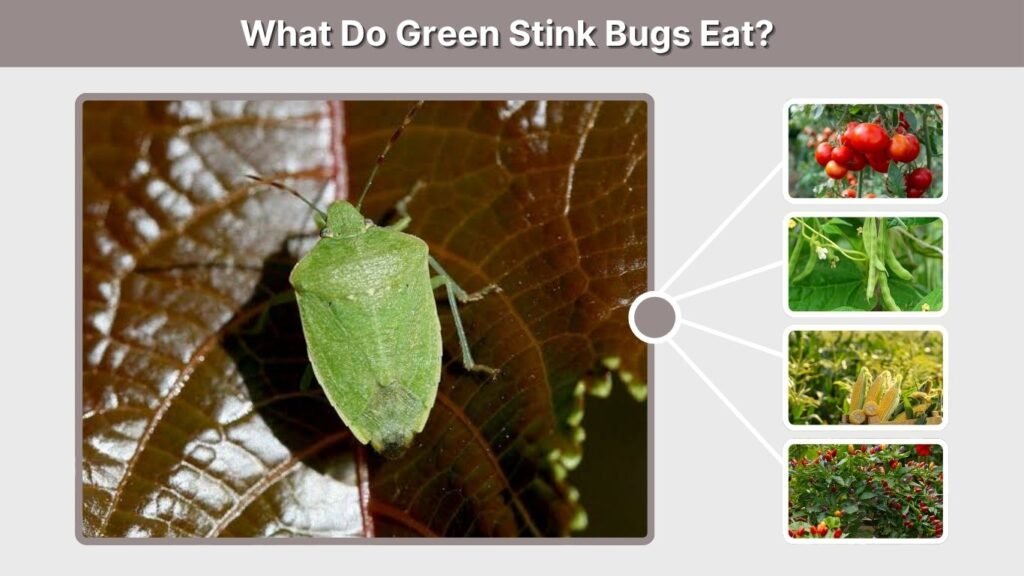
Green stink bugs are primarily plant feeders. Rather than chewing leaves like caterpillars, they insert specialized mouthparts into plant tissues and withdraw fluids.
Green Stink Bug Host Plants
Common host plants can include:
- Tomatoes
- Beans
- Peas
- Soybeans
- Corn
- Cotton
- Peppers
- Fruit trees
- Berries
- Various weeds
- Seed-producing plants
Stink bugs often become particularly damaging when they feed directly on developing fruits, pods, seeds, and vegetables.
Green Stink Bug Damage
A small number of stink bugs in a garden may cause little noticeable damage. Larger populations, however, can reduce both crop appearance and quality.
Their piercing mouthparts damage cells as they feed.
Signs of Green Stink Bug Damage
Possible symptoms include:
- Small punctures on fruits
- Discolored feeding spots
- Misshapen fruit
- Hard or corky areas beneath fruit skin
- Damaged seeds
- Deformed vegetables
- Premature fruit drop
- Reduced seed development
Tomatoes and other fruits can develop pale or yellowish areas around feeding sites.
Agricultural crops such as soybeans may experience reduced seed quality when stink bug populations become high.
Are Green Stink Bugs Poisonous?
Green stink bugs are not considered poisonous to humans.
Their bright coloration and strong smell sometimes cause people to assume they contain dangerous venom or toxins, but they do not sting and are not venomous insects.
They primarily defend themselves by releasing strong-smelling chemicals.
Are Green Stink Bugs Harmful?
For humans, the primary problem is usually their odor rather than physical danger.
For plants, the situation is different. Large populations can become significant pests because repeated feeding damages fruits, vegetables, and seeds.
Therefore, whether a green stink bug is considered “good or bad” depends largely on where it is found and how many are present.
Do Green Stink Bugs Bite?
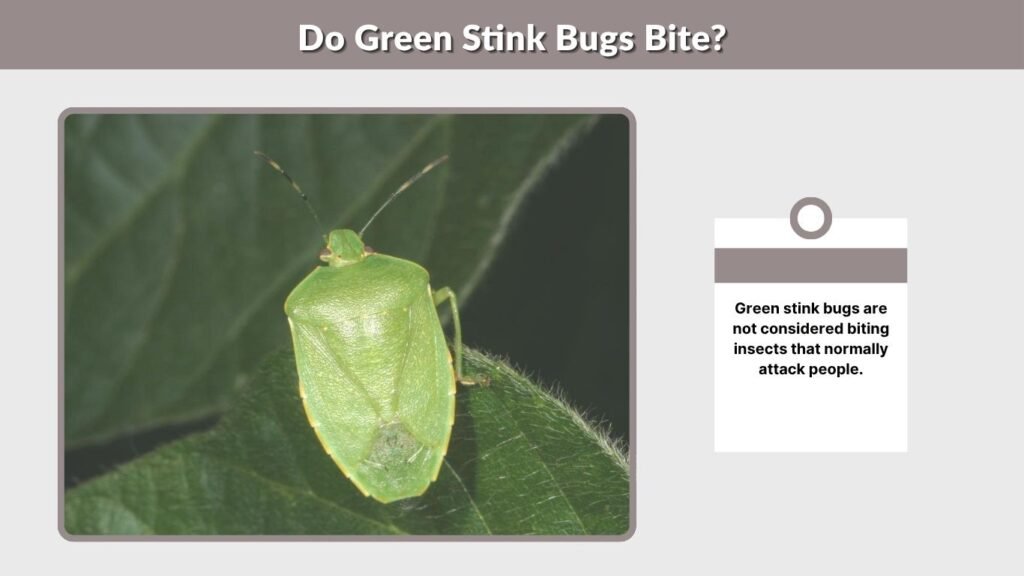
Green stink bugs are not considered biting insects that normally attack people.
Their mouthparts evolved primarily for piercing plant tissues rather than feeding on human blood.
Handling insects unnecessarily is still best avoided because they may release defensive secretions. Sensitive individuals could occasionally experience minor irritation after direct contact.
A painful unexplained skin lesion is therefore unlikely to have been caused by an ordinary green stink bug.
Why Do Green Stink Bugs Smell?
The famous green stink bug smell comes from defensive chemicals produced by specialized scent glands.
When frightened, grabbed, crushed, or disturbed, the bug releases an unpleasant odor designed to discourage predators.
People describe the smell differently, but it can be sharp, grassy, pungent, or chemically unpleasant.
Crushing a stink bug indoors can make the smell considerably stronger, which is why physical removal without crushing is usually preferable.
Green Stink Bug vs. Brown Stink Bug
Color provides an immediate clue, although many species require closer examination for accurate identification.
Green stink bugs are usually bright green, while the well-known brown marmorated stink bug has a mottled brown appearance.
Brown marmorated stink bugs also have distinctive pale bands on their antennae and alternating light-and-dark markings along the abdomen.
Both species may feed on garden and agricultural plants, but the brown marmorated stink bug is particularly well known for entering buildings in large numbers while seeking protected overwintering sites.
Green Shield Bug vs. Green Stink Bug
The terms shield bug and stink bug are sometimes used differently depending on region.
Many insects called shield bugs belong to the same family as stink bugs. For example, the common green shield bug found in parts of Europe is Palomena prasina, which is different from the North American green stink bug Chinavia hilaris.
Therefore, a green shield-shaped insect is not automatically the same species as the green stink bug.
Green Stink Bug in the House
Green stink bugs occasionally enter homes, particularly when adults search for protected places.
They do not normally reproduce indoors or damage furniture, clothing, or structures.
How to Remove Green Stink Bugs Indoors
If you find one inside:
- Capture it with a container and release it outdoors.
- Vacuum larger numbers when necessary.
- Empty the vacuum promptly if odor becomes a concern.
- Avoid crushing stink bugs indoors.
- Seal gaps around windows and doors.
- Repair damaged window screens.
- Close openings around pipes and utility lines.
Preventing entry is generally more effective than trying to eliminate stink bugs after they have moved inside.
How to Get Rid of Green Stink Bugs in the Garden
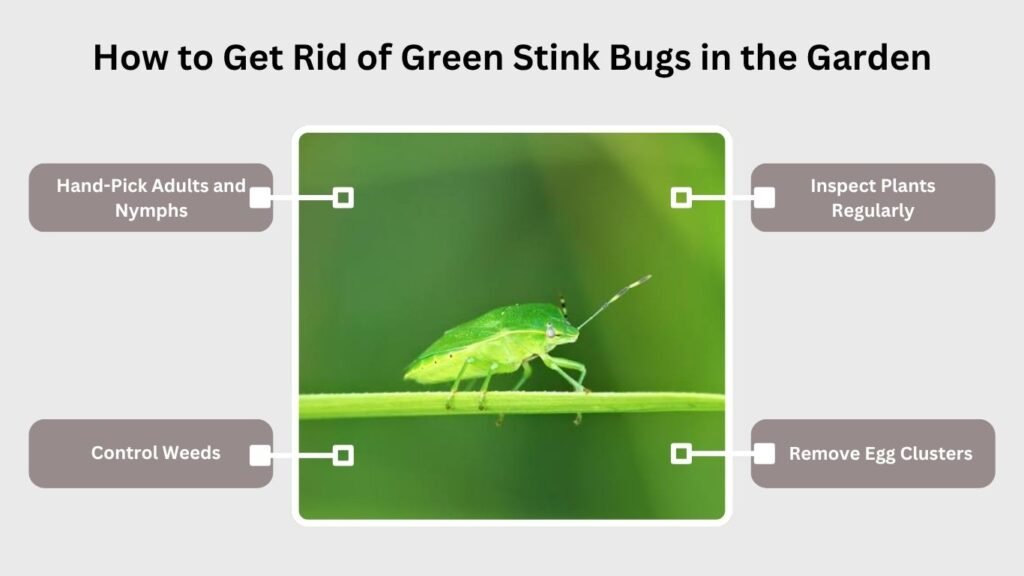
Control is not always necessary. A few stink bugs can often be tolerated, particularly in large gardens.
When numbers increase and plants begin showing damage, integrated control methods are preferable.
1. Inspect Plants Regularly
Check leaves, fruits, stems, and especially leaf undersides for adults, nymphs, and egg clusters.
Early detection prevents populations from becoming established.
2. Remove Egg Clusters
Egg masses can be removed from leaves by hand and destroyed before they hatch.
This is one of the easiest options for small gardens.
3. Hand-Pick Adults and Nymphs
Wear gloves and knock stink bugs into a container when populations are manageable.
Avoid crushing them because of their defensive odor.
4. Control Weeds
Some weeds act as alternative host plants where stink bugs can feed and reproduce before moving into crops.
Keeping garden borders maintained may reduce nearby populations.
5. Use Physical Barriers
Fine insect netting or row covers can prevent stink bugs from reaching susceptible plants when properly installed.
Covers may need to be removed when plants require pollinator access.
6. Encourage Natural Predators
Stink bug eggs and nymphs can be attacked by parasitoid wasps, predatory insects, spiders, birds, and other natural enemies.
Avoiding unnecessary broad-spectrum pesticide applications helps preserve these beneficial organisms.
7. Use Insecticides Only When Necessary
Severe agricultural infestations may require appropriately labeled insecticides.
Treatment depends on the crop, stink bug species, infestation level, and local regulations. Always follow the product label and avoid spraying flowering plants when pollinators are active.
Green Stink Bugs in Florida, Texas, California, and Other States
Green stink bugs occur across broad geographic areas, but the species encountered may differ by region.
Warm locations such as Florida and Texas can support southern green stink bugs and other stink bug species for long periods of the year.
Green stink bugs are also reported from areas including California, Georgia, North Carolina, Ohio, Pennsylvania, Michigan, Illinois, Missouri, New Jersey, Massachusetts, Utah, Colorado, Oregon, Washington, and other states.
Because several species resemble one another, geographic location should be combined with body markings when identifying an individual bug.
Green Stink Bug Predators
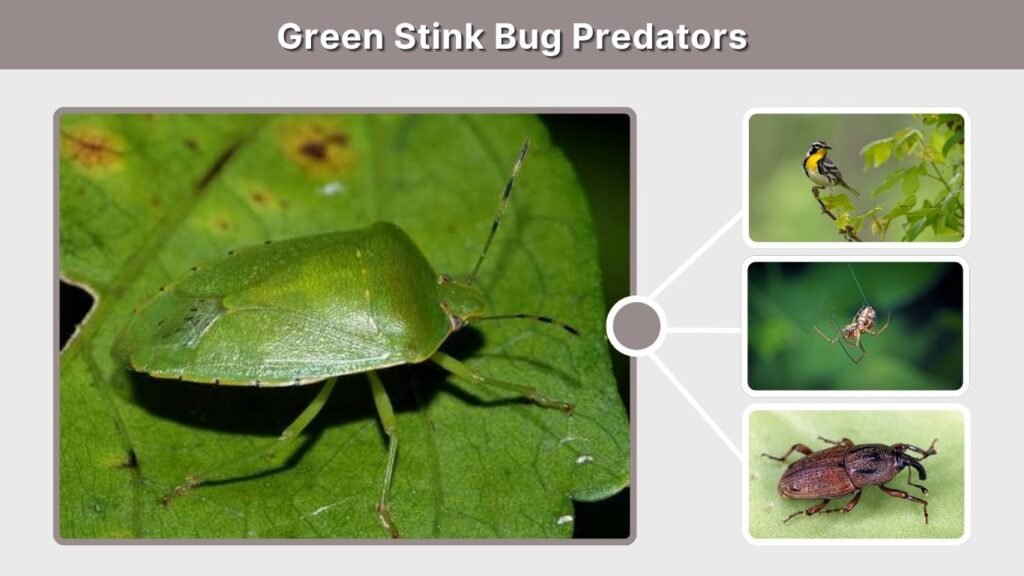
Despite their chemical defenses, green stink bugs have numerous natural enemies.
Predators and parasites can include:
- Birds
- Spiders
- Assassin bugs
- Predatory beetles
- Parasitic flies
- Parasitoid wasps
Some tiny parasitoid wasps specialize in attacking stink bug eggs, helping naturally suppress populations.
Interesting Green Stink Bug Facts
- Green stink bugs belong to the family Pentatomidae.
- Their broad body resembles a shield.
- Adults can fly.
- Young stink bugs are called nymphs, not larvae.
- Nymphs can look completely different from adults.
- Their smell is primarily a defense against predators.
- They feed using piercing-sucking mouthparts.
- Green stink bugs do not normally bite humans.
- They can become serious crop pests when populations are high.
- Several unrelated or closely related species may be described as green stink bugs.
FAQs
Is a green stink bug poisonous?
No. Green stink bugs are not considered poisonous or venomous to humans. Their main defense is releasing unpleasant-smelling chemicals when disturbed. Although their odor can be irritating, ordinary green stink bugs are primarily plant-feeding insects rather than dangerous pests to people.
What is the scientific name of the green stink bug?
The common North American green stink bug is Chinavia hilaris. It was previously known as Acrosternum hilare. The southern green stink bug is a different species called Nezara viridula, although the two can look similar at first glance.
What does a green stink bug nymph look like?
Green stink bug nymphs are smaller and rounder than adults and lack fully developed wings. Depending on their age and species, they may display combinations of black, green, white, red, orange, or yellow markings before gradually developing the greener coloration of adults.
Why do I have green stink bugs in my garden?
Green stink bugs enter gardens because vegetables, fruits, seeds, and weeds provide suitable food. Tomatoes, beans, peppers, fruit trees, soybeans, and many other plants can attract them. Populations often become more noticeable when developing fruits and seeds provide abundant feeding opportunities.
Are green stink bugs good or bad?
Green stink bugs are not dangerous to people, but they can be harmful to plants. A few individuals may cause little noticeable damage, whereas larger populations can injure fruits, vegetables, seeds, and field crops. Control is generally most important when numbers increase and visible plant damage appears.