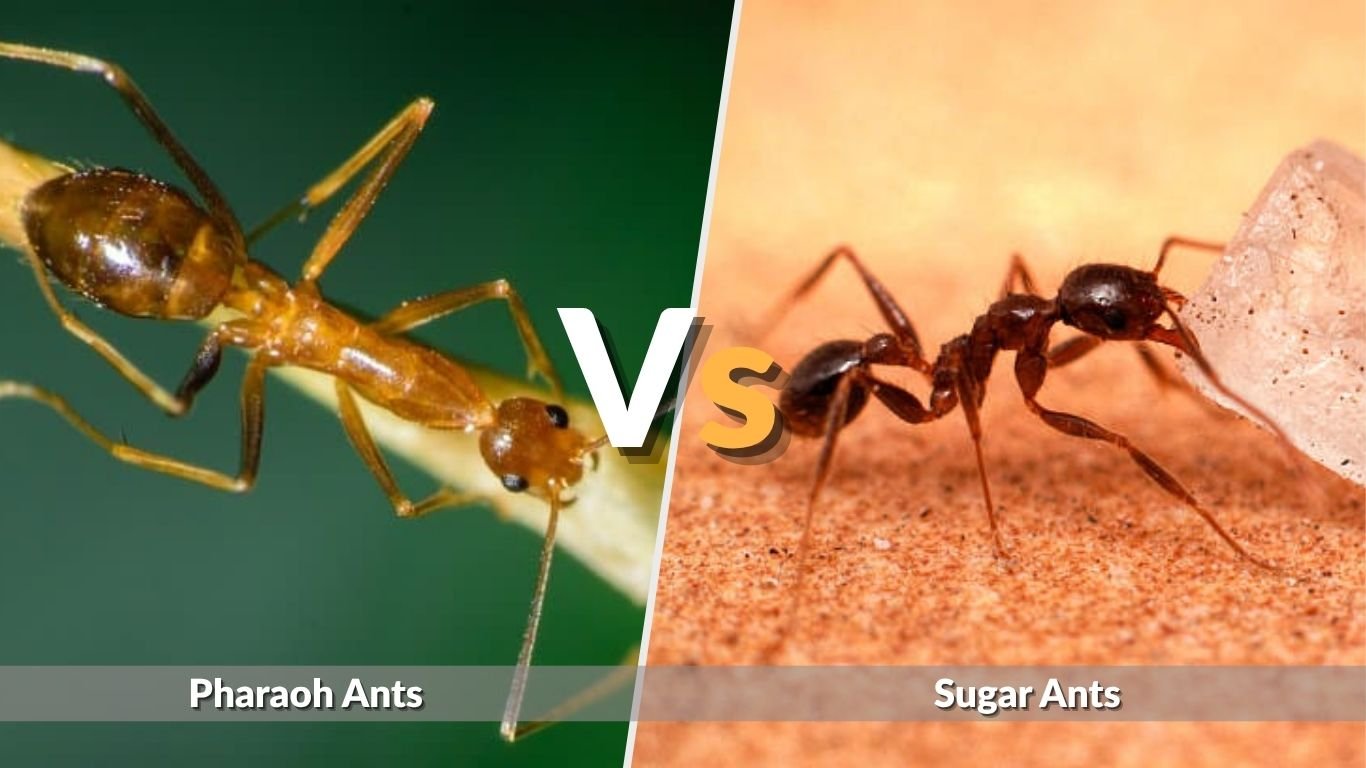
Pharaoh ants and sugar ants may both appear around sweet foods, sinks, cabinets, and countertops, but the names do not necessarily describe two clearly defined species. The pharaoh ant is a specific species, Monomorium pharaonis. “Sugar ant” is often an informal name for various ants attracted to sugary foods. Correct identification matters because spraying pharaoh ants can split one colony into several new nests.
Pharaoh Ants vs Sugar Ants: Quick Comparison
Pharaoh ants are extremely small, yellowish indoor ants that frequently nest in warm building voids. An ant called a sugar ant may instead be an Argentine ant, odorous house ant, ghost ant, or another sweet-feeding species, depending on the region.
| Feature | Pharaoh ant | “Sugar ant” |
| Scientific identity | Monomorium pharaonis | Not always one particular species |
| Worker size | About 1/16 inch | Varies by species |
| Color | Yellow, honey-colored, or orange | May be brown, black, yellow, or bicolored |
| Waist nodes | Two | One or two, depending on species |
| Preferred foods | Fats, proteins, sweets | Usually sugary foods and honeydew |
| Typical nest | Walls, cabinets, insulation, appliances | Indoors or outdoors, depending on species |
| Colony structure | Multiple queens and connected nests | Varies |
| Best treatment | Slow-acting, nonrepellent bait | Depends on the actual species |
| Main treatment risk | Sprays may cause colony budding | Repellent sprays often provide only temporary relief |
What Do Pharaoh Ants Look Like?
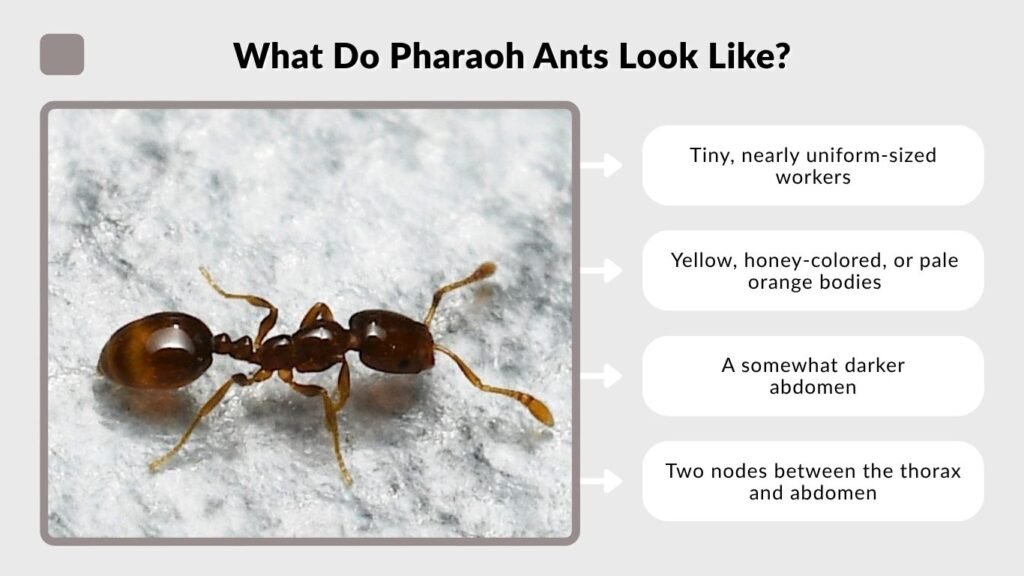
Pharaoh ant workers are approximately 1/16 inch long. Their bodies range from pale yellow to orange, while the abdomen may appear slightly darker. They have two small waist nodes and 12-segmented antennae ending in a three-segmented club. These details are difficult to see without magnification.
Identification Features
Look for these characteristics:
- Tiny, nearly uniform-sized workers
- Yellow, honey-colored, or pale orange bodies
- A somewhat darker abdomen
- Two nodes between the thorax and abdomen
- Organized trails near food, water, or warm appliances
- Nests hidden in walls, cabinets, insulation, and other voids
Pharaoh ants commonly travel through buildings along electrical wiring and hot-water pipes. They can nest inside appliances, behind baseboards, between stored materials, and in other protected spaces where food or warmth is available.
What Do Pharaoh Ants Eat?
Pharaoh ants have broad food preferences. They feed on sweets, oils, fats, proteins, dead insects, and numerous household foods. Their preference can change with the nutritional needs of the colony, which is why they may ignore one bait while actively feeding on another.
What Are Sugar Ants?
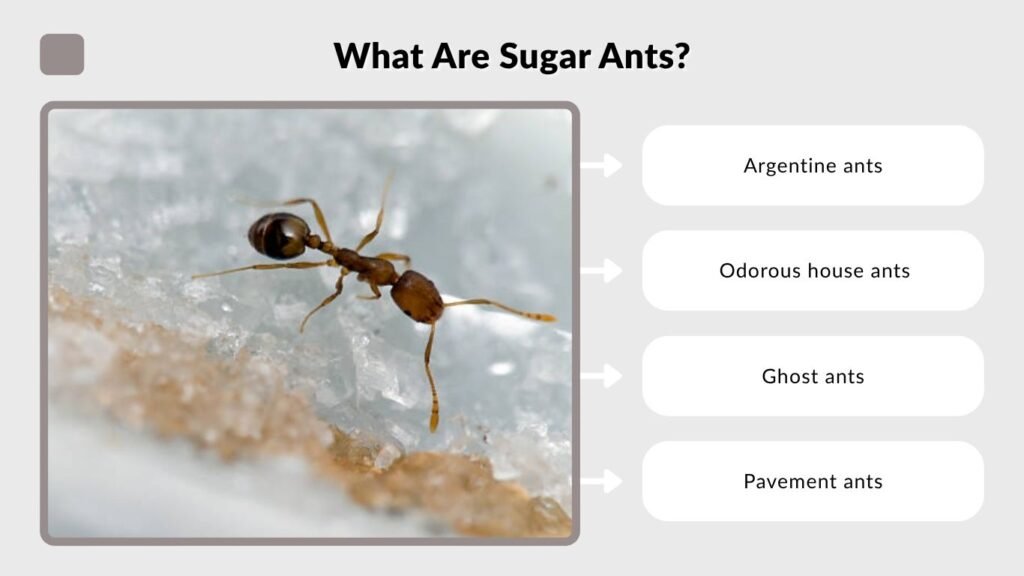
“Sugar ant” commonly describes ants found feeding on sugar, syrup, fruit, juice, or insect honeydew. Because many ant species eat sweet substances, the name alone does not provide a reliable identification.
Possible Sugar Ant Species
Depending on your location, ants described as sugar ants may include:
- Argentine ants
- Odorous house ants
- Ghost ants
- Pavement ants
- Carpenter ants
- Pharaoh ants themselves
- Banded sugar ants in Australia
Therefore, pharaoh ants may be called sugar ants casually, but not every sugar ant is a pharaoh ant.
How to Identify a Sugar-Seeking Ant
Observe its color, size, trail behavior, odor, nesting location, and reaction to disturbance. A clear close-up photograph or preserved specimen may be needed because many household ants are too small to identify accurately with the naked eye.
Pharaoh Ants vs Similar Household Ants
Pharaoh ants are frequently confused with thief ants, ghost ants, and other small household species. Their size and pale coloration make identification particularly challenging.
| Lookalike | How It Differs From a Pharaoh Ant |
| Ghost ant | Dark head and thorax with a pale, almost translucent abdomen; one waist node |
| Thief ant | Usually smaller; antenna has 10 segments and a two-segmented club |
| Argentine ant | Larger, uniformly dull brown, with one waist node |
| Odorous house ant | Dark brown or black and produces a strong odor when crushed |
| Carpenter ant | Much larger and may nest in moisture-damaged wood |
| Fire ant | Workers vary noticeably in size and can deliver painful stings |
| Pavement ant | Dark brown or black and commonly nests beside pavement or foundations |
| Termite | Broad waist, straight antennae, and equal-sized wings on swarmers |
Pharaoh Ants vs Ghost Ants
Ghost ants have a dark head and thorax combined with a pale, nearly translucent abdomen and legs. Pharaoh ants are more uniformly yellow or orange. Ghost ants have one waist node, while pharaoh ants have two. Both may occupy kitchens, bathrooms, and indoor voids.
Pharaoh Ants vs Thief Ants
Thief ants are among the most difficult pharaoh-ant lookalikes to distinguish. Both are tiny, pale, two-node ants that prefer greasy or protein-rich foods. Thief ants have 10-segmented antennae with two-segmented clubs; pharaoh ants have 12-segmented antennae with three-segmented clubs. Magnification is usually necessary.
Pharaoh Ants vs Argentine Ants
Argentine ants are approximately 1/8 inch long, making them about twice the length of pharaoh ant workers. They are dull brown, have one waist node, and create dense trails. Pharaoh ants are smaller, yellowish, and have two nodes.
Pharaoh Ants vs Carpenter Ants
Carpenter ants are dramatically larger, generally measuring between 1/4 and 1/2 inch. They may leave sawdust-like material near galleries excavated in wood. Pharaoh ants are tiny and usually nest in existing voids without excavating structural wood.
Pharaoh Ants vs Fire Ants
Fire-ant colonies contain workers of noticeably different sizes, while pharaoh ant workers are small and relatively uniform. Fire ants are reddish, frequently nest in soil mounds, and sting aggressively. Pharaoh ants primarily become indoor nuisance pests and do not present the same stinging risk.
Pharaoh Ants vs Termites
Worker termites are pale and may occasionally be mistaken for light-colored ants. However, termites have broad waists and straight antennae. Winged termites have four wings of approximately equal length, while winged ants have narrow waists, elbowed antennae, and shorter hind wings.
Which Ant Is More Difficult to Control?
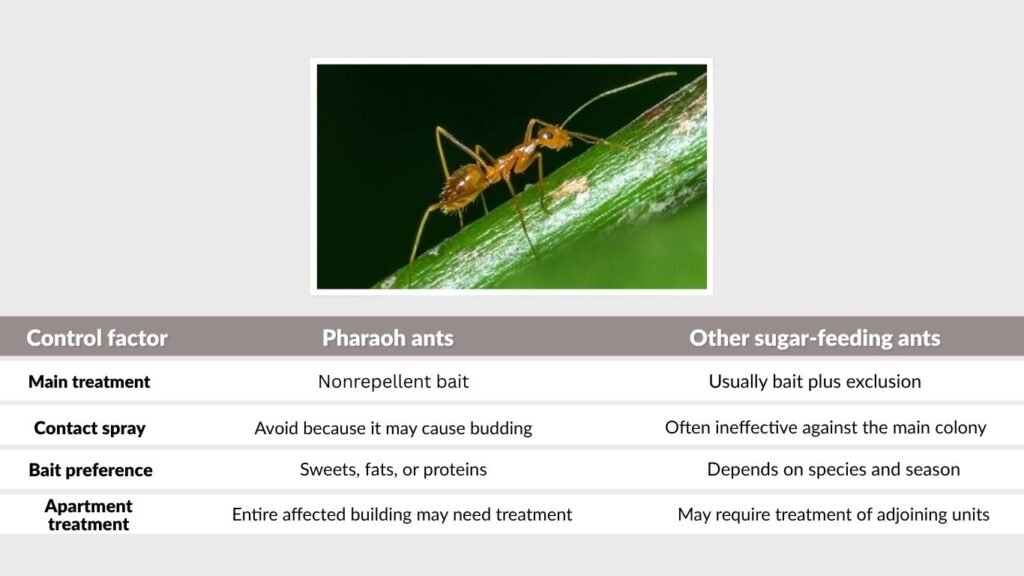
Pharaoh ants are often more challenging than ordinary sweet-feeding ants because their colonies contain multiple queens and can occupy numerous connected nests. When disturbed by repellent treatments, groups of workers and queens may separate and establish additional nests through budding.
| Control factor | Pharaoh ants | Other sugar-feeding ants |
| Recommended first step | Confirm identification | Identify the likely species |
| Main treatment | Nonrepellent bait | Usually bait plus exclusion |
| Contact spray | Avoid because it may cause budding | Often ineffective against the main colony |
| Bait preference | Sweets, fats, or proteins | Depends on species and season |
| Apartment treatment | Entire affected building may need treatment | May require treatment of adjoining units |
| Expected control time | Several weeks or longer | Several days to several weeks |
Why Spraying Pharaoh Ants Can Make Things Worse
Repellent sprays may cause a pharaoh ant colony to fracture. Activity can appear to decline temporarily while the newly formed nests become established, but ants may later emerge from several different locations. Baits are preferred because workers carry the treatment back to queens and developing ants.
Choosing the Correct Bait
Use a slow-acting bait specifically labeled for pharaoh ants and the intended indoor location. Because their food preference changes, placing small amounts of both sweet and protein- or grease-based bait may reveal what the colony currently accepts.
Keep competing food sealed and avoid spraying or using strong-smelling cleaners near bait. Multiple small placements along active trails are generally more effective than one station located far from the ants.
FAQs
Are pharaoh ants a type of sugar ant?
Pharaoh ants may be informally called sugar ants because they feed on sweet foods. However, “sugar ant” is a broad common name that can describe numerous sweet-seeking species. A pharaoh ant is specifically Monomorium pharaonis and requires careful treatment to prevent colony budding.
Which is smaller, a pharaoh ant or a sugar ant?
Pharaoh ant workers measure approximately 1/16 inch. The size of a sugar ant depends on the species being described. Some, including ghost and thief ants, are similarly tiny, while Argentine, odorous house, pavement, and carpenter ants are generally larger.
How can I tell pharaoh ants from ghost ants?
Pharaoh ants are yellow or orange with somewhat darker abdomens. Ghost ants have dark heads and thoraxes but pale, translucent legs and abdomens. Pharaoh ants possess two waist nodes, whereas ghost ants have one, although magnification may be required to see this difference.
Do pharaoh ants bite or sting?
Pharaoh ants are not considered aggressive stinging ants. Their main concerns are food contamination and persistent indoor infestations. They are especially problematic in hospitals and other sensitive facilities because workers can travel between contaminated materials, food, equipment, and patient-care areas.
Can the same bait kill pharaoh ants and sugar ants?
Possibly, but bait effectiveness depends on the actual species, its current food preference, and the product label. Never assume a general ant product is appropriate for pharaoh ants. Choose a nonrepellent bait labeled for them and avoid contact sprays during treatment.