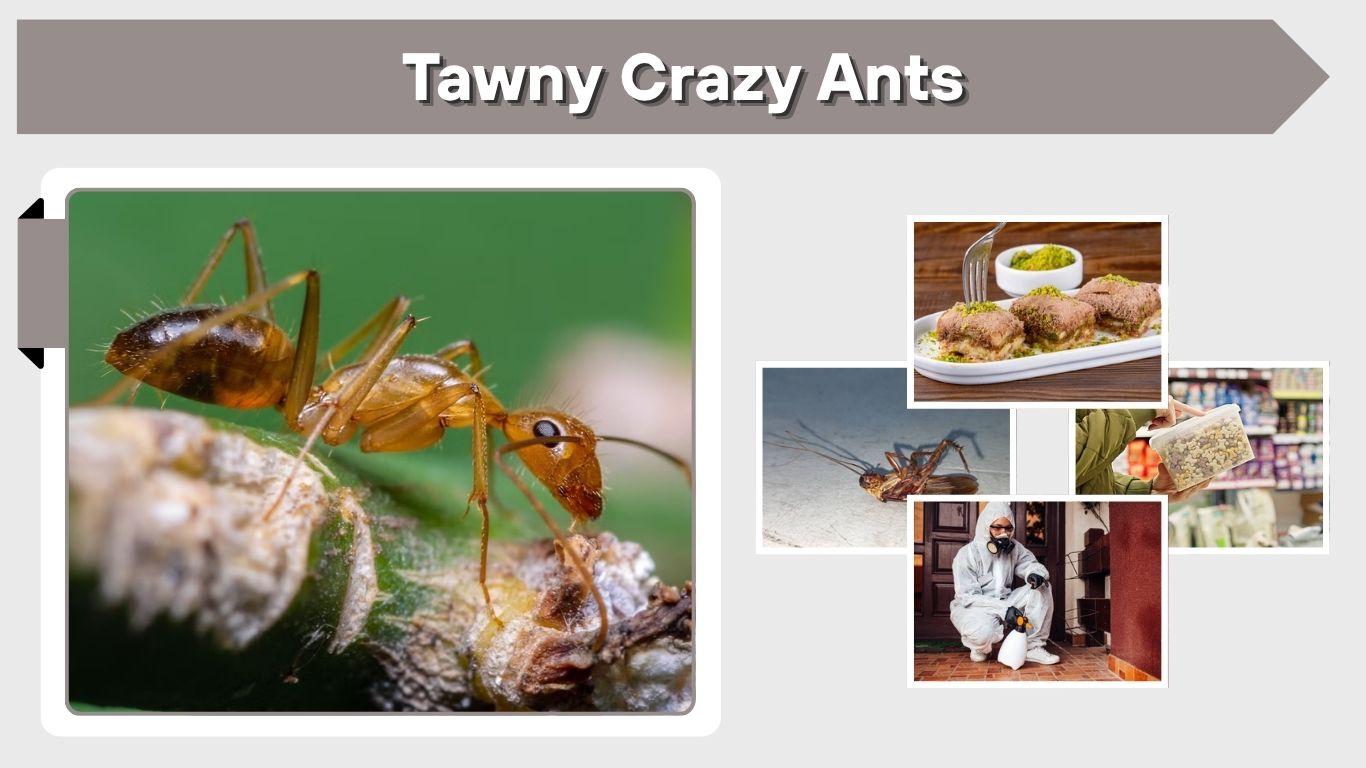
Tawny crazy ants are invasive ants known for huge colonies, fast irregular movement, and difficult control. They are also called Rasberry crazy ants, especially in Texas, where they were first noticed as a serious pest in the early 2000s. Their scientific name is Nylanderia fulva. Unlike fire ants, they do not build obvious mounds or deliver painful stings, but they can overwhelm yards, invade homes, damage electronics, and displace other ants.
What Are Tawny Crazy Ants?
Tawny crazy ants are small reddish-brown invasive ants native to South America. They have become a major nuisance in parts of the southern United States, especially Texas and Gulf Coast states. UGA Extension describes them as an introduced pest that can disrupt ecological balance, outcompete native ants, affect arthropods and vertebrates, and become an economic pest around properties.
They get the name “crazy ant” from their rapid, erratic movement. Instead of moving in neat, steady trails, disturbed workers often scatter in unpredictable directions. Their colonies can also spread across large areas, making control more difficult than simple indoor ant treatments.
Tawny Crazy Ant Scientific Name
| Common Name | Scientific Name | Other Common Name |
| Tawny crazy ant | Nylanderia fulva | Rasberry crazy ant |
The name “Rasberry crazy ant” came from early reports in Texas, but the approved common name is now tawny crazy ant. EDDMapS notes that the ant was officially identified as Nylanderia fulva and later given the approved common name “tawny crazy ant.”
How to Identify Tawny Crazy Ants
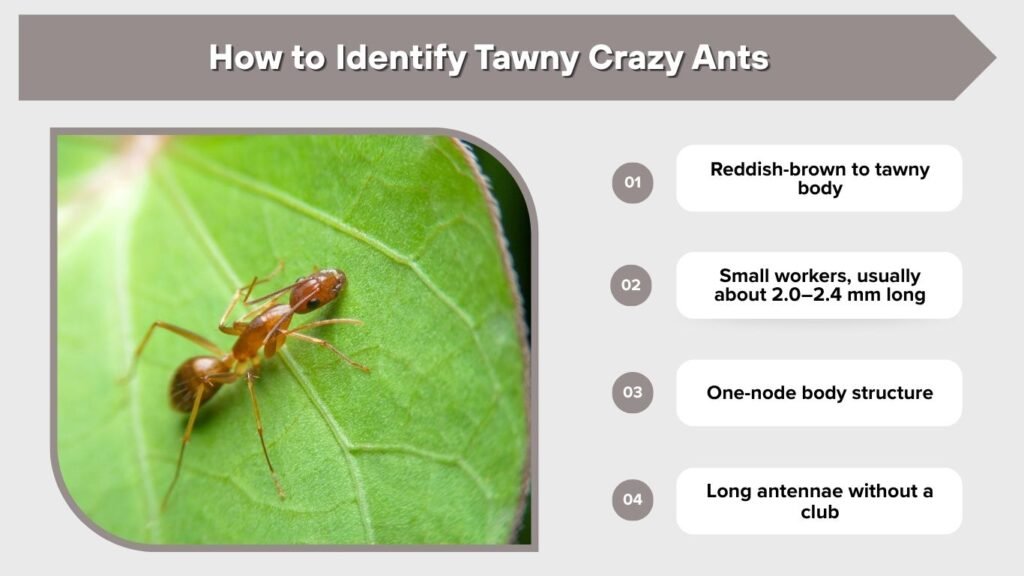
Tawny crazy ants are small, reddish-brown ants with long legs and long antennae. Color alone is not always enough for identification because other small ants may look similar. Movement, colony size, and nesting behavior are often important clues.
Identification Signs
- Reddish-brown to tawny body
- Small workers, usually about 2.0–2.4 mm long
- One-node body structure
- Long antennae without a club
- Long legs compared with body size
- Fast, erratic movement
- Large numbers of workers on the ground, walls, or objects
- No obvious fire-ant-style mound
UF/IFAS describes tawny crazy ant workers as reddish-brown, one-node ants with monomorphic workers about 2.0–2.4 mm long; queens are larger, often 4.0 mm or more.
Where Are Tawny Crazy Ants Found?
Tawny crazy ants are mainly a problem in warm parts of the southern United States. Their U.S. range includes Texas and several southeastern states. Texas A&M reports that tawny crazy ants expanded from their 2002 discovery in Harris County to 43 Texas counties, with confirmations in Louisiana, Mississippi, Alabama, Georgia, and Florida.
Common U.S. Locations
- Texas
- Florida
- Louisiana
- Mississippi
- Alabama
- Georgia
- South Carolina reports in mapping databases
EDDMapS describes tawny crazy ants as an exotic invasive ant from South America with a broad U.S. distribution from Texas to South Carolina.
Tawny Crazy Ants in Texas and Florida
Texas and Florida are two of the most searched locations for tawny crazy ants. In Texas, they are strongly associated with the Houston area, Gulf Coast, and expanding inland reports. In Florida, UF/IFAS reports them from multiple counties and describes them as an invasive ant with significant nuisance potential.
These ants spread easily when people move infested soil, potted plants, mulch, firewood, trash, equipment, vehicles, or stored outdoor materials. UGA Extension notes that human movement helps carry tawny crazy ants into uninfested areas, especially because they nest in debris, refuse piles, and stored outdoor materials.
Why Are Tawny Crazy Ants a Nuisance?
Tawny crazy ants can form extremely dense populations. When established, they may cover sidewalks, patios, walls, gardens, outdoor furniture, pet areas, and electrical equipment. They may also enter homes in large numbers, especially when outdoor colonies are close to the foundation.
Main Problems
- Heavy yard infestations
- Indoor invasion
- Ants in cars, garages, and sheds
- Electrical equipment problems
- Displacement of other ants
- Interference with pets and outdoor living
- Difficult long-term control
Texas A&M says tawny crazy ants can reach extraordinary densities within a year or two after introduction and become significant pests in urban, rural, and natural areas.
Do Tawny Crazy Ants Bite?
Tawny crazy ants can bite, but they do not sting like fire ants. Their bites are usually not considered medically serious for most people. The bigger issue is nuisance contact when thousands of ants crawl over surfaces, outdoor furniture, pet bowls, or tools.
They belong to a group of ants that can use formic acid as a defensive chemical, but they are not known for the painful venomous stings associated with red imported fire ants. People with sensitive skin should avoid crushing ants on bare skin and wash the area if irritation occurs.
Tawny Crazy Ants vs Fire Ants
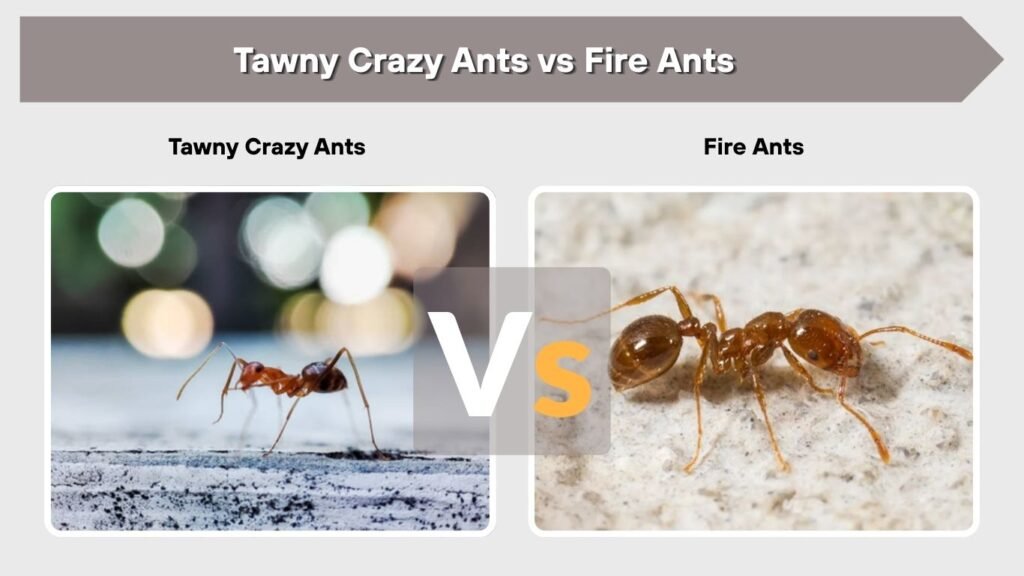
Tawny crazy ants and fire ants are often compared because both are major southern U.S. invasive ants. However, they behave very differently.
| Feature | Tawny Crazy Ant | Fire Ant |
| Scientific group | Nylanderia fulva | Solenopsis species |
| Color | Tawny to reddish-brown | Reddish-brown to dark |
| Movement | Fast and erratic | More organized trails |
| Sting | No painful sting | Painful venomous sting |
| Nest | Hidden, no obvious mound | Visible soil mounds common |
| Main issue | Huge nuisance colonies | Stings and mound infestations |
Tawny crazy ants may even replace fire ants in some invaded areas, but that does not make them harmless. They can become harder to manage because their colonies spread over broad areas and nest in many hidden sites.
Tawny Crazy Ants and Electronics
One of the most serious problems with tawny crazy ants is their attraction to electrical equipment. They may enter outlets, junction boxes, pumps, air-conditioning units, computers, and other devices. When large numbers accumulate inside equipment, they may cause short circuits or failure.
The Mississippi Entomological Museum notes that tawny crazy ants form huge supercolonies, are serious nuisance pests, and are known to disrupt electrical systems. USDA ARS also describes tawny crazy ants as a major invasive pest that damages residential and commercial infrastructure, particularly by infesting and short-circuiting electronic devices.
What Do Tawny Crazy Ants Eat?
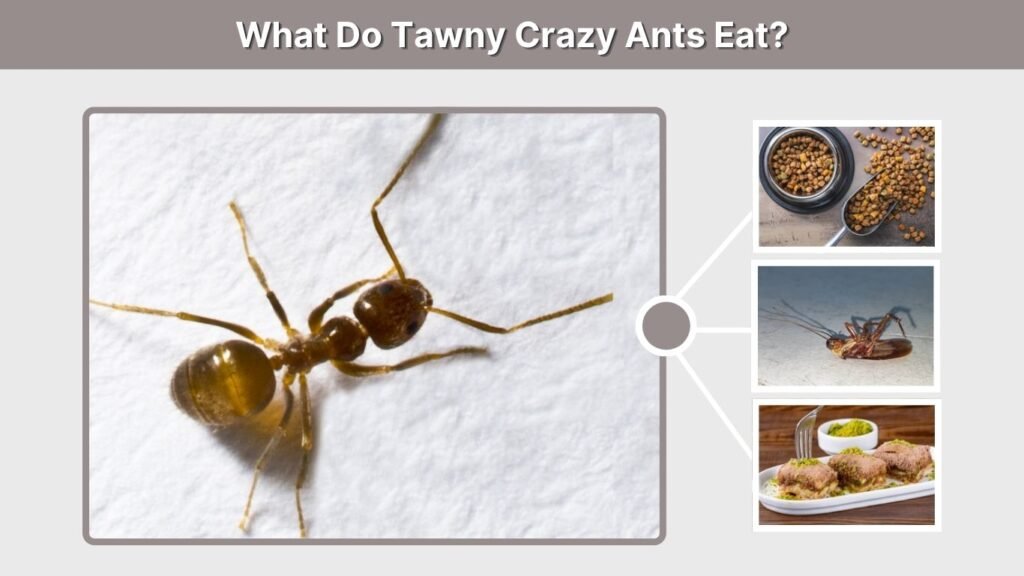
Tawny crazy ants are flexible feeders. They eat sweets, proteins, greasy foods, dead insects, live insects, and honeydew from sap-feeding insects. Around homes, they may be attracted to pet food, spilled drinks, fruit, garbage, and outdoor food scraps.
They can also protect plant pests such as aphids, mealybugs, whiteflies, and scale insects to obtain honeydew. USDA ARS notes that in agricultural systems, tawny crazy ants can worsen problems by tending these sap-feeding pests.
Tawny Crazy Ant Colony and Nesting Habits
Tawny crazy ants do not usually make obvious dome-shaped mounds like fire ants. Instead, they nest in protected, moist, hidden places. Their colonies often have many nest sites spread over a large area.
Common Nesting Sites
- Under mulch
- Under logs and boards
- In leaf litter
- Under rocks
- Around potted plants
- In trash piles or debris
- Inside wall gaps
- Around outdoor equipment
- Under loose bark or landscaping materials
Alabama Cooperative Extension says tawny crazy ants form large colonies with numerous nest sites over large foraging areas and may travel hundreds of feet between nesting and feeding sites.
How to Get Rid of Tawny Crazy Ants
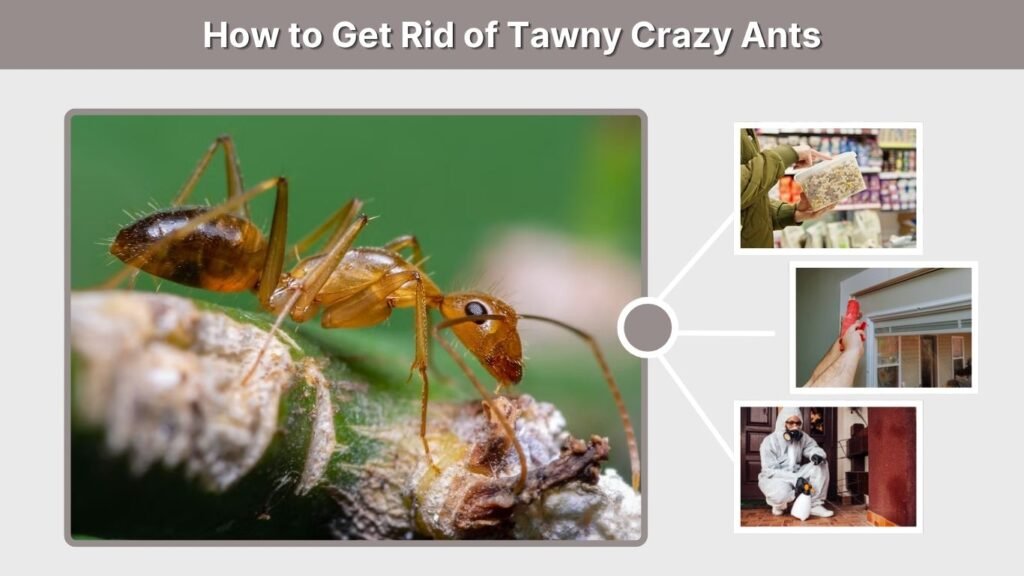
Tawny crazy ant control is difficult because the main colony is often outdoors and spread across multiple nesting sites. Spraying only the ants seen indoors usually gives poor long-term results.
Control Steps
- Inspect the yard for heavy trails and nesting sites.
- Remove leaf litter, trash, boards, firewood, and stored debris.
- Keep mulch away from the foundation.
- Seal gaps around doors, windows, pipes, and utility lines.
- Fix moisture problems and leaking outdoor faucets.
- Store pet food and household food in sealed containers.
- Use labeled ant baits where appropriate.
- Treat outdoor trails and nest concentrations according to product labels.
- Avoid moving infested plants, soil, or debris to new areas.
- Call a licensed pest-control professional for large infestations.
Texas A&M recommends preventing introduction as a key management practice and warns that plants and growing media should be inspected before being moved onto a property. It also notes that the microsporidian pathogen Myrmecomorba nylanderiae shows promise as a biological control organism, but it is not commercially available.
FAQs
Are tawny crazy ants native to the U.S.?
No. Tawny crazy ants are native to South America and were accidentally introduced to the U.S. mainland. They are now invasive in parts of the southern United States, especially Texas and Gulf Coast states.
Do tawny crazy ants bite?
Yes, tawny crazy ants may bite, but they do not sting like fire ants. Their bites are usually mild. The bigger issue is their huge numbers, indoor invasion, and ability to infest electrical equipment.
How big are tawny crazy ants?
Worker tawny crazy ants are very small, usually about 2.0–2.4 mm long. Queens are larger and may be around 4 mm or more. Their long legs and erratic movement help separate them from many other small ants.
Where do tawny crazy ants live?
They live in warm southern areas and nest in moist, protected places such as mulch, leaf litter, logs, rocks, potted plants, debris, and wall voids. In the U.S., they are mainly reported across Texas and southeastern states.
How do you control tawny crazy ants?
Control requires outdoor inspection, sanitation, debris removal, entry-point sealing, moisture reduction, and labeled bait or insecticide treatments. Because colonies spread across large areas, heavy infestations usually need professional pest-control treatment.