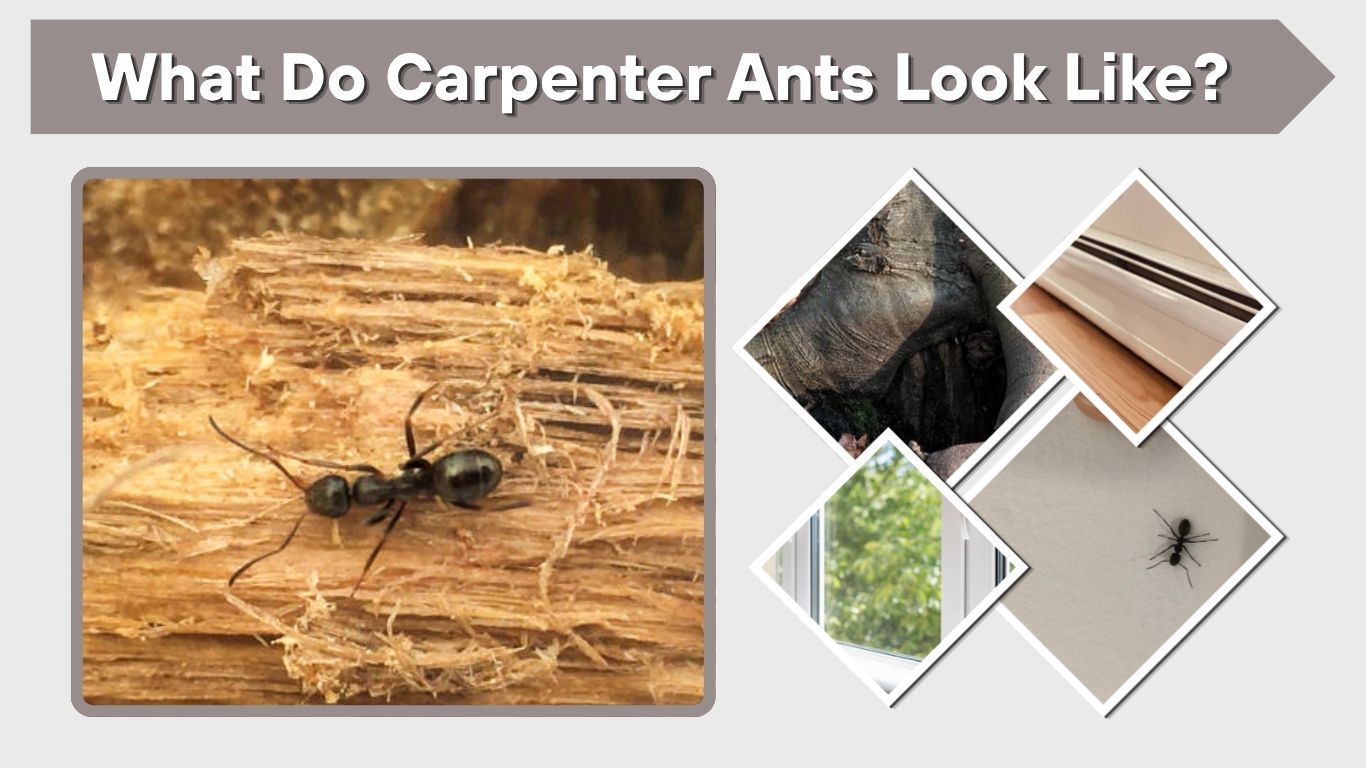
Carpenter ants are usually large ants with a narrow waist, bent antennae, and a dark black, brown, red, or red-black body. They are often mistaken for termites because some carpenter ants have wings during swarming season. Correct identification matters because carpenter ants do not eat wood like termites, but they can tunnel into damp wood and create hidden nests inside walls, trees, decks, and house framing.
What Do Carpenter Ants Look Like?
Carpenter ants are among the larger household ants. A typical worker may be black and wingless, but color and size can vary by species and even within the same colony. The Illinois Department of Public Health notes that worker carpenter ants are commonly black, wingless, and about 1/4 to 1/2 inch long, but size and color alone should not be used for identification.
The best carpenter ant ID features are body shape, antennae, waist, and thorax. Carpenter ants have elbowed antennae, a narrow waist, and a smoothly rounded upper thorax when viewed from the side. Ohio State University Extension also notes that carpenter ants have one node between the thorax and abdomen.
Quick Identification Features
- Large ant compared with many house ants
- Black, dark brown, red, reddish-brown, or red-black body
- Narrow pinched waist
- Bent or elbowed antennae
- Smooth, rounded thorax
- One node between thorax and abdomen
- Workers usually have no wings
- Winged ants may appear during swarming season
Carpenter Ant Size and Color
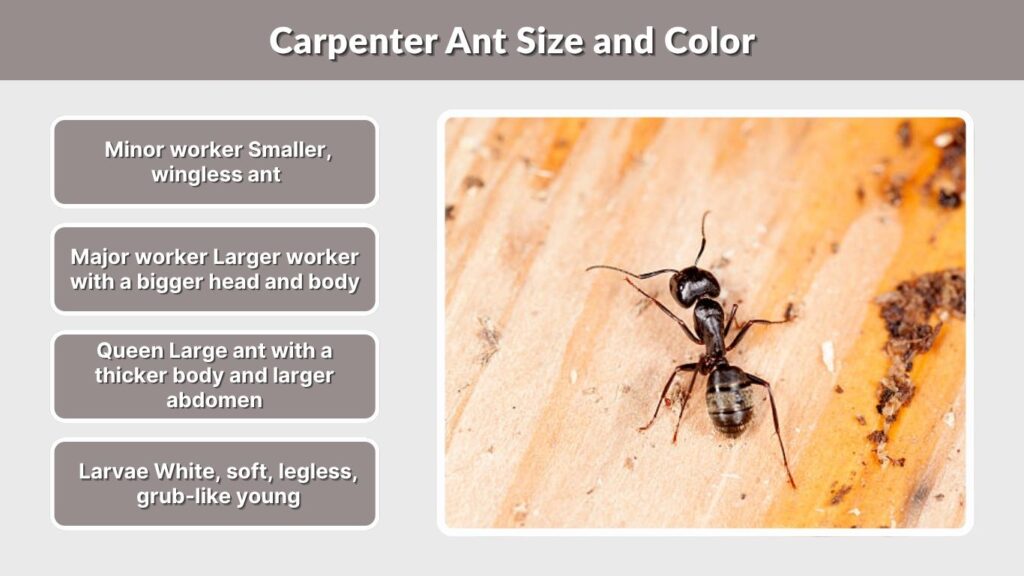
Carpenter ants are not always the same size. A colony can have small workers, medium workers, and larger major workers. This is why one carpenter ant may look smaller than another, even if they belong to the same colony.
| Type | What It Looks Like |
| Minor worker | Smaller, wingless ant that forages for food |
| Major worker | Larger worker with a bigger head and body |
| Queen | Large ant with a thicker body and larger abdomen |
| Winged carpenter ant | Reproductive ant with wings |
| Larvae | White, soft, legless, grub-like young |
Black carpenter ants are common in many areas, but some carpenter ants are red, brown, yellowish, or red and black. So, a large black ant may be a carpenter ant, but color alone is not enough for a sure ID.
What Do Black Carpenter Ants Look Like?
Black carpenter ants usually have a shiny or slightly glossy black body, long legs, bent antennae, and a narrow waist. They may look strong and bulky compared with tiny sugar ants or pavement ants.
A black carpenter ant may be a worker, major worker, or winged reproductive. Workers are wingless. Winged black carpenter ants are often confused with termite swarmers, especially when they appear near windows or lights.
What Do Carpenter Ants Look Like With Wings?
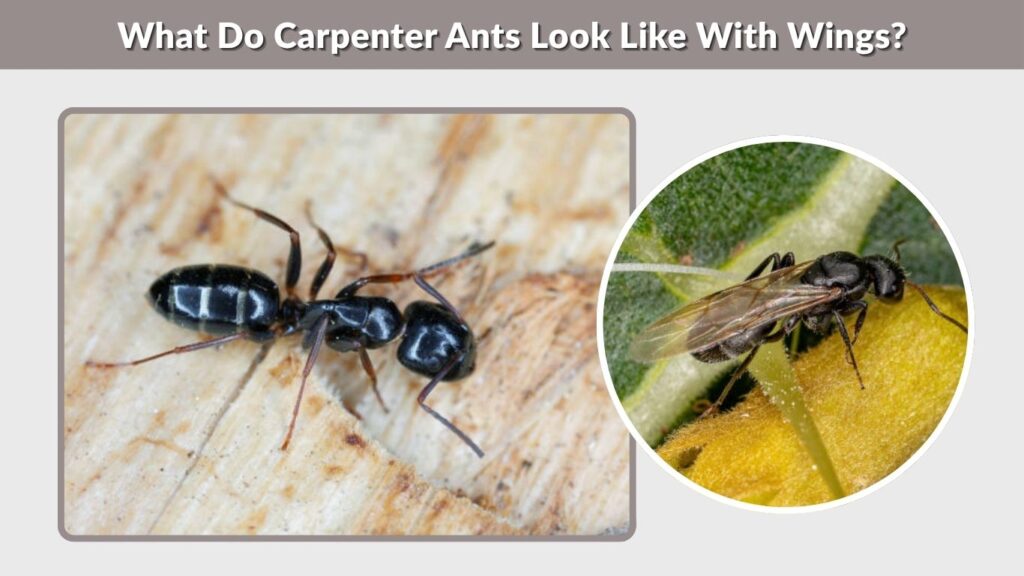
Winged carpenter ants are reproductive ants. They may be future queens or males leaving the colony to mate. They usually have a dark body, pinched waist, bent antennae, and two pairs of wings. The front wings are longer than the back wings. University of Minnesota Extension explains that carpenter ants have dark bodies, narrow waists, elbowed antennae, and hind wings shorter than the front wings.
Winged Carpenter Ants vs Termites
| Feature | Winged Carpenter Ant | Winged Termite |
| Antennae | Bent or elbowed | Straight |
| Waist | Narrow and pinched | Broad, not pinched |
| Wings | Front wings longer than back wings | Wings about equal length |
| Body color | Often dark | Often pale or dark, depending on caste |
| Body shape | Clear ant-like body sections | More straight-sided body |
Termites have straight antennae, equal-sized wings, and no narrow “wasp waist,” while carpenter ants have elbowed antennae, uneven wing length, and a pinched waist.
What Do Carpenter Ant Queens Look Like?
A carpenter ant queen looks like a larger, heavier carpenter ant. She has a bigger abdomen and a thicker thorax than most workers. A young queen may have wings before mating. After mating, she usually sheds her wings and may show small wing scars on the thorax.
Queen carpenter ants are not commonly seen walking around the kitchen. They usually stay hidden in the main nest. If you find a large winged carpenter ant indoors, it may be a reproductive ant from a mature colony or a swarmer that came from outside.
What Do Baby Carpenter Ants Look Like?
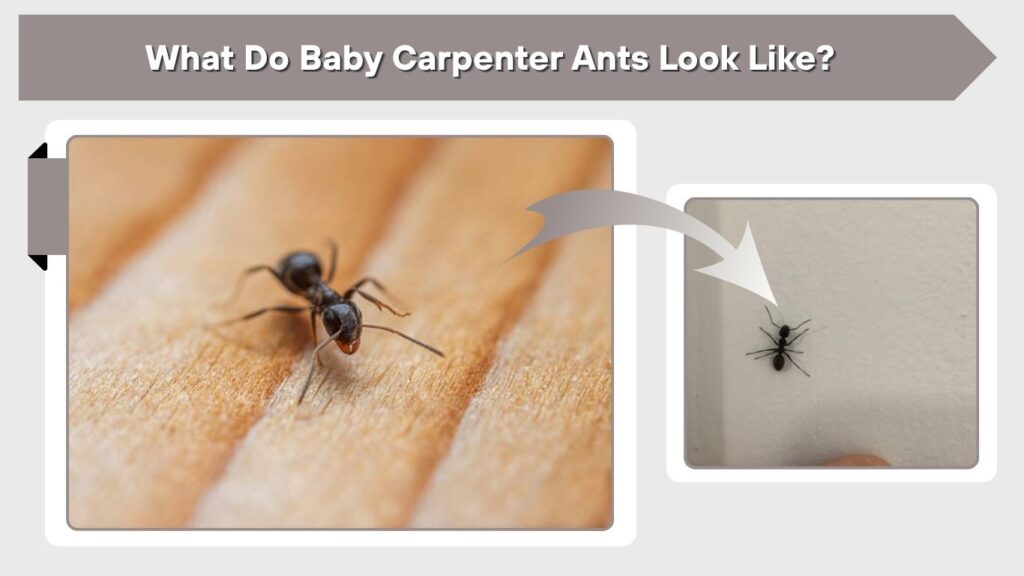
Baby carpenter ants do not look like tiny adult ants at first. Carpenter ants go through complete development: egg, larva, pupa, and adult. North Carolina State Extension explains that carpenter ant larvae are white, legless, and maggot-like, while pupae are enclosed in cocoons that people often mistake for eggs.
Carpenter Ant Eggs, Larvae, and Pupae
Carpenter ant eggs are very small and pale. Larvae look soft, white, and worm-like. Pupae may look like pale rice grains or small cocoons. If you open a nest and see white oval shapes, many of them may be pupae rather than eggs.
You usually will not see eggs or larvae unless a nest is disturbed. Workers keep the brood hidden and protected inside galleries, wall voids, wood cavities, or other nest areas.
What Do Carpenter Ant Nests Look Like?
A carpenter ant nest is usually hidden. It does not always look like a mound or hill. Indoors, nests may be inside walls, hollow doors, window frames, damp wood, insulation, crawl spaces, or attic areas. Outdoors, nests may be in dead trees, stumps, logs, firewood, fence posts, or rotting landscape timbers.
The nest itself often consists of smooth, clean galleries inside wood. Carpenter ants remove wood instead of eating it, so they push debris out of the nest. That debris is called frass.
What Do Carpenter Ant Droppings or Shavings Look Like?
Many people call carpenter ant debris “droppings,” but the more accurate word is frass. It often looks like coarse sawdust, pencil shavings, or tiny wood fragments. University of Maryland Extension says coarse sawdust-like frass near a spot can indicate that a carpenter ant nest is close by because ants push this material out as they carve galleries.
Frass may include:
- Wood shavings
- Soil particles
- Dead insect parts
- Ant body parts
- Small debris from inside the nest
If you see frass below a window frame, baseboard, deck board, tree cavity, or wall crack, carpenter ants may be nesting nearby.
What Do Carpenter Ant Holes Look Like?
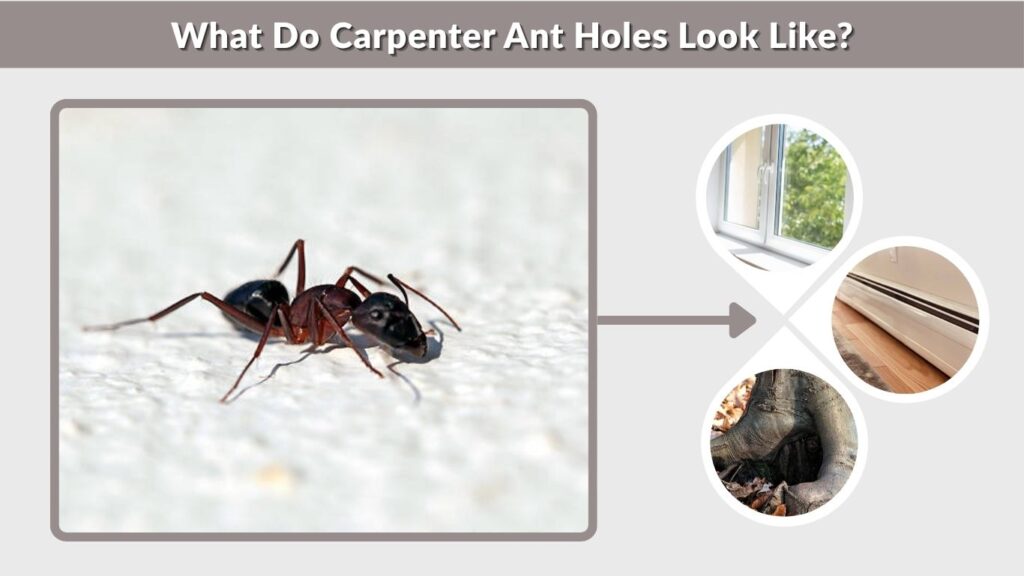
Carpenter ant holes are usually small openings where ants enter, exit, or push out frass. The hole itself may be hard to see. You may notice the sawdust-like pile first.
Common places for holes include:
- Window frames
- Door frames
- Baseboards
- Deck boards
- Porch posts
- Tree cavities
- Fence posts
- Wood near plumbing leaks
- Gaps around siding or trim
Carpenter ant holes may look clean compared with termite damage because carpenter ants make smoother galleries and do not pack them with mud.
What Do Carpenter Ant Trails Look Like?
Carpenter ant trails often look like lines of large ants moving between a food source and a nest. Trails may appear along walls, fences, tree branches, deck rails, foundations, pipes, or wires. Carpenter ants are often more active at night, so trails may be easier to see after dark.
If you see a trail, do not spray it immediately. Watch where the ants go. Following the trail can help you locate the nest or the entry point.
What Do Carpenter Ant Bites Look Like?
Carpenter ant bites are usually minor. A bite may look like a small red spot, mild swelling, or slight irritation. Some people may feel a brief pinch or burning feeling. Carpenter ants do not sting like bees or wasps.
A bite mark alone is not a good way to identify carpenter ants because many insect bites look similar. If there is strong swelling, spreading redness, allergic reaction, infection signs, or severe pain, medical advice is safer.
What Do Carpenter Ant Mounds or Hills Look Like?
Carpenter ants usually do not make obvious soil mounds like some other ants. If someone searches for “carpenter ant hills,” they are often seeing activity near wood, roots, stumps, or soil-covered nesting material.
Outdoors, carpenter ants may nest in:
- Old stumps
- Dead tree sections
- Buried roots
- Logs
- Firewood
- Wood touching soil
- Landscape timbers
A “mound” near carpenter ants may actually be excavated debris or soil around decaying wood, not a true ant hill.
What Do Carpenter Ants Look Like Inside a House?
Inside a house, carpenter ants often appear as large black or dark ants walking along floors, counters, bathroom walls, kitchen areas, windows, or baseboards. Seeing one ant does not always mean there is a nest indoors, but repeated sightings can be a warning sign.
Indoor warning signs include:
- Large ants appearing daily
- Ants near sinks, tubs, or dishwashers
- Ants coming from walls or trim
- Winged ants indoors
- Sawdust-like frass near wood
- Rustling sounds in walls
- Ants active during winter
If carpenter ants are found indoors during cold weather, it may suggest an indoor nest because outdoor colonies are usually less active.
Carpenter Ants vs Sugar Ants
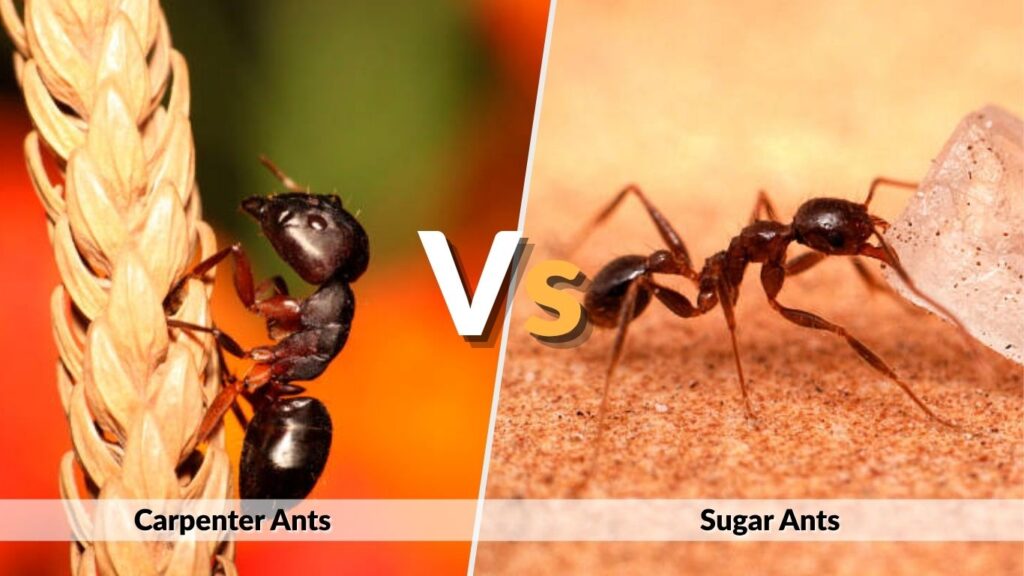
Many people call small house ants “sugar ants.” Carpenter ants are usually much larger than common sugar-feeding house ants. Carpenter ants also have a more robust body and may be seen near damp wood, while small sugar ants are usually seen around sweets, crumbs, and kitchen food.
The easiest difference is size. Carpenter ants look large and sturdy. Sugar ants are usually much smaller and more delicate.
Carpenter Ants vs Termites: What They Look Like
Carpenter ants and termites can both appear near wood, but they look different. Carpenter ants have bent antennae, a narrow waist, and clear body sections. Termites have straight antennae, a broad waist, and a more tube-shaped body. Ant identification can be challenging, and University of Minnesota Extension recommends expert help when you cannot identify an ant confidently.
If wings are present, check wing length. Carpenter ant wings are unequal, with front wings longer than hind wings. Termite wings are usually equal in length.
FAQs
What do carpenter ants look like to the eye?
To the eye, carpenter ants look like large dark ants with long legs, bent antennae, and a pinched waist. Many are black, but some may be red, brown, or red-black.
What do carpenter ant nests look like?
Carpenter ant nests are usually hidden inside wood or wall voids. The visible signs are often smooth galleries, sawdust-like frass, ant trails, or small openings in wood.
What do carpenter ant eggs look like?
Carpenter ant eggs are tiny and pale, but people often mistake pupae for eggs. Pupae may look like small white or cream-colored cocoons.
What do flying carpenter ants look like?
Flying carpenter ants look like large ants with wings, narrow waists, and bent antennae. Their front wings are longer than their back wings, unlike termite wings.
What do carpenter ants bites look like?
A carpenter ant bite may look like a small red mark with mild swelling or irritation. Bite marks are not a reliable way to identify carpenter ants because many insect bites look similar.