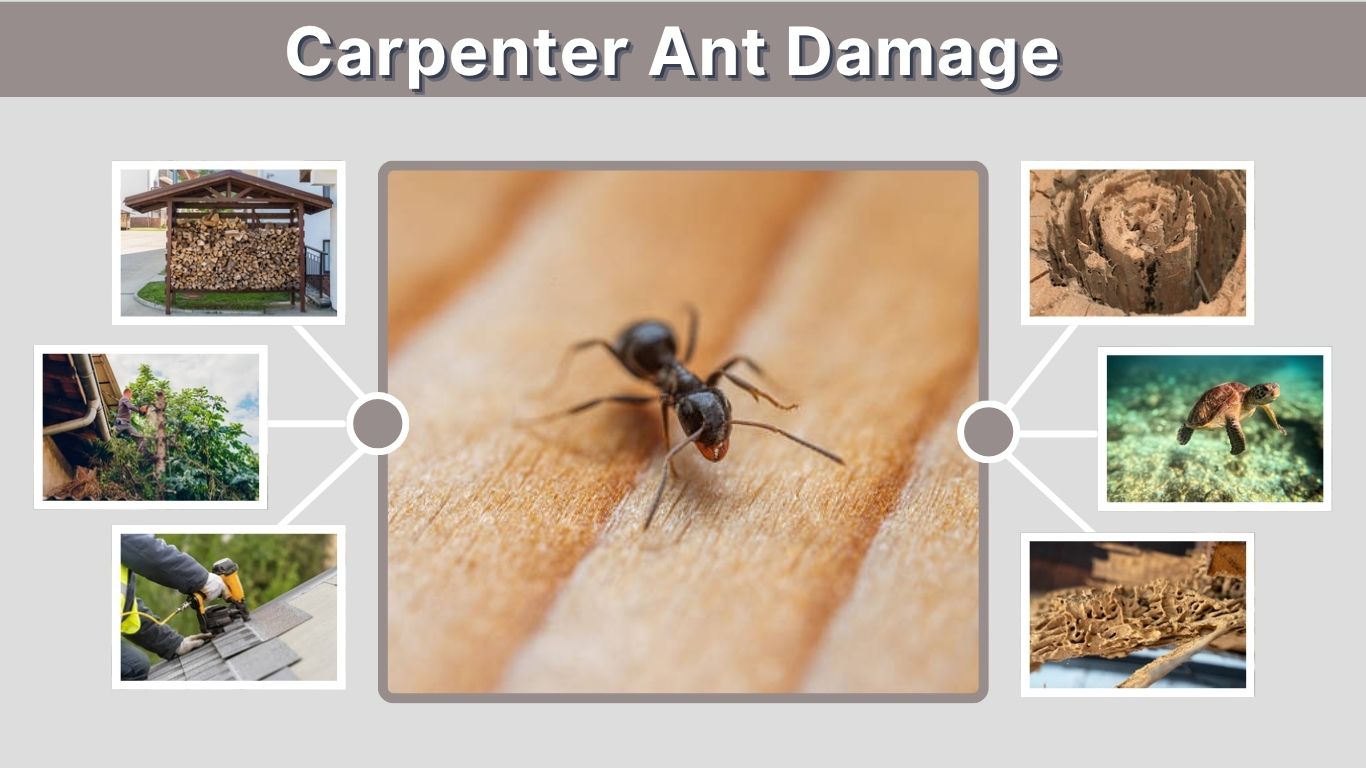
Carpenter ant damage can be confusing because it is often hidden inside walls, floors, trees, decks, or damp wood. These ants do not eat wood like termites. Instead, they tunnel through it to build nests, leaving smooth galleries behind. If the colony stays active for a long time, the damage can weaken wood and become costly to repair. Here is how to identify carpenter ant damage early and what to do next.
What Is Carpenter Ant Damage?
Carpenter ant damage happens when carpenter ants excavate wood to create nesting tunnels. The galleries are usually clean, smooth, and free of mud or soil. University of Minnesota Extension explains that carpenter ants damage wood by creating tunnels and galleries that have a smooth, well-sanded appearance.
Unlike termites, carpenter ants are not feeding on the wood. They remove wood pieces and push debris out of the nest. This debris is called frass and may look like coarse sawdust mixed with insect parts.
What Does Carpenter Ant Damage Look Like?
Carpenter ant damage often looks like hollowed-out wood with clean tunnels. You may not see the tunnels until wood is opened, but you may notice debris, ants, or weak wood around the damaged area.
| Sign | What It May Mean |
| Coarse sawdust-like frass | Ants are excavating wood nearby |
| Smooth tunnels inside wood | Carpenter ant galleries may be present |
| Rustling sounds in walls | A hidden nest may be active |
| Large black or red-black ants indoors | Workers may be foraging from a nest |
| Winged ants indoors | A mature colony may be inside |
Carpenter ants often begin in wood that already has moisture damage or decay, then may expand into sound wood as the colony grows. UC IPM notes that large colonies can create extensive galleries and may compromise structural integrity.
Early Signs of Carpenter Ant Damage
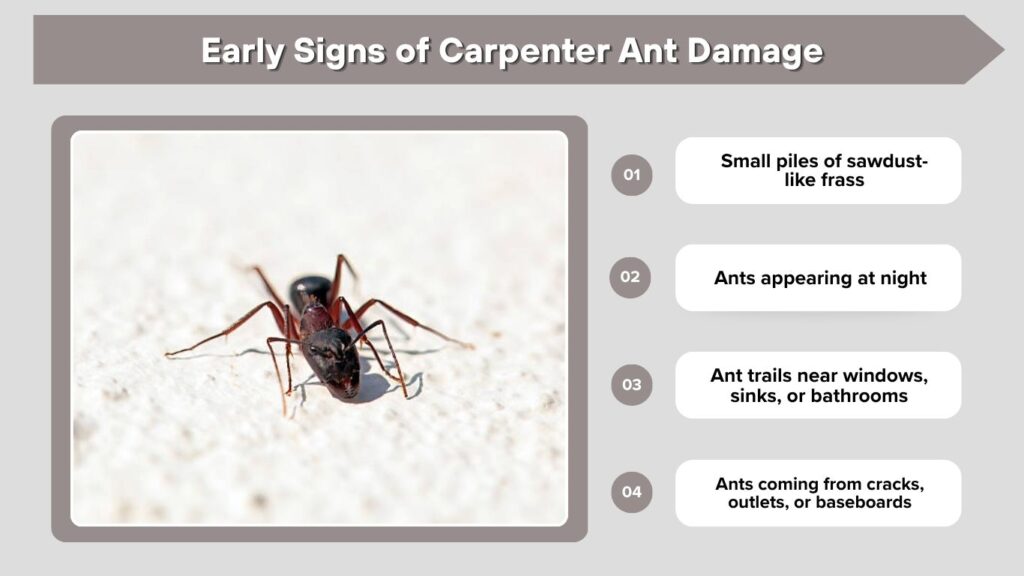
Early carpenter ant damage is easy to miss because the surface of the wood may look normal. The real damage may be behind trim, inside wall voids, under floors, or around damp framing.
Common early signs include:
- Small piles of sawdust-like frass
- Ants appearing at night
- Ant trails near windows, sinks, or bathrooms
- Ants coming from cracks, outlets, or baseboards
- Soft or damp wood near leaks
- Faint rustling sounds inside walls
- Winged ants appearing indoors
If you see carpenter ants indoors during cold months, it can be a stronger sign of an indoor nest because outdoor ants are usually less active in winter.
Carpenter Ant Wood Damage
Carpenter ant wood damage is usually connected to moisture. They prefer damp, softened, or decaying wood because it is easier to tunnel through. Common places include window frames, door frames, roof edges, crawl spaces, decks, porches, hollow doors, and areas around plumbing leaks.
Damage in Walls and Floors
Wall and floor damage may stay hidden for a long time. You may see ants near baseboards or hear noise inside the wall, but the actual nest may be several feet away. UC IPM lists wall voids, hollow doors, and insulation as common carpenter ant nesting areas.
Damage in Decks and Fences
Deck boards, railings, posts, and fences can attract carpenter ants when wood stays wet or touches soil. Rotten fence posts and old deck framing are especially vulnerable. If you see ants entering cracks in damp outdoor wood, inspect the wood for softness and frass.
Carpenter Ant Damage to House
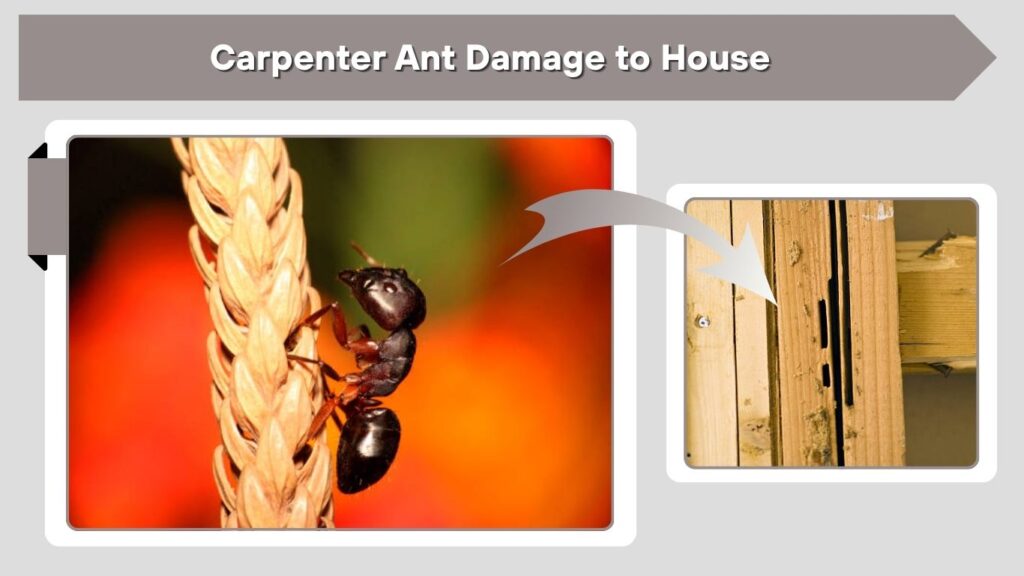
Carpenter ants can damage a house if the colony remains active for years. Small early infestations may not cause major structural problems right away, but long-term nesting inside framing, beams, subfloors, or roof structures can weaken wood.
The risk is higher when:
- The nest is inside structural wood
- The home has repeated moisture problems
- Ants have satellite nests indoors
- Frass appears in several locations
- Winged ants are found inside
- Damage is near load-bearing areas
University of Minnesota Extension notes that carpenter ant damage is variable, and severe damage can weaken structural wood, though it usually occurs slowly over years.
Carpenter Ant Tree Damage
Carpenter ants can nest in trees, especially trees with dead, hollow, or decaying sections. In many cases, the ants are using wood that is already weakened by rot, disease, injury, or moisture. Seeing carpenter ants on a tree does not always mean they are killing the tree, but it can mean the tree has hidden decay.
Check for:
- Ant trails going into cavities
- Sawdust at the tree base
- Hollow-sounding trunk areas
- Dead limbs
- Cracks, wounds, or rot pockets
- Ants entering old pruning wounds
If the tree is close to your house, trim branches away from the roof and check whether ants are using the tree as a bridge to enter the building.
Carpenter Ant Damage vs Termite Damage
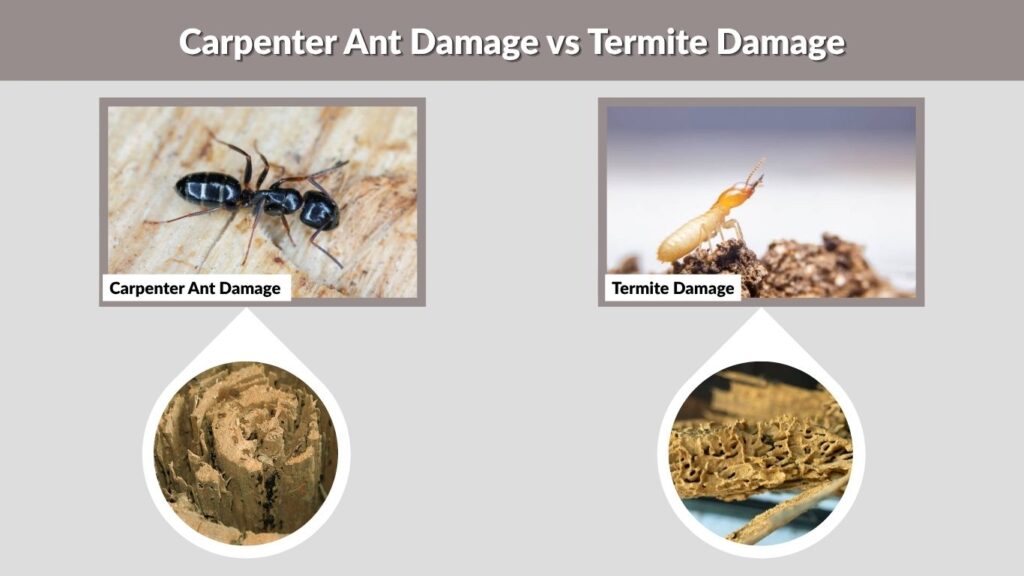
Carpenter ant damage and termite damage are often confused, but they are different.
| Feature | Carpenter Ant Damage | Termite Damage |
| Wood use | Ants tunnel through wood | Termites eat wood |
| Galleries | Smooth and clean | Often rough or layered |
| Debris | Sawdust-like frass may appear | Mud tubes or pellets may appear |
| Moisture link | Often starts in damp wood | Many termites also prefer moisture |
| Insect body | Narrow waist, bent antennae | Broad waist, straight antennae |
Winged ants and termites can also be confused. Ants have a narrow waist, bent antennae, and hind wings shorter than front wings. Termites have a more rectangular body, straight antennae, and four similar-sized wings.
How Fast Do Carpenter Ants Cause Damage?
Carpenter ants usually cause damage slowly compared with some termites. The speed depends on colony size, wood moisture, nest location, and how long the colony has been active. A small satellite nest may cause limited damage, while a large colony in structural wood can create serious problems over time.
Damage may develop faster when wood stays wet because damp wood is easier for ants to excavate. This is why fixing leaks is just as important as killing the ants.
Carpenter Ant Damage Repair
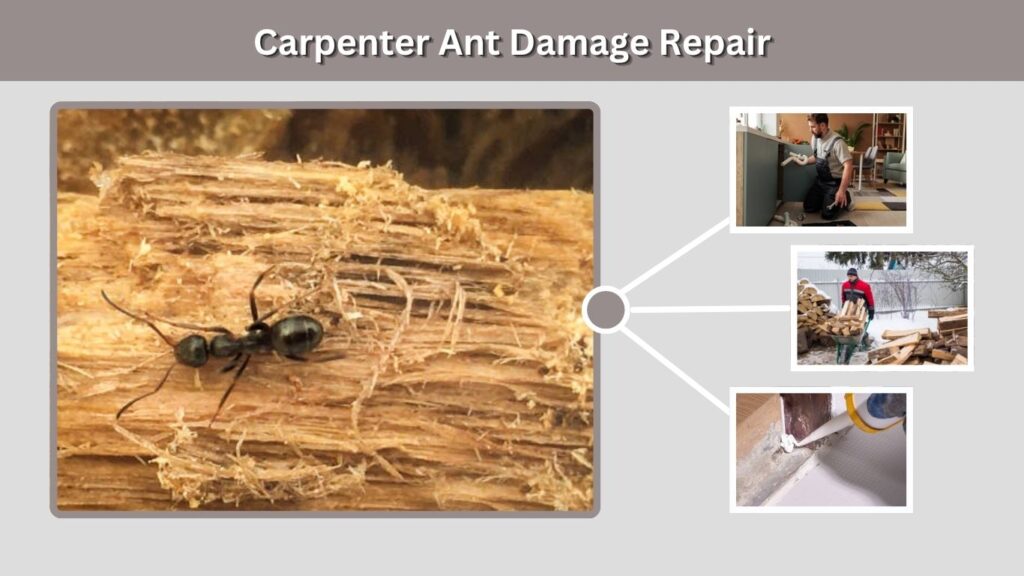
Repairing carpenter ant damage should start after the colony is controlled. If you repair the wood first but leave the nest active, ants may continue tunneling in nearby areas.
Important repair steps include:
- Find the main damaged area.
- Remove or treat the colony.
- Fix leaks and moisture problems.
- Replace rotten or weakened wood.
- Seal cracks and entry points.
- Keep wood from touching soil.
- Remove firewood and wood debris near the house.
Oregon State University recommends inspecting the structure, fixing leaks, repairing or replacing damaged wood, sealing exterior openings, removing firewood and debris, and following up to make sure control worked.
Is Carpenter Ant Damage Covered by Homeowners Insurance?
Carpenter ant damage is usually treated as a maintenance or pest-related problem, but coverage depends on the exact policy. Many standard policies exclude insect infestations because they are often considered preventable. State Farm says insect infestations are usually excluded from standard homeowners and renters policies, and Allstate says termite damage is usually not covered because prevention is the homeowner’s responsibility.
Before assuming coverage, read your policy and contact your insurer. If damage was connected to a sudden covered event, the answer may be different, but gradual pest damage is commonly excluded.
How to Prevent Carpenter Ant Damage
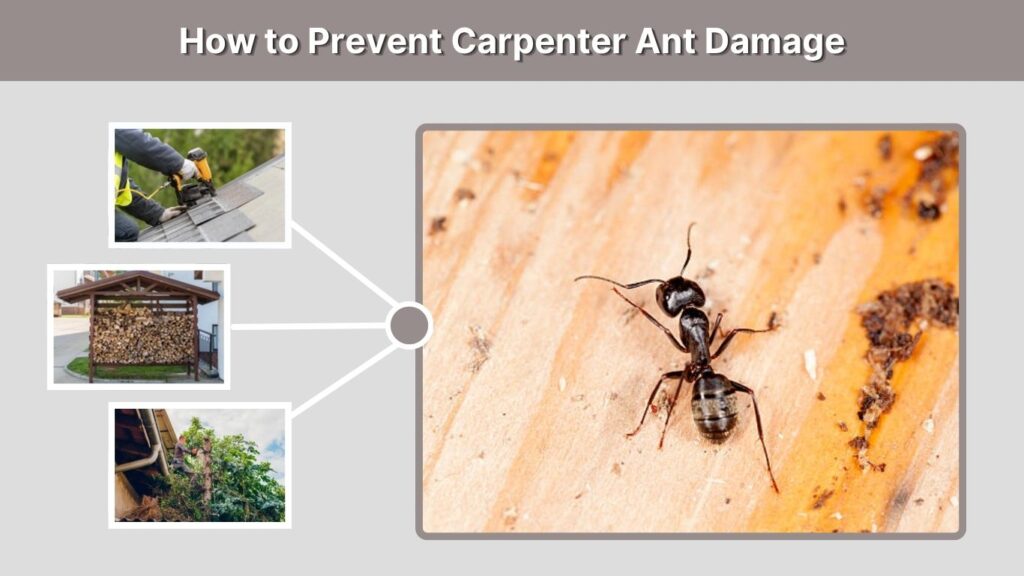
Prevention is mostly about keeping wood dry and reducing access to your home. Carpenter ants are attracted to damp, decaying wood, so moisture control is the biggest step.
Helpful prevention tips:
- Repair roof, gutter, and plumbing leaks.
- Replace rotted trim, siding, or deck boards.
- Store firewood away from the house.
- Keep mulch thin near the foundation.
- Seal gaps around pipes and wires.
- Improve crawl space and attic ventilation.
- Trim branches away from the roof.
- Remove old stumps and wood debris.
UC IPM recommends reducing moisture, replacing decayed wood, sealing openings, keeping firewood away from structures, and trimming vegetation away from buildings.
FAQs
Do carpenter ants cause structural damage?
Yes, carpenter ants can cause structural damage if they tunnel through important wood for a long time. Severe damage is more likely when the nest is inside framing, beams, floors, or other structural wood.
What does carpenter ant damage look like?
Carpenter ant damage usually looks like smooth, clean tunnels inside wood. Outside the wood, you may see coarse sawdust-like frass, ant trails, or small openings where ants push out debris.
Can carpenter ants damage a house?
Yes, carpenter ants can damage a house, especially if they nest in damp framing, wall voids, crawl spaces, or roof areas. The damage usually develops slowly, but it should not be ignored.
Do carpenter ants damage trees?
Carpenter ants can tunnel in trees, especially where wood is already dead, hollow, or decayed. Their presence may signal tree rot or weakness, so large affected trees near a house should be inspected.
Should I repair carpenter ant damage myself?
Small cosmetic repairs may be DIY, but structural damage should be checked by a professional. Always eliminate the colony and fix moisture problems before replacing damaged wood.