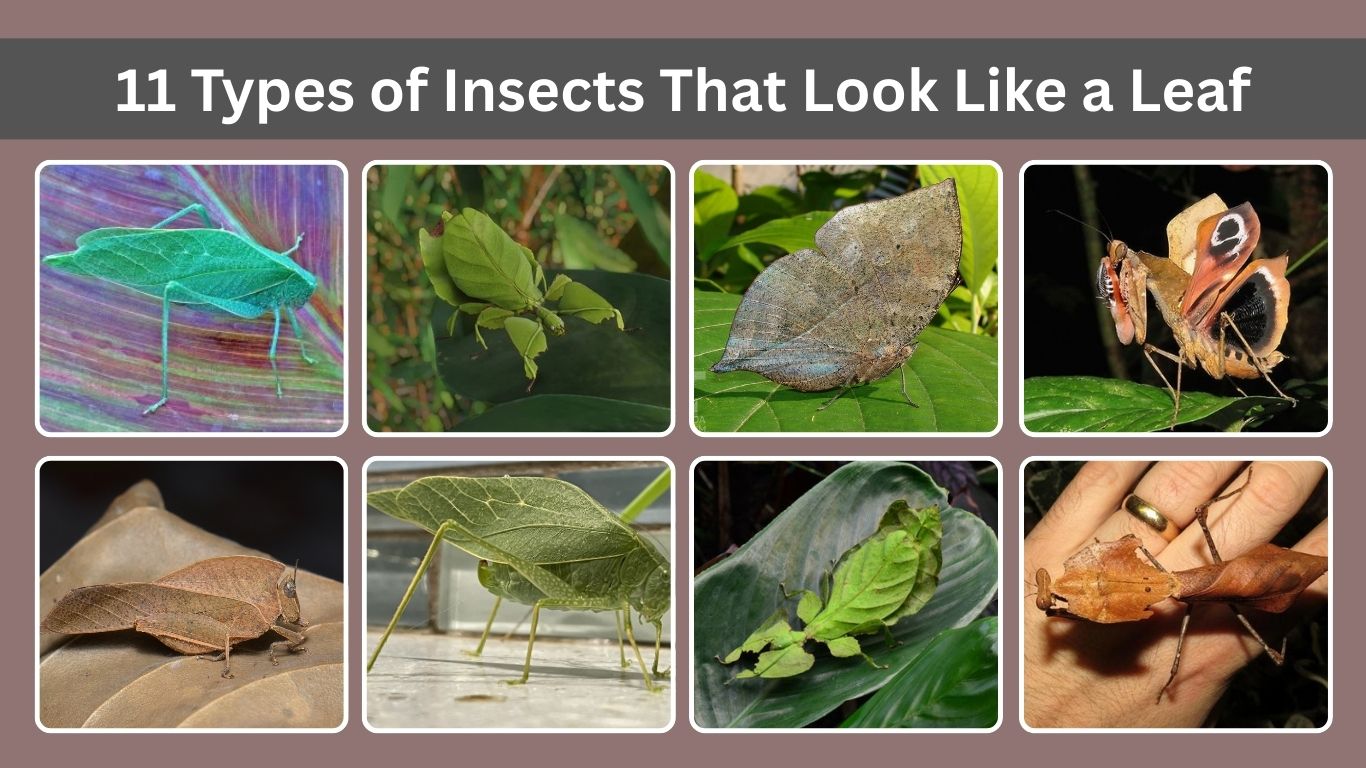
Nature is full of fascinating creatures, and some of the most incredible examples are insects that look like a leaf. Through camouflage and mimicry, these insects blend seamlessly into their surroundings, making it difficult for predators to spot them. From large leaf insects and mantises to butterflies and beetles, each species has evolved unique features that mirror real leaves in shape, color, and texture. This list explores 11 amazing insects that resemble leaves in the wild.
1. Leaf Insect (Phyllium)

Leaf insects are one of the most fascinating examples of an insect that looks like a leaf. They belong to the family Phylliidae and are masters of mimicry, often being mistaken for real leaves due to their flat bodies, leaf-like veins, and green coloration. This camouflage helps them stay hidden from predators in their natural forest habitats.
Identification
- Flat, green body with leaf-like veins
- Broad legs that resemble leaf edges
- Size ranges from 2 to 4 inches
- Coloration varies from light green to brownish green
Habitat
Leaf insects are mainly found in tropical forests of South and Southeast Asia, including countries like Malaysia, India, and the Philippines. They prefer dense vegetation where they can easily blend in with the leaves.
Behavior
These insects are nocturnal, remaining motionless during the day to avoid detection. At night, they feed on leaves, moving slowly to avoid drawing attention. When disturbed, they sometimes sway gently to mimic the motion of leaves in the wind.
Diet
Leaf insects feed exclusively on plant material, especially fresh leaves of guava, mango, rose, and other broadleaf plants.
2. Dead Leaf Grasshopper (Deroplatys dessicata)

The dead leaf grasshopper is another remarkable insect that looks like a leaf, perfectly resembling dried or fallen foliage. Its camouflage is so effective that it can easily go unnoticed on the forest floor or among leaf litter.
Identification
- Brown, mottled wings resembling dried leaves
- Flattened, irregular body shape
- Size ranges from 2 to 3 inches
- Vein-like patterns enhance the leaf-like appearance
Habitat
These insects are typically found in Southeast Asian forests, where dried leaves cover the ground. Their camouflage helps them survive by blending into the natural environment.
Behavior
Dead leaf grasshoppers remain motionless during the day, relying on their disguise to avoid predators. When threatened, they leap suddenly to escape danger.
Diet
They feed on fresh and dried plant material, mainly consuming grasses, leaves, and other vegetation.
3. Katydid (Tettigoniidae family)

Katydids are one of the most common examples of an insect that looks like a leaf, with their green wings closely resembling fresh foliage. Their camouflage allows them to hide among leaves and avoid predators with ease.
Identification
- Long, slender body with leaf-shaped wings
- Green coloration with visible vein-like patterns
- Long antennae often longer than the body
- Size ranges from 1 to 4 inches depending on species
Habitat
Katydids are found worldwide, especially in tropical and temperate forests. They prefer areas with dense vegetation where they can blend in among leaves.
Behavior
They are nocturnal and communicate through chirping sounds. During the day, they stay hidden on leaves, remaining still to avoid detection.
Diet
Katydids are omnivorous, feeding on leaves, flowers, fruit, and occasionally small insects.
4. Dead Leaf Mantis (Deroplatys lobata)

The dead leaf mantis is a striking insect that looks like a leaf, mimicking the shape, color, and texture of dried foliage. Its disguise helps it ambush prey and remain hidden from predators.
Identification
- Brown, flattened body resembling a curled dead leaf
- Wing edges have irregular shapes and vein-like patterns
- Size ranges from 2.5 to 4 inches
- Color varies from light brown to dark, dried-leaf tones
Habitat
Native to Southeast Asian rainforests, this mantis thrives in leaf litter and low vegetation, where its camouflage is most effective.
Behavior
It is an ambush predator, staying perfectly still until prey comes close. When threatened, it displays a defensive posture, spreading its wings to appear larger.
Diet
The dead leaf mantis feeds on other insects, including flies, crickets, and small grasshoppers.
5. Indian Leaf Butterfly (Kallima inachus)

The Indian leaf butterfly is a beautiful insect that looks like a leaf, famous for its incredible camouflage when its wings are closed. From the underside, it resembles a dried leaf with midribs and veins.
Identification
- Wings closed: brown with leaf-like veins and midrib patterns
- Wings open: vibrant blue and orange colors on the upper side
- Size ranges from 3 to 4 inches
- Pointed wing tips resemble the shape of a leaf stem
Habitat
This butterfly is found in tropical and subtropical forests across South and Southeast Asia, especially in India, Nepal, and Myanmar.
Behavior
When resting with wings closed, it becomes nearly invisible among dead leaves. It flies actively during the day and uses bright upper wing colors to distract predators in flight.
Diet
Adult butterflies feed on rotting fruit, nectar, and tree sap, while caterpillars feed on host plants like Strobilanthes.
6. Malaysian Leaf Mantis (Choeradodis stalii)

The Malaysian leaf mantis is another fascinating insect that looks like a leaf, with its broad, shield-like thorax and wings that perfectly mimic fresh foliage.
Identification
- Flattened, wide thorax shaped like a leaf
- Green wings with vein-like patterns
- Size ranges from 2.5 to 3.5 inches
- Camouflage includes leaf-like texture and coloration
Habitat
This mantis is native to tropical rainforests of Malaysia and other parts of Southeast Asia. It prefers leafy plants and shrubs where it can blend seamlessly with its surroundings.
Behavior
It is an ambush predator, staying motionless among leaves until prey approaches. When threatened, it may sway like a leaf in the wind to enhance its disguise.
Diet
The Malaysian leaf mantis feeds on small insects such as flies, crickets, and grasshoppers, relying on stealth to capture its prey.
7. Giant Leaf Insect (Phyllium giganteum)

The giant leaf insect is one of the largest and most well-known insects that look like a leaf, with an extraordinary resemblance to real foliage. Its body, wings, and even legs mimic the texture and edges of leaves.
Identification
- Large, flat body shaped like a leaf
- Prominent vein-like patterns on wings
- Legs have leaf-like flaps to enhance camouflage
- Can grow up to 4–5 inches in length
Habitat
Found mainly in tropical forests of Malaysia and surrounding regions, they live in areas with dense vegetation that provides both food and cover.
Behavior
They remain still during the day, blending in with surrounding leaves. When moving, they often sway side to side like a leaf in the breeze, making their disguise even more convincing.
Diet
The giant leaf insect feeds on a variety of broadleaf plants, including guava, mango, and oak leaves.
8. Dead Leaf Beetle (Chrysomelidae family)

The dead leaf beetle is another unique insect that looks like a leaf, using its brownish coloration and flattened body to resemble dried foliage. This disguise helps it hide from predators in forest environments.
Identification
- Oval, flattened body with leaf-like texture
- Brown or mottled coloration mimicking dried leaves
- Size ranges from 0.5 to 1 inch
- Wing covers (elytra) show vein-like patterns
Habitat
These beetles are found in tropical and subtropical forests across Asia and South America. They typically live on plants and shrubs with abundant leaf litter.
Behavior
Dead leaf beetles remain motionless when threatened, relying on their camouflage for protection. Some species also drop into leaf litter to disappear instantly.
Diet
They primarily feed on leaves, flowers, and soft plant tissues, often becoming pests on crops and ornamental plants.
9. Leaf Katydid (Pterochroza ocellata)

The leaf katydid is a remarkable insect that looks like a leaf, often mistaken for real foliage due to its green wings and detailed vein-like markings.
Identification
- Broad green wings with realistic vein structures
- Some species show brown patches mimicking leaf damage
- Long antennae extending beyond body length
- Size ranges from 2 to 3 inches
Habitat
Leaf katydids are commonly found in Central and South American forests, living in dense vegetation where their camouflage is most effective.
Behavior
They remain still during the day, blending in with surrounding leaves. When disturbed, they sometimes sway gently to enhance their disguise.
Diet
These katydids are herbivorous, feeding on leaves, flowers, and fruits from various forest plants.
10. Green Leaf Weevil (Polydrusus formosus)

The green leaf weevil is a small but striking insect that looks like a leaf, thanks to its shimmering green body that blends seamlessly with foliage.
Identification
- Small, elongated body covered in green metallic scales
- Distinctive long snout typical of weevils
- Size ranges from 0.2 to 0.3 inches
- Green coloration mimics fresh leaves
Habitat
This insect is commonly found in Europe and parts of Asia, living in gardens, woodlands, and hedgerows where leafy plants are abundant.
Behavior
Green leaf weevils are excellent climbers, often hiding on the underside of leaves during the day. Their coloration makes them nearly invisible to predators.
Diet
They feed on a wide range of plants, including fruit trees, shrubs, and broadleaf plants, occasionally causing minor damage to crops.
11. Leafhopper (Cicadellidae family)

The leafhopper is a tiny but well-camouflaged insect that looks like a leaf, using its green body and wedge-shaped form to blend into foliage.
Identification
- Small, wedge-shaped body
- Usually green, though some species show brown or mottled colors
- Prominent hind legs adapted for jumping
- Size ranges from 0.1 to 0.5 inches
Habitat
Leafhoppers are found worldwide, living on grasses, shrubs, and trees in both temperate and tropical regions.
Behavior
They are highly active and can leap quickly when disturbed. Their camouflage allows them to rest unnoticed on leaves.
Diet
Leafhoppers feed on plant sap using their piercing-sucking mouthparts, which sometimes makes them agricultural pests.