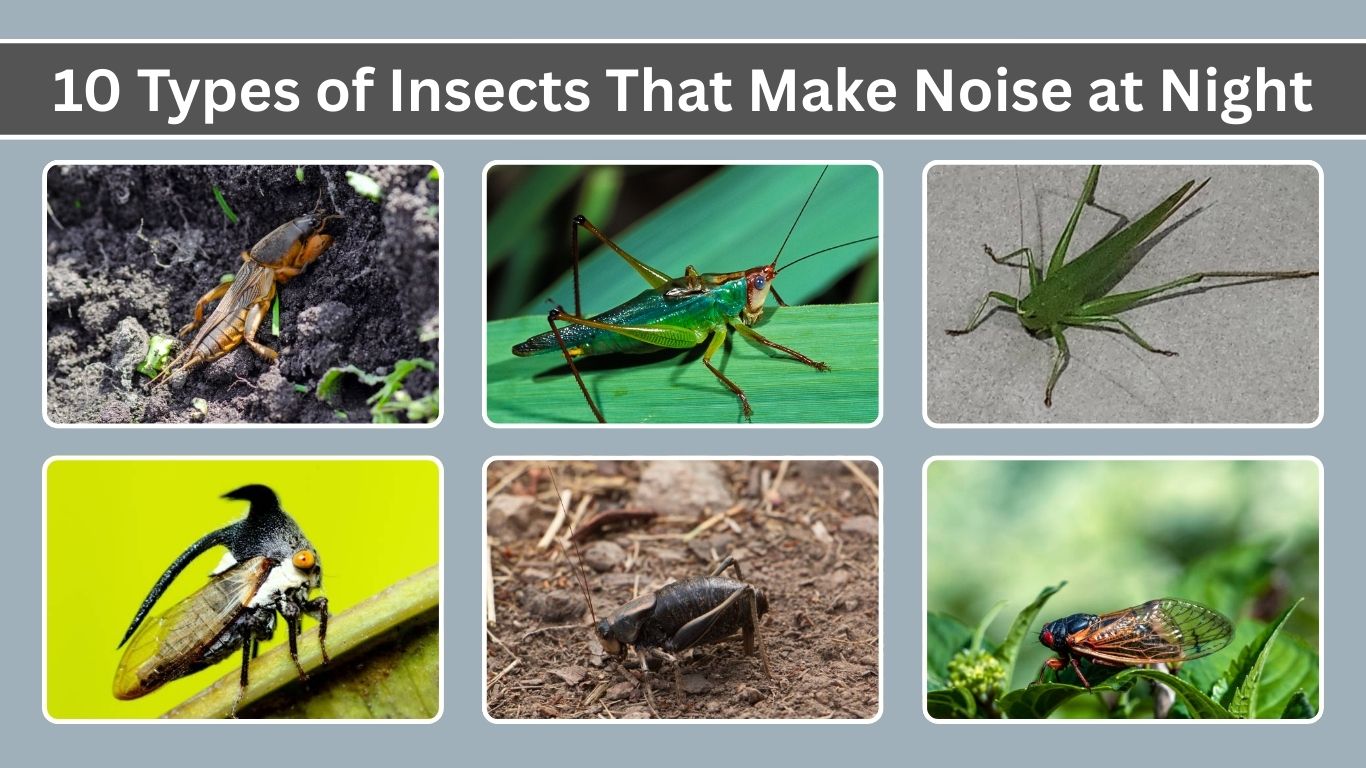
The nighttime soundscape is filled with the chirps, buzzes, and trills of insects. These creatures use their songs to attract mates, mark territory, or communicate with others, creating the familiar symphony we often hear after dusk. From crickets to cicadas, each insect has its unique way of producing sound, adding life and rhythm to the night.
1. Cricket

Crickets are one of the most recognizable nocturnal insects, known for their chirping that often fills the night air. Their sounds are created by rubbing their wings together, a behavior called stridulation. These insects play an important role in ecosystems and are also cultural symbols in many parts of the world.
Identification
- Medium-sized insects with cylindrical bodies
- Long antennae often longer than their bodies
- Strong hind legs adapted for jumping
- Males produce chirping sounds by rubbing forewings
Habitat
Crickets are commonly found in grassy fields, gardens, forests, and sometimes inside homes. They prefer warm, moist environments and often hide in soil cracks, under rocks, or in vegetation during the day.
Activity at Night
Crickets are primarily nocturnal and become most active after sunset. Their loud chirping is usually a mating call from males, which varies in tone and rhythm depending on the species.
Diet
Crickets are omnivorous and feed on a variety of materials including plant matter, fungi, and small insects. They may also scavenge on decaying organic matter, making them an important part of the ecosystem’s nutrient cycle.
2. Katydid

Katydids are nocturnal insects closely related to crickets and grasshoppers. They are best known for their loud, repetitive calls that resemble the phrase “katy-did,” which is how they got their name. Their leaf-like appearance helps them blend seamlessly into vegetation.
Identification
- Green, leaf-shaped wings for camouflage
- Long, slender antennae often exceeding body length
- Body length ranges from 1 to 5 inches depending on species
- Produce sounds by rubbing their forewings together
Habitat
Katydids thrive in trees, shrubs, and tall grasses, especially in warm, humid climates. They are often found in forests, gardens, and meadows where vegetation is dense.
Activity at Night
Primarily active after dusk, katydids use their distinctive songs to attract mates and establish territory. Their calls are typically slower and more drawn out compared to crickets.
Diet
Katydids are mainly herbivorous, feeding on leaves, flowers, and fruit. Some species are opportunistic omnivores and may eat small insects when plant food is scarce.
3. Cicada

Cicadas are famous for their loud and sometimes deafening songs, especially during the warmer months. While most species are active during the day, some cicadas sing at night, adding to the nocturnal chorus in forests and gardens.
Identification
- Stout-bodied insects with broad heads
- Large, transparent wings held roof-like over the body
- Prominent compound eyes
- Males produce sound using specialized organs called tymbals
Habitat
Cicadas live in trees, shrubs, and wooded areas. They spend most of their lives underground as nymphs, emerging as adults to mate and lay eggs in tree branches.
Activity at Night
Some cicada species, particularly in warmer regions, produce their high-pitched buzzing calls at night. Their songs can travel long distances and are often synchronized in large groups.
Diet
Both nymphs and adults feed on plant sap. Nymphs suck fluids from underground roots, while adults use their piercing-sucking mouthparts to feed on tree sap.
4. Grasshopper

Grasshoppers are well-known insects that produce sounds by rubbing their hind legs against their wings. While many species are diurnal, some grasshoppers are active at night and contribute to the nighttime soundscape with their distinctive chirping and buzzing.
Identification
- Medium to large body size with strong hind legs for jumping
- Short antennae compared to crickets and katydids
- Wings often extend beyond the body length
- Sounds are created through stridulation or wing snapping in flight
Habitat
Grasshoppers are commonly found in fields, meadows, gardens, and grasslands. They thrive in open, sunny environments where vegetation is abundant for feeding and cover.
Activity at Night
Though mainly active during the day, certain species become more vocal at dusk and during warm summer nights. Their calls are less frequent than crickets but still noticeable in grassy habitats.
Diet
Grasshoppers are primarily herbivorous, feeding on grasses, leaves, and crops. Some species can become agricultural pests when present in large numbers due to their heavy grazing habits.
5. Treehopper

Treehoppers are small, unique insects known for the odd shapes of their bodies, often resembling thorns or plant parts. While not as loud as crickets or cicadas, they produce subtle vibrations and sounds at night to communicate, especially during mating.
Identification
- Small size, usually less than 1 cm
- Pronotum (shield-like structure) often extended into thorn-like shapes
- Can be green, brown, or mottled to blend with plants
- Communicate using substrate-borne vibrations rather than loud chirps
Habitat
Treehoppers live on trees, shrubs, and herbaceous plants. They are commonly found in forests, gardens, and fields where they feed on plant sap.
Activity at Night
Mostly nocturnal, treehoppers use vibrations transmitted through plant stems to communicate with each other at night. These signals help them locate mates and coordinate group behaviors.
Diet
Treehoppers are sap-feeders, using their piercing-sucking mouthparts to extract nutrients from plant stems and leaves. Some species also tend to live near ants, which protect them in exchange for honeydew.
6. Mole Cricket

Mole crickets are burrowing insects known for their unusual appearance and loud nighttime calls. They spend much of their lives underground but emerge at night to sing and feed, creating distinctive chirping sounds that resonate from their burrows.
Identification
- Cylindrical, brownish body with velvety texture
- Strong, spade-like forelegs adapted for digging
- Long antennae and wings capable of flight
- Males produce calls amplified by their tunnel structures
Habitat
Mole crickets live in soil, gardens, lawns, and agricultural fields. Their burrows are typically near moist ground, where they construct chambers that act as natural amplifiers for their songs.
Activity at Night
Nocturnal by nature, mole crickets sing loudly at night, especially during the mating season. Their calls can often be mistaken for distant mechanical noises due to their deep, resonant quality.
Diet
Mole crickets are omnivorous. They feed on plant roots, grasses, and small soil invertebrates. While some species are mostly herbivorous, others also prey on larvae and soft-bodied insects.
7. Ground Cricket

Ground crickets are small relatives of field crickets, producing high-pitched chirps that are especially noticeable at night. Their sounds are softer than larger cricket species but form an important part of the nocturnal chorus in grassy areas.
Identification
- Small body size, usually less than 1 cm long
- Dark brown to black coloration
- Short wings that may not fully cover the abdomen
- Produce continuous high-pitched trills
Habitat
Ground crickets are found in fields, lawns, forests, and along roadsides. They prefer moist ground and often hide under leaf litter, stones, or soil crevices during the day.
Activity at Night
Most active after dusk, males sing to attract females using rapid, high-frequency trills. Their songs are often continuous, blending into a background hum of night sounds.
Diet
Ground crickets are omnivorous scavengers. They consume decaying plant material, fungi, seeds, and small insects, playing a role in nutrient recycling within ecosystems.
8. Conehead Katydid

Conehead katydids are a group of katydids recognized for the cone-shaped structure on their heads. They are strong singers at night, producing loud, buzzing calls that can carry over long distances in grassy habitats.
Identification
- Slender, elongated green body resembling grass blades
- Distinctive cone-shaped projection on the head
- Very long antennae, often twice the body length
- Wings used to create loud buzzing or rattling songs
Habitat
Conehead katydids live in tall grasses, marshes, and fields. They prefer areas with dense vegetation where their body shape provides excellent camouflage.
Activity at Night
Highly nocturnal, conehead katydids begin singing after dusk. Their songs are continuous, high-pitched buzzes that differ from the chirps of crickets and are often used to attract mates.
Diet
Mostly herbivorous, they feed on grasses, leaves, and seeds. Some species may occasionally nibble on smaller insects when vegetation is limited.
9. Meadow Katydid

Meadow katydids are small, colorful relatives of crickets and grasshoppers. Their songs are sharp buzzing or ticking sounds, often heard in fields and meadows during summer nights.
Identification
- Slender bodies with bright green, brown, or reddish markings
- Long antennae, sometimes twice their body length
- Wings shorter than the body in many species
- Produce buzzing or clicking calls using their forewings
Habitat
They thrive in meadows, wetlands, and grassy fields, often near water sources. Their presence is most noticeable in late summer when males sing persistently.
Activity at Night
Active mainly after dusk, meadow katydids create a constant background chorus in grassy habitats. Their songs are softer than conehead katydids but distinct when listened to closely.
Diet
Meadow katydids are omnivorous, feeding on seeds, grasses, and small insects. They also consume pollen and occasionally prey on tiny arthropods.
10. Shield-Backed Katydid

Shield-backed katydids are robust insects named for their extended pronotum, which forms a shield-like covering over part of their body. They are powerful singers, producing loud, resonant calls during warm summer nights.
Identification
- Large, stout bodies often brown, green, or black
- Pronotum extends backward, covering wings like a shield
- Very long antennae for sensing surroundings
- Males create strong, resonant songs using their forewings
Habitat
These katydids inhabit grasslands, shrublands, and open fields. They are commonly found in dry areas but also adapt to meadows and forest edges.
Activity at Night
Primarily nocturnal, shield-backed katydids produce continuous, droning calls that can be heard over long distances. Their songs serve both to attract females and to establish territory.
Diet
Omnivorous by nature, they feed on grasses, seeds, and flowers. Some species also prey on smaller insects, making them both plant feeders and opportunistic predators.
FAQs
What insect makes the loudest noise at night?
Cicadas are among the loudest, with some species producing calls over 100 decibels. Katydids and conehead katydids also generate powerful buzzing that carries far across fields and forests.
Why do crickets chirp more at night?
Crickets are nocturnal and use chirping primarily to attract mates. The cooler, quieter nighttime environment makes their calls more effective and easier to hear.
Do all katydids sound the same?
No, different katydid species have distinct songs. Some produce ticking, while others create loud buzzing or rattling sounds. Each song pattern helps females identify males of their species.
Can insects hear each other’s calls?
Yes, many insects have specialized hearing organs. For example, crickets and katydids have tympanal organs on their legs that detect vibrations and sounds from other individuals.
Are noisy insects harmful to humans?
Most noisy insects like crickets, katydids, and cicadas are harmless. While their sounds may be loud, they do not pose any danger to people and are often beneficial to ecosystems.