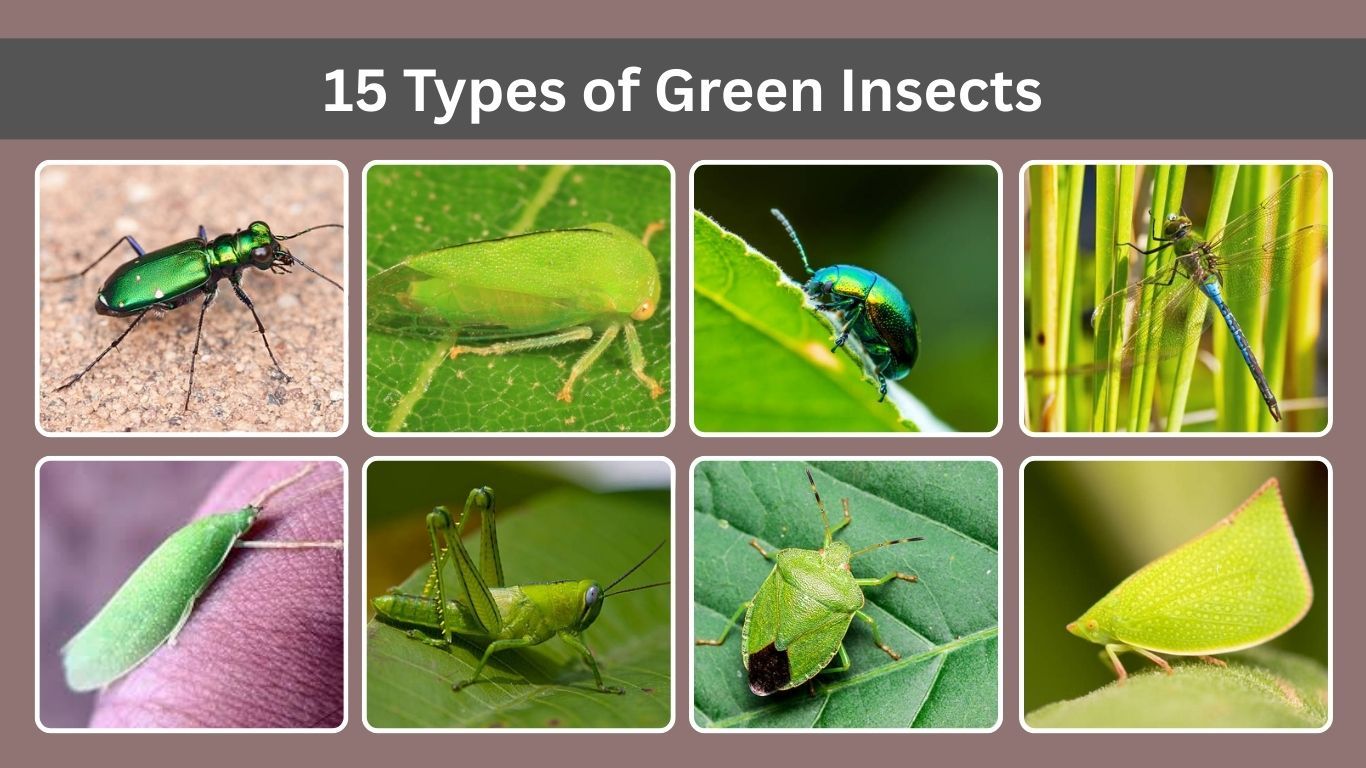
Green insects are some of the most fascinating and well-camouflaged creatures in nature. Their bright or leaf-like appearances not only help them blend into plants but also make them stand out when observed closely. From tiny green aphids on roses to large leaf insects that look exactly like foliage, these insects can be pests, predators, or beneficial allies in the garden. Here are 15 types of green insects you should know about.
1. Green Lacewing

Green lacewings are lime-green insects with delicate, transparent wings that make them stand out among green garden insects. They are especially helpful for controlling little green insects on plants, such as aphids, which often infest roses and vegetables. Their leaf-like color helps them blend in with foliage.
Identification
- Slender, bright green body (1–2 cm long)
- Transparent lace-like wings with fine veins
- Golden or copper-colored eyes
- Long, thread-like antennae
Habitat
Green lacewings are found in gardens, fields, and farmlands. They stay close to plants, especially roses and green leafy crops, where small green insects like aphids and mites are abundant.
Behaviors
Green lacewings are natural predators of plant pests, making them beneficial insects in the garden. When threatened, adults can release a foul odor as a defense. Females lay eggs on thin stalks attached to leaves, which protects them from predation. They are also attracted to lights and often appear near windows.
Diet
The larvae are aggressive hunters and feed on tiny green insects, mites, thrips, and leafhoppers. Adults mainly consume nectar, pollen, and honeydew, but some species may also feed on soft-bodied insects.
2. Green Stink Bug

The green stink bug is a bright green insect often found on plants, crops, and garden shrubs. Known for its shield-shaped body, it can release a strong odor when disturbed, which is its main defense mechanism. These insects are common pests of fruits and vegetables.
Identification
- Shield-shaped, bright green body (12–18 mm long)
- Broad, flat back with pointed edges
- Piercing-sucking mouthparts
- Wings folded flat over the body, forming a triangular shape
Habitat
Green stink bugs are found in gardens, fields, orchards, and farms. They commonly infest beans, tomatoes, corn, and other crops, often gathering in large numbers on leaves and fruits.
Behaviors
They are slow-moving insects but highly resilient. When handled or threatened, they emit a foul odor. Green stink bugs feed by piercing plant tissues and sucking sap, which can cause discoloration and damage to fruits and leaves.
Diet
They primarily feed on plant juices from fruits, seeds, stems, and leaves. Common targets include soybeans, corn, beans, and tomatoes.
3. Green Shield Bug

The green shield bug, also called the common green shield bug, is a widespread insect in gardens and fields. Its bright green, shield-like body helps it blend with leaves, making it hard to spot. It is often confused with the green stink bug but differs in behavior and host plants.
Identification
- Shield-shaped body, vivid green in color
- Size about 12–15 mm long
- Darker markings may appear in late summer or autumn
- Strong legs and wings allow short flights
Habitat
These insects are commonly found on garden plants, hedges, shrubs, and crops. They prefer warm, sunny spots with dense vegetation where they can hide among leaves.
Behaviors
Green shield bugs are less destructive than stink bugs but still feed on plant sap. They are generally harmless to humans but may gather in large groups on leaves. Their green color provides camouflage, and they may turn brownish in cooler seasons.
Diet
They feed on plant sap, especially from beans, berries, and garden plants. Although not considered a serious pest, heavy infestations can stress plants and reduce crop quality.
4. Green Leafhopper

The green leafhopper is a tiny, bright green insect often seen hopping between leaves in gardens and fields. Despite their small size, they can cause noticeable plant damage by feeding on sap and transmitting plant diseases.
Identification
- Small, slender body (3–5 mm long)
- Bright lime-green coloration
- Strong hind legs for hopping
- Wings held roof-like over the body
Habitat
Green leafhoppers are found on a wide range of plants, including roses, vegetables, and fruit crops. They thrive in warm, sunny environments and are common in gardens, farms, and grassy areas.
Behaviors
They are very active and quickly jump or fly when disturbed. Green leafhoppers feed in groups, which can lead to visible yellowing and curling of leaves. They are also known vectors of plant pathogens, spreading diseases between plants.
Diet
They feed on plant sap, piercing leaf tissues with their needle-like mouthparts. Heavy infestations can weaken plants and reduce yield in crops.
5. Green Bottle Fly

The green bottle fly is a metallic, shiny green insect often found near plants, flowers, and decaying organic matter. Its bright body color makes it easy to recognize, and it plays both beneficial and pest roles in ecosystems.
Identification
- Metallic green body with a shiny appearance
- Size about 10–14 mm long
- Large red compound eyes
- Transparent wings with dark veins
Habitat
Green bottle flies are common in gardens, fields, and urban areas. They are often seen around flowers, garbage, and animal waste, where they lay eggs.
Behaviors
These flies are fast and active fliers. While adults often feed on nectar and help with pollination, females also seek decaying matter to lay eggs, which develop into maggots that feed on organic waste.
Diet
Adults feed on nectar, honeydew, and sugary substances. Their larvae (maggots) consume decaying organic material, animal remains, and sometimes open wounds of animals.
6. Green Grasshopper

The green grasshopper is a common insect in fields and gardens, blending perfectly with grasses and leaves. Its strong hind legs allow it to leap great distances, and it produces sounds by rubbing its legs against its wings.
Identification
- Bright green, elongated body (2–5 cm long)
- Large hind legs built for jumping
- Short antennae compared to katydids
- Wings extend beyond the body length
Habitat
Green grasshoppers thrive in grassy fields, meadows, and gardens. They prefer open, sunny areas with plenty of vegetation.
Behaviors
They are active during warm seasons, feeding and mating in open areas. Green grasshoppers use stridulation (rubbing legs and wings) to produce their chirping sounds. Their green color provides excellent camouflage against predators.
Diet
Primarily herbivorous, feeding on grasses, leaves, and crops. In large numbers, they may damage plants and become agricultural pests.
7. Green Katydid

The green katydid is a leaf-like insect known for its loud, rhythmic calls at night. Its body shape and color allow it to disappear among foliage, making it hard to spot.
Identification
- Bright green body resembling a leaf
- Long, thin antennae often longer than the body
- Wings shaped like leaves with visible veins
- Size ranges from 3–6 cm depending on species
Habitat
Green katydids live in trees, shrubs, and tall grasses. They prefer warm, humid environments such as gardens, forests, and meadows.
Behaviors
They are nocturnal singers, producing mating calls by rubbing their forewings together. Their camouflage makes them difficult for predators to detect. Some species may also nibble on small insects.
Diet
Mostly herbivorous, feeding on leaves, flowers, and fruits. Some species are opportunistic and eat smaller insects when plant food is scarce.
8. Green Aphid

The green aphid is a tiny insect commonly found on plants, especially roses and vegetable crops. These small green insects cluster in large groups and are notorious for sucking plant sap, which weakens plants and encourages mold growth.
Identification
- Tiny, soft-bodied insect (1–3 mm long)
- Bright green or lime-green in color
- Pear-shaped body with long legs and antennae
- Some species develop transparent wings
Habitat
Green aphids live on leaves, stems, and flower buds of garden plants, fruit trees, and crops. They are especially common on roses, beans, and leafy vegetables.
Behaviors
They reproduce rapidly, often giving live birth to young without mating. Large colonies form quickly and can cover leaves and stems. Green aphids also produce honeydew, which attracts ants and leads to sooty mold on plants.
Diet
Feed exclusively on plant sap by piercing leaves and stems. Heavy infestations can cause curling, yellowing, and stunted plant growth.
9. Green June Beetle

The green June beetle is a large, metallic green insect commonly seen in summer. It is attracted to gardens, fields, and compost areas, where its larvae live in the soil.
Identification
- Large beetle, about 20–25 mm long
- Shiny, metallic green body with golden or bronze highlights
- Strong legs for digging in soil
- Loud buzzing flight similar to bumblebees
Habitat
Green June beetles are found in gardens, lawns, orchards, and agricultural fields. The larvae (white grubs) live underground, feeding on organic matter and plant roots.
Behaviors
Adults are strong fliers and often buzz loudly while flying over flowers or turf. They are most active in warm summer months. Females lay eggs in soil, and larvae may become pests in lawns by damaging roots.
Diet
Adults feed on ripe fruits, nectar, and flowers, often damaging peaches, grapes, and figs. Larvae feed on decaying organic material and roots in soil.
10. Green Treehopper

The green treehopper is a small, leaf-like insect that often disguises itself as part of a plant stem or thorn. Despite its tiny size, it can damage plants by feeding on sap and transmitting diseases.
Identification
- Small, triangular body (5–8 mm long)
- Bright green coloration with thorn-like pronotum
- Wings held tent-like over the body
- Strong legs for clinging to plant stems
Habitat
Green treehoppers are found on trees, shrubs, and herbaceous plants. They prefer areas with abundant vegetation, including gardens and forest edges.
Behaviors
They communicate through vibrations sent along plant stems, especially during mating. Treehoppers often form groups and may be protected by ants in exchange for producing honeydew. Their camouflage makes them hard to detect among leaves and stems.
Diet
They feed on plant sap, piercing stems and leaves with their specialized mouthparts. Prolonged feeding can weaken plants and spread pathogens.
11. Green Planthopper

The green planthopper is a tiny, wedge-shaped insect often seen hopping or flying short distances between plants. It resembles a leaf fragment, giving it excellent camouflage.
Identification
- Small, wedge-shaped body (4–6 mm long)
- Bright green to lime-green in color
- Wings extend backward, forming a pointed shape
- Large, prominent eyes
Habitat
Green planthoppers live on a variety of plants, including rice, sugarcane, and garden crops. They thrive in warm, humid environments and are common in both farms and gardens.
Behaviors
They are skilled jumpers, quickly escaping when disturbed. Green planthoppers often occur in large numbers, and some species are serious agricultural pests due to their ability to transmit plant viruses.
Diet
They feed on plant sap by inserting their piercing-sucking mouthparts into stems and leaves. Heavy infestations can cause plants to wilt, yellow, and become stunted.
12. Green Darner Dragonfly

The green darner dragonfly is a large and striking insect, recognized by its bright green thorax and long, slender body. It is one of the most common dragonflies in North America and is admired for its powerful flight and aerial hunting skills.
Identification
- Large body, 7–8 cm long
- Bright green thorax with a blue abdomen
- Two pairs of transparent wings
- Large compound eyes covering most of the head
Habitat
Green darners are found near ponds, lakes, rivers, and wetlands. They prefer freshwater habitats with abundant vegetation where they can lay eggs.
Behaviors
They are strong, fast fliers and excellent hunters, often seen catching mosquitoes, flies, and other small insects midair. Green darners are also migratory, traveling long distances in groups during seasonal changes.
Diet
Adults feed on flying insects such as mosquitoes, gnats, and flies. Nymphs (aquatic stage) are predators in the water, feeding on insect larvae, tadpoles, and small fish.
13. Green Leaf Insect

The green leaf insect is a master of camouflage, perfectly mimicking the shape, color, and even vein patterns of leaves. This remarkable disguise helps it avoid predators in its natural habitat.
Identification
- Flat, leaf-shaped body (5–10 cm long)
- Bright green with detailed vein-like markings
- Broad wings resembling leaves
- Long legs that also mimic leaf stems
Habitat
Green leaf insects live in tropical forests and dense vegetation. They are especially common in Southeast Asia, where their camouflage allows them to blend seamlessly with foliage.
Behaviors
They remain motionless for long periods, swaying gently like leaves in the wind to avoid detection. Green leaf insects are mostly nocturnal feeders and rely heavily on camouflage for survival.
Diet
They are strictly herbivorous, feeding on leaves of guava, mango, oak, and other broadleaf plants. Their leaf-mimicking appearance helps them feed safely without attracting predators.
14. Green Tiger Beetle

The green tiger beetle is a fast-moving predator known for its metallic green body and aggressive hunting behavior. It is one of the most striking beetles, often spotted in open sunny areas where it actively chases prey.
Identification
- Shiny, metallic green body (10–15 mm long)
- Long, slender legs built for speed
- Large, prominent eyes
- Strong mandibles for catching prey
Habitat
They prefer sandy paths, open fields, riverbanks, and sunny woodland clearings. Green tiger beetles are ground-dwelling and thrive in dry, exposed areas.
Behaviors
Known for their speed, they can run extremely fast to catch small insects. When disturbed, they often fly a short distance and land again. They are solitary hunters and highly territorial.
Diet
Carnivorous, feeding on ants, caterpillars, flies, and other small insects. Their strong jaws allow them to tear prey apart quickly.
15. Green Weevil

The green weevil is a small, plant-feeding beetle covered with shimmering green scales that give it a bright appearance. It is commonly found on plants and crops, where it feeds on leaves.
Identification
- Small beetle, 6–10 mm long
- Bright metallic or lime-green coloration
- Long snout-like rostrum (typical of weevils)
- Elbowed antennae
Habitat
Green weevils are found in gardens, orchards, forests, and fields. They are particularly common on fruit trees, shrubs, and flowering plants.
Behaviors
They are slow-moving and feed openly on leaves. When disturbed, green weevils may drop to the ground and remain still as a defense. Some species can also fly short distances to find new host plants.
Diet
They are herbivorous, feeding mainly on leaves of fruit trees, grapevines, and ornamental plants. Heavy infestations may cause noticeable leaf damage.
FAQs
What are the little green insects on plants?
The little green insects often seen on plants are usually green aphids. They feed on plant sap, cause curling leaves, and produce sticky honeydew that attracts ants.
Which green insects are beneficial in gardens?
Green lacewings and green tiger beetles are highly beneficial. Lacewing larvae eat aphids, mites, and thrips, while tiger beetles are fast hunters of small insects.
Do green insects bite or sting humans?
Most green insects, such as leafhoppers, aphids, and katydids, do not bite or sting humans. However, green stink bugs may release an odor when disturbed, and some green stinging insects can cause mild irritation.
What green insect looks exactly like a leaf?
The green leaf insect is a master of camouflage, mimicking the shape, color, and even veins of leaves to avoid predators.
How do I get rid of green insects on roses?
To control green insects like aphids on roses, you can use insecticidal soap, neem oil, or introduce natural predators such as ladybugs and lacewings. Regular pruning and checking for infestations also help.